Technical Specifications of GLM-5.2
| Item | GLM-5.2 |
|---|---|
| Provider | Zhipu AI |
| Release Date | June 13, 2026 |
| Model Type | Open-weight Mixture-of-Experts (MoE) LLM |
| Total Parameters | ~744B |
| Active Parameters | ~40B per token |
| Context Window | 1,000,000 tokens |
| Maximum Output | 131,072 tokens |
| Reasoning Modes | High, Max |
| License | MIT |
| Primary Focus | Agentic coding, software engineering, long-horizon reasoning |
| API Availability | Z.ai platform and compatible providers |
| Open Weights | Yes |
GLM-5.2 is the latest flagship model from Zhipu AI's GLM family. Unlike general-purpose frontier models, GLM-5.2 is positioned primarily as a coding-first and agent-oriented model designed for repository-scale software engineering, autonomous workflows, and extremely long-context reasoning. Its headline capability is a native 1 million token context window, making it one of the largest publicly available context windows among open-weight models.
Main Features of GLM-5.2
- 1M-token context window for entire repositories, lengthy documentation sets, and multi-session agent workflows.
- Coding-first optimization focused on refactoring, debugging, code generation, and software engineering tasks.
- Agentic workflow support for tools such as Claude Code, Cline, Roo Code, OpenCode, and similar coding agents.
- Open-weight release under MIT license, enabling self-hosting and fine-tuning.
- Two reasoning modes (High and Max) allowing trade-offs between latency and reasoning depth.
- Large MoE architecture with approximately 744B total parameters while activating only ~40B per token for efficiency.
Benchmark Performance of GLM-5.2
Zhipu did not publish comprehensive official benchmark results at launch, which makes direct benchmarking more uncertain than for models such as GPT-5 or Claude. Multiple industry reports note the absence of independently validated benchmark releases.
| Benchmark | Reported Score |
|---|---|
| Terminal-Bench 2.1 | 81.0 |
| SWE-Bench Pro | 62.1 |
| NL2Repo | 48.9 |
| AIME 2026 | 99.2 |
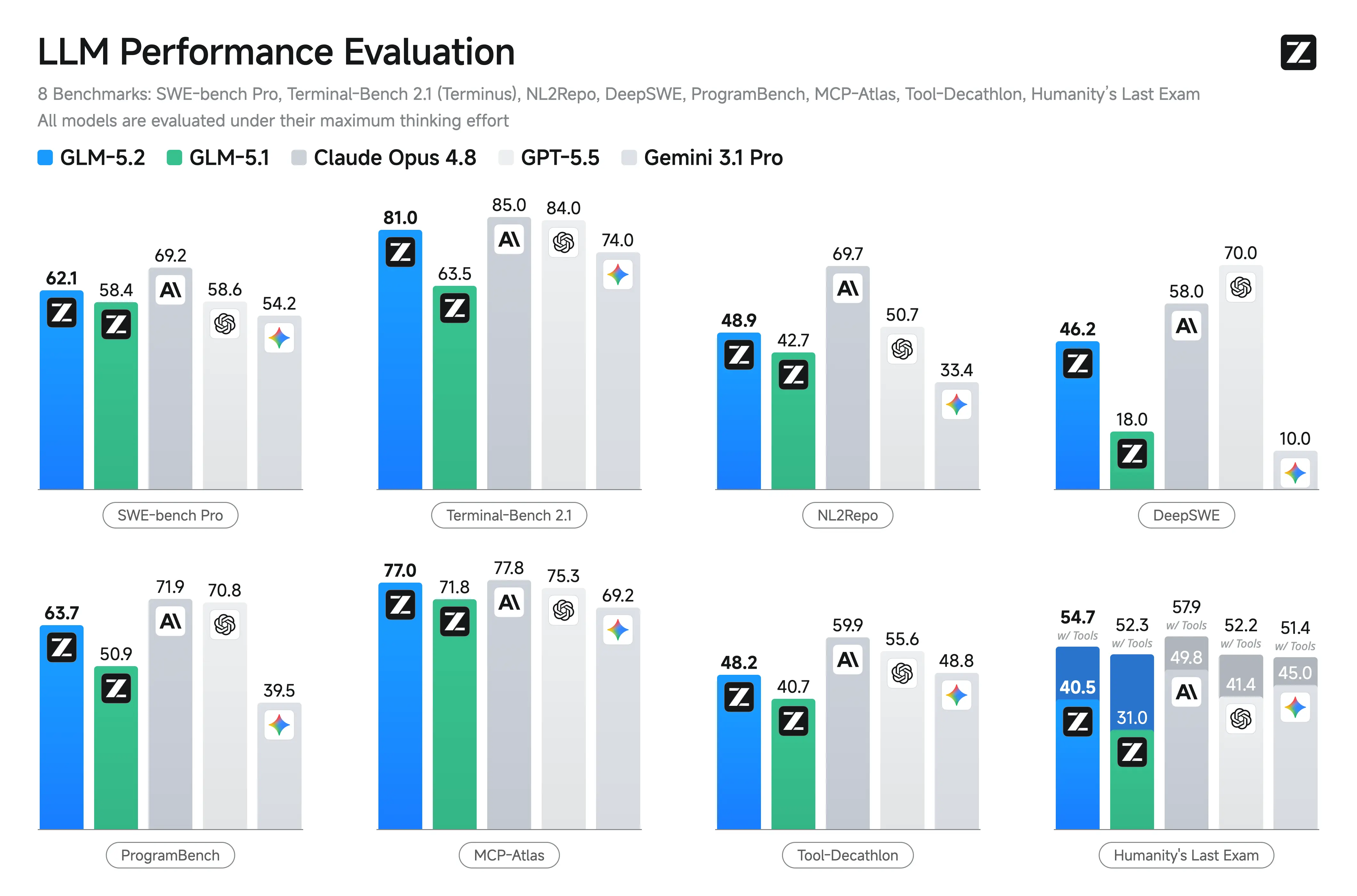
GLM-5.2 vs GLM-5.1 vs Claude Opus 4.8
| Specification | GLM-5.2 | GLM-5.1 | Claude Opus 4.8 |
|---|---|---|---|
| Release Date | 2026-06-13 | 2026 | 2026 |
| Context Window | 1,000,000 | ~200,000 | 1,000,000 |
| Open Weights | Yes (MIT) | Yes | No |
| Reasoning Modes | High, Max | Standard | Extended Thinking |
| Total Parameters | 744B | 744B | Not disclosed |
| Active Parameters | 40B | 40B | Not disclosed |
| Official Benchmark Data | Not published | Published at launch | Published |
GLM-5.2's primary documented upgrade over GLM-5.1 is its expansion to a 1M-token context window and the introduction of selectable High and Max reasoning modes. At launch, Z.ai did not publish official SWE-Bench, LiveCodeBench, HumanEval, or similar benchmark results, so performance comparisons against Claude Opus 4.8, GPT-5, DeepSeek, or Qwen models remain unverified.
Compared with other open models, GLM-5.2's primary differentiator is its combination of a very large context window, coding specialization, and MIT licensing. Its strongest appeal is for repository-scale software engineering rather than general chat applications.
Why Use GLM-5.2 Through CometAPI?
CometAPI allows developers to integrate GLM-5.2 using the same interface employed for dozens of leading AI models.
Benefits include:
- Unified authentication across multiple providers
- OpenAI-compatible API integration
- Simplified billing and usage management
- Rapid experimentation with alternative models
- Easy switching between coding, reasoning, image, audio, and video models
- Reduced vendor lock-in for production systems
Whether you're building an AI IDE, internal engineering assistant, or enterprise automation platform, CometAPI minimizes integration effort while preserving flexibility.
How to Access GLM-5.2 API on CometAPI
Get started with our product in just a few simple steps...
Step 1: Sign Up for Your GLM-5.2 API Key
Create an account on CometAPI and navigate to the API dashboard to generate your GLM-5.2 API key. This key authenticates all your requests and gives you immediate access to the full capabilities of GLM-5.2 API, including the 1M token context window and 128k output tokens.
Step 2: Send Requests to GLM-5.2 API
Use your GLM-5.2 API key to send POST requests to the CometAPI endpoint. Pass your prompt, set model parameters like effort level and max tokens, and GLM-5.2 API processes your request — handling everything from code generation to document analysis to agentic tool use.
Step 3: Retrieve Results and Integrate GLM-5.2 API
The GLM-5.2 API delivers structured responses, including completion text, tool calling instructions, and token usage metadata. It supports both standard synchronous responses and real-time streaming via Server-Sent Events (SSE) when stream: true is configured. The endpoint can be easily integrated into your existing workflows using standard HTTP clients or openAI compatible SDKs by routing requests through url(//api.cometapi.com/v1) with your Bearer Token.