
TL;DR
Start with GPT-6.1 Sol when you already use OpenAI Responses tools or need its explicit reasoning-effort ladder; test Claude Sonnet 5.5 for well-scoped coding iteration and template-driven professional deliverables. These are evaluation priorities, not a proven quality ranking. Both start at $2/M input and $10/M output and charge $0.10/M for base cache reads. With approximately 1M context and 128K standard maximum output, the practical differences are integration, task behavior, cache retention, and long-context billing rather than a base cache-read discount.
The key tradeoff is task behavior and billing conditions. GPT-6.1 Sol uses five effort levels and requires Responses for tool calling; Sonnet 5.5 uses adaptive thinking. Above 272K input tokens, GPT-6.1 Sol applies higher rates to the full request. The sources reviewed here do not establish a matched, exact-version benchmark winner, so select the model that meets your acceptance criteria with the lowest total workflow cost.
Key Takeaways
- Equal base prices: both models charge $2/M input, $10/M output, and $0.10/M cache reads. Compare cache writes, retention, long-context tiers, and actual billed usage.
- Context is close: 1.05M versus 1M tokens; both support 128K standard maximum output.
- Integration differs: GPT-6.1 Sol requires Responses for tool calling and does not accept none or minimal effort; Sonnet 5.5 uses adaptive thinking and model-specific tool constraints.
- Keep evidence version-specific: GPT-6 Sol scores cannot be relabeled as GPT-6.1 Sol results.
- Choose by completed work: measure quality, latency, retries, cache writes and reads, tool fees, and human correction.
GPT-6.1 Sol vs Claude Sonnet 5.5 at a Glance
| Decision factor / specification | GPT-6.1 Sol | Claude Sonnet 5.5 |
|---|---|---|
| Provider | OpenAI | Anthropic |
| Release date | September 29, 2026 | September 28, 2026 |
| Model ID | gpt-6.1-sol | claude-sonnet-5-5 |
| Context / standard maximum output | 1,050,000 / 128,000 tokens | 1,000,000 / 128,000 tokens |
| Input → output | Text and images → text | Text and images → text |
| Reasoning controls | low, medium, high, xhigh, max; medium default | Adaptive thinking; high default on Claude Platform |
| Default effort | medium | high on Claude Platform |
| Knowledge cutoff | April 30, 2026 | June 2026 |
| Official base input / output per 1M tokens | $2 / $10; Standard requests with up to 272K input tokens | $2 / $10 |
| Official base cache reads per 1M tokens | $0.10 | $0.10 |
| Official base cache writes per 1M tokens | $2.50 | $2.50 for 5 minutes; $4.00 for 1 hour |
| Long-context billing | Above 272K input: $4 input, $0.20 cache read, $5 cache write, $15 output per 1M; applies to the full Standard request | No equivalent surcharge stated in the cited model overview |
| Primary positioning | Complex coding, computer use, and professional work | Fast coding iteration and professional workflows |
| Test first when | You already use Responses tools or need explicit effort controls | Your work centers on coding, documents, slides, or spreadsheets |
| Evidence and decision limit | Documented capabilities; no matched exact-version numerical winner established here | Published coding and knowledge-work results; not a controlled win over GPT-6.1 Sol |
GPT-6.1 Sol Overview
GPT-6.1 Sol is OpenAI's September 29, 2026 Sol release for complex coding, computer use, and professional work. OpenAI describes it as near-Astra performance at a lower cost; that positioning should be validated on your tasks. Its large context and adjustable reasoning make it a candidate for repository agents and multi-step professional workflows.
Its operational constraints matter as much as its positioning: medium is the default effort, low is the lowest supported setting, and tool calling requires Responses. A workflow built around a no-reasoning path or Chat Completions tools needs migration work before it can use this model reliably.
Claude Sonnet 5.5 Overview
Claude Sonnet 5.5 is Anthropic's September 28, 2026 release for well-scoped everyday coding, agents, and professional work. Its model overview documents adaptive thinking, a high default effort on Claude Platform, text-and-image input, and 128K standard maximum output. Anthropic emphasizes bug fixing, clear documents, polished slides, and efficient iteration.
For a development team, that makes Sonnet a useful candidate for repeated implementation and review cycles. For an office workflow, evaluate its first-draft quality and template adherence. The provider’s speed claim compares Sonnet 5.5 with Sonnet 5; it does not establish a speed advantage over GPT-6.1 Sol.
GPT-6.1 Sol vs Claude Sonnet 5.5: Performance
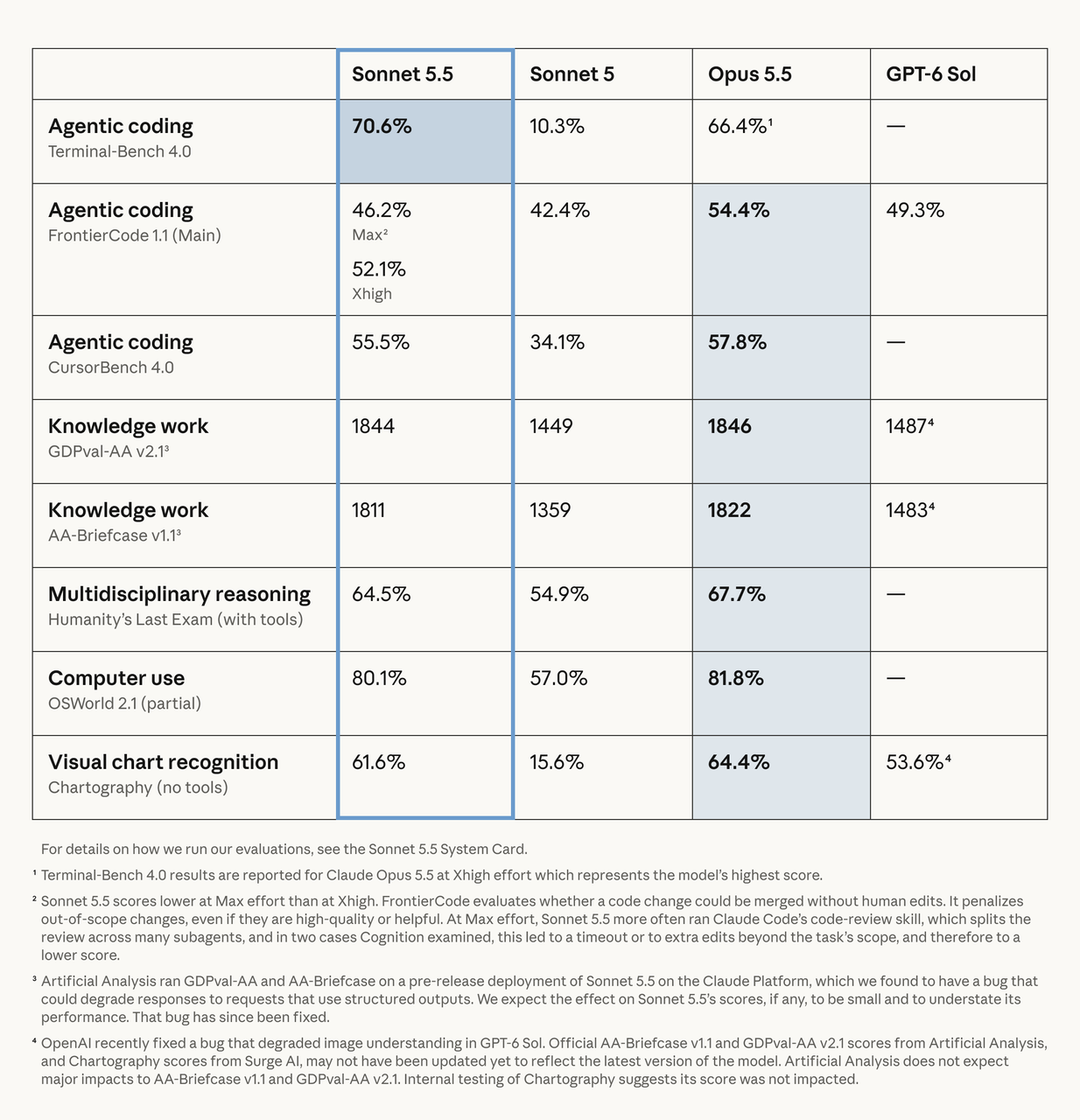
Anthropic's Sonnet 5.5 launch results provide a useful set of workload signals. Its comparison includes the older GPT-6 Sol, so those OpenAI-column values are excluded from the current-model table below. “Not established” means the cited sources do not support an exact-version score for this comparison; it does not mean zero performance.
| Benchmark / conditions | GPT-6.1 Sol | Claude Sonnet 5.5 | What it measures |
|---|---|---|---|
| Terminal-Bench 4.0 | Not established here | 70.6% | Terminal coding tasks |
| FrontierCode 1.1 Main | Not established here | 52.1% Xhigh; 46.2% Max | Mergeable repository changes |
| CursorBench 4.0 | Not established here | 55.5% | Agentic development in Cursor tasks |
| GDPval-AA v2.1 | Not established here | 1844 | Professional knowledge work |
| AA-Briefcase v1.1 | Not established here | 1811 | Long-horizon knowledge work |
| Humanity’s Last Exam, tools | Not established here | 64.5% | Multidisciplinary reasoning |
| OSWorld 2.1, partial | Not established here | 80.1% | Computer-use partial reward |
| Chartography, no tools | Not established here | 61.6% | Visual chart recognition |
Test conditions: effort and agent harness affect the coding results. GDPval-AA and AA-Briefcase are Artificial Analysis evaluations, while Chartography results come from Surge AI. Anthropic notes a subsequently fixed structured-output bug in the pre-release Sonnet deployment that may have slightly understated its professional-work results. Use the announcement’s System Card link for test environments and full methodology; do not combine unlike metrics into one overall ranking.
The original Anthropic image below includes its evaluation footnotes. Its GPT-6 Sol column is historical context only and does not report GPT-6.1 Sol performance.
Agentic Coding and Software Engineering
Sonnet 5.5 has reported evidence on terminal coding, mergeable code changes, and IDE-style agent tasks. GPT-6.1 Sol is documented for complex coding and integrates with the OpenAI tool ecosystem. Neither product positioning nor a predecessor’s score establishes a current coding winner. For a useful evaluation, choose real changes with regression tests and ask reviewers to assess scope, maintainability, and readiness to merge.
Knowledge Work, Reasoning, Math, and Science
Sonnet’s GDPval-AA and AA-Briefcase results make reports, analysis, and office deliverables sensible evaluation targets. GPT-6.1 Sol also targets professional work, but the sources used here do not provide a matched comparison across these models. Use your own document, spreadsheet, and presentation templates. Advanced math and scientific claims require task-specific evidence rather than extrapolation from general reasoning controls.
Computer Use, Browser Automation, and Multimodal Workflows
Both models accept images, which supports screenshot debugging and visual analysis. Sonnet’s OSWorld and Chartography results are evidence for those particular evaluations. GPT-6.1 Sol documents computer use through Responses tools. Test the full workflow: navigation accuracy, recovery after a failed tool call, output correctness, and time to completion. Text-and-image input does not by itself guarantee identical computer-use integration.
Independent Evaluation and Evidence Quality
A provider-published table can contain third-party results without becoming a single controlled experiment. For any independent comparison, record the exact model IDs, deployment dates, effort, tools, safeguards, timeout, retry policy, and stopping rules. An aggregate intelligence index, a coding success rate, and a partial-reward computer-use score answer different questions. The reviewed sources do not establish a complete matched independent result set for this exact pair.
GPT-6.1 Sol vs Claude Sonnet 5.5: Cost
Official API Pricing
| Pricing metric | GPT-6.1 Sol official rates | Claude Sonnet 5.5 official rates |
|---|---|---|
| Input / 1M tokens, base Standard | $2.00 | $2.00 |
| Output / 1M tokens, base Standard | $10.00 | $10.00 |
| Cache read / 1M tokens, base | $0.10 | $0.10 |
| Cache write / 1M tokens, base | $2.50 | $2.50 for 5m; $4.00 for 1h |
| Batch processing | 50% below Standard | 50% input/output discount |
| Input above 272K, Standard full request | $4 input / $0.20 cache read / $5 cache write / $15 output | No equivalent surcharge stated in the cited overview |
All rates are USD per million tokens. GPT-6.1 Sol base cache reads cost $0.10/M and Sonnet 5.5 cache reads also cost $0.10/M. Sol's above-272K input condition raises rates for the full Standard request, not only excess tokens. Compare cache writes, retention, long-context tiers, regional processing, and service tiers; the base read price alone gives neither model an advantage.
Cost per Completed Task
Cost per accepted result = total cost across all attempted tasks / number of accepted results. Total cost includes billed fresh input, cache reads and writes, output (including billed reasoning tokens where applicable), paid tool calls, and human review or correction. Retry costs are counted through their actual usage, not added again as a duplicate charge.
For one million cache-read tokens billed entirely at the base rate, either model costs $0.10; the base read-price difference is $0.00. This is a rate illustration, not a one-million-input-token Sol request priced at the base tier. Actual session cost also includes fresh input, cache writes, output, tools, and retries. Compare cold and warm sessions under the applicable context tier and report accepted-result rate alongside billed usage.
CometAPI Pricing
| Published CometAPI tier | GPT-6.1 Sol API in CometAPI | Claude Sonnet 5.5 API in CometAPI |
|---|---|---|
| Base input / output per 1M | $1.60 / $8.00 | $1.60 / $8.00 |
| Base discount vs provider | 20% | 20% |
| GPT long-context input / output | $3.20 / $12.00 | Check current route-specific terms |
| GPT cache reads, base / long | $0.08 / $0.16 | Not specified in the cited basic pricing table |
These are the published model-route prices checked for this revision, separate from provider rates. GPT-6.1 Sol’s CometAPI pricing distinguishes short and long context. The cited Sonnet basic table lists input and output, so it does not justify assuming an identical gateway cache policy. Check the selected route’s current billing terms before estimating a production session.
How Do Context Windows, Speed, and Technical Specs Compare?
GPT-6.1 Sol supports 1.05M tokens, while Claude Sonnet 5.5 supports 1M tokens. The nominal difference is only about 5%, so context capacity alone is unlikely to decide most deployments.
GPT-6.1 Sol’s effort ladder is low, medium, high, xhigh, and max; medium is the default. Sonnet 5.5 uses adaptive thinking with high as the Claude Platform default. Those names do not imply equal reasoning budgets. At equal quality requirements, measure time to first token, output throughput, tool-loop latency, and end-to-end completion separately.
Anthropic reports more than 30% faster output generation for Sonnet 5.5 than Sonnet 5. Treat that as a predecessor comparison. This article’s evidence does not establish one universal latency number for GPT-6.1 Sol or a direct speed winner between the current models. For interactive workloads, test lower effort settings against the same acceptance rubric rather than assuming max is the best deployment setting.
What Matters for Safety, Alignment, and Deployment?
Deployment decisions should distinguish documented model behavior from application controls. A model comparison alone cannot establish which deployment meets your organization’s data handling or access requirements. Evaluate the provider or gateway you actually use, including request logging, data residency, tool permissions, and failure handling.
- Reasoning migration: GPT-6.1 Sol does not support none or minimal. OpenAI's migration guidance directs tool-calling workflows to Responses.
- Claude tool behavior: Sonnet 5.5's documented compatibility changes include unsupported forced-tool modes and conversation-bound thinking blocks. Test these paths before rollout.
- Operational controls: give agents only the tools needed for the task, record failed calls, and retain human review for consequential external actions. These are application design choices, not measured advantages for either model.
GPT-6.1 Sol vs Claude Sonnet 5.5: Which Should You Choose?
Test GPT-6.1 Sol first when you already use Responses tools or need a predictable effort ladder. Test Sonnet 5.5 for well-scoped coding iteration, slides, spreadsheets, and document workflows where its reported evidence matches your tasks. For cached-prefix sessions, test both: their base cache-read rates are equal, while write costs, retention, long-context tiers, and task success can change the total bill. Route work only after representative evaluations establish a useful quality, cost, or latency difference.
Workload-Based Selection
| Workload | Starting point | What to verify |
|---|---|---|
| Existing OpenAI Responses agent | GPT-6.1 Sol | Tool compatibility and effort changes |
| Coding iteration / bug fixing | Sonnet 5.5, then compare Sol | Merge readiness, latency and retries |
| Slides / spreadsheets / reports | Sonnet 5.5, then compare Sol | Template adherence and human edit time |
| Stable cached-prefix sessions | Both; equal base cache-read rates | Hit rate, writes, context tier and accepted quality |
| Full requests above 272K input | Both | Actual long-context bill and retrieval quality |
| Computer / browser automation | Both | Recovery, task completion and permissions |
| Math / scientific analysis | Both on task-specific tests | Correctness with verifiable answers |
| Cost-sensitive production | Both | Total cost per accepted result |
A production comparison should hold the surrounding system constant. Use the same prompts, repositories or documents, tool permissions, timeout, retry policy, and output acceptance rubric.
Record fresh input, cache writes and reads, output usage, paid tool calls, retries, human-review time, task success, and end-to-end latency. A cheaper first response can still produce a more expensive accepted result.
How Can You Access GPT-6.1 Sol and Claude Sonnet 5.5?
Developers can access GPT-6.1 Sol API in CometAPI and Claude Sonnet 5.5 API in CometAPI through the documented model routes. Create an API key, store it securely, and verify model access and route-specific billing before production use.
GPT-6.1 Sol Access
For Sol, use the documented Responses route when tool calling is required. Select gpt-6.1-sol and a supported effort level, with medium as the default. Pass the task input, configure only the tools needed, and validate returned text, tool calls, errors, and usage. Confirm gateway support for provider-specific features rather than assuming every OpenAI option is available.
Claude Sonnet 5.5 Access
For Sonnet, select claude-sonnet-5-5 on a documented compatible interface and send the task as conversation messages with an appropriate output budget. Confirm how that route handles native thinking and tool parameters; OpenAI reasoning fields are not automatically interchangeable with Claude options. Validate conversation continuation and error handling before agent deployment.
An endpoint check verifies connectivity, not comparative performance. For evaluation, align prompts, effective output and reasoning budgets, tools, retries, timeouts, and acceptance criteria, then compare accepted work, latency, and total billed cost.
Conclusion
GPT-6.1 Sol and Claude Sonnet 5.5 share the same base input, output, and cache-read rates, with similar context capacity. Sol is a natural candidate for existing Responses agents and explicit effort controls. Sonnet's adaptive thinking and reported coding and professional-work results make it a useful candidate for everyday deliverables. Cache-heavy workflows require a full-session comparison: equal base read rates do not guarantee equal write, retention, long-context, or completed-task costs.
Choose the model that completes your actual work within quality, latency, and cost requirements. Keep predecessor scores separate from current-model evidence, price the context tier your workload uses, and compare both routes before adopting a default.
FAQ
Can GPT-6.1 Sol and Sonnet 5.5 share one tool schema?
A common JSON tool definition can be a starting point, but endpoint support, forced-tool behavior, thinking blocks, and response handling differ. Validate each model's tool calls with contract tests for arguments, failure paths, and conversation continuation. Keep model-specific adapters for unsupported options rather than assuming a successful text request proves agent compatibility.
How should reasoning effort be matched across both models?
Do not treat identically named settings as equal compute budgets. Define an acceptance rubric and either a cost limit or latency target, then sweep effort settings for each model. Compare the best configuration that meets the same operational constraint, including retries and human correction, rather than comparing only both models' highest settings.
When should a 1M-context workflow use retrieval instead?
Use retrieval when a task needs a small, identifiable part of a large corpus and your retrieval tests show that relevant material is consistently recovered. Test full-context requests when evidence is distributed or cross-file relationships matter. Compare answer correctness, citation coverage, input cost, and latency; a large context limit alone does not establish that filling the entire window is economical or reliable.
How can teams avoid a misleading cache-cost comparison?
Measure cold-cache and warm-cache runs separately, record cache writes as well as reads, and apply the correct retention window and long-context tier. Keep shared prefixes stable and compare repeated realistic sessions, not just one discounted request. Report the hit rate and total billed usage so an apparent saving can be reproduced.
What should trigger a new GPT-6.1 Sol vs Sonnet 5.5 evaluation?
Rerun the affected task suite after a deployment update, provider bug fix, routing change, tool or prompt change, or a material pricing revision. Record evaluation date, model ID, endpoint, effort, and harness version. Preserve the earlier run as a baseline so quality or latency changes are not confused with changes in the surrounding system.