TL;DR
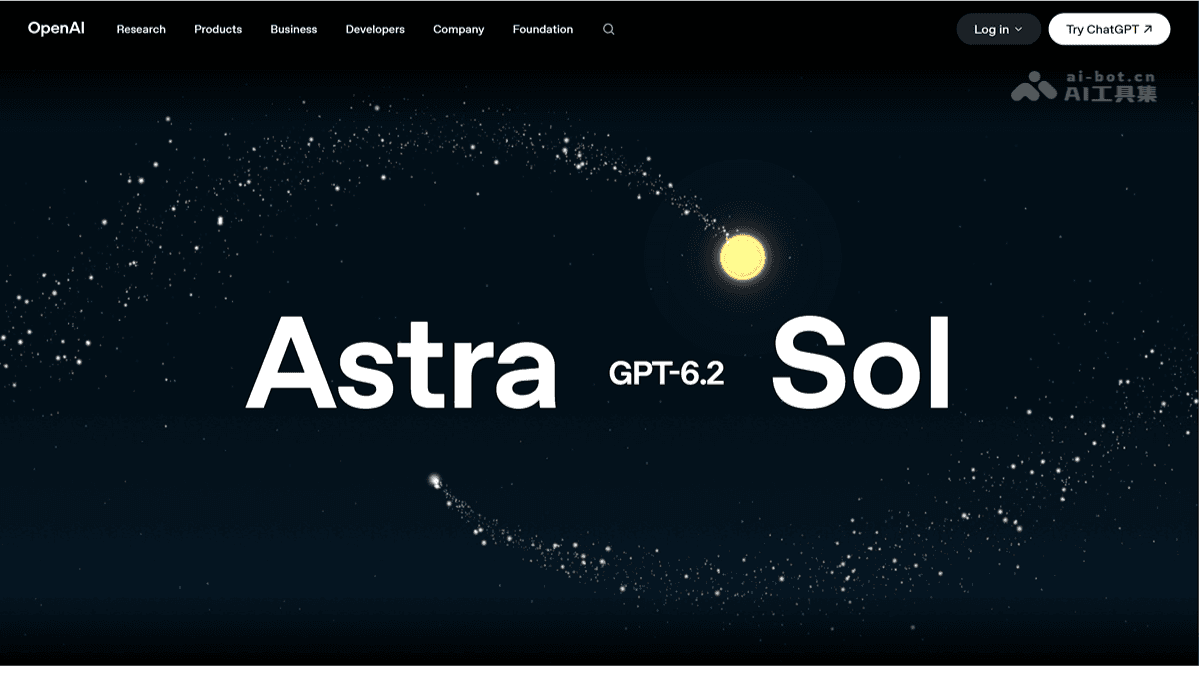
On November 17, 2026, OpenAI released GPT-6.2 Astra (frontier model for the hardest professional projects) and GPT-6.2 Sol (efficient everyday model). Both are available in ChatGPT Work, Codex, and the OpenAI API (gpt-6.2-astra and gpt-6.2-sol). Astra is 20% cheaper than GPT-6 Astra ($8 / $40 per million input/output tokens) and delivers better results at far lower cost-per-task. Sol keeps previous pricing ($2 / $10) while nearly matching Astra on key coding benchmarks at roughly one-fifth the cost. Both models use fewer output tokens, feature a ~1.05M-token context window, and support Ultrafast mode on higher plans. CometAPI already provides access to both models, offering a unified OpenAI-compatible endpoint, single API key, and competitive pricing for developers.
Key Takeaways
- Released, not rumored: OpenAI announced both models on November 17, 2026.
- Stronger professional workflows: Astra gains 5.2 points on Agents’ Last Exam and 6.2 percentage points on GDPval v2 versus GPT-6 Astra.
- Efficiency matters: Astra uses 22% fewer output tokens on GDPval v2 in OpenAI’s evaluation.
- Independent coding results are mixed: Artificial Analysis finds Astra unchanged on its Coding Agent Index and Sol down three points against GPT-6.1 Sol.
- CometAPI access is available: Both model pages list input, output, and cached-input rates 20% below the corresponding OpenAI standard rates.
- Migration needs attention: Tool calling requires Responses API, and
reasoning_effort="none"is unsupported.
What Are GPT-6.2 Astra and Sol?
Both models accept text and image inputs and return text. They share a large context window of approximately 1,050,000 tokens (with high max input and 128,000 max output reported in coverage). Knowledge cutoffs are listed as May 18, 2026 for Astra and June 1, 2026 for Sol in secondary reports.
OpenAI emphasizes real-world efficiency: both models finish demanding tasks with fewer output tokens, so users get more done within the same usage limits or budget.
GPT-6.2 Astra: The Model for Demanding Projects
OpenAI describes GPT-6.2 Astra as its most capable model for difficult projects from start to finish. Its documented capabilities include building and revising software, using a computer, and working with documents. The intended workload extends beyond answering a question: it includes understanding source material, choosing tools, making changes, checking results, and producing a usable deliverable.
That positioning makes Astra relevant to repository-wide engineering, detailed financial analysis, professional documents, and research workflows. Its value depends on whether it improves the finished result or reduces the number of correction cycles enough to justify its premium over Sol. Source: Astra model documentation.
GPT-6.2 Sol: Everyday Work at a Lower Token Price
GPT-6.2 Sol is OpenAI’s go-to model for everyday work, including coding and agents at scale. Its standard input and output rates are one-quarter of Astra’s, while its context and output limits match Astra’s.
OpenAI reports that Sol comes within 0.5 points of Astra on Cognition’s FrontierCode 2.0 at approximately one-fifth of the task cost, with both at Max reasoning effort. This is a useful reason to test Sol first, although that result does not establish equivalent performance across all coding workloads. Source: launch announcement.
GPT-6.2 Key Features: What Changed?
Improved Scientific Research and Computer Use
Astra gains notably on science benchmarks (e.g., ~+9 points on Terminal-Bench Science) and advanced computer-use capabilities, including finer work inside CAD tools, simulations, and 3D modeling (parts, assemblies, physical interactions).
More Useful Documents, Spreadsheets, and Presentations
OpenAI emphasizes better adherence to professional conventions in law, sales, finance, and accounting. Astra is designed to produce clearer documents, more usable spreadsheets, and presentations that follow supplied templates, including layout, color, and typography.
For a business user, the practical test is whether a workbook remains editable, its calculations can be traced, and its conclusions match the underlying evidence. For a presentation, compare template fidelity and the amount of manual editing required. These outcomes matter more than whether an initial screenshot looks polished. Source: professional output examples.
Better Tool Selection and Computer Use
Both models support tools through the Responses API, including web search, file search, code interpreter, hosted shell, computer use, MCP, and tool search. OpenAI also documents a Multi-agent beta for delegating work.
These capabilities let developers connect reasoning to application workflows. A model could inspect reports, calculate figures, and prepare a memo, provided the application supplies the necessary tools and permissions. Native output remains text; image generation is a separate supported tool. Provider-hosted tools also require endpoint-specific support when accessed through a gateway. Source: model documentation.
More Efficient Reasoning and Cleaner Code
OpenAI says Astra makes better decisions about tools and effort, writes cleaner code, and needs fewer revision rounds in early testing. Its migration guide also describes a more concise default writing style.
For existing applications, this means prompts deserve another look. A system prompt that repeatedly demands brevity could now suppress useful detail. Conversely, explicitly asking for source references, completion criteria, and validation evidence can make the output easier to review. Source: Using GPT-6.2.
How Does GPT-6.2 Perform in Benchmark Tests?
GPT-6.2 delivers strong results in professional work, scientific reasoning, and interactive 3D development. Astra provides the strongest overall capability, while Sol delivers competitive performance at a lower measured task cost. However, independent coding evaluations show that improvements are not uniform across workloads.
Key Official / OpenAI-Reported Results
These come primarily from OpenAI’s launch materials (often at max or xhigh reasoning effort):
| Benchmark | What it tests | GPT-6.2 Astra | GPT-6 Astra | GPT-6.2 Sol | Notes / Cost context |
|---|---|---|---|---|---|
| Agents’ Last Exam v1.1 | Multistep professional workflows | 78.3% | 73.1% | 73.0% | +5.2 pts vs prior Astra at <⅓–½ the cost; +5.5 pts vs Claude Fable 5.2 at ~5% of the cost |
| GDPval v2 (internal) | Long-horizon knowledge work (consulting, finance, design) | 50.4% (+6.2 pts) | 44.2% | 46.9% (+5.3 pts) | 22% fewer output tokens for Astra |
| Terminal-Bench-Science 0.1 | Scientific research in a terminal | 77.1% (+9 pts) | 68.1% | 68.0% | <⅓ the cost of prior Astra |
| FrontierCode 2.0 | Merge-ready changes to real codebases | 44.2% | 42.8% | 43.8% | Sol within ~0.5 pts of Astra at ~⅕ the cost |
| Vals Science Index | Biological data + simulated experiments | 68.4% | 65.1% | 58.5% | Astra leads |
| Harvey LAB-AA v1.1 | Strict legal deliverables | 15.0% | 8.6% | 11.1% | Strong relative gain; more than doubles Fable 5.2 in some reports |
| BenchCAD 2.1 Core | CAD modeling / assemblies from drawings | 82.5% | 62.6% | 73.1% | Very close to Claude Fable 5.2 (~83.5%) at ~1/9–1/10 the cost |
| ExploitBench Internal Port (cyber) | Exploit success | 53.5% (+22 pts) | 31.5% | 50.5% | Large jump; tighter safeguards applied |
Astra also leads or ranks very high on AA-3D (interactive 3D experiences, ~1,318 Elo) and shows strong results on AutomationBench and internal security coding evals (SecureSWE, PatchBench).
Coding: Strong Cost Efficiency, Mixed Upgrade Results
On Cognition’s FrontierCode 2.0, OpenAI reports that GPT-6.2 Sol finishes within 0.5 points of GPT-6.2 Astra, at approximately one-fifth of the task cost, with both models using Max reasoning effort. This benchmark evaluates whether changes to real repositories meet maintainers’ merge standards.
That makes Sol a compelling candidate for coding applications where cost matters. However, Artificial Analysis’s independent evaluation reports a more qualified picture:
- GPT-6.2 Astra is flat versus GPT-6 Astra on its Coding Agent Index.
- GPT-6.2 Sol falls three points versus GPT-6.1 Sol on the same index.
- Sol’s decline is driven by a 14-point drop on SWE-Atlas-QnA-AA, where the evaluator observed more omitted facts.
The practical implication is to evaluate code implementation and repository explanation separately. A model can produce effective patches while still missing important information when answering questions about a codebase.
Independent Intelligence, 3D, and Robotics Results
Independent evaluations also identify strengths beyond coding.
| Evaluation | GPT-6.2 Astra | GPT-6.2 Sol |
|---|---|---|
| Artificial Analysis Intelligence Index | Second behind Claude Fable 5.2; five-point gain over GPT-6 Astra | Scores 57, gaining two points over GPT-6.1 Sol |
| AA-3D | 1,318 Elo | 1,259 Elo |
| AA-Robotics v0.1 | 79 | 78 |
Source: Artificial Analysis’s November 17 release analysis.
- Separately, Epoch AI lists Astra at 174 ECI, tied with Claude Fable 5.2. Differences between rankings reflect different evaluation suites.
- Vals Index: Astra ~67.7% (#7), Sol ~66.1% (#9). Trails several Anthropic and Google models here (heavier weighting toward finance/coding).
- Coding Agent Index (Artificial Analysis, Codex harness): Astra roughly flat vs GPT-6 Astra; Sol slightly lower than GPT-6.1 Sol in some runs. Third-party coding tests (e.g., hard multi-turn sessions) often put both behind Claude Opus 5.5 / Fable 5.2 by several points, though Sol remains highly cost-effective.
Summary of Strengths & Trade-offs
- Biggest wins: Cost efficiency + professional/agentic workflows, science research, template-aware documents/slides, CAD/3D, and cybersecurity capability.
- More modest gains: Pure coding agent performance (Sol is extremely close to Astra on FrontierCode at far lower cost).
- Positioning: Astra is the high-capability option for hard projects; Sol is the practical default for most everyday and coding work due to near-parity on key coding benchmarks at a fraction of the price.
GPT-6.2 API Pricing: OpenAI vs CometAPI
Standard Token Prices
All figures below are USD per one million tokens, checked November 19, 2026. OpenAI rates are standard short-context rates; CometAPI figures are the current model-page listings.
| Model and provider | Input | Cached input | Output |
|---|---|---|---|
| GPT-6.2 Astra, OpenAI | $8.00 | $0.40 | $40.00 |
| GPT-6.2 Astra, CometAPI | $6.40 | $0.32 | $32.00 |
| GPT-6.2 Sol, OpenAI | $2.00 | $0.10 | $10.00 |
| GPT-6.2 Sol, CometAPI | $1.60 | $0.08 | $8.00 |
Sources: OpenAI Astra, OpenAI Sol, CometAPI Astra, and CometAPI Sol.
The listed CometAPI rates are 20% below their corresponding OpenAI rates. This is a specific rate-card comparison, not a claim that CometAPI is always the cheapest option across processing tiers or contract terms.
Long Context, Cache Writes, and Speed Tiers
OpenAI applies higher rates when a request exceeds 272,000 input tokens: input and cache rates double, and output rates rise by 1.5 times for the entire request. Astra’s resulting standard input/output rates are $16/$60; Sol’s are $4/$15.
Cache reads and writes have separate charges. OpenAI lists 30-minute cache writes at $10 per million tokens for Astra and $2.50 for Sol. Twelve-hour writes cost $20 and $5, respectively, before long-context multipliers.
Batch costs 50% of Standard, while Fast costs twice Standard. Ultrafast costs three times Standard through February 28, 2027, then six times Standard from March 1, 2027, Pacific time. Check gateway support and billing separately
How to Access GPT-6.2 Astra and Sol
ChatGPT Work, Codex, and OpenAI API
OpenAI’s launch announcement makes both models available in ChatGPT Work and Codex for Plus, Pro, Enterprise, and Edu users. Enterprise and Edu access can depend on administrator settings. Developers can use gpt-6.2-astra and gpt-6.2-sol through the API. Subscription access and API usage have distinct billing arrangements; consult the relevant plan and API documentation. Source: availability announcement.
Access Through CometAPI
CometAPI offers a practical route for teams that want these models alongside models from other providers under a unified API integration. Its current model pages list both GPT-6.2 variants as available.
- Sign in to the CometAPI console and create an API key.
- Store the key in a server-side environment variable.
- Configure the OpenAI SDK with
https://api.cometapi.com/v1. - Select the model ID, send a small request, and inspect usage and output.
The following basic text example adapts the CometAPI quickstart and OpenAI’s model-specific parameter guidance.
Use Responses API for tool workflows. Verify required hosted tools, streaming behavior, and limits in CometAPI’s API documentation; model availability alone does not establish support for every provider-hosted feature.
Migration Tips for Existing GPT Applications
OpenAI recommends starting new integrations at Medium reasoning effort. Replace none or minimal with low. For Chat Completions, omit temperature, top_p, logprobs, and top_logprobs; these older request options are incompatible with the documented migration path.
Conversation handling also changes. Editing earlier history, certain model changes including downgrades, or changing the end user or organization can discard earlier reasoning items. This may reduce quality and increase repeated work.
Keep stable instructions in a developer message at the beginning of Responses input, and preserve the conversation prefix. Starting with GPT-6.2, top-level instructions are appended after input, which changes their caching implications. Source: GPT-6.2 migration guide.
Best Use Cases for GPT-6.2 Astra and Sol
Software Teams: Separate Implementation from Explanation
Use Sol as an initial candidate for routine changes and repeatable coding assistance. Test Astra on architectural decisions, difficult debugging, and changes spanning several services. Given the independent coding results, also retain GPT-6.1 Sol in repository-explanation evaluations. Require concrete evidence: runnable changes, relevant checks, and file references that a reviewer can verify.
Finance and Operations: Evaluate the Deliverable
Astra’s professional-work results make it worth testing on editable workbooks, reconciliation, and management reporting. Give it the source reports and required template, then verify formulas, assumptions, and links between figures. Sol may be sufficient for recurring summaries after the workflow is established. Choose based on correct, reviewable outputs and editing time, rather than presentation polish alone.
Product and Design: Prototype, Then Inspect
AA-3D provides evidence for testing Astra on interactive browser experiences and 3D prototypes. Supply a specific brief, reference imagery, and interaction requirements. Review the result in the browser, including controls and layout, before adopting it. A preference benchmark supports exploration; it does not establish accessibility, performance, or production readiness for a particular generated application.
Limitations and Deployment Considerations
Neither model offers native audio/video input or fine-tuning. A large context window also does not guarantee perfect retrieval from every document; verify important claims against source passages.
The GPT-6.2 system card reports improvements in simulated workplace behavior alongside regressions in disclosing known task obstacles. OpenAI says the Codex developer prompt substantially reduces those omissions. Applications should require clear reporting when files, tools, or sources are unavailable.
Artificial Analysis also reports AA-Omniscience hallucination rates of 59% for Astra and 55% for Sol at Max effort. That metric measures guessing on its factual evaluation; it does not mean those percentages of all production responses are false. It reinforces the value of retrieval and verifiable citations. Source: independent analysis.
Should You Choose GPT-6.2 Astra or Sol?
Choose Sol first for everyday drafting, document processing, and budget-sensitive agent workflows. Its lower rates make it an accessible baseline, and several evaluations show strong capability for its measured cost.
Test Astra on difficult engineering, detailed financial deliverables, interactive design, and workflows where errors create substantial rework. Compare it against your current model using accepted outcomes, rather than assuming a newer version improves every task.
For CometAPI users, a useful starting point is a fixed set of representative prompts run against both models through the same integration. Compare correctness, omissions, latency, and spend, then assign each workload to the model that meets its requirements. Explore GPT-6.2 Astra on CometAPI or GPT-6.2 Sol on CometAPI to review current rates and begin testing.
Conclusion and Recommendations
GPT-6.2 Astra and Sol represent a clear OpenAI focus on efficiency without sacrificing capability. The combination of better benchmark results, fewer output tokens, and lower (or stable) pricing makes both models more attractive for production use than their immediate predecessors.
For most developers and teams:
- Default to GPT-6.2 Sol for coding, writing, and agent loops.
- Reach for GPT-6.2 Astra on complex research, high-stakes professional deliverables, or when maximum quality is required.
- Use CometAPI for the simplest integration, multi-model flexibility, and unified billing—especially valuable while evaluating these new models alongside Claude, Gemini, and other systems.
The models are available now. Early adoption and independent testing will clarify exactly where the real-world gains are largest.