TL;DR
GPT-6.2 Astra and Gemini 4 Neon are closely matched on overall reasoning. For a repository fix with a regression test, start by evaluating Astra. At xhigh, it scored 49.0% on FrontierCode-AA 2.0, compared with Neon’s 44.4%. For an application that needs to interpret audio or video directly, start with Neon. Neon also charges less per token, though Astra used fewer dollars per task on the Artificial Analysis Intelligence Index.
Key Takeaways
- Overall intelligence: GPT-6.2 Astra leads narrowly, scoring 62 versus Gemini 4 Neon's 61 on the Artificial Analysis Intelligence Index.
- Coding: Astra scores 49.0% on FrontierCode-AA 2.0 at xhigh reasoning, compared with 44.4% for Neon at xhigh.
- Business automation: Neon achieves 79.3% on AutomationBench-AA at xhigh, compared with Astra's 77.2% at max.
- At standard short-context rates, the same 100K uncached input tokens and 20K billed output tokens cost $1.60 with Astra or $0.60 with Neon.
- Input formats can decide the choice before price does. Neon can analyze a screen recording and its audio together. With Astra, the same review requires a transcript and selected frames.
GPT-6.2 Astra vs Gemini 4 Neon
| At a glance | GPT-6.2 Astra | Gemini 4 Neon |
|---|---|---|
| Where to start | Repository changes and scientific computing | Audio, video and business analysis |
| Native inputs | Text and images | Text, images, audio and video |
| Context window | 1,050,000 tokens | 1,048,576 tokens, shared across input and output |
| Reasoning effort | Low through max | Low through xhigh |
| Standard input / output per million tokens | $8 / $40 at short context | $3 / $15 |
What is GPT-6.2 Astra?
OpenAI released Astra on November 17, 2026. It succeeds GPT-6 Astra and supports software revision, computer use and document work. The Responses API also supports delegation to subagents in beta.
What is Gemini 4 Neon?
Google introduced Neon on November 18, 2026 for developers running frequent reasoning tasks. It can take a screen recording and its audio track as inputs to the same request, a practical advantage when the evidence for a bug is in the demonstration itself.
Neon occupies a position between Gemini 4 Carbon, optimized for difficult long-horizon projects, and Gemini 4 Hydrogen, designed for fast everyday execution.
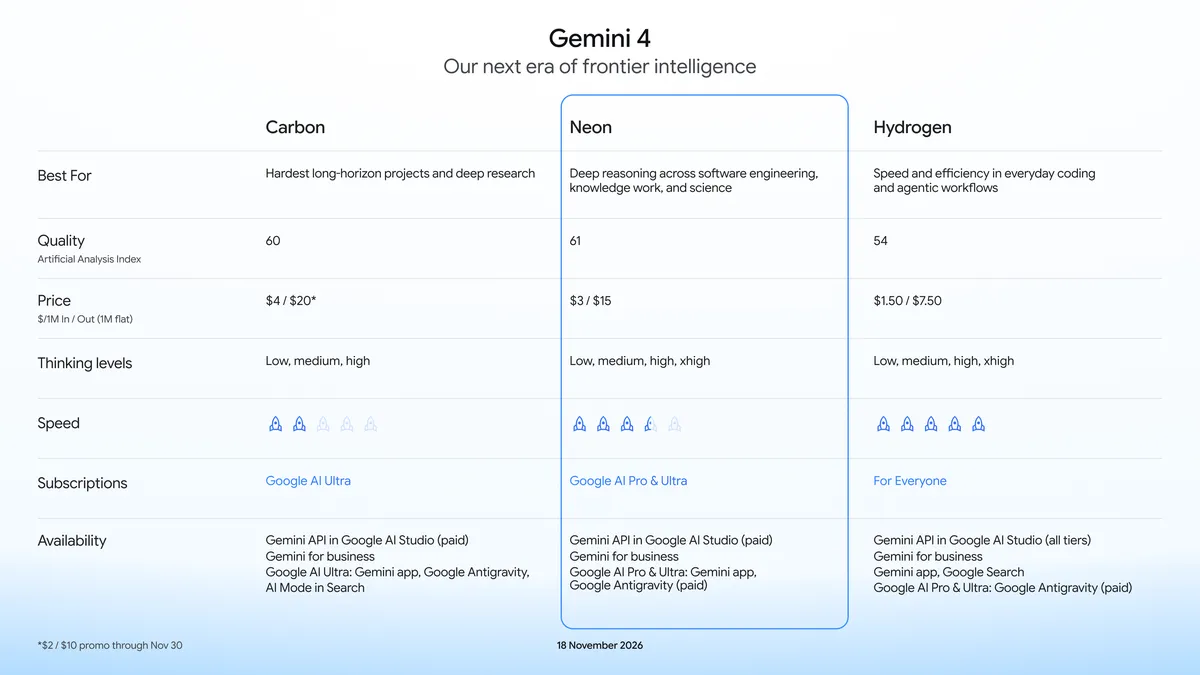
Google's comparison of the Gemini 4 model family, published at Neon's launch.
GPT-6.2 Astra vs Gemini 4 Neon: Performance
The Artificial Analysis release comparison covers several reasoning settings. The table uses its November 19, 2026 results. Index scores use each index's own scale. Percentages refer to scores on the named evaluation.
The following comparison uses Astra's max effort and Neon's xhigh effort, their highest available settings, except where a separate effort level is explicitly stated.
| Benchmark | GPT-6.2 Astra Max | Gemini 4 Neon Xhigh | Leader |
|---|---|---|---|
| Intelligence Index v5.0.1 | 62 | 61 | Astra |
| Finance & Accounting Index | 61 | 65 | Neon |
| Strategy & Operations Index | 63 | 64 | Neon |
| Legal Index | 59 | 64 | Neon |
| AutomationBench-AA | 77.2% | 79.3% | Neon |
| Terminal-Bench 4.0 | 64.1% | 63.6% | Astra |
| FrontierCode-AA 2.0 | 45.4% | 44.4% | Astra |
| HLE-Diamond | 72.2% | 71.3% | Astra |
| CritPt v2 Hard Subset | 71.5% | 60.5% | Astra |
| Terminal-Bench-Science 0.1 | 78.1% | 70.0% | Astra |
Coding and agent tools
On FrontierCode-AA 2.0, Astra reaches 49.0% at xhigh reasoning compared with Neon's 44.4%. On Terminal-Bench 4.0, Astra reaches 64.1% at max versus Neon's 63.6% at xhigh.
More notably, the Gemini 4 Neon model card reports a 39.0% SWE-sweep result using Google's Antigravity harness, compared with 12.8% using the mini-SWE harness.
If you are choosing an agent for a repository, give both models the same issue, checkout and test command. A change passes only if it fixes the issue and the existing tests still pass. The large gap between Neon's two SWE-sweep results shows why the tools available to the agent belong in the test record.
Scientific reasoning and business analysis
On Terminal-Bench-Science 0.1, Astra reaches 78.1% at max reasoning, compared with Neon's 70.0% at xhigh in the independent evaluation.
On CritPt v2 Hard Subset, Astra leads by 11 percentage points, scoring 71.5% against 60.5%.
For an accounting workflow, the results point the other way: Neon scored 65 on the Finance & Accounting Index, against Astra's 61. Test the distinction on a real deliverable. Give both models the same ledger and ask for a reconciliation, then verify the totals and trace each adjustment to a source row.
Reasoning effort
Both models score 60 on the Intelligence Index at high effort. Astra reaches 62 at xhigh and stays at 62 at max.
If response time matters, test medium and high on your own tasks and record which outputs pass within your deadline. On FrontierCode-AA, for example, Astra scored 49.0% at xhigh and 45.4% at max.
Choose Astra first for a repository fix or a scientific calculation with a verifiable answer. Its lead widens to 11 percentage points on the hard CritPt science problems. For a ledger reconciliation, start with Neon: it leads on the Finance and Accounting Index. If the task also involves listening to a recording or following a video demonstration, Neon can take that evidence directly.
GPT-6.2 Astra vs Gemini 4 Neon: Cost and Speed
Provider API prices
| USD per million tokens | GPT-6.2 Astra | Gemini 4 Neon |
|---|---|---|
| Uncached input | $8.00 | $3.00 |
| Cached input (read) | $0.40 | $0.15 |
| Output | $40.00 | $15.00 |
At these rates, a repository review that uses 100,000 uncached input tokens and 20,000 billed output tokens costs $1.60 with Astra ($0.80 for input and $0.80 for output) or $0.60 with Neon ($0.30 each). With identical token counts, Neon saves $1.00 per review before tool calls and retries.
These are standard provider rates for short-context text requests. Google includes thinking tokens in billed output and offers implicit caching for Neon. On Astra, a request with more than 272K input tokens doubles the input and cache rates and multiplies the output rate by 1.5 across that request.
Time and cost per Intelligence Index task
For its Intelligence Index, Artificial Analysis estimates task time from output tokens and measured output speed, then weights the results across benchmarks. Its cost measure weights token charges, including cache writes, reads and reasoning.
At high effort, both models score 60, but the estimated cost per Intelligence Index task is $2.07 for Astra and $3.74 for Neon. At xhigh, the estimates rise to $2.52 and $6.44, respectively.
For a service with a response deadline, also measure elapsed time from submission to the first usable result, including tool calls and retries.
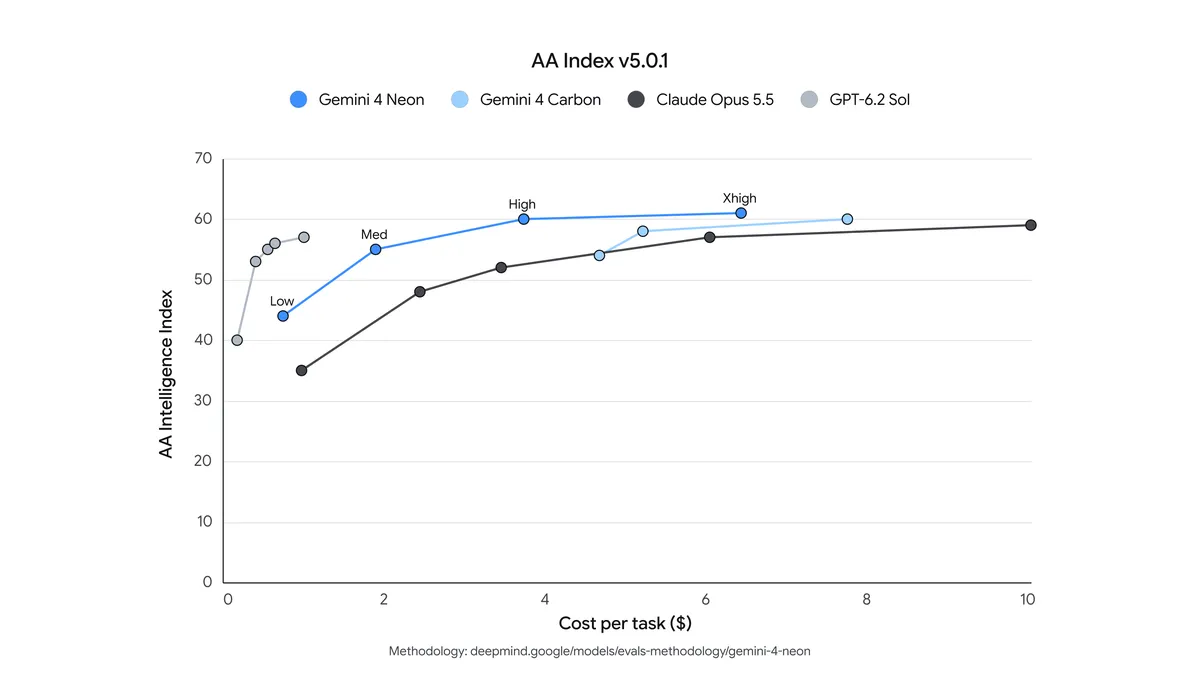
Google reports a 32% lower cost per task for Neon at its default high setting compared with Gemini 4 Carbon. The chart compares models within that evaluation.
Neon costs less at the same billed token counts. For a batch job, compare the total API cost per accepted result, including tool calls and retries. For a queue of reasoning tasks with a tight turnaround, test Astra at high effort first. At high, both models scored 60. Artificial Analysis estimated 6.5 minutes and $2.07 per index task for Astra, compared with 15.3 minutes and $3.74 for Neon, using data retrieved on November 24, 2026. Use a sample of your own queue to check whether that advantage holds through retries and tool calls.
Limitations of GPT-6.2 Astra and Gemini 4 Neon
GPT-6.2 Astra
Astra has separate limits for input and output: a request can contain up to 922,000 input tokens and generate up to 128,000 output tokens. The long-context price increase starts earlier. Once input exceeds 272,000 tokens, higher rates apply to the whole request. For a repository review, start with the failing test and the files it exercises.
Astra accepts text and still images. For a narrated bug report, you have to extract frames and transcribe the audio, which can lose the timing of an on-screen error.
Gemini 4 Neon
Neon shares a 1,048,576-token window across the prompt, source material, reasoning, tool calls and final answer. A long recording leaves less room for the report. A single foreground segment can generate up to 65,536 output tokens. If you need a longer answer, use an API or SDK that supports continuation. Each additional segment draws on the remaining context budget.
For code changes, test Neon with the repository tools you plan to deploy: its SWE-sweep scores varied substantially between the two harnesses.
Where Can You Access GPT-6.2 Astra and Gemini 4 Neon
Official Provider Access
For Astra, create an OpenAI project API key and send a short prompt to the Responses API using the model ID gpt-6.2-astra. The OpenAI quickstart shows how to send the first request. To try Neon in a browser, open Gemini 4 Neon in Google AI Studio. For an application, use a Gemini API key from a billing-enabled project and specify gemini-4-neon in your request.
CometAPI Access
To use one OpenAI-compatible client, create a CometAPI key and set the base URL to https://api.cometapi.com/v1. For the GPT-6.2 Astra API in CometAPI, use gpt-6.2-astra. For the Gemini 4 Neon API in CometAPI, use gemini-4-neon. Send the same short prompt to each route with your project key to confirm access before running a batch. Check the CometAPI rate for each model when estimating the bill.
FAQ
Is GPT-6.2 Astra better than Gemini 4 Neon?
Astra has a slight overall lead at peak effort, 62 to 61, and the two tie at 60 on high. For a lab comparing numerical solutions, the larger gap on the scientific benchmarks makes Astra a stronger starting point. For a team extracting decisions from recorded meetings, Neon can work directly from the audio and video.
Which model is better for debugging a large codebase, GPT-6.2 Astra or Gemini 4 Neon?
Start with Astra if the deliverable is a patch that passes regression tests. At xhigh effort it scored 49.0% on FrontierCode-AA 2.0, compared with 44.4% for Neon. If the only reproduction evidence is a narrated screen recording, Neon can review it directly and turn it into steps a developer can test.
Is GPT-6.2 Astra more expensive than Gemini 4 Neon?
Yes for equal token counts at standard short-context rates. Astra charges $8 per million uncached input tokens and $40 per million output tokens, versus $3 and $15 for Neon. For a completed job, the answer depends on how many tokens and attempts each model uses. Count the charges for failed attempts as well as the one you accept.
How should I score a patch if both models pass the tests?
Add one regression test for the reported bug, then inspect the diff for changes outside the issue. A patch that needs a developer to undo unrelated edits adds review time. Record that time alongside the API bill.
Can I estimate Gemini 4 Neon costs from the visible answer alone?
Use the billed output count in the usage record. Neon also bills thinking tokens, so multiplying the number of visible words by a token estimate can understate the cost. Track cache hits separately if the same source documents appear in many requests.
What if only part of my workload needs audio or video?
For a support queue, try Neon on tickets with screen recordings. Pass the extracted steps, timestamps and error messages to the model handling the code fix. Check a sample against the original recordings before relying on the written handoff.
Conclusion
Pick a recent task with a known outcome: a bug with a regression test, a ledger with a reconciled balance or a recording with verified timestamps. Run both models on the same inputs. For each one, divide the total bill, including retries, by the number of outputs you would accept. Use that figure and your delivery deadline to choose the model for that workflow.