TLDR GPT-6.2 Sol is the rumored next iteration of OpenAI’s mid-tier “Sol” family (positioned below flagship GPT-6 Astra). As of November 10, 2026, OpenAI has not issued an official announcement, model card, or public API listing.
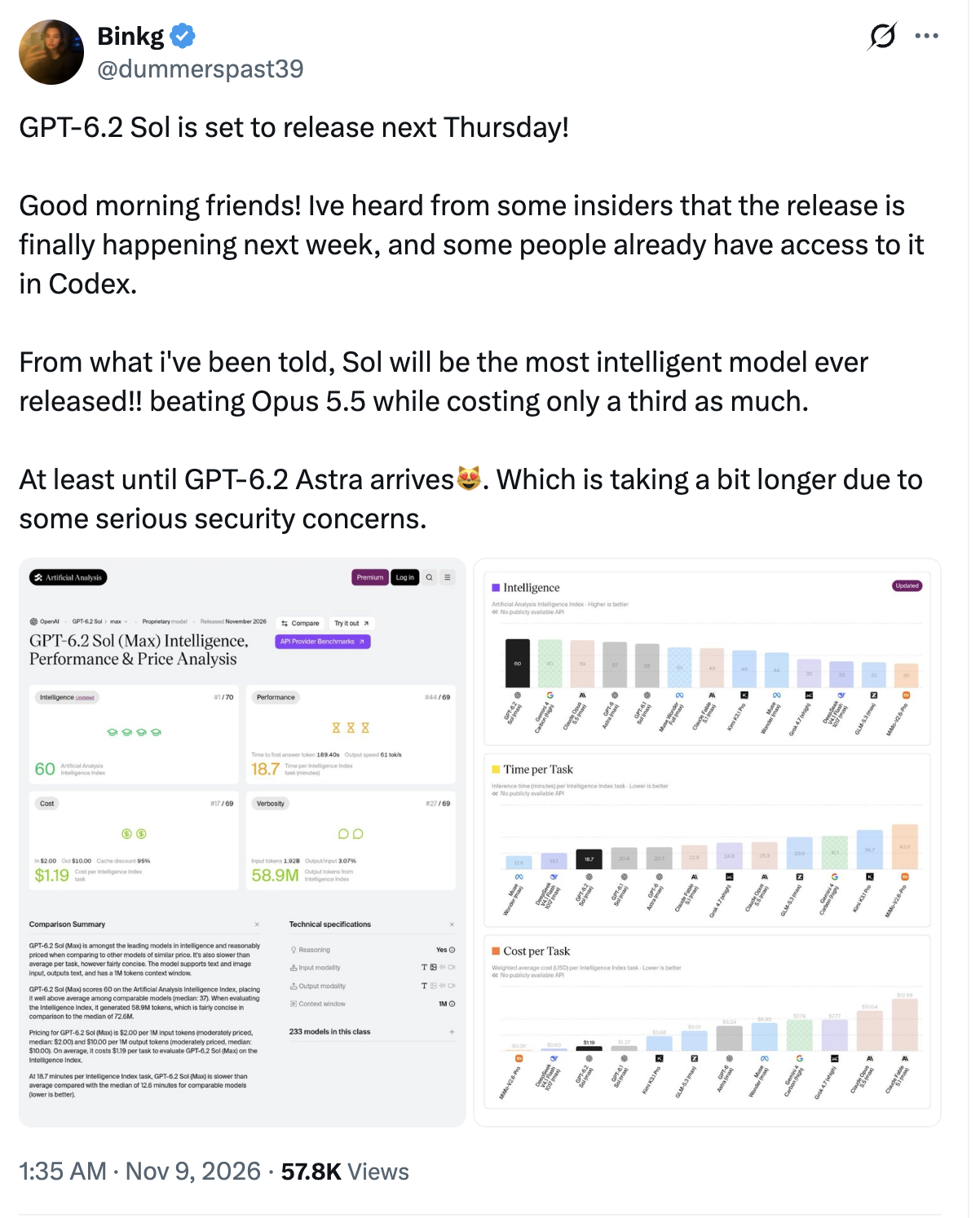
The model ID “gpt-6.2-sol” has appeared in Google Cloud quota screenshots and infrastructure telemetry. Community reports describe silent routing of some GPT-6.1 Sol traffic (especially in Codex and ChatGPT Work) to a stronger checkpoint starting around November 8. Early unofficial Artificial Analysis Intelligence Index claims put a max-effort version near 60 (matching or edging Gemini 4 Carbon and ahead of prior Sol/Astra scores in some snapshots). Strong visual-coding demos (complete interactive Three.js scenes from a single prompt) have circulated. Full public release timing remains unconfirmed; earlier reporting pointed to a possible early-November window that slipped. Developers can already access the current Sol/Luna/Astra lineup (and competing models) through unified gateways such as CometAPI for routing, cost control, and monitoring.
Key Takeaways
GPT-6.2 Sol is unreleased; only the model ID and gray-release routing reports exist in public sources.
Reviewed for clarity, source attribution and current API terminology.
Predecessor GPT-6 Sol launched September 22, 2026; GPT-6.1 Sol followed on September 29 at the same $2/$10 pricing with improved caching.
Community and secondary reports claim strong gains in coding, agentic workflows, and cost-efficiency versus Claude Opus 5.5 (reported ~11.8% of the per-task cost on one leaderboard snapshot).
Expected context window remains ~1M tokens; modalities text + image input / text output.
Pricing prediction: hold or modestly undercut $2/$10 (input/output per 1M tokens), continuing OpenAI’s pattern of aggressive mid-tier price cuts.
CometAPI already provides unified access to live OpenAI Sol-family models plus MiniMax, Claude, Gemini and others, simplifying multi-model routing and spend tracking for production agents.
MiniMax M4 remains unannounced; the company has only publicly committed to a new M-series generation in H2 2026 after M3 (June) and M3.1 Flash (October 19).
What Is GPT-6.2 Sol?
GPT-6.2 Sol is an unannounced model reportedly being tested or gradually deployed by OpenAI. The strongest clues come from two separate channels: Google Cloud infrastructure sightings and user reports on X.
What can we conclude?
Claim
Evidence level
The recent Sol release cycle helps explain expectations of another update. OpenAI released GPT-6 Sol on September 22 and GPT-6.1 Sol on September 29. Those releases show that updates within this family can arrive close together, although they do not establish a fixed schedule.
What Do the Leaks Actually Say About GPT-6.2 Sol?
A Journalist Reported That New Sol Models Were Approaching Release
On November 4, The Information journalist Stephanie Palazzolo posted on X that new OpenAI “Sol, Astra and cyber models” “could be coming as soon as Friday.”
This is a directly attributable report about an approaching release. Its wording matters: “could” describes a possible window, rather than a confirmed launch.
The post also did not specify the name “GPT-6.2 Sol,” disclose technical specifications, or guarantee that all three models would arrive together. The referenced Friday was November 6, so that window should no longer be presented as an upcoming release date.
GPT-6.2 Sol Reportedly Appeared in Google Cloud Quotas
Also on November 4, @AiBattle_ claimed that GPT-6.2 Astra and Sol had appeared on the Google Cloud Console’s Quotas page.
A reported infrastructure listing is a useful deployment signal. It suggests that identifiers may be circulating through partner systems, but it does not establish public access, launch timing, or the final API model name.
The account’s accompanying prediction—“Release likely tomorrow”—was its own interpretation.
Users Claim They Are Encountering GPT-6.2 Sol in Limited Testing
On November 8, Token Gremlin posted that GPT-6.2 Sol was already appearing for some ChatGPT users. The post described Three.js scenes generated from a single prompt, with the code packaged into one HTML file.
Separately, Sahil Panhotra shared a “peacock BMX” example and said some users were reportedly being routed to GPT-6.2 Sol while selecting GPT-6.1 Sol.
These accounts help explain the excitement around visual coding. However, the accessible posts do not provide independently verifiable backend identification or controlled comparisons. The model attribution remains a user claim.
A Later Release-Date Rumor Points to November 12
In a November 8 post, @dummerspast39 claimed that Sol would release “next Thursday,” corresponding to November 12.
The account attributed this to unnamed insiders and claimed that Sol would outperform Opus 5.5 at a lower cost. Neither statement was supported by an official announcement in the documentation inspected.
The same post associated security concerns with Astra’s timing. That should not be rewritten as a confirmed safety problem or delay affecting GPT-6.2 Sol.
What Could Actually Improve Over GPT-6.1 Sol?
The most useful way to evaluate GPT-6.2 Sol is to look at where GPT-6.1 Sol already performs well and where meaningful improvements would make a difference.
OpenAI's official GPT-6 Sol announcement describes Sol as a cost-efficient reasoning model for coding, professional workflows and computer use. GPT-6.1 Sol subsequently became the newer documented version.
OpenAI+1
The following are potential improvements, not confirmed GPT-6.2 specifications.
More Reliable One-Prompt Creative Coding
The viral Three.js demonstration is particularly interesting because it suggests a possible focus on turning natural-language instructions into complete interactive experiences.
Potential improvements include:
More coherent 3D scenes with fewer visual inconsistencies.
Better handling of Three.js, WebGL and complex JavaScript interactions.
More complete single-file HTML applications.
Better visual consistency across multiple generated components.
Fewer runtime errors and less manual debugging.
The real improvement would not simply be producing an attractive 3D scene. It would be producing a working application with correct interactions, responsive layouts and maintainable code.
Stronger Agentic Coding and Long-Horizon Execution
GPT-6.1 Sol already performs strongly on software engineering tasks, but complex coding agents still need to manage long execution chains, inspect existing codebases and recover from failed attempts.
GPT-6.2 Sol could improve in:
Planning and executing larger coding projects with fewer interruptions.
Understanding dependencies across multiple files and repositories.
Maintaining consistency during long-running coding sessions.
Running tests, identifying failures and automatically correcting implementation errors.
Producing production-ready code rather than merely functional prototypes.
This would be particularly important for competing with Claude Opus 5.5, which has demonstrated strong performance on large-scale codebase migrations and autonomous engineering tasks.
Better Visual Generation Through Code
The most interesting part of the Token Gremlin demonstration is its reported ability to generate a complete 3D environment from one natural-language prompt.
If the demonstration genuinely came from a new GPT-6.2 checkpoint, it could indicate improvements in:
Visual reasoning and spatial understanding.
Translating creative descriptions into executable code.
Generating complex interactive scenes with Three.js.
Coordinating visual assets, animations and user interactions.
Producing self-contained HTML applications without extensive follow-up prompts.
However, a single successful demonstration cannot establish a general improvement in visual reasoning. It also remains unclear whether the output came from GPT-6.2 Sol or GPT-6.1 Sol Max.
More Reliable Computer Use and Autonomous Agents
GPT-6.1 Sol already approaches GPT-6 Astra on OSWorld 2.0 while costing substantially less.
A logical next step would be improving the reliability of autonomous computer operations.
Potential upgrades include:
More accurate recognition of interface elements.
Better handling of dynamic websites and changing layouts.
More reliable multi-step browser and desktop operations.
Improved recovery from unexpected application states.
Better verification before submitting forms or modifying important data.
The goal would be to make GPT-6.2 Sol more capable of completing entire workflows without human intervention.
Improved Reasoning and Complex Problem Solving
Another potential improvement is more consistent reasoning across tasks involving multiple constraints and large amounts of information.
GPT-6.2 Sol could introduce:
Better decomposition of complicated problems.
More effective allocation of reasoning effort.
Improved consistency across long conversations.
Fewer logical contradictions in multi-step answers.
More reliable self-verification before delivering results.
This would help Sol compete with Opus 5.5 in research, technical analysis and professional knowledge work.
Higher Factual Accuracy and More Reliable Outputs
GPT-6.1 Sol already made substantial progress in factuality compared with GPT-6 Sol.
OpenAI reported that its factual-error rate on a challenging internal evaluation decreased from 11.4% to 7.7% at low reasoning effort.
GPT-6.2 Sol could potentially build on this with:
Better source verification.
Fewer unsupported statements.
Improved handling of conflicting information.
More transparent communication about uncertainty.
Better recognition of incomplete tool results.
For professional applications, these improvements could be as important as higher reasoning benchmark scores.
When Is the GPT-6.2 Sol Release Date? (Leaks, Reports & Predictions)
OpenAI has published no official release date. Key public signals include:
Early November 2026 reporting from The Information indicated OpenAI could ship next-generation Sol (and Astra) models as soon as Friday, November 6, citing people familiar with the models. That window passed without a public launch.
Screenshots of Google Cloud quota settings showing the string “gpt-6.2-sol” (alongside a corresponding Astra identifier) circulated on X.
From approximately November 8 onward, multiple users reported that requests previously routed to GPT-6.1 Sol were being silently directed to a stronger model they attributed to the 6.2 checkpoint, especially inside Codex and ChatGPT Work. Named accounts included reports from TokenGremlin, kimmonismus, and others. OpenAI has not confirmed the routing.
OpenAI developer channels posted a short “Tomorrow” teaser around the same period; the post did not name Sol or 6.2.
Given the pattern of rapid Sol point releases (6 → 6.1 in seven days) and the gray-release behavior, a broader public rollout in mid-to-late November 2026 remains the most commonly discussed community expectation. Full confirmation will only come with an OpenAI model page, API listing, and system card. Safety or alignment work has been cited in some secondary reports as a possible reason for any delay; these claims are unverified.
GPT-6.2 Sol Pricing: Confirmed vs Predicted
No official price card exists. The live GPT-6.1 Sol rate card (and the original GPT-6 Sol rates) provides the baseline:
Input: $2.00 per 1M tokens (short context ≤ ~272k tokens)
Cached input: $0.10 per 1M (halved from the original Sol’s $0.20)
Output: $10.00 per 1M tokens
Long-context requests (above the threshold) are billed at higher multipliers (typically 2× input / 1.5× output for the entire request).
Batch/Flex tiers run at roughly half standard rates; Fast tiers are higher.
Community reports and secondary analyses that attribute performance data to GPT-6.2 Sol continue to list the same $2/$10 figures. Given OpenAI’s explicit 50% price reduction from the GPT-5.6 Sol promotional rates when GPT-6 Sol launched, and the subsequent efficiency gains, a modest further reduction or at least price stability is the consensus expectation. Any confirmed 6.2 pricing will be announced alongside the model page.
For production cost control, many teams already route Sol-family traffic (and competitors) through multi-provider gateways. CometAPI offers unified access, usage monitoring, and routing across OpenAI, MiniMax, Anthropic, Google and other providers, which becomes especially useful when model IDs and pricing shift rapidly during gray releases.
GPT-6.2 Sol vs. GPT-6.1 Sol and GPT-6 Astra
GPT-6.1 Sol is the natural baseline for evaluating a 6.2 release. Astra provides a comparison point for workloads where additional capability justifies higher spending.
For existing Sol users, the strongest upgrade case would be measurable improvement on tasks that currently require repeated corrections.
For Astra users, the question would be whether GPT-6.2 Sol can handle enough of their workload at a lower total cost.
What Can You Use While Waiting for GPT-6.2 Sol?
The best alternative depends on your workload. GPT-6.1 Sol is the closest match for complex coding and professional tasks, while Astra, Terra, and Luna serve different needs in reasoning depth, visual work, and cost efficiency.
GPT-6.1 Sol: The Closest Alternative
Start with GPT-6.1 Sol if your main needs are complex coding, reasoning, and professional work.
It supports text and image input, structured outputs, and configurable reasoning effort. Its large context window also makes it relevant for repository analysis and extensive document workflows.
Using it now creates a direct baseline for a future upgrade. Keep a small set of real tasks and record completion quality, execution time, and cost. You can reuse those tasks when evaluating GPT-6.2 Sol.
GPT-6 Astra: For the Most Demanding Tasks
Choose GPT-6 Astra when difficult reasoning or coding tasks justify its higher price.
Examples include architectural decisions involving several systems, complicated debugging, and research requiring substantial synthesis.
An application can reserve Astra for difficult cases while sending routine work to a lower-cost model. This allocates spending according to task difficulty.
GPT-6.1 Terra: For Visual Work and Everyday Productivity
GPT-6.1 Terra is a useful starting point for workflows involving screenshots, technical drawings, application screens, and professional writing.
OpenAI describes applications such as matching product photos to catalog entries, interpreting drawings, acting on application screens, and drafting or revising text.
For these workloads, Terra may already provide the required capability at a lower price than Sol.
GPT-6 Luna: For High-Volume Tasks
GPT-6 Luna fits applications that make many focused, repeatable calls.
Examples include classifying support tickets, extracting fields, routing requests, and producing short structured responses.
Its low token prices make it attractive when the application’s requirements can be expressed clearly and evaluated consistently.
Explore GPT-6.2 Sol Alternatives on CometAPI
CometAPI provides a unified API for models from multiple providers. Its current catalog includes GPT-6.1 Sol, GPT-6.1 Terra, and GPT-6 Luna, making it a practical option for evaluating existing alternatives.
For developers using an OpenAI-compatible client, the basic configuration involves a CometAPI API key, the platform’s base URL, and the selected model ID. Review the chosen model’s documentation for supported endpoints and features.
At the time of writing, CometAPI lists GPT-6.1 Sol at $1.60 per million input tokens and $8 per million output tokens for its short-context tier. Those listed rates are 20% below the corresponding official standard rates.
If an existing model meets your project’s requirements, start building now.
Choose GPT-6.1 Sol for complex work with a balanced budget, Astra for the hardest tasks, Terra for visual and writing workflows, or Luna for focused work at scale.
Waiting becomes more relevant when your current model repeatedly fails a task or makes the workflow too expensive. Document the specific limitation and test the next release against it.
Establishing a baseline today will make the value of a future upgrade easier to assess.
GPT-6.2 Sol identifier exists in infrastructure sightings
Moderate
OpenAI is preparing a next-generation Sol
Plausible
GPT-6.2 Sol is available to selected ChatGPT users
Unverified
GPT-6.2 Sol has officially launched
Not confirmed
It outperforms Claude Opus 5.5
Not established
Dimension
GPT-6.2 Sol outlook
GPT-6.1 Sol today
GPT-6 Astra today
Primary role
Expected improvement to Sol’s capability and efficiency
Complex work at a lower cost than Astra
OpenAI’s most demanding workloads
Coding
Better reliability is a key expectation
Designed for complex coding
Designed for difficult coding and reasoning
Context
Existing Sol capacity provides a reference
1.05M tokens
1.05M tokens
Official API pricing
Awaiting publication
$2 input / $10 output per 1M
$10 input / $50 output per 1M
Evaluation priority
Completion rate, speed, and cost
Establish a practical baseline
Assess the value of added capability
GPT-6.2 Sol: Leaks, Specs, Release Timeline, and Alternatives - CometAPI