TL;DR: GPT-6 Cyber is OpenAI’s cybersecurity-specialized variant of GPT-6 Astra, built for authorized vulnerability research, exploit development, and security testing. Access currently requires Daybreak Red approval. For developers without access, GPT-6.1 Sol, GPT-6 Astra, and GPT-6.1 Terra offer alternatives for coding, technical analysis, and documentation through CometAPI.
Key Takeaways
Specialized security capabilities: GPT-6 Cyber is trained to investigate vulnerabilities, reproduce issues, and verify fixes within an authorized scope.
Restricted access: As of November 6, 2026, GPT-6 Cyber is available to select Daybreak Red customers.
Consider Sol for balanced coding assistance, Astra for complex reasoning, and Terra for visual analysis and clear writing.
Reviewed for clarity, source attribution and current API terminology.
Three alternatives:
Available through CometAPI: Access and compare these alternatives through a unified API.
What Is GPT-6 Cyber?
GPT-6 Cyber is a cybersecurity-focused variant of GPT-6 Astra. According to OpenAI, its specialized post-training targets tasks such as reproducing crashes, developing working exploits, and searching codebases for vulnerabilities.
That training serves two connected goals: improving the model’s security research capabilities and reducing unnecessary refusals on authorized cybersecurity requests. OpenAI also trains it to follow the user’s authorization, avoid unrequested actions, and report results accurately.
Its intended applications include:
Vulnerability discovery: Investigating code and identifying potential weaknesses.
Vulnerability reproduction: Reproducing suspected issues in an authorized test environment.
Exploit research: Helping researchers understand and validate exploitability.
Web penetration testing: Supporting security assessments within an approved scope.
Fix verification: Checking whether a proposed patch addresses the underlying issue.
OpenAI reports substantially stronger cybersecurity capabilities and improved alignment compared with GPT-5.6 Cyber.
GPT-6 Cyber Specifications and Cybersecurity Benchmarks
GPT-6 Cyber combines the underlying capabilities of GPT-6 Astra with specialized cybersecurity training. Its specifications support large-scale analysis, while OpenAI’s published evaluations show how consistently it completes different categories of security tasks.
The large context window provides room for substantial code, logs, and supporting documentation in a single request. Tool support allows developers to build workflows that connect analysis with testing and fix verification.
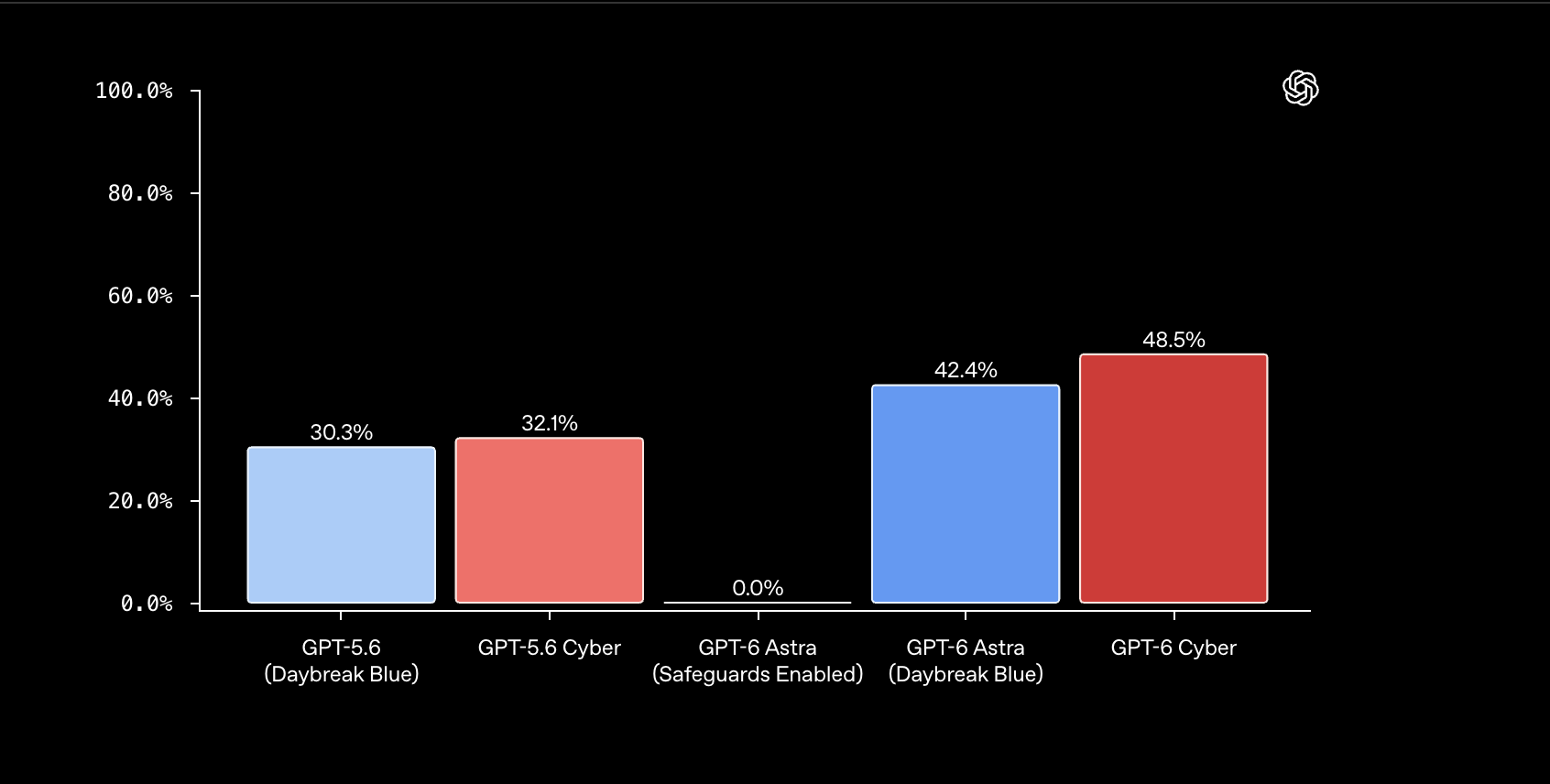
GPT-6 Cyber Benchmarks: Security Task Completion
OpenAI evaluated GPT-6 Cyber using its defensive-use evaluation suite. The published results cover general security assistance, vulnerability patching, exploit development, and red-teaming.
These results measure task completion in an evaluation of cyber refusals; they should not be read as accuracy rates or percentages of vulnerabilities successfully discovered. They support a narrower conclusion: GPT-6 Cyber completed nearly all evaluated security requests, including categories that can trigger refusals in general-purpose models.
OpenAI also reports substantially stronger cybersecurity capabilities than GPT-5.6 Cyber. The figures above, however, do not establish a performance ranking against GPT-6.1 Sol, GPT-6 Astra, or GPT-6.1 Terra.
Specialized Training for Security Research
GPT-6 Cyber’s post-training includes reproducing crashes, developing working exploits, and searching codebases for vulnerabilities. Through reinforcement learning, the model learns to revise its approach, try different strategies, and recognize mistakes.
This matters because security research often involves an investigative loop: inspect the evidence, form a hypothesis, test it, and adjust the explanation when the results disagree. The training targets that process alongside reducing unnecessary refusals on authorized requests.
There is also evidence of practical deployment. In its launch announcement, OpenAI said GPT-6 Cyber powered its recently announced Linux kernel research and was already being used by security teams at Mozilla, Palo Alto Networks, Calif, and Cisco.
Alignment With the User’s Authorized Scope
OpenAI trains GPT-6 Cyber to follow the user’s intended scope, avoid unrequested actions, and accurately report results. These behaviors matter when a model can use tools and pursue an investigation across multiple steps.
The deployment also includes safeguards designed to block high-risk activity against critical systems. Together, the training and safeguards aim to make the model more useful for authorized research while keeping its actions within the assignment’s boundaries.
Can You Try GPT-6 Cyber ?
GPT-6 Cyber has been released through restricted access. Organizations need Daybreak Red access and approval before using its API, and OpenAI directs customers to their account team to confirm eligibility.
The system card describes requirements including identity verification, organizational security controls, and API IP allowlisting. OpenAI says it is expanding access over time, but the cited announcement does not provide a date for general self-service availability.
For developers without approval, the most useful next step is to choose a broadly available model based on the work they need to complete.
GPT-6 Cyber Alternatives
For developers without GPT-6 Cyber access, these three models cover different needs across coding, technical analysis, and documentation. Here is a quick comparison before exploring each option.
Model
Primary Strength
Best-Fit Tasks
GPT-6.1 Sol: A Practical Starting Point for Coding Work
GPT-6.1 Sol balances capability and cost. OpenAI positions it as offering near-Astra performance for complex work at a lower price, making it a sensible starting point for teams adding AI assistance to everyday development.
For security-related engineering, useful tasks to evaluate include reviewing a patch, explaining suspicious code, drafting regression tests, and turning technical findings into remediation guidance.
For example, after a developer identifies a possible input-validation issue, Sol can help trace the relevant logic and propose tests for expected and unexpected inputs. This gives the team a concrete output to review before changing the application.
Choose GPT-6.1 Sol when: You want one model for routine coding and analysis, with enough capability for complex requests and a lower cost than Astra.
GPT-6 Astra: For Demanding Reasoning and Code Analysis
GPT-6 Astra is OpenAI’s flagship model for complex reasoning and coding. It is also the base model behind GPT-6 Cyber, making it a relevant option for developers handling difficult technical investigations.
Astra is worth evaluating when a task requires reasoning across multiple components: understanding unfamiliar architecture, tracing interactions between services, or assessing competing explanations for a bug.
For instance, investigating an authorization problem may involve following a request through middleware, permission checks, application logic, and database access. Astra’s positioning makes it a strong candidate for that kind of extended analysis.
Choose GPT-6 Astra when: The task involves substantial ambiguity or complicated dependencies, and you can justify a higher model cost to pursue a better technical result.
GPT-6.1 Terra: For Visual Analysis and Clear Technical Writing
GPT-6.1 Terra is designed for fast, efficient visual reasoning, precise computer use, and clear writing. It fits workflows where the input includes screenshots or where the main deliverable is an understandable explanation.
Potential applications include interpreting a security dashboard screenshot, summarizing visible configuration settings, and converting technical notes into a structured report.
For example, a team documenting an incident could use Terra to organize screenshots and analyst notes into a clear account of what was observed, what remains unresolved, and which follow-up checks are needed.
Choose GPT-6.1 Terra when: Your workflow centers on visual information, documentation, or straightforward analysis, and speed and cost are priorities. Computer-use workflows also require a compatible tool environment.
How to Access GPT-6 Cyber Alternatives
CometAPI lets you access GPT-6.1 Sol, GPT-6 Astra, and GPT-6.1 Terra with one API key. Its OpenAI-compatible interface simplifies integration with existing applications and makes it easier to compare models without maintaining separate provider connections.
Run the same representative tasks across the three models, then compare output quality, response time, and cost. A useful evaluation might include a patch review, a complex code explanation, and a screenshot-based report.
Getting Started With CometAPI
Create an account and API key. Register with CometAPI and generate a key for your application.
Choose a model. Find GPT-6.1 Sol, GPT-6 Astra, or GPT-6.1 Terra in the model catalog, and review its pricing and supported features.
Configure the connection. Set your compatible application’s API base address to https://api.cometapi.com/v1 and enter your CometAPI key.
Use , , or in your application’s model setting.
Frequently Asked Questions
Is GPT-6 Cyber publicly available?
As of November 6, 2026, GPT-6 Cyber is available to select Daybreak Red customers. API access requires organizational approval. OpenAI plans to expand access over time but has not announced a general self-service launch date.
How is GPT-6 Cyber different from GPT-6 Astra?
GPT-6 Cyber is a specialized variant of GPT-6 Astra with additional training for cybersecurity research. That training targets tasks such as vulnerability discovery, crash reproduction, and exploit development, while reinforcing adherence to the user’s authorized scope. Astra serves a broader range of complex reasoning and coding needs.
Which GPT-6 Cyber alternative should I choose?
GPT-6.1 Sol is a practical starting point for everyday coding and remediation assistance. GPT-6 Astra is worth evaluating for difficult investigations involving complex code or dependencies. GPT-6.1 Terra suits workflows focused on screenshots, visual information, and technical documentation.
Can these alternatives help with cybersecurity work?
Yes. They can assist with tasks such as explaining code, reviewing proposed fixes, drafting regression tests, and preparing reports. Their usefulness depends on the task and surrounding tools; the sources cited here do not establish equivalent performance to GPT-6 Cyber on specialized security research.
Can I use these models through CometAPI?
CometAPI’s catalog lists GPT-6.1 Sol, GPT-6 Astra, and GPT-6.1 Terra. You can select a model, create an API key, and follow the platform’s integration documentation to connect it to a compatible application. Review the model page for current pricing and supported features.
Conclusion
GPT-6 Cyber brings specialized training to authorized security research, with access currently reserved for approved Daybreak Red customers. For developers choosing a model today, the immediate decision is which capability their workflow needs most.
Start with GPT-6.1 Sol for balanced coding assistance, consider GPT-6 Astra for demanding analysis, or choose GPT-6.1 Terra for visual tasks and clear documentation. Through CometAPI, you can evaluate all three using representative tasks and select the model that delivers the most useful results within your budget.
Specification
GPT-6 Cyber
Model ID
gpt-6-cyber
Base model
GPT-6 Astra
Primary focus
Authorized vulnerability research and security testing
Context window
1,050,000 tokens
Maximum output
128,000 tokens
Supported inputs
Text and images
Output
Text
API features
Streaming, function calling, and structured outputs
Tool support
Includes web search, file search, code interpreter, hosted shell, and computer use through the Responses API
Standard input price
$20 per million tokens
Standard output price
$100 per million tokens
96%
Red-teaming
97%
GPT-6.1 Sol
Balance of coding capability and cost
Everyday code review, remediation suggestions, and regression test drafting
GPT-6 Astra
Complex reasoning and coding
Investigations involving unfamiliar architecture, multiple components, or difficult dependencies
GPT-6.1 Terra
Efficient visual analysis and clear writing
Interpreting screenshots, organizing findings, and preparing technical documentation
Select the model identifier.
gpt-6.1-sol
gpt-6-astra
gpt-6.1-terra
Evaluate before scaling. Test real examples from your workflow and select the model that meets your quality, latency, and budget requirements.
GPT-6 Cyber Explained: Features, Access, and Alternatives - CometAPI