
TL;DR
The short answer is: GPT-Image-2.5 currently has the stronger early showing in blind human-preference benchmarks, especially for image editing, while Nano Banana 2 offers a broader production feature set around search grounding, extreme aspect ratios, predictable resolution-based pricing, and high-volume generation.
OpenAI launched GPT-Image-2.5 on September 8, 2026 with two API variants. GPT-Image-2.5 Flare in CometAPI is designed as the faster default for everyday and high-volume generation, while GPT-Image-2.5 Sunburst in CometAPI targets premium generation and precision editing.
Nano Banana 2 API in CometAPI, officially Gemini 3.1 Flash Image, takes a different approach. It combines image generation with Gemini reasoning, Google Search and Image Search grounding, 0.5K-to-4K output, unusually wide aspect ratios, and strong multi-reference consistency.
If your priority is precise editing, edit locality, reference preservation, structured compositions, or premium final assets, GPT-Image-2.5 Sunburst is the strongest candidate. If you need fast iteration, real-time information, flexible output formats, batch economics, and scalable production, Nano Banana 2 is unusually competitive.
Quick Comparison
| Decision factor | GPT-Image-2.5 Flare | GPT-Image-2.5 Sunburst | Nano Banana 2 |
|---|---|---|---|
| Best fit | Fast iteration and high-volume OpenAI workflows | Precision editing and premium final assets | Grounded, flexible and scalable generation |
| Editing priority | Fast controlled edits | Strongest preservation and edit locality | Conversational editing with broader context |
| Search grounding | Not documented natively | Not documented natively | Web Search and Image Search grounding |
| Output flexibility | Up to 3840 px edge; transparent PNG/WebP | Up to 3840 px edge; transparent PNG/WebP | 0.5K鈥?K; aspect ratios through 1:8 and 8:1 |
| Pricing model | Quality- and token-dependent | Quality- and token-dependent | Predictable resolution tiers and Batch pricing |
| Practical rule | Use for iteration | Use for approval-ready edits | Use for context-rich production at scale |
Key Takeaways
- GPT-Image-2.5 is not one API model. OpenAI provides Flare for speed and volume and Sunburst for maximum editing precision.
- On the current Arena Text-to-Image leaderboard, Sunburst scores 1421±13, Flare 1399±13, and Nano Banana 2 1261±5. On Arena's Single Image Edit leaderboard, Sunburst scores 1520±9, Flare 1491±9, and Nano Banana 2 1387±4.
- The GPT-Image-2.5 Arena results are still marked Preliminary, so the early lead should not be interpreted as a permanent or universal quality gap. OpenAI says Flare can deliver up to 50% lower generation latency than GPT Image 2, but this is not a direct speed comparison against Nano Banana 2.
- Nano Banana 2 supports 0.5K, 1K, 2K and 4K output, plus extreme 1:4, 4:1, 1:8 and 8:1 aspect ratios.
- Google's Gemini API documentation explicitly lists Search grounding for Gemini 3.1 Flash Image and states that text and image search results can inform generation with real-time web data. This advantage applies when the Google Search tool is enabled and its attribution requirements are followed: official model documentation.
- Google publishes straightforward per-resolution API costs, while GPT-Image-2.5 uses a quality- and token-dependent pricing model.
- There is no universal winner: the better choice depends on whether your workflow optimizes for creative precision or grounded, scalable image production.
What Are GPT-Image-2.5 and Nano Banana 2?
The comparison is more interesting than a conventional new-model-versus-old-model contest because the two products are increasingly optimized for different production philosophies.
OpenAI describes ChatGPT Images 2.5 as a major image-generation upgrade centered on sharper detail and precise editing. It also emphasizes natural lighting, richer textures, better preservation of people and objects in reference images, and more reliable multi-turn editing.
For API users, OpenAI splits those capabilities into two lanes. Flare is the fast default, while Sunburst spends more generation time on tighter creative and editing control.
Google introduced Nano Banana 2 on February 26, 2026 as Gemini 3.1 Flash Image. Its architecture is designed to combine the reasoning and world-knowledge advantages associated with Gemini with the latency profile of a Flash-class model. Google specifically highlights real-time information and image grounding.
That creates the core distinction for developers: GPT-Image-2.5 is increasingly an image-generation and editing specialist. Nano Banana 2 behaves more like a multimodal Gemini workflow that happens to produce and edit images extremely well.
Official launch visuals from OpenAI and Google are embedded below.
Specifications
| Specification | GPT-Image-2.5 Flare | GPT-Image-2.5 Sunburst | Nano Banana 2 |
|---|---|---|---|
| Provider | OpenAI | OpenAI | |
| Release date | Sep. 8, 2026 | Sep. 8, 2026 | Feb. 26, 2026 |
| API model ID | gpt-image-2.5-flare | gpt-image-2.5-sunburst | gemini-3.1-flash-image |
| Primary role | Fast, everyday generation | Premium precision and editing | Fast, grounded multimodal image generation |
| Input | Text, image | Text, image | Text, image, video* |
| Output | Image | Image | Image, text |
| Image editing | Yes | Yes | Yes |
| Quality modes | low, medium, high, xhigh, max, auto | low, medium, high, xhigh, max, auto | Resolution-driven |
| Common resolutions | 1024×1024, 1536×1024, 1024×1536 | Same | 0.5K, 1K, 2K, 4K |
| Maximum edge | 3840 px | 3840 px | Up to 4K |
| Aspect-ratio range | 1:3 to 3:1 | 1:3 to 3:1 | Includes 1:4, 4:1, 1:8, 8:1 |
| Transparent background | PNG / WebP supported | PNG / WebP supported | Not a headline API capability |
| Search grounding | No native image-model grounding documented | No native image-model grounding documented | Google Web + Image Search |
| Thinking | Not exposed as a core model capability | Not exposed as a core model capability | Supported |
| Batch API | Not a core 2.5 headline feature | Not a core 2.5 headline feature | Supported |
| Reference consistency focus | Strong | Strongest OpenAI lane | Up to 5 characters / 14 objects highlighted by Google |
- Google made gemini-3.1-flash-image generally available in May 2026 and added video-to-image context support. The older preview model ID was deprecated; some third-party integration URLs still retain the preview slug.
- OpenAI's current API documentation confirms that both variants support six quality settings. Flare is the fast everyday model, whereas Sunburst is optimized for editing precision.
- Google's current release notes confirm that gemini-3.1-flash-image became generally available on May 28, 2026. Google also documents 0.5K, 1K, 2K and 4K image pricing and Search grounding in the Gemini API.
GPT-Image-2.5 Generation and Editing Improvements
The most important GPT-Image-2.5 improvement is not simply sharper first-generation images. It is control over what changes and what stays unchanged.
OpenAI says the new generation is better at preserving subjects from reference photos while modifying settings, visual styles and compositions. It also improves multi-turn editing consistency, so previous changes are less likely to disappear or degrade when another edit is applied.
That matters in real production work. A product-image workflow may start with a reference photograph, replace the background, change the lighting, add seasonal styling, revise a text element and finally change the aspect ratio. A model can produce an attractive result on every individual request and still be unusable if the product itself gradually changes.
Sunburst is specifically designed for workflows where this edit locality and reference fidelity matter more than minimum latency. Flare uses much of the same generation stack but targets faster iteration.
OpenAI states that Flare delivers higher-quality output than its previous-generation model with up to 50% lower latency.
The 50% figure compares Flare with OpenAI's previous GPT Image generation, not directly with Nano Banana 2. It should therefore be treated as an intra-family performance claim rather than evidence that Flare is 50% faster than Google's model.
What Makes Nano Banana 2 Different
Nano Banana 2's strongest differentiator is that image generation is connected to a broader reasoning and information-retrieval stack.
Google says the model can draw on Gemini's world knowledge and use real-time information and images from web search before generating an image. This is useful when a prompt depends on a particular landmark, object, scientific concept, current visual reference or factual infographic.
It also makes Nano Banana 2 unusually attractive for educational diagrams, current-information graphics, localized marketing material, data-oriented infographics, travel and location visuals, visual search applications, and large batches of assets in multiple shapes and resolutions.
Google also expanded its production controls. Nano Banana 2 supports resolutions from 512px to 4K and can preserve the identities of up to five characters and the fidelity of up to 14 objects in a workflow.
The image model also improves international text rendering and can translate text within an existing visual, an important capability for teams localizing one campaign across markets.
Benchmark Results: : GPT-Image-2.5 vs Nano Banana 2
The most useful current direct comparison comes from Arena's public image leaderboards, which aggregate blind side-by-side human preferences.
| Arena benchmark | GPT-Image-2.5 Sunburst | GPT-Image-2.5 Flare | Nano Banana 2 |
|---|---|---|---|
| Text-to-Image Arena score | 1421±13 | 1399±13 | 1261±5 |
| Text-to-Image rank | #1 | #2 | #9 |
| Text-to-Image votes | 3,149 | 2,856 | 41,957 |
| Single Image Edit score | 1520±9 | 1491±9 | 1387±4 |
| Single Image Edit rank | #1 | #2 | #12 |
| Single Image Edit votes | 6,704 | 5,676 | 157,693 |
On text-to-image generation, Sunburst is currently 160 Arena points ahead of Nano Banana 2, while Flare is 138 points ahead. On single-image editing, Sunburst leads by 133 points and Flare by 104 points.
Those are large early differences in human preference, and the editing result aligns particularly well with OpenAI's positioning of Sunburst. However, the confidence caveat matters.
Arena marks both new OpenAI entries as Preliminary, with only a few thousand votes. Nano Banana 2 has tens of thousands of text-to-image votes and more than 150,000 image-edit votes. The new OpenAI scores could therefore move more materially as additional comparisons arrive.
Arena scores measure relative human preference in Arena's test distribution. A 160-point difference does not mean one model has a fixed percentage advantage in image quality.
The benchmark result should therefore be read as strong early evidence favoring GPT-Image-2.5, not as proof that it wins every production task.
Feature Comparison: GPT-Image-2.5 vs Nano Banana 2
Image Editing
At the moment, this is the dimension where the answer is clearest: GPT-Image-2.5 has the advantage, with Sunburst as the stronger option.
There are three reasons. First, editing precision is one of the explicit design goals of the new OpenAI generation. Second, Sunburst is specifically optimized for workflows where editing precision matters more than generation speed. Third, the independent preference signal points in the same direction: Sunburst currently sits at the top of Arena's Single Image Edit leaderboard.
That combination makes it particularly suitable for product photography, campaign revisions, brand assets, reference-driven character work and iterative creative production.
Nano Banana 2 remains a capable conversational editor. The distinction is not that one can edit and the other cannot. The more useful distinction is that OpenAI currently appears stronger at minimizing unintended change, while Google offers more surrounding intelligence and grounding during the editing workflow.
Text and Infographics
Both companies now emphasize text rendering, but they approach the problem differently.
OpenAI highlights improved infographic accuracy and layout, while Images 2.5 is designed to preserve hierarchy and composition through increasingly detailed instructions.
Google emphasizes precision text rendering and translation. Nano Banana 2 can also use search grounding to obtain information before producing an infographic.
For a static poster, advertisement, UI concept or layout where exact spatial structure is the dominant challenge, GPT-Image-2.5 is the more compelling first test. For a localized or information-driven graphic where current factual context matters, Nano Banana 2 may offer the more useful end-to-end workflow because Search grounding can become part of generation itself.
Neither model should be trusted to publish critical numerical or legal information without post-generation verification. Image-generation models can still produce visually convincing but incorrect copy.
Photorealism
This category is less decisive than the headline Arena rankings suggest.
OpenAI says Images 2.5 improves natural lighting, richer textures and recognizable reference subjects. Google makes similar claims around photorealistic quality, sharper detail, richer texture and vibrant lighting.
Several early direct comparisons have favored Nano Banana 2 for photographic camera feel, materials and natural-looking product scenes, while favoring GPT-Image-2.5 for text-heavy layouts and controlled edits. Those observations are useful, but they are subjective tests rather than standardized cross-provider benchmarks.
For production evaluation, photorealism should therefore be tested with your own prompt distribution: skin and hair, glossy and matte products, transparent materials, fabrics, food, architecture, indoor lighting, cinematic depth of field, and reference-photo identity.
For teams producing thousands of assets, cost per accepted image is much more informative than whichever model creates the prettiest single cherry-picked sample.
Resolution and Aspect Ratios
Nano Banana 2 has the cleaner advantage here.
Google supports 0.5K, 1K, 2K and 4K generation. The API also supports extreme ratios including 1:4, 4:1, 1:8 and 8:1.
- website hero banners
- panoramic backgrounds
- mobile story creatives
- tall product displays
- long-form promotional graphics
- multi-format ad campaigns
GPT-Image-2.5 offers custom dimensions and supports an aspect-ratio range of roughly 1:3 to 3:1, with a maximum edge of 3840 pixels and a maximum total output area of 8,294,400 pixels in its current specifications.
OpenAI has a separate advantage for compositing workflows: transparent PNG and WebP backgrounds are explicitly supported.
So the split is simple: Nano Banana 2 wins for extreme canvas flexibility and native 4K tiers. GPT-Image-2.5 is especially attractive when transparency and controlled asset editing matter.
Real-Time and Grounded Generation
This is one area where Google has a clear architectural advantage.
Nano Banana 2 supports Google Web and Image Search grounding. A generation request can therefore use retrieved text and visual information as context before producing an output.
That changes what developers can build. Consider a travel application generating a visual explanation of a landmark. A normal image model relies largely on information encoded during training or on references explicitly supplied by the application. Nano Banana 2 can incorporate search into the generation process.
The same mechanism can help with visual research, product discovery, educational content and current-information graphics. GPT-Image-2.5 does not document equivalent native search grounding at the image-model level.
If your application already performs retrieval separately, that disadvantage becomes smaller. If you want retrieval and image generation inside one Gemini workflow, Google's implementation is materially simpler.
GPT-Image-2.5 vs Nano Banana 2 Pricing: Official API and CometAPI
| Model / billing unit | Official API | CometAPI | Interpretation |
|---|---|---|---|
| GPT-Image-2.5 text input | $5 / 1M tokens | $4 / 1M tokens | Token-priced input |
| GPT-Image-2.5 image input | $8 / 1M tokens | See current provider quote | Varies with input and quality |
| GPT-Image-2.5 image output | $30 / 1M image tokens | $24 / 1M output tokens | Quality ladder changes cost per image |
| Nano Banana 2 — 0.5K | $0.045 / image | $0.0360 / image | Fixed resolution tier |
| Nano Banana 2 — 1K | $0.067 / image | $0.0536 / image | Fixed resolution tier |
| Nano Banana 2 — 2K | $0.101 / image | $0.0808 / image | Fixed resolution tier |
| Nano Banana 2 — 4K | $0.151 / image | $0.1208 / image | Fixed resolution tier |
| Nano Banana 2 Batch | Approximately 50% below standard tiers | Check provider availability | Best for asynchronous volume |
The pricing models are sufficiently different that comparing only dollars per million output tokens can be misleading.
Note:
- The apparent $30 versus $60 per million image tokens difference does not make GPT-Image-2.5 automatically half the price. The two providers tokenize image output differently, and OpenAI consumption also changes with its quality ladder.
- Google makes budgeting simpler because it publishes explicit resolution pricing: $0.045 for 0.5K, $0.067 for 1K, $0.101 for 2K and $0.151 for 4K. The Batch API cuts those equivalents to approximately $0.022, $0.034, $0.050 and $0.076 respectively.
- OpenAI instead lets a developer move through low, medium, high, xhigh and max, which can be advantageous when an application wants inexpensive drafts and more expensive final renders rather than a fixed quality target.
How to save costs and reduce integration
For developers who do not want to maintain separate OpenAI and Google integrations, both model families can be accessed through CometAPI. GPT-Image-2.5 Sunburst API in CometAPI currently shows $4 per million input tokens and $24 per million output tokens, compared with the corresponding $5/$30 official pricing dimension.
GPT-Image-2.5 Flare API in CometAPI uses the same $4/$24 published CometAPI token rates for the comparable input/output dimensions.
Using both models through one API is particularly useful for applications that do not have a single dominant image workload. A creative platform could route grounded or extreme-aspect-ratio generation to the Google model, use Flare for rapid OpenAI generation, and send high-value iterative edits to Sunburst.
The architectural advantage is not simply having more models. It is being able to select the model per request instead of redesigning the application around one provider's strengths and weaknesses.
GPT-Image-2.5 vs Nano Banana 2: Which Features Matter Most?
| Dimension | GPT-Image-2.5 | Nano Banana 2 | Better choice |
|---|---|---|---|
| Blind text-to-image preference | Current Arena leader | Behind 2.5 in current Arena | GPT-Image-2.5 |
| Blind single-image editing preference | Current Arena leader | Competitive but lower | GPT-Image-2.5 |
| Precision editing | Major design focus | Strong conversational editing | GPT-Image-2.5 |
| Multi-turn edit preservation | Major 2.5 improvement | Strong subject consistency | GPT-Image-2.5, early edge |
| Real-time web knowledge | No native model-level grounding documented | Web + Image Search | Nano Banana 2 |
| Extreme aspect ratios | 1:3 to 3:1 | Up to 1:8 / 8:1 | Nano Banana 2 |
| Maximum output format | Flexible, max edge 3840 px | Native tiers through 4K | Nano Banana 2 |
| Transparent assets | Explicit PNG/WebP support | Not a headline feature | GPT-Image-2.5 |
| Multiple-character consistency | Strong reference preservation | Up to 5 characters highlighted | Nano Banana 2 for documented scale |
| Multiple-object consistency | Strong reference preservation | Up to 14 objects highlighted | Nano Banana 2 for documented scale |
| International text/localization | Improved | Explicit i18n + translation focus | Nano Banana 2 |
| Quality control | Six quality settings | Primarily resolution-driven | GPT-Image-2.5 |
| Batch economics | Less clearly documented for 2.5 | Native Batch API | Nano Banana 2 |
| High-volume workflow | Flare is designed for it | Flash architecture + batch | Depends on workload |
| Premium final editing | Sunburst | Generalist Flash model | GPT-Image-2.5 Sunburst |
This table explains why a single overall winner obscures the more useful answer. OpenAI has created a quality-and-edit-control ladder. Google has created a reasoning-grounding-resolution stack.
Practical applications Example with the same Prompt
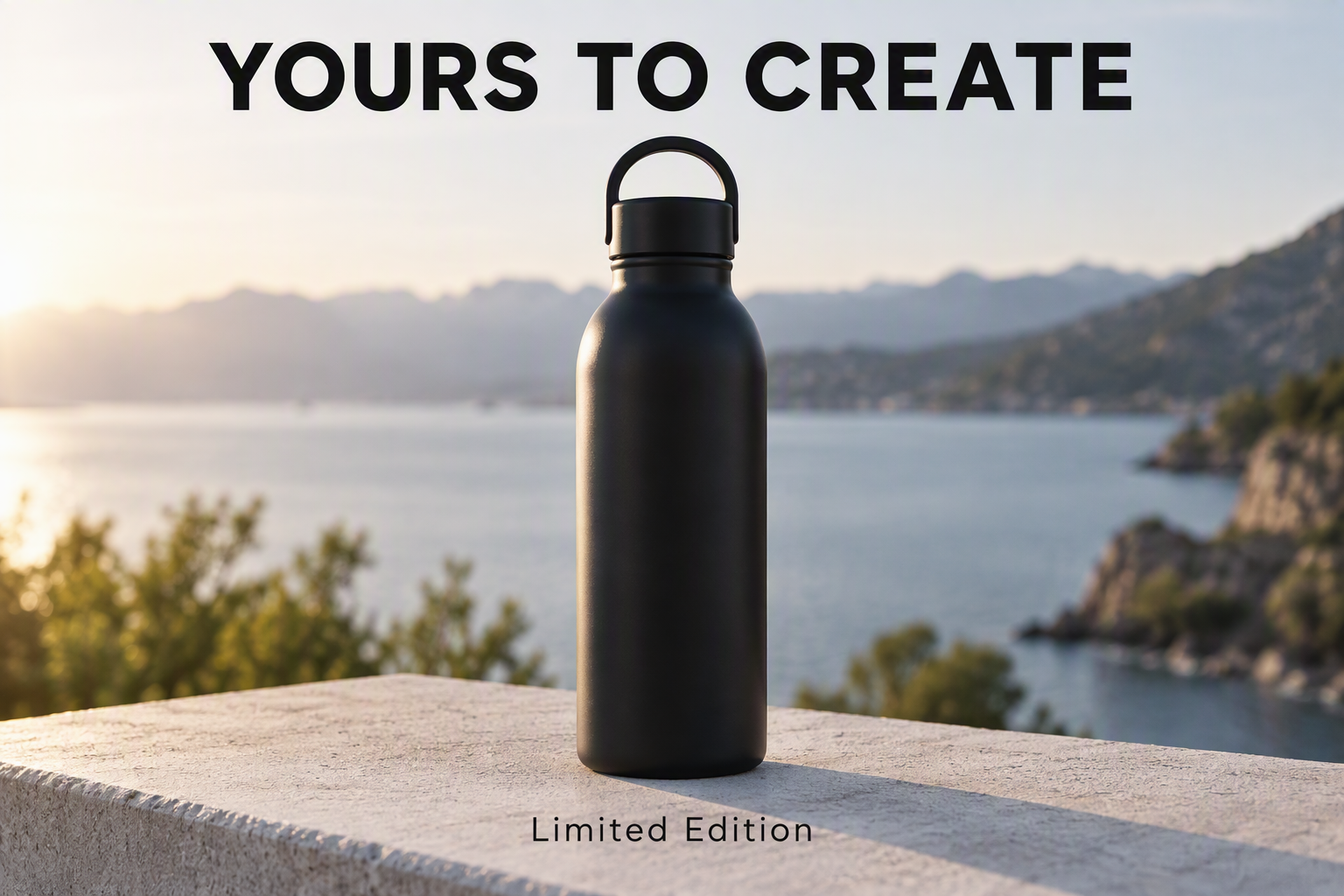
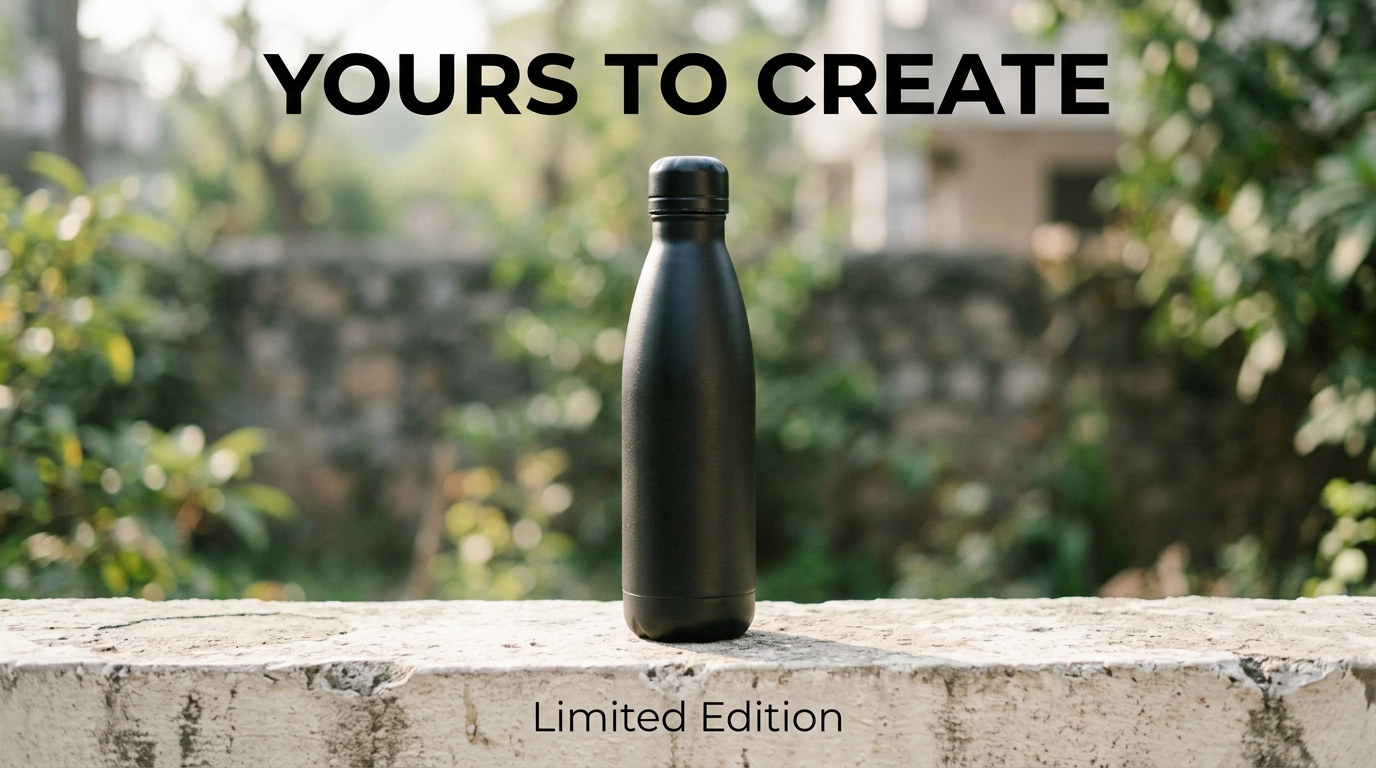
Prompt: Photorealistic product photograph of a matte black water bottle standing on a pale concrete ledge. Soft morning light from the left, gentle reflections, shallow depth of field. Centered composition, Include ONLY this text (verbatim): headline "YOURS TO CREATE" in bold sans-serif across the top, subhead "Limited Edition" smaller at the bottom. No other text or logos.
GPT Image 2.5(sunburst):
Nano Banana 2:
Which Model Should You Choose?
Choose GPT-Image-2.5 When...
Choose the OpenAI family when the cost of a bad edit is higher than the cost of another few seconds of generation.
- ecommerce product photography where the product itself must remain unchanged
- advertising creative requiring multiple controlled revisions
- reference-led character or subject transformations
- posters, branded layouts and structured visual assets
- transparent product or design elements
- iterative creative applications
- workflows that benefit from a draft-to-final quality ladder
Within the family, use Flare when throughput and iteration speed are important. Use Sunburst when a final asset needs careful preservation and the additional latency is acceptable.
A useful operating rule: Flare for iteration; Sunburst for approval.
Choose Nano Banana 2 When...
Choose Google's model when image generation is part of a larger information or multimodal workflow rather than an isolated rendering step.
- grounded visual search
- current-event or real-world information graphics
- international and multilingual creative
- extreme vertical or horizontal assets
- high-resolution 4K workflows
- multi-character and multi-object compositions
- batch generation
- applications already built around Gemini
- high-volume pipelines requiring predictable resolution-based costs
A useful operating rule: Nano Banana 2 for context-rich generation at scale.
Use Both Models Together When...
Yes, and for many production systems that is the more robust architecture.
There is no technical reason the first model in a workflow must also perform the final edit. A team might use Nano Banana 2 to retrieve current visual context and produce a grounded concept, then use GPT-Image-2.5 for a tightly controlled final revision. Another application might use Flare to generate rapid variants, route only difficult edits to Sunburst, and reserve Nano Banana 2 for formats outside OpenAI's preferred aspect-ratio range.
CometAPI makes this routing strategy easier because the application can use one API infrastructure while selecting GPT-Image-2.5 Flare, GPT-Image-2.5 Sunburst, or Nano Banana 2 for different jobs.
Instead of asking which company to commit to, the better engineering question is: Which model minimizes cost and rework for this individual request?
Final Verdict: GPT-Image-2.5 or Nano Banana 2?
If the decision is based only on the current blind preference benchmark, GPT-Image-2.5 wins.
Sunburst and Flare occupy the first two positions on the current Arena Text-to-Image leaderboard and the first two positions on the Single Image Edit leaderboard. The margin over Nano Banana 2 is substantial enough that it should not be dismissed as noise.
But this is an early result. The OpenAI entries are still preliminary and have far fewer Arena votes.
For professional editing, the result is nevertheless convincing enough to make Sunburst the first model to test. Its product positioning, editing architecture and early independent preference data all point in the same direction.
For general application development, the answer is more balanced. Nano Banana 2 gives developers capabilities that a leaderboard cannot measure well: Search grounding, Gemini reasoning, 0.5K-to-4K resolution tiers, extreme aspect ratios, documented multi-reference scale and a discounted Batch API.
So the practical decision is: choose GPT-Image-2.5 Sunburst when precision and edit preservation matter most. Choose GPT-Image-2.5 Flare when you want OpenAI's new quality level with faster iteration. Choose Nano Banana 2 when grounding, flexible formats, scale and predictable image economics matter more.
For teams that face all three workloads, using the GPT-Image-2.5 API in CometAPI and Nano Banana 2 API in CometAPI allows each request to be routed to the model whose strengths match the job.
FAQ
Is GPT-Image-2.5 better than Nano Banana 2?
On current Arena human-preference benchmarks, yes. Both Sunburst and Flare score above Nano Banana 2 in text-to-image generation and single-image editing. However, the GPT-Image-2.5 results remain preliminary, so this should not be interpreted as proof that it is superior in every workflow.
What is the difference between GPT-Image-2.5 Flare and Sunburst?
Flare is OpenAI's faster default for high-quality everyday and high-volume generation. Sunburst is the precision-oriented variant intended for premium creative production and detailed editing. Sunburst generally trades additional generation time for tighter control.
Is Nano Banana 2 faster than GPT-Image-2.5?
There is no sufficiently controlled official cross-provider benchmark to give a universal answer. OpenAI says Flare lowers latency by up to 50% compared with its own previous-generation image model, while Google positions Nano Banana 2 as a low-latency Flash model. Actual latency should be benchmarked with identical prompts, resolutions and concurrency.
Which model is better for image editing?
GPT-Image-2.5 currently has the stronger evidence. Sunburst leads Arena's Single Image Edit ranking and OpenAI specifically designed it for precise, controlled edits and stronger preservation across multiple revisions.
Which model is better for generating text in images?
Both are strong. OpenAI emphasizes infographic accuracy, layout and precise editing, while Google emphasizes international text rendering, translation and grounded information. GPT-Image-2.5 is a strong first choice for structured brand layouts; Nano Banana 2 is especially useful for multilingual or search-grounded graphics.
Does GPT-Image-2.5 support 4K images?
GPT-Image-2.5 supports flexible custom dimensions, with a documented maximum edge of 3840 pixels and maximum output area of 8,294,400 pixels. It therefore should not simply be described as having the same 4096×4096 4K tier as Nano Banana 2.
Which model has better aspect-ratio support?
Nano Banana 2 supports more extreme canvases, including 1:4, 4:1, 1:8 and 8:1. GPT-Image-2.5's documented range is approximately 1:3 to 3:1.
Can I use GPT-Image-2.5 and Nano Banana 2 through CometAPI?
Yes. Developers can use both families through CometAPI and route different image-generation workloads to different models without maintaining completely separate provider integrations.