
In the rapidly evolving world of AI image generation, April 2026 marked a pivotal moment. OpenAI launched ChatGPT Images 2.0 powered by the gpt-image-2 model, immediately claiming the top spot on major leaderboards and sparking intense debates across Reddit, YouTube, and AI communities. Meanwhile, Google's Nano Banana 2 (built on Gemini 3.1 Flash Image architecture), released earlier in February 2026, had already set high standards for speed and photorealism.
For developers and businesses seeking cost-effective, unified access to both models (and 500+ others including LLMs, video generators, and more), platforms like CometAPI offer a single API endpoint that simplifies integration, reduces vendor lock-in, and often provides competitive pricing compared to direct providers.
What Is GPT Image 2? OpenAI's State-of-the-Art Image Model
GPT Image 2 (officially tied to ChatGPT Images 2.0) represents OpenAI's most advanced native image generation and editing model as of April 2026. Unlike earlier DALL·E series models, it integrates deeply with ChatGPT's reasoning capabilities, enabling "thinking" modes that allow web search, multi-image generation from one prompt, and enhanced instruction following.
Key Features and Improvements:
- Superior Text Rendering: Reports indicate near-perfect accuracy (up to 99.2% in some tests), making it ideal for UI mockups, logos, posters, and any image requiring legible text, including multilingual support (English primary, with improvements in Chinese, Hindi, etc.).
- Spatial Logic and Composition: Excels at complex multi-element scenes, precise object placement, and structural control. It handles dense compositions, iconography, and subtle stylistic constraints better than predecessors.
- Image Editing: Strong performance in single- and multi-image editing, preserving identity and following detailed instructions.
- Resolution and Flexibility: Supports flexible aspect ratios (e.g., 3:1 wide to 1:3 tall) and high-fidelity outputs up to 4K in some workflows.
- Reasoning Integration: Can double-check outputs, generate variations, or create coherent sets (e.g., multi-panel comics or marketing assets in different sizes).
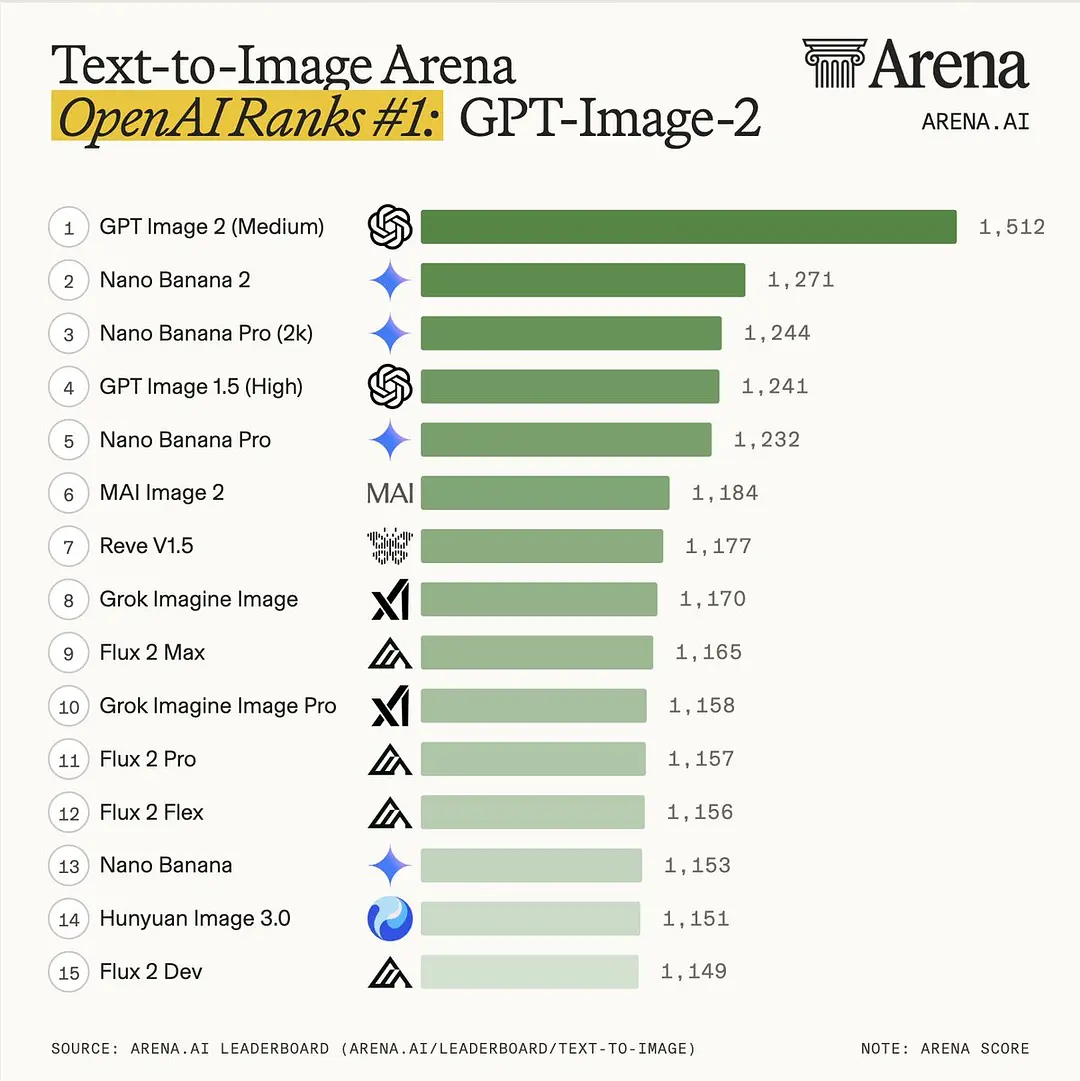
Launch Impact: Within hours of release, GPT Image 2 topped the Image Arena leaderboard with an Elo score around 1,512 on text-to-image tasks, creating a reported 242-point gap over the previous leader (Nano Banana 2 at ~1,360 in pre-launch or competing benchmarks). This is described as the largest gap in Arena history.
What Is Nano Banana 2? Google's Fast, Photorealistic Contender
Nano Banana 2, Google's latest image generation model (technically Gemini 3.1 Flash Image), launched around February 26, 2026. It bridges the gap between the high-fidelity "Pro" tier (Nano Banana Pro) and ultra-fast Flash performance, combining advanced reasoning, world knowledge, and production-ready speed.
Key Features and Strengths:
- Generation Speed: Significantly faster—often 3-5 seconds per image versus longer times for heavier models. This makes it ideal for rapid iteration, high-volume production, and real-time applications.
- Photorealism and Aesthetics: Frequently praised for cinematic lighting, hyper-realistic textures, natural skin tones, and atmospheric depth, it produces "more realistic" results in direct comparisons, avoiding the overly polished look of some OpenAI outputs.
- Real-Time Grounding: Integrates Google Search for up-to-date knowledge, enabling timely images (e.g., current events or trending styles). Supports 4K resolution and strong subject/character consistency across multiple objects (up to 5 characters or 14 objects reported in tests).
- Editing and Control: Excellent for photo editing, style blending, and maintaining consistency with reference images. Includes SynthID watermarking for AI-generated content.
- Text Rendering: Improved over earlier versions but generally trails GPT Image 2 in precision for complex or dense text layouts (strong for infographics).
- Market Positioning: Nano Banana 2 emphasizes efficiency for professional workflows like product mockups, ad variations, social media assets, and video frame generation. It delivers "Pro-level" quality at Flash speeds, making it highly cost-effective for scale.
Head-to-Head Comparison: GPT Image 2 vs Nano Banana 2
Community benchmarks, LM Arena data, GitHub rigs judged by Claude Opus, and YouTube side-by-sides reveal a clear split in strengths rather than a outright winner.
1. Text Rendering and UI/Branding Tasks
- GPT Image 2 Wins Decisively: Near-flawless text accuracy, layout hierarchy, and iconography. Ideal for mockups, logos, menus, posters, or any text-heavy content. One analysis noted 99.2% accuracy versus lower rates for competitors.
- Nano Banana 2: Solid improvements but can struggle with dense or stylized text. Better suited for simpler overlays or when photorealism takes priority.
- Use Case Winner: GPT Image 2 for branding and professional design assets.
2. Photorealism, Lighting, and Artistic Quality
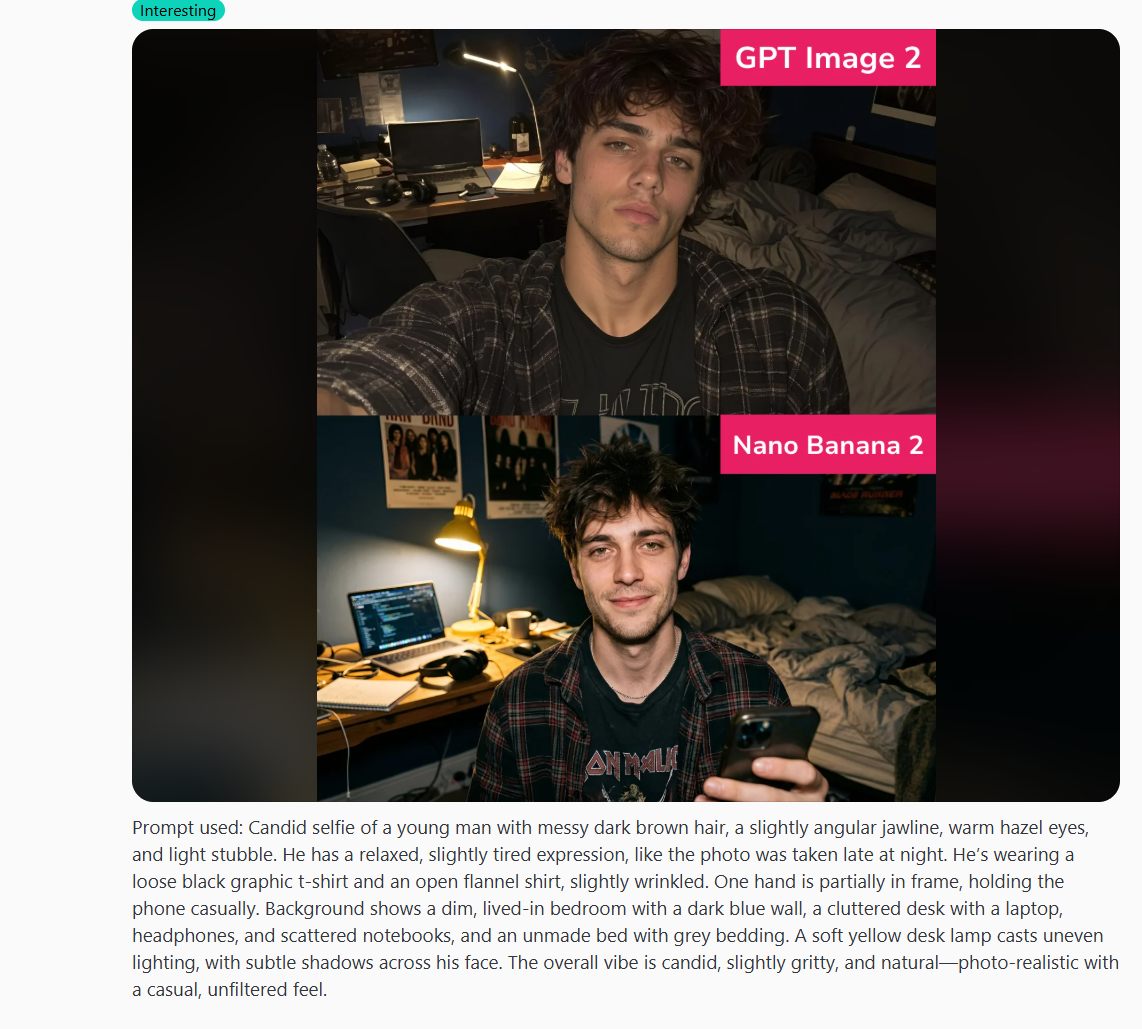
- Nano Banana 2 Often Preferred: Delivers more natural, cinematic results with superior textures and lighting. Reddit users frequently comment that Nano Banana outputs look "more realistic" or less "AI-polished."
- GPT Image 2: Strong photorealism with excellent detail, but some testers find it overly refined or painting-like.
- Use Case Winner: Nano Banana 2 for photography-style images, portraits, product visuals, or atmospheric scenes.
3. Prompt Adherence, Spatial Logic, and Complex Compositions
- GPT Image 2 Excels: Superior structural control, object placement, and following nuanced instructions. Handles multi-object scenes and logical consistency better in blind tests.
- Nano Banana 2: Strong reasoning via Gemini architecture, with good consistency for characters and objects, aided by real-time search.
- Use Case Winner: GPT Image 2 for intricate scenes or precise creative direction.
4. Speed and Iteration
- Nano Banana 2 Dominates: 3-5 seconds typical generation time enables fast workflows. GPT Image 2 can be slower, especially in reasoning/thinking modes (up to 10-30+ seconds in some reports).
- Use Case Winner: Nano Banana 2 for high-volume or time-sensitive tasks.
5. Image Editing and Reference Image Handling
- Both perform well, but GPT Image 2 shines in precise, instruction-based edits. Nano Banana 2 excels at style transfer and maintaining consistency with references while being faster.
- Community tests show mixed results; some prefer Nano Banana for realistic edits.
6. Cost and Accessibility
- Nano Banana 2 generally offers better speed-to-cost ratio for volume.
- GPT Image 2 may command a premium for its precision and reasoning depth.
- Developer Tip: Using an aggregator like CometAPI allows seamless switching between models (and others like Midjourney, Flux variants, or video tools) via one API key, optimizing for cost and performance without managing multiple accounts. CometAPI supports unified access to frontier image models, often with transparent pricing and easy integration for apps, automation (n8n, Make), or production pipelines.
Comprehensive Comparison Table: GPT Image 2 vs Nano Banana 2
| Metric | GPT Image 2 (OpenAI) | Nano Banana 2 (Google Gemini 3.1 Flash) | Winner / Notes |
|---|---|---|---|
| Text Rendering | Excellent (99.2% accuracy, dense text/UI) | Good (improved, strong for infographics) | GPT Image 2 |
| Photorealism | Very High (polished, detailed) | Superior (natural lighting, textures) | Nano Banana 2 |
| Speed | Medium (slower in thinking mode) | Very Fast (3-5 sec typical) | Nano Banana 2 |
| Spatial Logic/Composition | Superior (precise control) | Strong (good consistency) | GPT Image 2 |
| Prompt Adherence | Excellent (reasoning integration) | Very Good (real-time search grounding) | Tie / Task-dependent |
| Image Editing | Strong precise instruction following | Fast, consistent with references | GPT for precision; Nano for speed |
| Resolution | Up to 4K, flexible ratios | 4K production-ready | Tie |
| Elo / Leaderboard | ~1,512 (top spot post-launch) | ~1,360 (strong contender) | GPT Image 2 (larger gap reported) |
| Best For | Branding, UI, complex scenes, text-heavy | High-volume, photorealistic, rapid iteration | Depends on needs |
| Pricing signal | gpt-image-2 is $8 input and $30 output per 1M tokens | Gemini 2.5 Flash Image pricing shows $0.30 per 1M tokens for input and about $0.039 per 1024×1024 output image on standard tier. | CometAPI offers a 20% discount on API pricing and playGround testing. |
| API Access via CometAPI | Available through unified endpoint | Available through unified endpoint | CometAPI for easy switching |
Real-World Use Cases and Community Feedback
YouTube and Reddit tests (e.g., "GPT Image 2 vs Nano Banana 2 using reference images") show subjective preferences: some favor Nano Banana's realism, others GPT's control. Blind tests judged by Claude often lean toward GPT Image 2 overall, but individual prompts vary.
Latest news (as of April 28-29, 2026) shows continued buzz: OpenAI's release has users testing multi-image outputs and web-grounded generations, while Google iterates on Nano Banana consistency. The gap remains a hot topic, with some calling it a "tie" in specific niches and others declaring GPT Image 2 the new king.
Use Cases
- Marketing & Social Media: Nano Banana 2's speed wins for quick asset variations and trending visuals. GPT Image 2 for polished campaign materials with accurate branding text.
- Product Design & E-commerce: GPT Image 2 for mockups and UI; Nano Banana 2 for lifestyle product shots.
- Content Creation (Blogs, Books): GPT Image 2 for illustrative covers or infographics requiring text.
- Development & Automation: Both integrate well via APIs. CometAPI users report streamlined workflows, consolidating image generation with LLMs and video models (e.g., Veo, Kling) under one key—reducing overhead for apps or pipelines. One user highlighted switching from separate platforms for images and text to CometAPI for efficiency.
Limitations and Considerations
- GPT Image 2: Higher potential cost and latency in advanced modes; occasional "over-polished" aesthetic; still evolving multilingual support.
- Nano Banana 2: May lag in ultra-precise text or highly complex spatial logic; relies on ecosystem (Gemini) for full features.
- Ethical/Safety: Both include watermarks (SynthID for Google). Always review provider policies on commercial use and copyright.
- Censorship/Guardrails: Vary; test sensitive prompts carefully.
How to Access and Integrate: Recommendation for Developers
Direct access is available via OpenAI API/ChatGPT for GPT Image 2 and Gemini for Nano Banana 2. However, for production-scale or multi-model needs, CometAPI stands out as a robust solution. It aggregates 500+ models—including the latest image generators—through a single, developer-friendly API.
Why Choose CometAPI for GPT Image 2 and Nano Banana 2?
- Unified Interface: Switch models with minimal code changes.
- Cost Optimization: Often competitive rates; monitor usage across image, text, and video in one dashboard.
- Scalability: Supports high-volume generation, automation tools (n8n, Make), and custom pipelines.
- Ease of Use: Comprehensive docs, API keys, and support for popular models beyond these two (e.g., Midjourney, Stable Diffusion variants).
Sign up at CometAPI, obtain your API key, and start testing both models side-by-side in your workflows. Many users consolidate traffic to reduce management overhead while accessing frontier capabilities affordably.
Final Verdict: Which Should You Choose?
There is no universal winner in GPT Image 2 vs Nano Banana 2—it depends on your priorities:
- Choose GPT Image 2 for precision, text accuracy, branding, complex compositions, and when reasoning depth matters most.
- Choose Nano Banana 2 for speed, photorealism, high-volume output, and atmospheric, natural-looking images.
- Best Strategy: Use both via a unified platform like CometAPI. Test prompts relevant to your use case, monitor costs, and iterate. The 2026 AI image landscape rewards flexibility.
Ready to experiment? Head to CometAPI to access GPT Image 2, Nano Banana 2, and hundreds of other AI models through one powerful API. Optimize your creative and production pipelines today.