
TL;DR
Grok 4.6 has not yet received an officially documented public release as of August 10, 2026. Elon Musk initially said the model would arrive around August 7, then gave a newer estimate during SpaceX's August 4 earnings call, saying Grok 4.6 would come out “probably next week.”
Based on that latest statement, August 10–16 is the most reasonable current release window, but xAI has not announced a fixed launch date.
Musk has described Grok 4.6 as a 1.5-trillion-parameter model with significantly improved supervised fine-tuning and reinforcement learning. Its API model ID, pricing, context window, and official benchmarks have not yet been published.
Has Grok 4.6 Been Released as of Today?
No—not in an officially documented public release as of August 10, 2026.
The current xAI Release Notes contain no Grok 4.6 launch entry. Grok 4.5 remains the latest documented flagship release in xAI's developer materials.
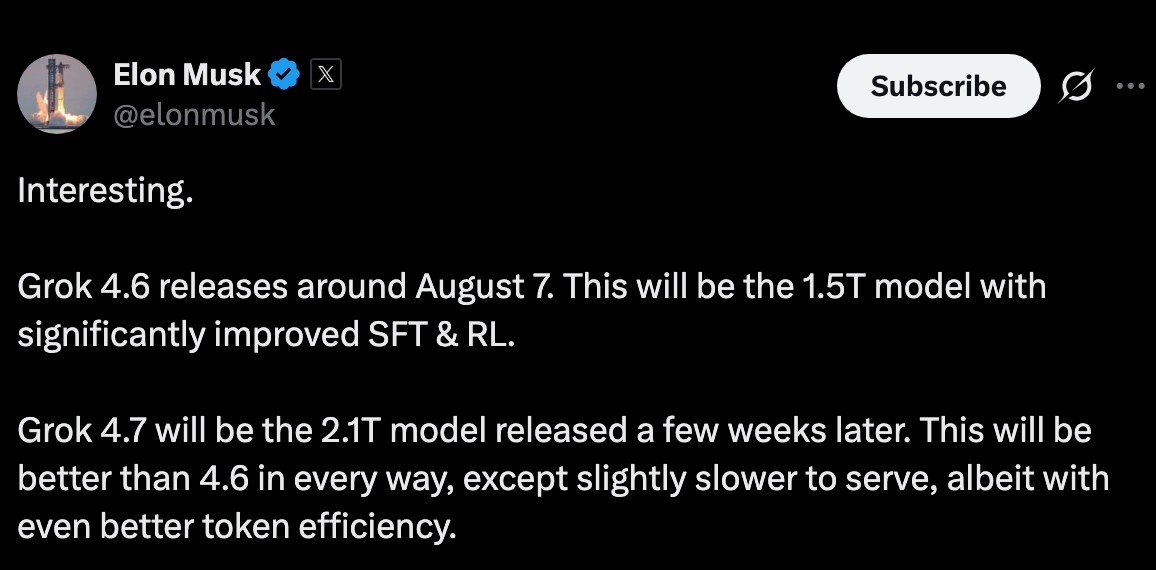
This distinction matters because August 7 was an estimate from Elon Musk, not an official xAI release date. His original X post said Grok 4.6 would release “around August 7.”
A newer update came on August 4, during SpaceX’s Q2 2026 earnings call. Musk said Grok 4.6 was coming out “probably next week,” while Grok 4.7 was expected three to four weeks later.
Based on that latest timeline, August 10–16 is currently the most reasonable release window for Grok 4.6. However, as of August 10, xAI’s official release notes still do not list Grok 4.6, so this should be treated as an estimate rather than a confirmed launch date.
For developers, the current status is:
| Question | Status as of Aug. 10, 2026 |
|---|---|
| Has Grok 4.6 officially launched? | Not publicly documented |
| API model ID | Not published |
| API pricing | Not published |
| Context window | Not published |
| Official benchmarks | Not published |
| Current expected window | Likely Aug. 10–16 |
Until xAI publishes a model page or release note, any exact API ID, price, or benchmark attributed to Grok 4.6 should be treated as unverified.
When Is Grok 4.6 Expected to Be Released?
The release timeline has changed.
Musk initially wrote on X that:
“Grok 4.6 releases around August 7.”
In the same post, he described it as a 1.5T model with significantly improved SFT and RL.
A newer update came during SpaceX's Q2 2026 earnings call on August 4. Musk said Grok 4.5 had been a major improvement and that Grok 4.6 was coming out “probably next week.” He also said Grok 4.7 was about three or four weeks away at that point.
Based on the newer statement, our current estimate is:
Expected Grok 4.6 release window: August 10–16, 2026
This is an inference from Musk's latest public timeline, not a confirmed launch date from xAI.
That distinction is useful because some third-party pages already treat August 7 as a confirmed launch date. Developers should instead watch xAI's official release notes and model documentation for confirmation.
What Do We Know About Grok 4.6?
Official details are still limited, but several things are now on the record.
Musk has described Grok 4.6 as a 1.5-trillion-parameter model, with the main improvements coming from significantly better supervised fine-tuning (SFT) and reinforcement learning (RL).
That suggests Grok 4.6 is primarily a post-training upgrade rather than a major increase in model size. For developers, the more useful question is whether those changes improve coding, tool use, instruction following, agentic workflows, and reasoning efficiency in real workloads.
Grok 4.7 is already on the roadmap
Musk has also described Grok 4.7 as a larger 2.1T model. During the August 4 earnings call, he said it was roughly three to four weeks away.
That rapid release cadence matters for developers: an integration strategy built around one fixed model version can become outdated quickly.
Grok 4.6 vs Grok 4.5: What Could Actually Improve?
The clearest technical detail disclosed so far is the model size. Musk has described Grok 4.6 as a 1.5-trillion-parameter model, with the main improvements coming from significantly better supervised fine-tuning and reinforcement learning. Other developer-facing specifications—including the API model ID, context window, pricing, and reasoning controls—have not yet been officially published.
Until xAI releases the full documentation, Grok 4.5 remains the most useful verified API baseline.
| Specification | Grok 4.6 | Grok 4.5 |
|---|---|---|
| Parameters | 1.5T | 1.5T V9 foundation |
| Release status | Expected | Available |
| API model ID | Not published | grok-4.5 |
| Context window | Not published | 500,000 tokens |
| Input price | Not published | $2 / 1M tokens |
| Cached input | Not published | $0.30 / 1M tokens |
| Output price | Not published | $6 / 1M tokens |
| Reasoning controls | Not published | Supported |
| API access | Not confirmed | Available |
Significantly Improved Writing Quality
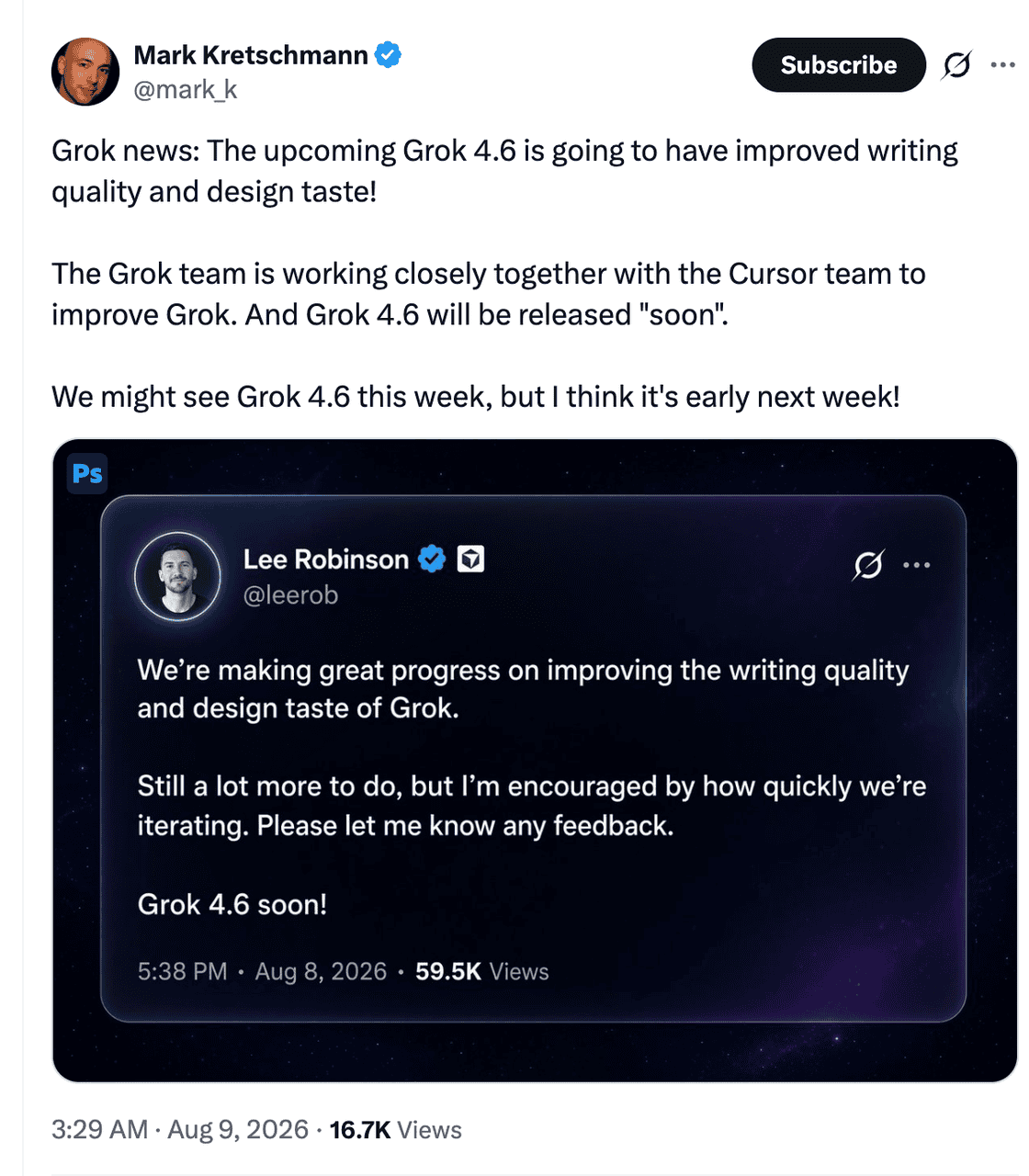
Grok 4.5 already delivered solid performance for coding, agentic work, and knowledge tasks, but user feedback frequently highlighted remaining gaps in natural prose, creative flow, tone judgment, structure, and avoiding over-explanation or formulaic patterns. Grok 4.6 is positioned to address this directly through deeper supervised fine-tuning and reinforcement learning focused on writing quality. Expect more coherent long-form output, better stylistic control, stronger narrative judgment (knowing when to be concise versus expansive), and reduced “AI-sounding” artifacts. Creative and professional writing tasks—stories, explanations, emails, documentation—should feel more polished and human-like without requiring as much prompt engineering or post-editing.
Source: x
Enhanced Design Aesthetics and Taste
One of the more distinctive claims is an upgrade in design taste. This goes beyond pure text generation into better aesthetic judgment—whether for UI/UX suggestions, visual descriptions, layout recommendations, creative briefs, or even code that produces more pleasing interfaces. Grok 4.5 could handle functional design-related queries, but 4.6 is expected to show refined “taste”: more elegant defaults, stronger sense of hierarchy and visual balance, and outputs that feel intentionally designed rather than generically competent. Collaboration signals with the Cursor team further support improvements in the practical intersection of code and design sensibility.
Improved Parameters via Advanced Post-Training
Rather than a raw parameter count increase (Grok 4.6 reuses the same ~1.5T V9-scale foundation as 4.5), the gains come from significantly stronger supervised fine-tuning and reinforcement learning. This effectively improves how the existing capacity is utilized—better reasoning reliability, stronger agentic tool use, improved long-context memory handling, and sharper math/coding performance. The result should be a noticeable capability jump in real-world usefulness without the usual trade-offs of a larger base model. In practice this means more consistent multi-step planning, fewer instruction drifts, and higher-quality outputs across complex workflows.
Price Expected to Remain Unchanged
Despite the targeted improvements in writing, taste, post-training quality, and efficiency, pricing is anticipated to stay in line with Grok 4.5 levels. This keeps the model positioned as a high-value option relative to larger or more expensive frontier alternatives—delivering meaningful quality and capability gains without a corresponding price hike. The combination of same-scale architecture plus refined training makes this outcome realistic. Grok 4.5 costs $2 per 1M input tokens, $0.30 per 1M cached input tokens, and $6 per 1M output tokens
There are no official Grok 4.6 benchmark results yet, so predicting exact scores would add more speculation than value.
Grok 4.5 gives us a better reference point.
xAI reported Grok 4.5 scores of 64.7% on SWE-Bench Pro, 53% on DeepSWE 1.1, 83.3% on Terminal-Bench 2.1, and 29.0% on SWE Marathon. It is served at around 80 tokens per second, and xAI reported substantially lower output-token usage than Claude Opus 4.8 on its SWE-Bench Pro evaluation.
Those results also show why one benchmark should not decide whether to switch models. Grok 4.5 is strong on some engineering evaluations but does not lead every test.
If improved SFT and RL are the main changes in Grok 4.6, the more meaningful gains may appear in:
- task completion rate;
- instruction following;
- tool use;
- error recovery;
- output efficiency;
- reliability on longer agent workflows.
Those are exactly the areas worth testing on your own application once API access becomes available.
Alternatives to grok 4.6 while waiting
While waiting for Grok 4.6 (still in post-training as of August 10, 2026, with 4.5 remaining the current public model), you have strong alternatives for coding, agentic work, reasoning, and knowledge tasks.
Stick with Grok 4.5 for now
Grok 4.5 continues to deliver competitive real-world engineering performance, high token efficiency, fast inference (~80 tokens/sec), and strong cost-performance (roughly $2 input / $6 output per million tokens). It remains available via the xAI API, Grok Build, Cursor, and other integrations. Use it for ongoing coding, multi-step agent workflows, and office-style tasks until 4.6 ships.
Use CometAPI for seamless access to other frontier models
CometAPI is a unified API aggregator that gives you one OpenAI-compatible endpoint and a single API key to reach 500+ models from multiple providers. You change only the base URL (https://api.cometapi.com/v1) and model name—existing OpenAI SDK code continues to work with almost no changes.
Key assistance CometAPI provides while you wait:
- Instant switching between top models without managing separate accounts, keys, or rate limits.
- Competitive pricing (typically 20–40% below official rates, pay-as-you-go, no monthly fees).
- Broad coverage of the current frontier, including the models you mentioned and more.
- Support for chat completions, tool/function calling, long context, multimodal inputs in many cases, and easy A/B comparison of outputs.
- Real-time availability of newly released models so you stay current without waiting on individual provider integrations.
Alternatives to grok 4.6 models accessible through CometAPI include:
- GPT-5.6 series (OpenAI) — Flagship tiers such as GPT-5.6 Sol for complex reasoning and coding, plus more balanced Terra and high-volume/cost-efficient Luna variants.
- Claude Opus 5 (Anthropic) — Strong agentic coding, long-context reasoning, and high intelligence-index performance at a mid-flagship price point.
- Kimi K3 (Moonshot AI) — Flagship with very large context (up to 1M tokens), strong coding and end-to-end knowledge-work capabilities; competitive on several independent evaluations.
- Additional strong options such as Claude Sonnet 5 / Fable 5, various Gemini 3.x models, Qwen3.8 Max, DeepSeek variants, and even current Grok models where available.
This setup lets you route different workloads (e.g., heavy agentic coding to Claude Opus 5 or Kimi K3, high-volume simpler tasks to a cheaper GPT-5.6 Luna tier, or keep Grok 4.5 for efficiency-sensitive jobs) through one integration. Sign up for a free API key (test credits are typically included), point your client at CometAPI, and swap model IDs as needed.
In short: keep using Grok 4.5 day-to-day, and lean on CometAPI to freely test or productionize GPT-5.6, Claude Opus 5, Kimi K3, and the rest of the current frontier until Grok 4.6 arrives. This combination covers virtually any coding, reasoning, or agentic need without lock-in.
How Should Developers Test Grok 4.6?
The most useful comparison will not be Grok 4.6 versus a leaderboard.
It will be Grok 4.6 versus whatever model is already running in your product.
Before the launch, build a small frozen evaluation set using real production tasks. Around 50–100 representative prompts is enough for an initial comparison if the set includes both normal workloads and cases your current model tends to fail.
Measure four things:
Quality. Use unit tests, schema validation, exact match, human review, or another scoring method appropriate to your application.
Latency. Track time to first token and total response time separately. Compare p50 and p95 rather than relying only on averages.
Reliability. Record timeouts, failed requests, malformed output, tool-call errors, and rate-limit failures.
Cost. Compare cost per successful task, not only the advertised price per million tokens. A model that produces fewer tokens or needs fewer retries can have a very different real cost.
Keeping the same prompts and scoring process across models matters more than running a very large benchmark.
A Practical Grok 4.6 Launch Checklist
When Grok 4.6 appears:
- Confirm the official release in xAI's documentation.
- Copy the real API model ID rather than guessing it.
- Check pricing, context limits, and supported capabilities.
- Run one smoke test before starting a larger evaluation.
- Replay your existing eval set against Grok 4.6 and your production model.
- Compare quality, latency, reliability, and token usage.
- Test only the production features you depend on, such as structured outputs, streaming, or tool calling.
- Roll out gradually rather than replacing your current model immediately.
With Grok 4.7 already expected shortly after 4.6, the reusable evaluation process is likely to matter more than optimizing your application around one particular Grok release.
The Bottom Line
As of August 10, 2026, Grok 4.6 still has no officially documented public API release, model ID, pricing, context window, or benchmark table. xAI's current developer documentation continues to document Grok 4.5 as the latest flagship release.
The most recent timeline comes from Elon Musk's August 4 comments that Grok 4.6 would arrive “probably next week.” Based on that statement, August 10–16 is currently the most reasonable release estimate, but it is not an official date.
What developers can do now is more concrete: establish a baseline with the models already in production, keep a fixed set of real evaluation prompts, and make it easy to add a new model when it actually becomes available.
Then the important question after launch is not simply whether Grok 4.6 scores higher on a benchmark.
It is whether it delivers better quality, latency, reliability, or cost per successful task for your workload.