
TL;DR
Grok 4.7 and Xiaomi MiMo-V2.6 arrived only one day apart, but they represent two different approaches to frontier AI. Grok 4.7 emphasizes a proprietary, tightly integrated agent stack for coding and professional knowledge work, while MiMo-V2.6-Pro combines open weights, a larger context window, native multimodal understanding, and aggressive API pricing.
SpaceXAI positions Grok 4.7 as its frontier model for coding, agentic tasks, and knowledge work with a 500K-token context window and configurable reasoning effort.
Xiaomi positions MiMo-V2.6-Pro as a 1M-context multimodal flagship with open weights and support for text, image, audio, and video understanding.
In short: Grok 4.7 is the more vertically integrated managed-agent product; MiMo-V2.6-Pro gives developers more deployment control and much lower raw token pricing. The best fit depends on the workload rather than one benchmark score.
Key Takeaways
- Grok 4.7 is built for long-horizon coding and professional agents.In SpaceXAI's vendor-published evaluation, it scores 46.3% on CursorBench 4.0, 71.0% on DeepSWE v1.1 at high effort, and 1,657 on AA Briefcase v1.1.
- MiMo-V2.6-Pro is unusually competitive for an open model.Xiaomi publishes the model weights and reports results near proprietary frontier systems on several coding and agent benchmarks, but cross-vendor scores are not directly interchangeable.
- MiMo has the context and multimodal advantage. MiMo-V2.6-Pro supports a 1M-token context window and text, image, audio, and video understanding, versus Grok 4.7's 500K context with text and image input.
- MiMo is substantially cheaper on raw API tokens.Official standard pricing is $0.435/$0.87 per million uncached input/output tokens for MiMo-V2.6-Pro versus $2/$6 for Grok 4.7.
- Deployment architecture is the decisive trade-off.Grok offers the stronger first-party hosted tool stack; MiMo's open weights enable private deployment, custom serving, and deeper infrastructure control.
Grok 4.7 vs MiMo-V2.6-Pro at a Glance
| Dimension | Grok 4.7 | MiMo-V2.6-Pro |
|---|---|---|
| Release | September 21, 2026 | September 22, 2026 |
| Access and control | Proprietary API and managed agent ecosystem | Open weights, self-hosting option, and API access |
| Performance evidence | Provider-reported strength in coding and long-running agent tasks; validate on the same task harness | Provider-reported strength across reasoning, coding, and multimodal tasks; validate on the same task harness |
| Distinctive strengths | First-party tools, managed workflows, and web/X-connected agents | Deployment control, 1M-token context, and text/image/audio/video understanding |
| Context window | 500K tokens | 1M tokens |
| Input modalities | Text and image | Text, image, audio, and video |
| Official standard uncached input / output per 1M tokens | $2 / $6 | $0.435 / $0.87 |
| Reasoning | Low to xHigh | Deep reasoning |
| Open weights | No | No |
| Best fit | Managed coding and agent workflows | Private deployment, multimodal input, and lower raw token cost |
What Is Grok 4.7?
SpaceXAI officially released Grok 4.7 on September 21, 2026 as its most capable model for coding and knowledge work. The launch matters because pre-release reporting had mixed confirmed facts with leaked architectural claims. The final launch documentation does not publish a total or active parameter count, so pre-release parameter estimates should not be treated as official specifications.
According to the official launch post, Grok 4.7 uses a new, larger base model than Grok 4.6 and was trained with a longer reinforcement-learning run weighted toward problems that take many hours to complete.
The models optimize different layers of the stack. Grok 4.7 provides a richer managed environment around the model; MiMo-V2.6-Pro exposes more of the model and deployment layer to developers.
For prompts above 200K tokens, SpaceXAI applies higher-context pricing. The published tier is $4 per million input tokens, $1 per million cached input tokens, and $12 per million output tokens.
Changes in Grok 4.7
The most meaningful change is the training objective, not merely a higher benchmark number. SpaceXAI says its reinforcement-learning mix shifted toward longer, multi-hour tasks, while the model was trained to verify its own work more carefully and to understand the Grok Bot harness natively. That combination targets real agent execution: maintaining state, using tools, checking intermediate work, and staying coherent through long task trajectories.
Grok 4.7 Performance
| SpaceXAI-published benchmark | Grok 4.7 | Grok 4.6 | GPT-5.6 Sol | Fable 5.1 |
|---|---|---|---|---|
| CursorBench 4.0 | 46.3% | 40.4% | 41.7% | 51.8% |
| DeepSWE v1.1 | 71.0%* | 65.2% | 72.7% | 70.0% |
| EEBench | 64.0% | 53.0% | 39.4% | 56.4% |
| AA Briefcase v1.1 | 1,657 | 1,546 | 1,487 | 1,678 |
| Terminal-Bench 4.0 | 38.0% | 20.3% | 37.3% | 57.9% |
| Harvey Legal Agent Benchmark | 19.6% | 15.8% | 2.5% | 6.7% |
| HealthBench Professional | 56.7% | 48.5% | 60.5% | 62.1% |
* SpaceXAI marks Grok 4.7 DeepSWE as high effort. These are vendor-published evaluations and should be interpreted under the documented harness and reasoning settings.
SpaceXAI presents the launch charts as web-native content on the official announcement page; the sourced table above preserves the disclosed benchmark values without substituting a redrawn chart.
What Is Xiaomi MiMo-V2.6?
Xiaomi officially released and open-sourced MiMo-V2.6 on September 22, 2026. The family includes MiMo-V2.6-Pro and MiMo-V2.6-Flash, with a Pro-UltraSpeed serving option for latency-sensitive workloads. For a direct Grok 4.7 comparison, MiMo-V2.6-Pro is the appropriate flagship counterpart.
Xiaomi's official materials separately document open weights, native multimodal input, and API pricing. This combination makes MiMo-V2.6 relevant beyond benchmark leaderboards.
MiMo-V2.6 vs MiMo-V2.5: What was improved?
The architectural headline is not simply a larger checkpoint. Xiaomi's public release focuses heavily on post-training and Live RL. According to the official release notes, Pro and Flash each completed 30 reinforcement-learning steps and together generated roughly 750,000 trajectories; the disclosed RL-stage costs were approximately $2.62 million for Pro and $850,000 for Flash.
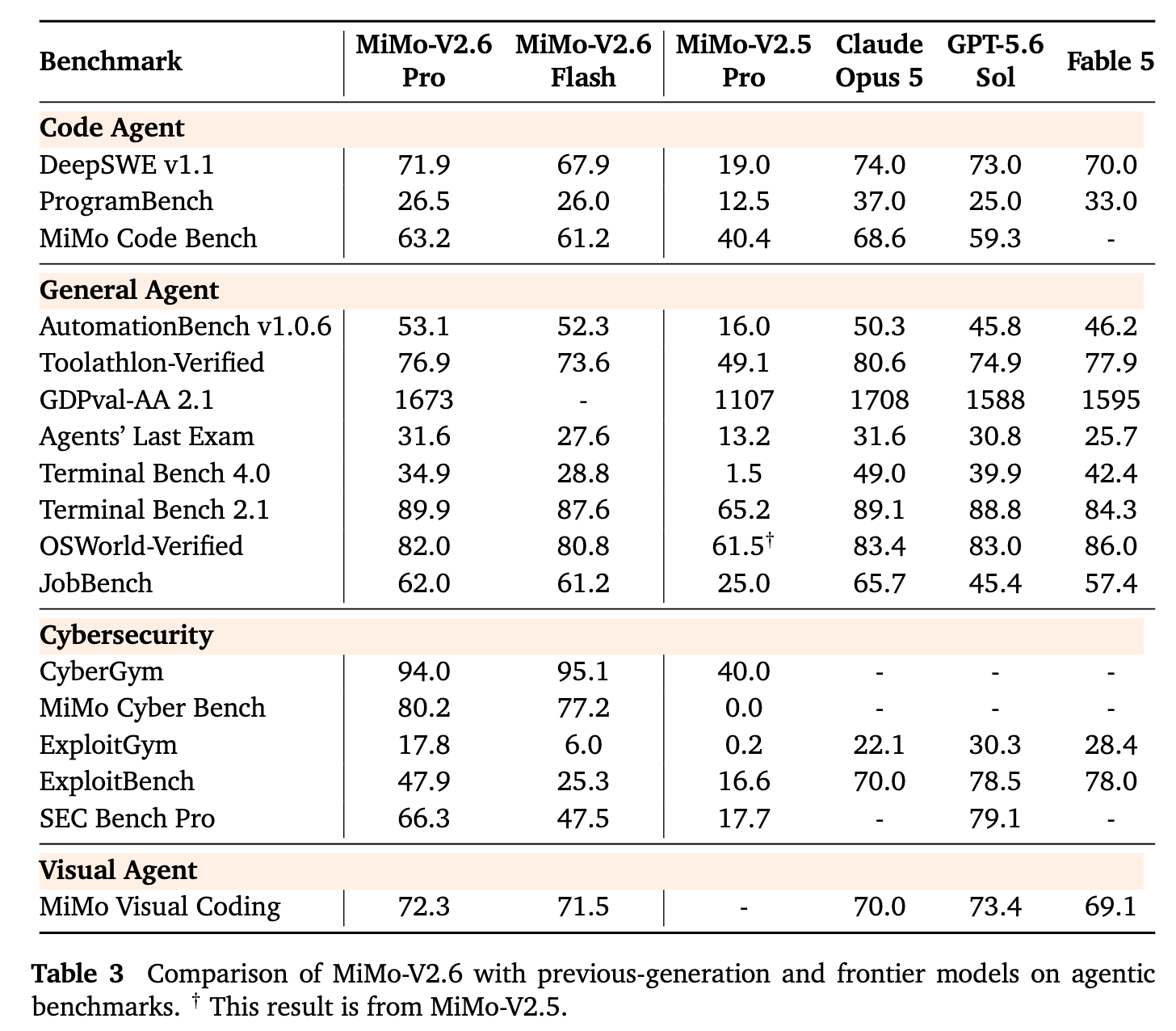
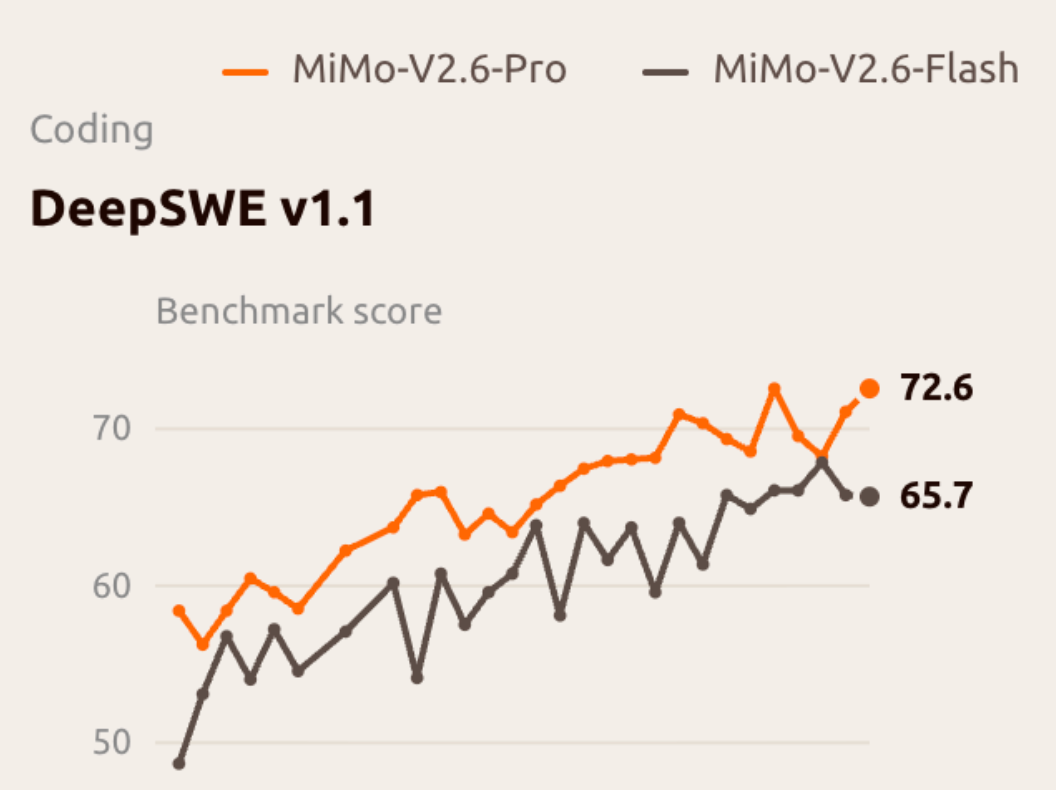
One benchmark detail deserves careful handling: Xiaomi's Live RL curve shows MiMo-V2.6-Pro reaching about 72.6 on DeepSWE v1.1 during the training run, while the final comparison table reports 71.9. These numbers refer to different reported evaluation contexts and should not be silently merged.
Grok 4.7 vs MiMo-V2.6-Pro: Benchmark Comparison
Direct benchmark comparisons require caution. Vendors do not always use identical harnesses, reasoning budgets, checkpoints, or tool configurations. Even when benchmark names match, small score differences can be less meaningful than they appear. The safest comparison is to separate genuinely aligned measurements from directional evidence.
Artificial Analysis Intelligence Index
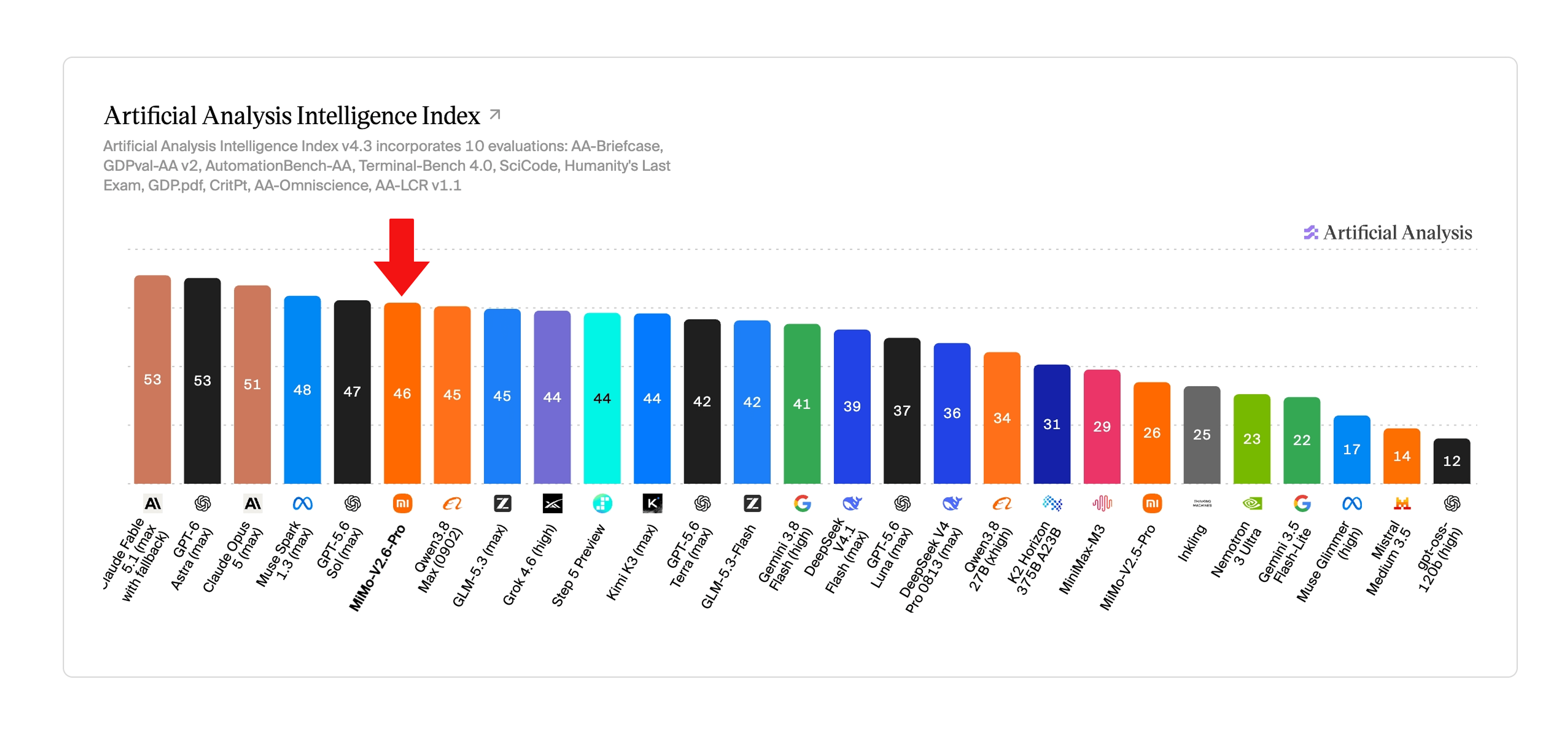
Xiaomi reports 46.32 for MiMo-V2.6-Pro on the Artificial Analysis composite index. Any Grok comparison should be tied to the exact Artificial Analysis snapshot and model configuration used; a rounded equality claim should not be presented without that source.
Coding and Agent Performance
| Benchmark | Grok 4.7 — SpaceXAI | MiMo-V2.6-Pro — Xiaomi | Interpretation |
|---|---|---|---|
| DeepSWE v1.1 | 71.0* | 71.9** | Close numerically; published runs and settings differ |
| GDPval-AA | See SpaceXAI chart | 1,673 | Directional only unless harnesses are aligned |
| AA Briefcase | 1,657 | See Xiaomi chart | Use vendor-reported values with source context |
| Terminal-Bench 4.0 | 38.0 | 34.9 | Similar direction; harness matters |
| Context window | 500K | 1M | MiMo supports more working context |
* SpaceXAI reports Grok 4.7 DeepSWE at high effort. ** Xiaomi's final comparison table reports 71.9; its Live RL training curve reaches roughly 72.6. These figures come from different evaluation contexts.
Coding Workflow Fit
For coding, the distinction depends on whether “coding” means raw repository problem solving or a complete managed coding-agent experience. On DeepSWE v1.1, the published numbers are close enough that a sub-one-point gap should not decide production selection on its own.
Grok 4.7's advantage is higher in the stack. It is integrated with Grok Build, available in Cursor, designed to understand the Grok Bot harness, and paired with first-party code execution and search tools.
MiMo-V2.6-Pro's advantage is lower in the stack. Open weights make it practical to build a private coding assistant, customize serving, enforce data-residency controls, or experiment with a proprietary agent harness.
For teams choosing between them, a production A/B test on representative repositories will be more informative than a single public coding benchmark.
Grok 4.7 vs MiMo-V2.6-Pro: Multimodal Capability Differences
This is one of the clearest differences. Grok 4.7 accepts text and image inputs and produces text. The wider Grok platform offers separate media products, but those should not be conflated with the modality surface of the grok-4.7 model itself.
MiMo-V2.6-Pro supports text, image, audio, and video understanding. Combined with a 1M-token context window, this expands the range of workflows that can be handled in one model context.
- Screenshot and code analysis in the same task
- Video understanding with accompanying instructions
- Long-form audio processing
- Computer-use agents with visual feedback
- Multimodal research assistants
- Large-scale multimodal extraction and QA
Grok 4.7 vs MiMo-V2.6-Pro: API Pricing Comparison
| Official API pricing | Grok 4.7 | MiMo-V2.6-Pro |
|---|---|---|
| Input / 1M tokens | $2.00 | $0.435 |
| Cached input / 1M | $0.50 | $0.0036 |
| Output / 1M | $6.00 | $0.87 |
| Long-context surcharge | Yes, above 200K prompt tokens | No comparable standard tier published |
| Open-weight/self-host option | No | Yes |
At sticker price, MiMo-V2.6-Pro is several times cheaper on both normal input and generated output, with an especially large difference for cached context. That can materially affect the economics of agents that repeatedly process repositories, long documents, or persistent context.
Important pricing note: Grok 4.7's 500K context window does not mean the entire context is billed at the standard rate. Requests above 200K prompt tokens are charged at the long-context tier.
As of September 24, 2026, CometAPI lists Grok 4.7 at $1.60 input and $4.80 output per 1M tokens, versus the official $2.00 and $6.00. It lists MiMo-V2.6-Pro at $0.348 input and $0.696 output, versus the official $0.435 and $0.87. Those listed standard rates are 20% below the corresponding official rates. Prices and eligibility can change; confirm the live model pages before budgeting.
Token price is not identical to cost per completed task. Reasoning models can consume different token volumes, use different numbers of tool calls, and require different retry rates. Production evaluation should therefore track completed-task cost, latency, and success rate together.
Grok 4.7 vs MiMo-V2.6-Pro: Access and Availability
The access difference is straightforward: Grok 4.7 is available through the API and managed Grok workflows, while its model weights are not offered for self-hosting. MiMo-V2.6-Pro is available through the API and as open weights, giving teams an additional self-hosted route.
Availability is separate from licensing or deployment flexibility. As of September 24, 2026, both models also have live CometAPI catalog pages. Teams should confirm the endpoint, region, rate limits, and account eligibility before production rollout; a listed model does not guarantee identical availability or service levels for every account.
| Availability question | Grok 4.7 | MiMo-V2.6-Pro |
|---|---|---|
| Official API | Available through xAI | Available through Xiaomi MiMo |
| CometAPI catalog | Listed as available | Listed as available |
| Self-hosted weights | Not available | Open-weight option |
| Operational check | Confirm account access, region, rate limits, and tool availability | Confirm account access, endpoint readiness, and self-hosting requirements |
Open Weights and Proprietary Access
MiMo-V2.6-Pro being open-weight changes the comparison more than a one-point benchmark gap. It creates options for private deployment, inference-engine tuning, custom post-training, data-residency controls, and deeper infrastructure integration.
Grok 4.7 takes the opposite trade-off: less control over the model internals in exchange for a managed, continuously operated service and a tightly integrated first-party ecosystem. For many organizations, governance and infrastructure requirements will determine the shortlist before benchmark performance does.
How to Use Grok 4.7 and MiMo V2.6 APIs in CometAPI
Developers can access Grok 4.7 API in CometAPI through unified API workflow, reducing the need to maintain separate provider-specific integrations.
For teams benchmarking multiple frontier models, a unified API layer is especially useful because the same production prompts, test harness, token accounting, and application code can be replayed across models with fewer integration variables.
CometAPI now lists MiMo-V2.6-Pro as available, with API availability confirmed on September 22, 2026. Check the live catalog and account access before production use.
With both model pages now listed as available, an application-level A/B test can keep prompts, tools, reasoning settings, and success criteria as consistent as possible, then compare task completion, latency, token usage, and failure modes.
Grok 4.7 vs MiMo-V2.6-Pro: Model Fit by Use Case
| Requirement | Model fit / evaluation guidance |
|---|---|
| First-party web and X search | Grok 4.7 |
| Managed long-running agents | Grok 4.7 |
| Grok Build / Cursor workflows | Grok 4.7 |
| 1M-token context | MiMo-V2.6-Pro |
| Native audio/video understanding | MiMo-V2.6-Pro |
| Open weights, self-hosting, and model control | MiMo-V2.6-Pro |
| Lowest raw API token cost | MiMo-V2.6-Pro |
| Repository coding | Benchmark both on representative repositories |
| Professional knowledge agents | Benchmark both on production tasks |
The decision should therefore be framed around workload architecture. Grok 4.7 is designed to make a managed agent stack more capable; MiMo-V2.6-Pro is designed to make high-end intelligence cheaper, more multimodal, and more controllable.
Which one should you choose?
Choose Grok 4.7 if you want a managed agent experience with first-party web and X search, native code execution, and less infrastructure to operate. It is the more practical option for teams that value an integrated tool stack and long-running professional or coding workflows.
Choose MiMo-V2.6-Pro if you need open weights, private deployment, a 1M-token context window, native audio and video understanding, or substantially lower raw API pricing. It is the stronger option when deployment control, multimodal coverage, and cost efficiency are the primary constraints.
If the choice is still unclear, run both models on the same representative tasks with identical prompts, tools, reasoning budgets, timeouts, and retry policies. Select the model that delivers the best combination of completion rate, latency, total cost per successful task, and human-review effort.
Conclusion
Grok 4.7 vs MiMo V2.6 is revealing because raw intelligence is no longer the only meaningful differentiator. Both models occupy a similar high-capability band in current public evaluations, yet their product strategies diverge sharply.
Grok 4.7 combines a 500K context window, configurable reasoning, strong long-horizon agent training, and a mature first-party search and execution stack. MiMo-V2.6-Pro combines a 1M context window, native multimodal inputs, open weights, and API pricing far below many proprietary frontier systems.
For developers, the practical question is therefore less “which benchmark score is higher?” and more “where should the intelligence live?” A managed agent ecosystem and an open customizable model stack solve different operational problems. The right choice is the one that best matches the production workload, infrastructure constraints, and cost model.
FAQs
Is Grok 4.7 a 2.1-trillion-parameter model?
A roughly 2.1T figure circulated before release, but the final SpaceXAI Grok 4.7 documentation does not publish total or active parameter counts. The confirmed statement is that Grok 4.7 uses a larger base model than Grok 4.6.
Is MiMo-V2.6 open source?
Xiaomi released MiMo-V2.6 as an open model family with downloadable weights and associated research resources. In production planning, teams should still review the exact model license and redistribution terms for their intended use.
How much does Grok 4.7 vs MiMo-V2.6-Pro cost per completed agent task?
Normalize the task set, prompts, tool permissions, retry policy, and success criteria. Track total input, cached input, reasoning and output tokens, tool calls, latency, retries, and human-review time. Raw token price is only one component of completed-task cost.
How reliable are Grok 4.7 vs MiMo-V2.6-Pro benchmark comparisons?
Use the same repository or task set, agent harness, tools, reasoning budget, timeout, retry policy, and scoring rubric. Report confidence intervals or repeated-run variation, and keep vendor-published figures separate from internal results.
Does Grok 4.7 charge more for long-context prompts?
SpaceXAI documents higher rates once prompt tokens exceed 200K. Because the higher tier applies to the request, teams using large repositories or persistent agent context should model the threshold explicitly.