Hy4 is a strong starting point for financial research and high-volume text generation; GPT-6.1 Terra is a strong starting point for terminal coding and debugging. Both accept text and images and support tool use. The clearest differences are task performance, output capacity, and price: Terra leads the terminal-coding test below, while Hy4 leads the finance and research tests and costs less at the listed CometAPI rates.
Key Takeaways
Choose by workload: Hy4 for research and output-heavy applications; Terra for terminal coding and debugging.
Both offer roughly one-million-token context windows. Terra provides a larger maximum output budget.
Terra leads Terminal-Bench 4.0 by 10.10 percentage points; Tencent’s model leads Finance Agent v2.1 by 8.74 points in Vals AI’s results.
Reviewed for clarity, source attribution and current API terminology.
The CometAPI example of 10M input and 2M output tokens costs $10.672 versus $16.00 at the displayed base rates.
Match the endpoint, tool behavior, and reasoning settings to your application before switching providers.
Specifications, benchmark snapshots, and prices checked on November 6, 2026.
Hy4 vs GPT-6.1 Terra: Specifications and Capabilities
Hy4 combines text and image understanding with reasoning and tool use, including workflows across command-line and graphical interfaces. GPT-6.1 Terra supports visual reasoning, computer use, and writing, with explicit reasoning-effort controls and a larger output budget. The table below compares specifications from Tencent and OpenAI.
Official API Specifications
Both models can work with large document collections and codebases. For long prompts, budget room for the response as well: Tencent lists a 960K maximum input for Hy4. The small difference in advertised context capacity is less useful for selection than how accurately each model uses your material.
Terra offers more room for a long response, with up to 128,000 output tokens versus Hy4’s published 64K limit. This helps when a report or code deliverable must fit into one response. Reasoning tokens also consume Terra’s output budget.
Reasoning Controls
Terra offers six reasoning-effort settings: none, low, medium, high, xhigh, and max, with medium as the default. This gives applications an explicit way to adjust inference effort by task. A classification request and a difficult debugging task need not use the same budget.
Tencent’s launch describes reasoning combined with visual perception and tool use, but does not define an equivalent six-level control in that announcement. Treat reasoning parameters as endpoint-specific: do not copy one provider’s effort setting into another request and assume it has the same meaning.
Hy4 vs GPT-6.1 Terra: Performance
Vals AI provides direct results for both models across coding, finance, legal research, and tax tasks. These scores show where each model is a useful candidate for your workload.
Independent Benchmark Results and Test Conditions
The following Vals Index v2.2 results were checked on November 10, 2026. Higher scores are better.
Vals AI lists temperature 0.9, top_p 1.0, and a 65,536-token output limit for Hy4; Terra uses max reasoning effort and a 128,000-token output limit. These settings differ, so read the results as comparisons of the tested configurations rather than equal-budget runs.
Terra’s lead is larger on terminal tasks than on code generation: 10.10 percentage points on Terminal-Bench 4.0 versus 2.99 points on Vibe Code Bench. That makes debugging and command-line development the clearest places to begin evaluating Terra.
Hy4 leads Finance Agent, Legal Research Bench, and Tax Agent Bench by 8.74, 15.39, and 17.32 percentage points. Research workflows that gather evidence and apply domain rules are therefore promising starting points for Hy4.
The overall gap is 1.19 percentage points, and the published uncertainty intervals overlap.
Tencent’s Hy4 Launch Benchmarks
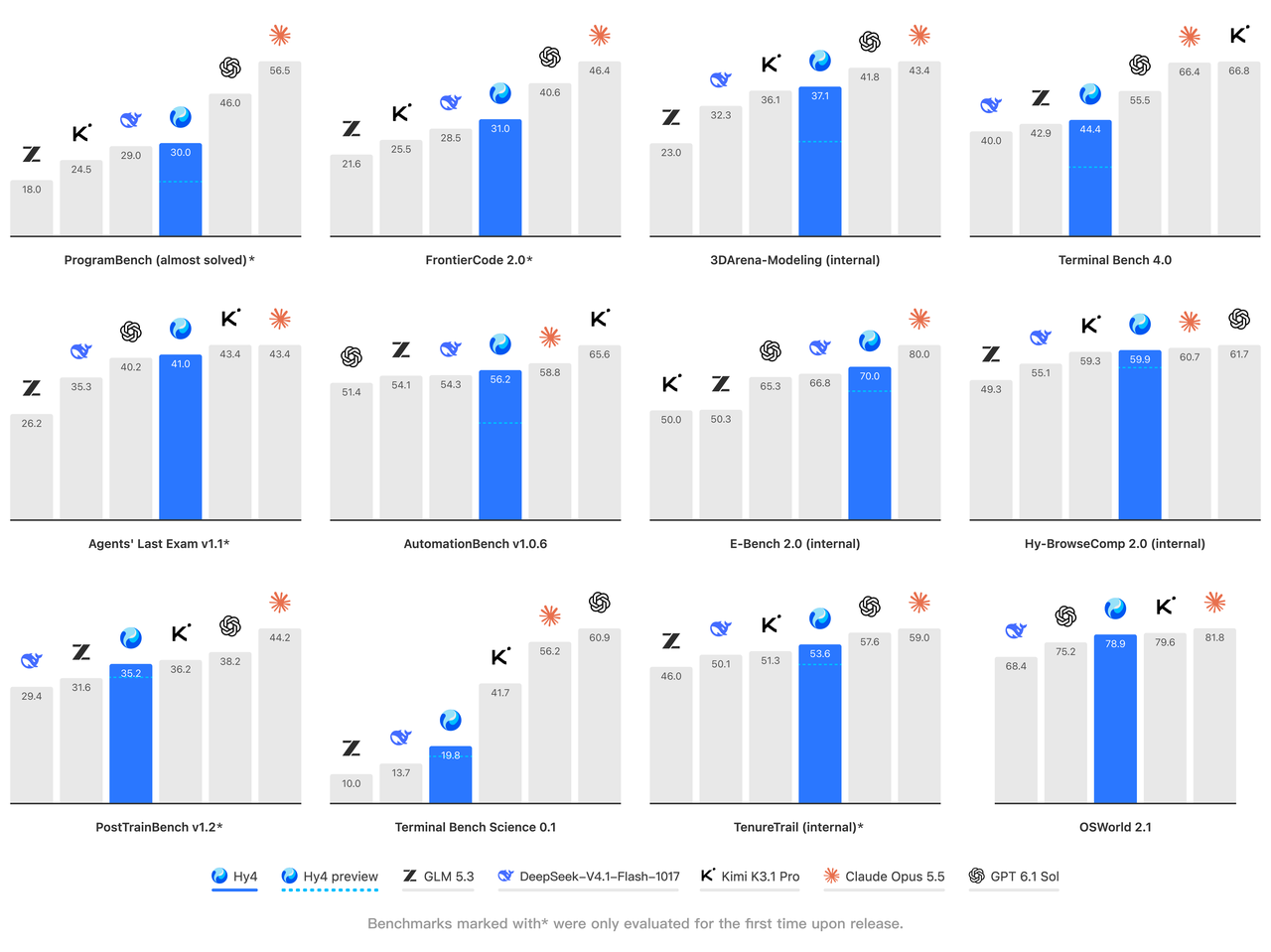
Tencent’s launch chart adds results for coding and computer use. It compares Hy4 with GPT-6.1 Sol; use the Vals AI table above for the direct comparison with GPT-6.1 Terra.
Tencent-reported Hy4 benchmark results, November 2026. The OpenAI model shown is GPT-6.1 Sol.
In Tencent’s launch chart, Hy4 scores 44.4 on Terminal Bench 4.0 and 78.9 on OSWorld 2.1. These figures describe Tencent’s evaluation setup and are separate from the Vals AI scores above.
Vision and Computer-Use Workflows
Tencent introduces image understanding in the official release and describes training for workflows spanning command-line tools, graphical interfaces, Blender, and CAD. This makes chart analysis and visual software tasks central to its positioning.
OpenAI positions its model for screen-based workflows, concise writing, and scoped code fixes. For a catalog application, test product-photo matching; for technical work, use drawings with small labels and measurements; for desktop automation, verify the saved files and application state.
A good visual test set should separate reading from acting. First measure whether the model extracts the correct values or identifies the right interface element. Then measure whether the complete workflow reaches the required result without incorrect clicks, missing files, or unnecessary human intervention.
Speed and End-to-End Latency
For chat, the relevant speed measures are how soon the answer begins and how long it takes to finish. For agents, measure the complete task, including tool execution and any repairs.
Compare both models on typical and demanding tasks at your expected concurrency. Track median and tail latency alongside successful completion: a fast response is useful only if it gets the work done.
Hy4 vs GPT-6.1 Terra: Cost
Compare token rates first, then account for the work required to obtain a usable result. The prices below are CometAPI base rates in US dollars per million tokens; they are separate from the cost-per-test figures reported by Vals AI.
CometAPI Input and Output Pricing
Cost item
Hy4 API in CometAPI
GPT-6.1 Terra API in CometAPI
Input per million tokens
$0.6672
$0.80
Output per million tokens
$2.00
$4.00
The table below uses CometAPI’s listed base rates in US dollars per million tokens. Compare input and output separately, then calculate the cost of your typical request.
Example Cost for 10,000 Requests
Consider 10,000 requests, each using 1,000 uncached input tokens and 200 billable output tokens. Across all requests, that is 10 million input tokens and 2 million output tokens. Using the CometAPI base prices above:
Hy4 costs about 33.3% less in this example. This estimate covers uncached input and billable output; add cache, tool, and retry charges when budgeting a complete workflow.
Direct-Provider Billing and Long-Context Requests
For long documents on OpenAI’s direct API, prompts above 272K input tokens trigger 2× input and cache rates and 1.5× output rates for the full request. Apply the billing rules of the service you use; the CometAPI example above uses CometAPI base rates. OpenAI pricing details.
Cost per Accepted Task
An accepted task is one that meets your application's quality and completion checks. Count all attempts, tool use, and review work needed to reach that result, including spending on attempts that fail.
Cost per accepted task = total model, retry, tool, and human-review costs ÷ tasks that pass acceptance checks.
A more expensive call can still be economical if it removes several repair attempts. Conversely, when a lower-cost model meets the quality threshold, paying a higher rate for every task may add little value.
Which Model Should You Choose: Hy4 or GPT-6.1 Terra?
Start with the model whose strengths match your main workload. Use the following choices to build a shortlist, then compare the quality and cost of completed tasks.
When to Choose Hy4
Choose Hy4 first for financial research, legal or tax document analysis, and applications that generate substantial text. Its leads on the three domain benchmarks make it a useful candidate for evidence-heavy research. At the listed CometAPI rates, its output price is half Terra’s, which can make a material difference to high-volume drafting and reporting.
For research work, judge the finished answer by source accuracy, calculations, and coverage of the question. Hy4 is the better fit when it meets those requirements at a lower total cost, including review and retries.
When to Choose GPT-6.1 Terra
Choose GPT-6.1 Terra first for terminal coding, debugging, and code fixes. Its 10.10-point Terminal-Bench lead is the strongest coding signal in this comparison. The larger output budget also makes it worth testing for long reports and substantial code responses.
Judge Terra by whether its patches pass your tests and its deliverables are complete. For visual or desktop work, compare both models on your actual screens, charts, and files, checking the final saved result.
Routing Research and Coding to Different Models
A mixed workload may benefit from using both models. A financial-analysis assistant could use Hy4 for research and report drafting, then call Terra when an analysis script needs debugging:
Send evidence gathering and report drafting to Hy4.
Check citations, source values, and calculations before accepting the report.
Route a failing analysis script to Terra with the code, error output, and expected behavior.
Run the corrected script and apply the same evidence checks before returning the final result.
Use a second model when it improves the final result enough to cover the extra cost and integration work.
Where Can You Access Hy4 and GPT-6.1 Terra?
Official Provider Access
Access Hy4 through Tencent Cloud TokenHub and GPT-6.1 Terra through OpenAI’s API. Use the provider’s documentation for authentication, model IDs, and billing.
CometAPI Access and Tool Compatibility
CometAPI offers both models under the IDs hy4 and gpt-6.1-terra. Its model pages list request examples and pricing for each route: Hy4 and GPT-6.1 Terra.
For tool-enabled applications, verify the selected route’s support for function calls and structured outputs. On OpenAI’s direct API, Terra tool calling requires the Responses API.
How to Test and Roll Out Your Choice
Before changing production traffic, compare the models on representative tasks using the same inputs, tools, and pass criteria. Record successful completions, total cost, and elapsed time, then roll out the stronger route gradually.
Include routine requests and difficult cases that matter to your users.
Check tool arguments, structured outputs, errors, and completion status.
Set retry limits and rollback triggers before sending live traffic.
Conclusion
Choose Hy4 when research quality and lower text-generation costs are your priorities. Choose GPT-6.1 Terra when terminal coding, debugging, and a larger output budget matter most.
For a mixed application, begin with one model per major workload and add a second route where it improves results. The best choice is the one that completes your tasks accurately at a cost you can sustain.
Specification
Hy4 · Tencent Cloud official specifications
GPT-6.1 Terra · OpenAI official specifications
Developer
Tencent
OpenAI
API model ID
hy4
gpt-6.1-terra
Input / output
Text and images / text
Text and images / text
Context window
1024K tokens (Tencent notation)
1,050,000 tokens
Maximum output
64K tokens (Tencent notation)
128,000 tokens
Tool calling
Supported (Function Calling)
Supported; requires Responses API
Structured outputs
Supported
Supported
Main applications
Software engineering, financial analysis, and long-running agent tasks
Visual reasoning, computer use, writing, and scoped code tasks
Benchmark or metric
Hy4: Vals AI results
GPT-6.1 Terra: Vals AI results
Interpretation
Vals Index
59.35% ± 1.08
60.54% ± 0.99
Terra +1.19 percentage points
Terminal-Bench 4.0
39.39%
49.49%
Terra +10.10 points
Vibe Code Bench v1.1
81.01%
84.00%
Terra +2.99 points
Finance Agent v2.1
64.70%
55.96%
Tencent model +8.74 points
Legal Research Bench
41.35%
25.96%
Tencent model +15.39 points
Tax Agent Bench
34.40%
17.08%
Tencent model +17.32 points
Hy4 vs GPT-6.1 Terra: Benchmarks, API Pricing, and Which Model to Choose - CometAPI