
TL;DR: Google released Gemini 4 Neon on November 18, 2026, for complex coding, analytical reasoning, and enterprise workflows. It balances advanced reasoning with efficient task execution. Standard API pricing is $3 per million input tokens and $15 per million output tokens, with CometAPI offering 20% lower rates.
Key Takeaways
- Multimodal understanding: Accepts text, images, audio, video, and PDFs; generates text.
- Large context: Supports a unified 1M-token context window and up to 64K output tokens in standard synchronous requests.
- Adjustable reasoning: Offers four thinking levels, from
lowtoxhigh, withhighas the default. - Agent capabilities: Supports function calling, structured outputs, code execution, and search.
- Access options: Available through supported Google products and CometAPI.
What Is Gemini 4 Neon?
Gemini 4 Neon is Google’s AI model for complex coding, analytical reasoning, and production-grade enterprise workflows. Adapted from Gemini 4 Carbon, it combines frontier-level reasoning with faster, more cost-efficient task completion, making it a strong candidate for demanding work that runs frequently.
Its capabilities are particularly relevant to workflows that involve extensive context, repeated tool calls, and multiple rounds of verification. Examples include debugging across a code repository, reconciling business documents, and turning research materials into structured reports. Neon is designed to sustain these workflows through execution, feedback, and revision.
Within the Gemini 4 family, Neon sits between Carbon’s focus on the hardest long-horizon projects and Hydrogen’s emphasis on fast everyday execution, balancing reasoning depth with practical efficiency.
Gemini 4 Neon Specifications
The official model documentation and DeepMind model card list the following specifications:
| Specification | Gemini 4 Neon |
|---|---|
| Official model ID | gemini-4-neon |
| Input / output | Text, images, audio, video, and PDFs / Text |
| Unified context window | 1,048,576 tokens |
| Default synchronous output limit | 65,536 tokens |
| Background long-decode output | Up to 1,048,576 tokens |
| Thinking levels | low, medium, high (default), xhigh |
| Context caching | Implicit caching |
| Developer capabilities | Function calling, structured outputs, code execution, file search, and computer use |
| Knowledge cutoff | March 2026 |
The context window and output limit are separate constraints. Standard synchronous requests support up to 64K output tokens. Longer generation requires background long decode, and requests must still satisfy the shared input-output context budget.
What Are the Main Features of Gemini 4 Neon?
Neon’s main capabilities address three recurring problems: understanding large collections of material, carrying tasks through multiple execution steps, and controlling the resources spent on reasoning.
Long-Context and Multimodal Analysis
Gemini 4 Neon can connect evidence across different formats. A financial analysis could combine annual reports, spreadsheet data, charts, and meeting recordings; a software review could compare requirements and interface screenshots with implementation files.
Preserving filenames, dates, and section labels—and requesting source references—makes the resulting analysis easier to verify.
Repository Coding and Long-Running Agents
Neon supports multi-file debugging and refactoring, including tasks that require updating dependencies, adding tests, and correcting failures.
Google highlights reduced redundant file reads, progress reporting, and reliable context compaction during long sessions. In Antigravity, Neon can also coordinate parallel Hydrogen subagents. Official demonstrations include building a WebGL2 ski simulator and interactive 3D environments.
Adjustable Thinking for Cost Control
Neon’s thinking levels let teams allocate reasoning effort by task. The default high setting provides a starting point; lower levels can be evaluated for extraction and formatting, while xhigh targets harder engineering, analytical, and scientific problems.
In the Artificial Analysis evaluation cited by Google, Neon at high achieved a 32% lower cost per task than Carbon.
Tool Use and Enterprise Automation
Neon’s tool capabilities connect analysis with business operations. An invoice workflow, for example, could extract document fields, query a business system, calculate discrepancies, and return structured results for downstream processing.
The model organizes and interprets the work, while connected tools perform queries, calculations, and system operations. Reliable integrations therefore require clear tool interfaces and result validation.
Cybersecurity Defense
Google also introduced Gemini 4 Neon for cyber, covering secure code generation, vulnerability discovery, validation, and patching.
Reported results include:
- SEC-bench Pro: 90.5%.
- CWE-Bench v2: 70.7%.
- WebExploitBench v1.2: Approximately 51.3%.
Access to this specialized offering is rolling out to eligible defenders through the Fairwind Program. Organizations evaluating it should use that program’s access process.
How Does Gemini 4 Neon Perform?
The DeepMind model card compares Neon with Claude Opus 5.5 and GPT-6.2 Sol across coding, automation, reasoning, and multimodal tasks. The results support evaluating Neon for demanding business workflows, while also showing where competitors remain strong.
Gemini 4 Neon Benchmark Results
The following selection covers several important model-selection criteria:
| Benchmark | Gemini 4 Neon | Claude Opus 5.5 | GPT-6.2 Sol |
|---|---|---|---|
| Artificial Analysis Index v5.0.1 | 61 | 59 | 57 |
| Terminal-Bench 4.1 | 65.20% | 65.80% | 61.50% |
| AutomationBench | 56.30% | 42.50% | 41.30% |
| HLE-Diamond | 71.30% | 67.90% | 64.00% |
| GraphWalks, 256K–1M, BFS F1 | 95.20% | 66.80% | 80.10% |
Source: Google DeepMind’s November 2026 model card. Evaluations use their respective settings and environments; Google identifies Neon’s AA Index score of 61 with the xhigh thinking level.
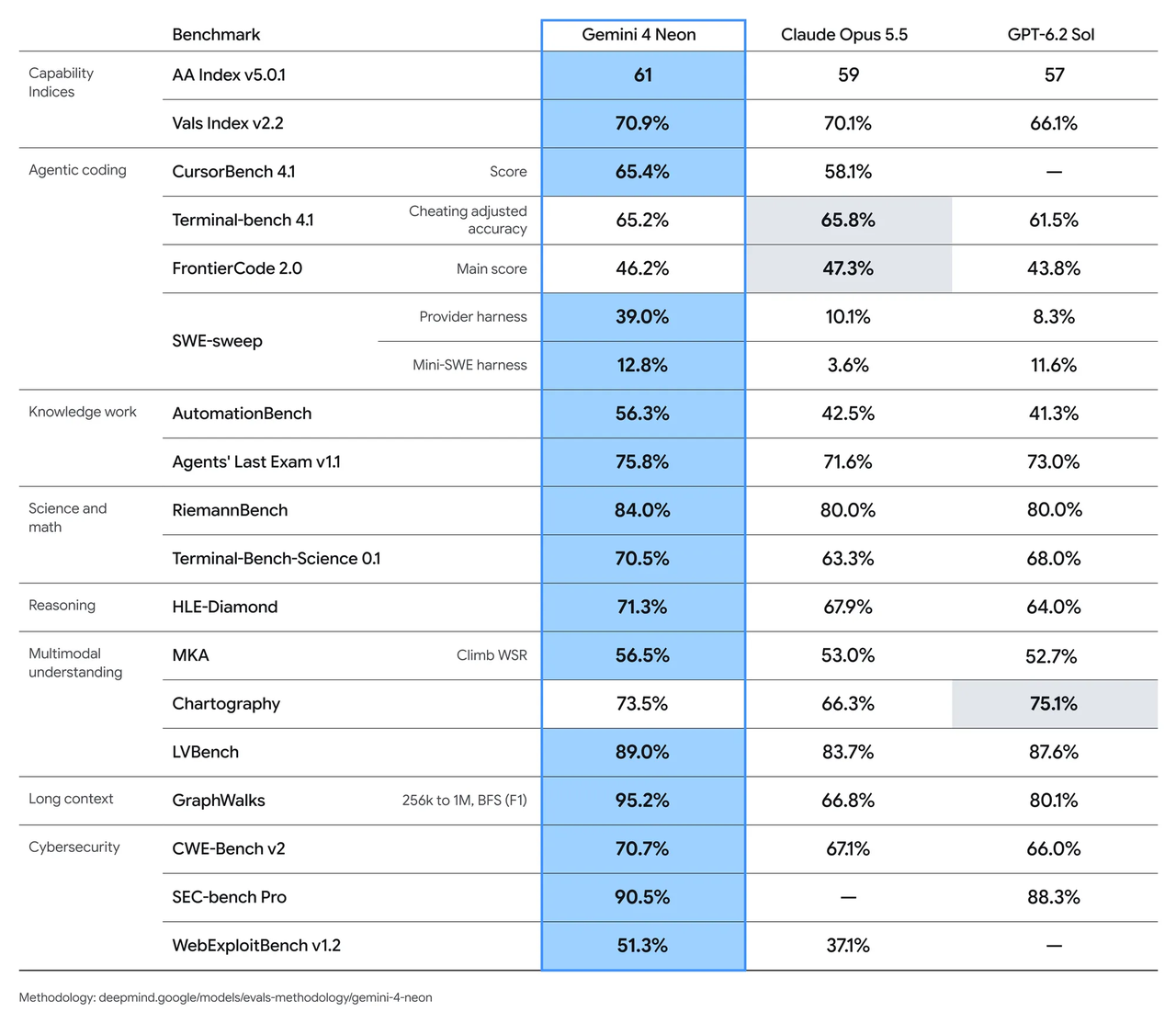
Gemini 4 Neon’s strongest results in this selection are in automation and long-context reasoning. It scores 56.3% on AutomationBench and 95.2% on GraphWalks, supporting its positioning for complex enterprise and document-heavy workflows. Its Terminal-Bench 4.1 score of 65.2% also places it close to the leading result in this comparison, making repository coding another relevant use case to evaluate.
What the Results Mean for Model Selection
Neon leads this comparison in automation, reasoning, and long-context performance, while its Terminal-Bench 4.1 score is close to Opus 5.5. These results support evaluating it for enterprise agents, document-heavy analysis, and repository coding.
The agent environment also matters: on SWE-sweep, Neon scores 12.8% with the mini-SWE harness and 39.0% in Google Antigravity. For a practical comparison, keep tools and acceptance criteria consistent, then measure completion quality, execution time, review effort, and total cost.
Gemini 4 Neon Pricing
Gemini 4 Neon uses token-based API billing. Developers should account for input, output—including thinking tokens—and any additional tool charges.
Standard API Pricing
CometAPI offers Gemini 4 Neon at 20% below Google’s standard token rates:
| Billing Item | Google Official Price | CometAPI Price |
|---|---|---|
| Input, per 1M tokens | $3.00 | $2.40 |
| Output, per 1M tokens | $15.00 | $12.00 |
| Cached input, per 1M tokens | $0.15 | $0.12 |
Google also lists Batch pricing of $1.50 per million input tokens and $7.50 per million output tokens for workloads suited to asynchronous processing.
Example Request Cost
A standard request using 100,000 uncached input tokens and 10,000 billable output tokens, including thinking tokens, costs $0.45 through Google or $0.36 through CometAPI.
Tool charges apply separately. For multi-step agents, include every request in the workflow when calculating the total cost.
How to Access Gemini 4 Neon
The appropriate access route depends on whether you want an interactive assistant, a coding environment, or an API integration. Google provides several product channels, while CometAPI offers a shared interface for working with multiple model providers.
Access Through CometAPI
CometAPI is a convenient option for developers who want centralized Gemini 4 Neon access, API keys, and billing.
To get started:
- Sign in to CometAPI and create an API key.
- Select Gemini 4 Neon in the model list and confirm its model identifier.
- Configure your application using the platform’s endpoint and documentation.
- Test a representative task and review its response and usage.
For OpenAI-compatible integrations, CometAPI uses the base URL https://api.cometapi.com/v1. Teams already using other models through CometAPI can evaluate Neon within the same integration.
Access Through Google Products
Developers can test Neon in Google AI Studio and integrate it through the paid Gemini API using the model ID gemini-4-neon. Google AI Pro and Ultra subscribers can select it in Gemini for research and document work, or in Antigravity for coding and agents. Enterprise access is also available through Gemini for business.
Who Should Use Gemini 4 Neon?
Gemini 4 Neon is a strong candidate for teams whose recurring tasks require both deep reasoning and efficient execution. It is especially relevant to:
- Development teams working across repositories: Consider Neon when changes span multiple files, require repeated testing, or involve debugging unfamiliar code.
- Operations teams automating document-heavy processes: Workflows such as invoice reconciliation and exception handling benefit from combining document analysis with business-system tools.
- Researchers comparing extensive source material: Neon is worth evaluating when conclusions depend on connecting evidence across reports, charts, and other inputs.
- Professional services teams preparing reviewed deliverables: Financial analysis and regulatory research are relevant applications when outputs need traceable evidence and expert review.
The strongest fit is a workflow that runs often enough for improvements in completion time, review effort, or cost to accumulate.
FAQ
The following questions address practical access, output, and deployment considerations.
Is Gemini 4 Neon Free?
Google’s Gemini API does not offer a Free Tier for Neon. Gemini app and Antigravity access is available through supported Google AI Pro and Ultra subscriptions. CometAPI provides usage-based API access.
Can Gemini 4 Neon Generate Images or Audio?
Neon accepts image, audio, and video inputs and produces text. Its official documentation does not list image generation, audio generation, or Live API support.
Can Gemini 4 Neon Access Current Information?
It supports Google Search grounding and URL Context for retrieving external information. For time-sensitive research, request source links and publication dates in the response.
Can Gemini 4 Neon Run Locally?
The announced distribution channels provide application and API access. The release materials do not provide downloadable weights or a local deployment package.
Conclusion
Gemini 4 Neon is a strong candidate for teams that need advanced reasoning across frequent, demanding workflows. Its benchmark results support that positioning, while the agent environment can substantially affect coding outcomes.
Start with a workflow your team already understands, then expand if Neon delivers consistent results. Developers can use Google’s supported products or access Neon alongside other leading models through CometAPI.
.