
TL;DR
MiMo-V2.5 is the stronger default for multimodal work, routine agents, and cost-sensitive production. MiMo-V2.5-Pro is the specialist option for difficult reasoning, repository-scale coding, and long-running tool use. Both provide a 1M-token context window and up to 128K output tokens, but Pro uses a much larger language backbone and costs about 3.1× as much for ordinary input and output tokens.
MiMo-V2.5 vs. Pro: Quick Decision
| Specification — official release | MiMo-V2.5 | MiMo-V2.5-Pro | Recommended model | Reason |
|---|---|---|---|---|
| Primary positioning | Omni-modal model and efficient agents | Flagship agent and complex coding | Choose by workload | Omni-modal inputs favor V2.5; sustained difficult text work favors Pro. |
| Architecture | Sparse MoE | Sparse MoE | Choose by workload | Model size alone does not establish a better choice for every task. |
| Total parameters | 310B | 1.02T | Choose by workload | The larger model targets difficult reasoning, but total size is not a task outcome. |
| Activated parameters | 15B | 42B | Choose by workload | Use task completion and cost to decide. |
| LLM layers | 48 | 70 | Choose by workload | Layer count describes architecture, not a universal win. |
| Routed experts | 256 | 384 | Choose by workload | The difference matters only if it improves the target workload. |
| Experts activated per token | 8 | 8 | Either | Both activate eight experts per token. |
| Context window | 1M tokens | 1M tokens | Either | Both advertise a 1M-token window; test effective retrieval. |
| Maximum output | 128K tokens | 128K tokens | Either | Both advertise up to 128K output tokens. |
| Input modalities | Text, image, video, and audio | Text | MiMo-V2.5 | It accepts image, video, and audio input; Pro is text-input focused. |
| Tool calling | Yes | Yes | Choose by workload | Both call tools; test success rate on the actual trajectory. |
| Open weights and license | Yes; MIT | Yes; MIT | Either | Both offer open weights under MIT; serving costs differ. |
The Decisive Difference: Multimodal vs Agent-First
V2.5 natively accepts text, images, video, and audio. Xiaomi pairs the language backbone with a 729M-parameter vision encoder and a 261M-parameter audio encoder, allowing multimodal information to participate directly in the same reasoning workflow.
- Analyze screenshots before calling tools.
- Understand a video and its audio track together.
- Extract information from diagrams and document images.
- Operate visual-interface and multimodal support agents.
- Reason over long video sequences.
V2.5-Pro follows a different design. Xiaomi currently specifies text as the input modality and emphasizes deep reasoning, code development, and long-running tool orchestration.
If the workflow itself contains image, video, or audio input, begin with V2.5. Test Pro when the difficult part is reasoning over text, source code, tools, or a long agent trajectory.
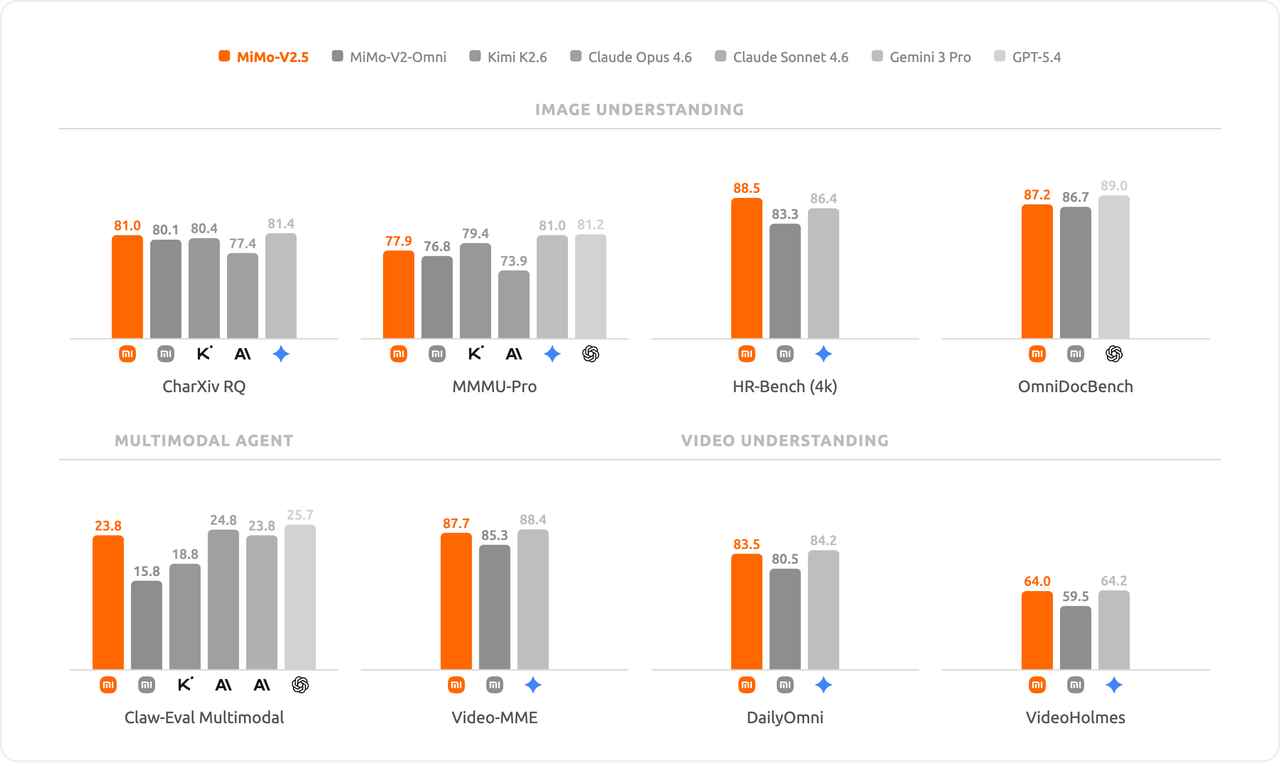
Official Xiaomi multimodal benchmark comparison.
Why V2.5-Pro Can Be Better on Hard Tasks
Model Scale: 310B/15B vs. 1.02T/42B
The two models use sparse Mixture-of-Experts backbones, hybrid sliding-window and global attention, and three Multi-Token Prediction modules. Xiaomi’s V2.5 model card documents a 310B-total, 15B-active backbone; the Pro model card scales this to 1.02T total parameters with 42B activated per token.
| Architecture — official model card | V2.5 | Pro | Difference |
|---|---|---|---|
| Total parameters | 310B | 1.02T | About 3.3× |
| Active parameters | 15B | 42B | 2.8× |
| Hidden size | 4,096 | 6,144 | 1.5× |
| LLM layers | 48 | 70 | 22 more |
| Attention heads | 64 | 128 | 2× |
| Routed experts | 256 | 384 | 1.5× |
| Experts per token | 8 | 8 | Same |
| MTP layers | 3 | 3 | Same |
V2.5 uses a 5:1 attention pattern, while Pro moves to a 6:1 local-to-global pattern. Xiaomi says these designs reduce KV-cache requirements by nearly 6× and 7× respectively compared with full attention throughout the network.
Total parameters do not translate linearly into answer quality. Pro’s larger backbone matters most when reasoning difficulty or trajectory length makes small per-step reliability gains compound.
Why Small Reliability Gains Compound
A long agent task has many dependent steps. An error in an early tool call can force retries or invalidate later work, so a modest gain in per-step reliability may have a larger effect on end-to-end completion. Evaluate that effect on representative tasks rather than assuming model size guarantees it.
Where Does V2.5-Pro Actually Improve?
The cleanest numerical comparison is Xiaomi’s base-model evaluation, where both models appear under the same settings. This avoids combining results produced by unrelated harnesses or post-training configurations.
General Knowledge: Small to Moderate Gains
In Xiaomi’s base-model comparison, Pro gains 1.2 points on BBH, 3.1 on MMLU, and 2.7 on MMLU-Pro. These are measurable but smaller than its gains on harder reasoning tasks.
Mathematics and Science: Larger Gains
Pro gains 8.6 points on GPQA-Diamond, 16.3 on GSM8K, and 18.5 on MATH in the same base-model evaluation. This is the clearest evidence for choosing Pro when difficult reasoning drives task success.
Coding: Better, but Not Uniformly Better
The reported gains are 4.3 points on HumanEval+, 3.2 on MBPP+, 4.1 on LiveCodeBench v6, and 4.9 on SWE-Bench AgentLess. Test repository-level tasks and tool use separately: these base-model scores do not measure every production agent workflow.
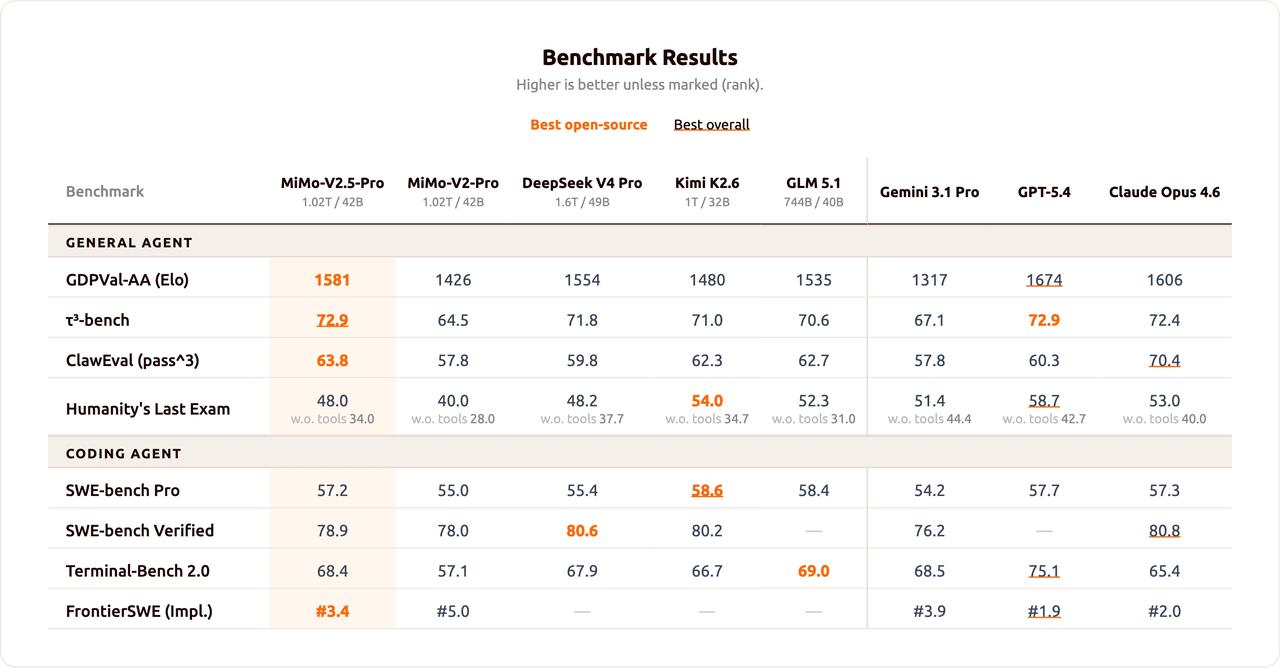
Benchmark result: Pro is not three times better because it costs about three times more. It becomes progressively more valuable as reasoning difficulty and task duration increase.
These rows are base-model evaluations, not a promise that a production API will reproduce the same scores. Agent results depend on tools, prompts, retries, execution environment, and token budgets.
Post-Training and Long-Horizon Agents
The production models add supervised fine-tuning, agentic reinforcement learning, and Multi-Teacher On-Policy Distillation. Xiaomi reports post-training scores of 56.1 on SWE-bench Pro, 65.8 on Terminal-Bench 2.0, and 62.1 Pass³ on the general portion of Claw-Eval for V2.5.
Pro is more explicitly optimized for long-horizon software engineering. Xiaomi describes hundreds of tool calls in sustained trajectories and publishes a 78.9% SWE-bench Verified result.
One official case study shows Pro completing a SysY compiler in 4.3 hours with 672 tool calls and all 233 tests passing. The lesson is not that every coding request needs Pro; it is that small reliability differences can determine whether a workflow with hundreds of dependent actions completes.
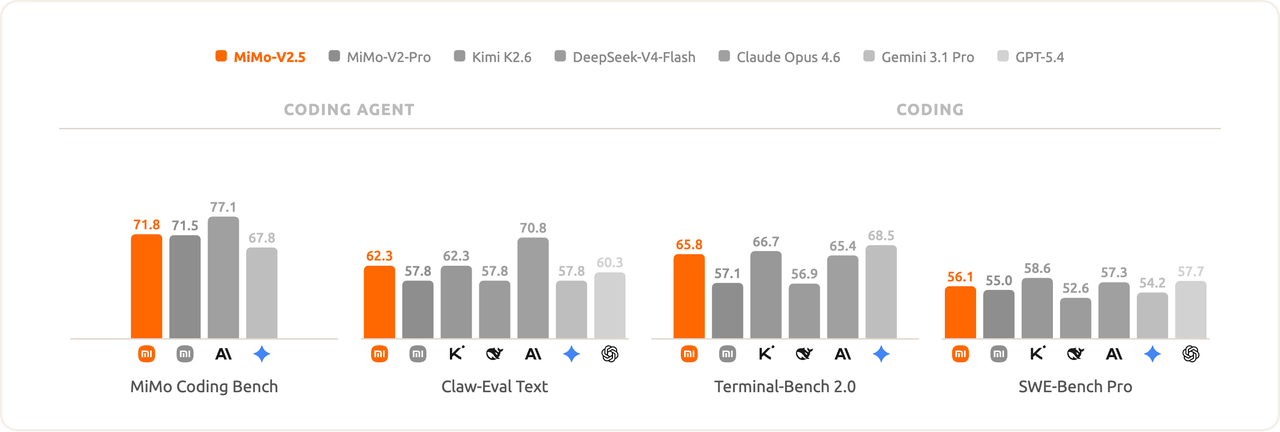
Official Xiaomi coding and agent benchmark figure.
Long Context: Same Capacity, Different Workloads
Both models provide a 1M-token context window and up to 128K output tokens through Xiaomi’s current API. Raw context size therefore does not separate them.
V2.5 is attractive when long context includes multimodal material such as video, document images, or visual agent traces. Pro is the model to test when the context itself becomes the reasoning problem: a large repository, a long contract, a research corpus, or an agent trajectory containing many sequential actions.
A large context window describes capacity, not guaranteed reasoning fidelity. Evaluate retrieval, instruction retention, and evidence use at the lengths that matter to the application.
Price and Cost Efficiency
Xiaomi’s overseas pay-as-you-go prices make the trade-off clear.
| Pricing — official price sheet | V2.5 | Pro | Ratio |
|---|---|---|---|
| Uncached input per 1M tokens | $0.14 | $0.435 | 3.11× |
| Cached input per 1M tokens | $0.0028 | $0.0036 | 1.29× |
| Output per 1M tokens | $0.28 | $0.87 | 3.11× |
| Context window | 1M | 1M | Same |
| Maximum output | 128K | 128K | Same |
A request with 1M uncached input tokens and 200K output tokens costs an estimated $0.196 on V2.5 and $0.609 on Pro before cache hits, web-search charges, or provider-specific billing.
The cache-price difference is smaller: Pro is about 29% more expensive for cache-hit input rather than 211% more expensive. Long-running agents with stable system prompts, tool definitions, or repository prefixes should therefore measure their actual cache-hit rate.
Estimate cost per successful task. A Pro agent that completes a difficult workflow once may cost less than repeated failed attempts on a cheaper model.
Which Model Should You Use?
| Workload — official guidance | Better choice | Why |
|---|---|---|
| Routine text chat | V2.5 | Lower cost; Pro often unnecessary |
| High-volume generation | V2.5 | About 3.1× lower standard token price |
| Image, video, or audio understanding | V2.5 | Native multimodal input |
| Routine tool calling | V2.5 | Strong agent capability at lower cost |
| Difficult mathematics and science | Pro | Larger benchmark gains |
| Repository-scale coding | Pro | Designed for complex software engineering |
| Hundreds of dependent tool calls | Pro | Better fit for sustained execution |
| Cost-sensitive 1M context | V2.5 | Same nominal context at much lower cost |
Selection result: V2.5 is the default for multimodal applications, routine agents, and cost-sensitive workloads. Pro is the upgrade for difficult reasoning, complex software engineering, and long autonomous trajectories.
A Better Production Strategy: Route Between Both
A single global model choice is often unnecessary. Route multimodal and routine requests to V2.5, then escalate only difficult text reasoning, complex coding, or long-horizon execution to Pro.
| Evaluation dimension | Measure | Why it matters | Routing signal |
|---|---|---|---|
| Completion | Successful tasks / attempts | Captures end-to-end reliability | Escalate low-completion classes |
| Quality | Human or rubric score | Prevents token cost from dominating | Escalate high-stakes tasks |
| Tool reliability | Errors and retries | Small errors compound in agents | Escalate long trajectories |
| Latency | Time to accepted result | Includes retry overhead | Keep interactive tasks lightweight |
| Cost | Spend per accepted task | Reflects failures and reruns | Use the cheapest model that succeeds |
Test Both APIs in CometAPI
MiMo-V2.5 API in CometAPI and MiMo-V2.5-Pro API in CometAPI support side-by-side evaluation through one aggregation layer. Send the same prompts, system instructions, tools, and output limits to both models, then compare task success and cost.
import os
from openai import OpenAI

client = OpenAI(
    api_key=os.environ["COMETAPI_KEY"],
    base_url="https://api.cometapi.com/v1",
)

models = ["mimo-v2.5", "mimo-v2.5-pro"]
prompt = """
Review this implementation plan.
Identify hidden technical risks and propose the three highest-priority fixes.
"""

for model in models:
    response = client.chat.completions.create(
        model=model,
        messages=[{"role": "user", "content": prompt}],
        max_tokens=2000,
    )
    print(f"\n--- {model} ---")
    print(response.choices[0].message.content)
Run a representative batch containing straightforward requests, difficult reasoning, code editing, long-context tasks, and agent tool calls. Record completion rate, tokens, latency, tool errors, retries, answer quality, and cost per successful task.
Limitations
V2.5 limitations
The smaller language backbone leaves performance on the table as reasoning difficulty rises. The gap is modest on BBH but becomes much larger on GPQA-Diamond and MATH. A 1M-token context window should also not be confused with guaranteed 1M-token reasoning fidelity.
Pro limitations
Pro’s ordinary input and output prices are about 3.1× those of V2.5, and its text-only input makes it unsuitable as a drop-in replacement for multimodal applications. The 1.02T-parameter open-weight model is also a demanding self-hosting project even though 42B parameters are activated per token.
Final Verdict
Choose V2.5 for multimodal applications, routine agents, and cost-sensitive production. Choose Pro for difficult reasoning, complex software engineering, and long-running autonomous agents. For mixed workloads, route most traffic to V2.5 and escalate only requests whose difficulty or trajectory length justifies the added cost.
FAQ
Is Pro always better than V2.5?
No. Pro is stronger on difficult text reasoning and coding, but V2.5 supports image, video, and audio input and is substantially cheaper.
Do both models support a 1M-token context window?
Yes. Both advertise 1M tokens of context and up to 128K output tokens. Applications should still test retrieval and reasoning at their actual operating lengths.
Which model should a multimodal agent use?
Begin with V2.5 because it natively accepts visual and audio input. Pro currently targets text-input workflows.
When is Pro worth its higher price?
It is most defensible when better reasoning reliability affects completion of difficult mathematics, repository-scale coding, or long trajectories containing many dependent tool calls.
Should production systems use only one model?
Not necessarily. A routing layer can keep routine and multimodal work on V2.5 while escalating difficult text and agent tasks to Pro.