
Short answer
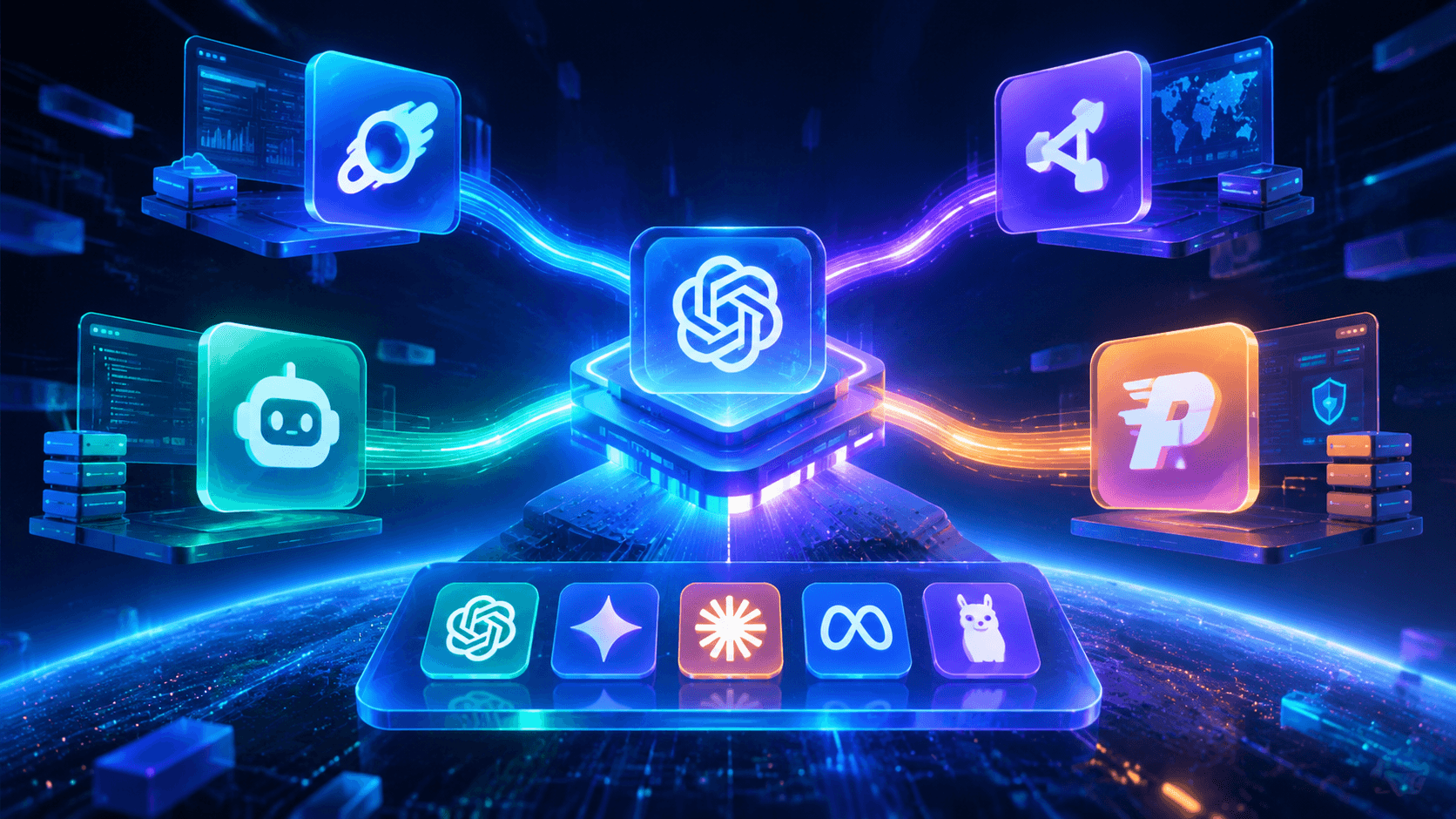
Yes—when the models are exposed through the same compatible endpoint. A multi-model API provider or gateway can give your application one OpenAI-compatible base URL and API key, while the model parameter selects the model. However, changing the model does not guarantee identical support for tools, structured output, reasoning controls, context limits, or modality-specific endpoints. CometAPI is a strong managed choice for one key, unified billing, and access across text and generative media; OpenRouter is especially useful for LLM routing, while LiteLLM and Portkey suit teams that prefer self-hosting or bring-your-own-key governance.
“OpenAI-compatible” does not mean every model behaves identically. Models may share /v1/chat/completions, but tools, structured output, context limits, native controls, and image, audio, or video routes can still differ. An AI gateway usually sits between your application and model providers, while a managed API provider may also provide the underlying model access and billing relationship.
What Is an OpenAI-Compatible Multi-Model API?
A multi-model API gives one application a consistent request format for models from different creators. This solves a common developer problem: separate SDKs, credentials, invoices, rate limits, and response formats make model evaluation slow and production switching risky.
OpenAI compatibility describes the interface, not the company behind every model. A managed provider such as CometAPI can supply model access and consolidated billing, while a gateway such as LiteLLM or Portkey usually routes traffic to accounts that your team already operates. See the unified API versus direct-provider comparison for the architectural trade-offs.
Can One Base URL Really Access Multiple AI Models?
Yes, if the selected models are exposed through the same compatible endpoint. With CometAPI, compatible chat models can use https://api.cometapi.com/v1 and the same API key; the model value selects the underlying model. The live model catalog shows current availability.
The qualification is feature parity. Tool calling, structured output, reasoning parameters, context limits, streaming details, and media generation may require model-specific request fields or separate endpoints. Test the exact model-and-feature combination before treating a model switch as a one-line production change.
Which Multi-Model API Should You Use?
| Provider | Base URL | Billing model | Best for |
|---|---|---|---|
| CometAPI | https://api.cometapi.com/v1 | Managed pay-as-you-go access with one balance | Simple multi-provider and multimodal access |
| OpenRouter | https://openrouter.ai/api/v1 | Underlying model price plus a 5.5% pay-as-you-go platform fee | Broad LLM discovery and provider routing |
| LiteLLM | Your deployment URL | $0 open-source self-hosted tier; Enterprise is quote-based; provider and infrastructure costs are separate | Self-hosting and infrastructure control |
| Portkey | https://api.portkey.ai/v1 | Gateway plan plus connected-provider charges | BYOK observability and governance |
Choose CometAPI for one managed account across text and generative media
CometAPI fits teams that want one key, one balance, and access to models from multiple creators without operating a gateway. It is especially relevant when the roadmap includes image, audio, or video APIs as well as chat.
Choose OpenRouter for LLM discovery and provider-level routing
OpenRouter fits developers who want a broad language-model marketplace, routing across upstream providers, and configurable fallbacks behind an OpenAI-style interface.
Choose LiteLLM for a self-hosted gateway
LiteLLM fits platform teams that want the proxy, keys, policies, and traffic inside their own infrastructure and are prepared to manage deployment and upstream provider accounts.
Choose Portkey for governance over existing provider accounts
Portkey fits production teams that already bring provider keys and need observability, budgets, guardrails, retries, and access controls around those connections.
These options are not priced on the same basis: CometAPI and OpenRouter can fund inference through a platform account, while LiteLLM and Portkey commonly add a gateway layer over separately funded provider accounts.
How the Four Options Differ
Managed API provider: CometAPI
CometAPI combines model access, an OpenAI-compatible route, and unified billing. The service operates the provider layer, so developers mainly manage one account and validate model-specific features.
Hosted LLM marketplace: OpenRouter
OpenRouter focuses on language-model access and upstream-provider routing. Developers can compare routes and use fallbacks without self-hosting the gateway.
Self-hosted proxy: LiteLLM
LiteLLM is software your team can deploy as an internal gateway. It normalizes many provider APIs, while your team remains responsible for infrastructure, credentials, and provider charges.
Governance gateway: Portkey
Portkey adds routing, observability, budgets, guardrails, and enterprise controls around connected provider accounts. Its value is operational control rather than replacing every upstream commercial relationship.
What Matters When Choosing a Multi-Model API?
Endpoint and schema compatibility
Confirm the endpoint, request fields, streaming format, error schema, and SDK behavior for every model you plan to call. OpenAI-compatible chat support does not automatically cover Responses API features, provider-native tools, or media endpoints.
Account and billing ownership
Decide whether you want one managed balance or separate upstream provider accounts. The first reduces account and invoice overhead; the second can provide more direct control over quotas, commercial terms, and provider relationships.
Model and modality coverage
Check the exact model IDs and required modalities, not only the provider count. A product that needs text, image, audio, or video generation has a different integration scope from an LLM-only application.
Routing, reliability, and fallbacks
Evaluate retries, fallback constraints, provider selection, timeouts, and observability. A fallback is only valid when the replacement model supports the same capabilities and output contract.
Governance and operating effort
Compare key management, budgets, logs, privacy controls, data retention, deployment ownership, and on-call work. A self-hosted gateway may provide more control, but its infrastructure and maintenance are part of the total cost.
1. CometAPI — Best for Managed Multi-Model Access
Best for: Developers who want one account for models from several creators without maintaining separate API keys and balances.
Key capabilities: CometAPI documents https://api.cometapi.com/v1 as its OpenAI-compatible base URL. Its catalog spans text, image, video, audio, and multimodal models, while compatible text models can share the same OpenAI client pattern.
Pricing: As of September 9, 2026, pay-as-you-go pricing varies by model and modality. CometAPI lists current rates on each model page; its pricing guide explains the general billing model. Verify the exact model page before estimating production cost.
Pros: One key and balance, broad model and modality coverage, and easier model switching. Cons: Native provider features may arrive later or require a creator-specific endpoint.
Verdict: Choose CometAPI when quick integration, consolidated billing, and access beyond LLMs are more important than managing direct relationships with every model creator.
2. OpenRouter — Best for LLM Routing
Best for: Developers comparing many language models and multiple upstream inference providers.
Key capabilities: OpenRouter exposes https://openrouter.ai/api/v1, supports OpenAI-style chat calls, and provides model and provider routing with fallback options.
Pricing: As of September 9, 2026, OpenRouter lists a 5.5% platform fee for pay-as-you-go accounts. Its official FAQ says inference prices pass through without markup, but each model and upstream route can have a different displayed price. Compare the selected model-and-provider route rather than assuming every route matches a model creator invoice.
Pros: Broad LLM catalog, provider choice, and mature routing controls. Cons: The effective bill includes the platform fee, and model prices, capabilities, and policies still vary by upstream route.
Verdict: Choose OpenRouter when LLM breadth and provider-level routing are the main decision factors.
3. LiteLLM — Best for Self-Hosted Control
Best for: Engineering teams that want an OpenAI-compatible proxy inside their own infrastructure.
Key capabilities: LiteLLM translates OpenAI-style inputs and outputs across more than 100 providers and supports virtual keys, budgets, logging, and fallback policies.
Pricing: As of September 9, 2026, the LiteLLM pricing page lists the self-hosted open-source gateway at $0. Enterprise adds governance, security, support, and SLAs through annual quote-based pricing sized to request capacity, deployment architecture, and support needs. Upstream inference and self-hosting costs remain separate.
Pros: Strong control over deployment, traffic, keys, and data flow. Cons: Your team operates the gateway and still manages upstream accounts, quotas, and invoices.
Verdict: Choose LiteLLM when infrastructure ownership and self-hosting matter more than managed setup.
4. Portkey — Best for BYOK Governance
Best for: Production teams that already use direct provider accounts and need a control layer for AI traffic.
Key capabilities: Portkey exposes https://api.portkey.ai/v1 and adds logs, budgets, retries, fallbacks, load balancing, guardrails, and enterprise controls around connected provider credentials.
Pricing: Portkey offers open-source and hosted plans; inference remains a separate upstream-provider cost when the team brings its own keys. Check the current feature and pricing comparison before deployment.
Pros: Detailed observability, reliability policies, and governance. Cons: Setup and total cost span both Portkey and the connected providers.
Verdict: Choose Portkey when governance over existing provider accounts is more important than buying inference through one managed balance.
How to Switch Models Without Rewriting Your Application
The examples below were checked against the public CometAPI model catalog on September 9, 2026. They illustrate models currently listed with compatible chat access where shown. Prices are a dated snapshot in USD per 1 million input/output tokens and may change; verify the linked model page before deployment.
In code, the key and base URL can remain fixed while model changes. Before production, verify the selected models against the same request contract, then define timeouts and capability-matched fallbacks. The Quick Start documents the base integration, and the fallback guide shows routing patterns. Neither document removes the need to test model-specific tools, reasoning controls, structured outputs, or native parameters.
Model and Endpoint Examples
| CometAPI model ID | Creator | Useful for | Input / output |
|---|---|---|---|
| claude-sonnet-5 | Anthropic | Coding agents and long-context work | $1.60 / $8.00 |
| gemini-3.8-flash | Fast multimodal understanding | $0.60 / $3.00 | |
| grok-4.6 | xAI | Reasoning, coding, and agents | $1.60 / $4.80 |
| qwen3.8-max | Alibaba Qwen | Reasoning and multimodal analysis | $1.60 / $4.80 |
from openai import OpenAI
client = OpenAI(
    base_url="https://api.cometapi.com/v1",
    api_key="YOUR_COMETAPI_KEY",
)

models = [
    "claude-sonnet-5",
    "gemini-3.8-flash",
    "grok-4.6",
    "qwen3.8-max",
]

for model in models:
    response = client.chat.completions.create(
        model=model,
        messages=[
            {"role": "user", "content": "Explain what an API gateway is."}
        ],
    )

    print(model)
    print(response.choices[0].message.content)
CometAPI is no longer limited to text-only LLM routing. Its current API also supports image, video, audio, embeddings, and transcription through the same API surface, although dedicated endpoints may be used for some modalities.
When Changing Only model Is Not Enough
Changing only model is safe only when the destination supports the same endpoint and application contract. Treat compatibility as a feature-by-feature test, not a provider-wide label.
| Capability | Is changing only model usually enough? | What to verify |
|---|---|---|
| Basic text chat | Often | Model availability, request fields, response schema, and token limits |
| Streaming | Often, but not guaranteed | SSE event shape, usage reporting, cancellation, and timeout behavior |
| Tool calling | No guarantee | Tool schema, parallel calls, tool-result format, and finish reasons |
| Structured output | No guarantee | response_format, JSON Schema support, validation, and refusals |
| Reasoning controls | Model-specific | Supported parameters, token accounting, and default behavior |
| Image, audio, or video generation | Usually no | Dedicated endpoint, request body, file handling, and asynchronous task flow |
Build a small contract test for every production model: one normal response, one stream, one tool call, one structured output, and expected error cases. Only include models in a fallback pool after they pass the same required contract.
Pricing and Billing Differences
Last checked: September 9, 2026. Compare total cost rather than a single token rate. The relevant components are model usage, aggregator or gateway fees, infrastructure, observability, support, and the engineering time required to run the integration.
| Option | Primary cost components | Billing implication |
|---|---|---|
| CometAPI | Per-model usage through one managed balance | Consolidates supported model charges in one platform account; verify current model-page rates |
| OpenRouter | Displayed model price plus a 5.5% pay-as-you-go platform fee | Inference prices pass through without markup according to OpenRouter; route prices can differ by provider |
| LiteLLM | $0 open-source license or quote-based Enterprise, plus inference and hosting | Your team pays and operates the upstream accounts and infrastructure |
| Portkey | Gateway plan plus connected-provider usage | Gateway and upstream inference costs remain separate when using BYOK |
A fair cost test uses the same prompts, output limits, caching assumptions, retry policy, and provider route. Token prices alone do not capture duplicate charges from retries, self-hosting labor, or enterprise support.
Production Rollout Checklist
- List the exact models, modalities, and features the application requires.
- Run the same contract tests against every candidate model and provider route.
- Measure time to first token, total latency, error rate, and full cost under the same workload.
- Define fallbacks by capability, not only by model quality or price.
- Set budgets, key scopes, logging, privacy, retention, and incident ownership before production traffic.
Use a native creator API alongside the unified layer when a provider-specific feature, direct commercial agreement, or compliance requirement is essential.
| Your priority | Best option |
|---|---|
| One account + many model providers | CometAPI |
| Claude/Gemini/GPT through one API | CometAPI / OpenRouter |
| Provider routing and fallbacks | OpenRouter |
| Self-hosting | LiteLLM |
| Existing provider keys + governance | Portkey |
| Lowest infrastructure ownership | Managed provider |
| Provider-specific native features | Direct provider API |
| Multimodal API access | CometAPI / OpenRouter, depending on modality |
Frequently Asked Questions
Can the OpenAI SDK call Claude, Gemini, Grok, and Qwen models?
Yes, through a compatible third-party provider or gateway. The official OpenAI endpoint does not serve those creators’ models, but a multi-model service such as CometAPI can expose supported IDs through an OpenAI-style client.
Do I only need to change the model ID?
Usually, when the models share the same endpoint. Tools, streaming, structured output, limits, and provider-specific parameters still require testing.
Does one base URL also cover image, audio, and video generation?
One service domain can cover them, but the endpoints and request bodies may differ. Check the live catalog and the relevant media API documentation instead of sending every modality to Chat Completions.
Is CometAPI a model creator?
No. CometAPI is a third-party API provider that connects developers to models created by Anthropic, Google, xAI, Alibaba, OpenAI, and other companies.
Does OpenAI's API support Claude and Gemini?
No. The official OpenAI API does not become a multi-provider API merely because it uses the OpenAI API format. A third-party provider or gateway must expose those models.
Final Recommendation
Yes, multiple models can share one OpenAI-compatible base URL when the selected models support the same endpoint and request contract. CometAPI is a practical fit for teams that want managed multi-model access, unified billing, and coverage beyond text; OpenRouter is more LLM-routing focused, LiteLLM favors self-hosted control, and Portkey favors governance over existing provider accounts. Keep native APIs for features or commercial requirements that a unified layer cannot reproduce.