
TL;DR
Nano Banana 2.1 is a strong choice for efficient, reference-driven generation and grounded infographic workflows. GPT Image 2.5 Flare is a fast, versatile default; Sunburst targets premium image fidelity and more exacting edits. There is no universal winner: select by task success rate, preservation quality, latency, and total cost per accepted image.
Key Takeaways
- Nano Banana 2.1 combines 1K–4K output and integrated search grounding. Google documents up to 14 input images per prompt; reference composition and provider-specific endpoint limits still apply.
- GPT Image 2.5 offers Flare (everyday creation) and Sunburst (precision-oriented creation and editing).
- Reported human-preference ratings favor GPT Image 2.5, but leaderboard results are time-sensitive and do not replace controlled tests.
- Both providers use token billing. Google also publishes resolution-based per-image equivalents; compare total cost at matched quality.
- For business use, optimize cost per approved image, not simply advertised cost per call.
Nano Banana 2.1 vs GPT Image 2.5 at a Glance
| Decision factor | Nano Banana 2.1 | GPT Image 2.5 Flare | GPT Image 2.5 Sunburst |
|---|---|---|---|
| Where to test first | Reference fusion and grounded infographics | Everyday generation and fast iterations | Precision-focused generation and editing |
| Input / output | Text, image, video, PDF → image and text | Text/image → image | Text/image → image |
| Generation controls | 1K–4K; configurable thinking | Size and quality controls | Size and quality controls |
| Reference workflow | Up to 14 input images per prompt in Google documentation; supported reference mix and route limits must be checked | Multiple references; preservation-focused tests | Premium editing positioning; not tested in cited five-task experiment |
| Official image-output billing | $30/MTok Standard; 1K equivalent $0.0336 | $30/MTok Standard; actual cost depends on usage | $30/MTok Standard; actual cost depends on usage |
| Independent preference scores | 1328 generation / 1428 editing | 1398 generation / 1481 editing | 1425 generation / 1524 editing |
| CometAPI status checked | Available listing | Available listing | Independent route unconfirmed |
| Decision metric | Cost per approved image at required quality | Cost per approved image at required quality | Cost per approved image at required quality |
This summary separates provider specifications from independent preference ratings. Arena scores are Preliminary and reflect the October 6, 2026 snapshot; API status was checked on October 8, 2026. Detailed conditions and sources appear in the sections below.
Nano Banana 2.1 vs GPT Image 2.5 Overview and Specifications
What Is Nano Banana 2.1?
Google's Nano Banana 2.1 is a multimodal image-generation and editing model with 1K, 2K, and 4K output, multi-reference workflows, and Google Search grounding. It emphasizes typography, layout, and iterative consistency for creative production.
Developers can use the Nano Banana 2.1 API in CometAPI with the identifier gemini-nano-banana-2.1.
What Is GPT Image 2.5?
OpenAI announced GPT Image 2.5 on September 8, 2026. Its official launch article describes better lighting, richer textures, improved subject preservation, and up to 50% lower latency compared with the earlier Images 2.0 generation. That improvement is not a head-to-head result against Google.
GPT Image 2.5 Flare is optimized for everyday creation and rapid iterations. GPT Image 2.5 Sunburst is positioned for high-fidelity visual work and fine-grained editing, at longer generation times.
Developers can evaluate the GPT Image 2.5 Flare API in CometAPI and the Sunburst variant using the appropriate model endpoint.
Model Specifications
The Google model specifications document Nano Banana 2.1's supported inputs and token limits. The Flare specifications and and Sunburst specifications describe text/image input, image output and token pricing. Product architecture and parameter counts are not established by these specifications. Information checked on October 8, 2026. describe text/image input, image output and token pricing. The official Nano Banana 2.1 model card confirms that the model is based on Gemini 3.6 Flash. This establishes its model lineage; parameter counts and implementation details should not be inferred from the API specifications. Information checked on October 8, 2026.
| Specification | Nano Banana 2.1 | GPT Image 2.5 Flare | GPT Image 2.5 Sunburst |
|---|---|---|---|
| Developer | OpenAI | OpenAI | |
| Release | Oct. 6, 2026 | Sep. 8, 2026 | Sep. 8, 2026 |
| Model ID | gemini-nano-banana-2.1 | gpt-image-2.5-flare | gpt-image-2.5-sunburst |
| Primary role | Efficient multimodal creation | Fast everyday generation | High-fidelity generation/editing |
| Image dimensions | 1K / 2K / 4K | Custom within API limits | Custom within API limits |
| Reference inputs | Up to 14 input images per prompt; subject to reference mix and endpoint limits | Multiple-image workflows | Multiple-image workflows |
| Search grounding | Native Google grounding | No equivalent native feature stated | No equivalent native feature stated |
| Precision editing | Conversational editing and semantic masking; verify endpoint-specific mask support | Supported | Core emphasis |
| Transparency | Validate by workflow | Supported | Supported |
| Batch processing | Supported | Supported | Supported |
| Input / output | Text, image, video, PDF → image and text | Text/image → image; no audio/video | Text/image → image; no audio/video |
| Input / output token limits | 131,072 input; 32,768 output | No comparable context limit established here | No comparable context limit established here |
| Reasoning controls | minimal, medium (default), high thinking | Image quality controls; no equivalent Gemini thinking levels | Image quality controls; no equivalent Gemini thinking levels |
| Architecture / coding | Based on Gemini 3.6 Flash; parameter count not established here; code execution unsupported | Detailed architecture not disclosed here; image workflow, not a coding model | Detailed architecture not disclosed here; image workflow, not a coding model |
Comparison result: Google offers integrated grounding and extensive multi-reference inputs. OpenAI offers a clearer split between speed-optimized and fidelity-optimized variants.
Nano Banana 2.1 vs GPT Image 2.5: Performance
Official capability claims
Google emphasizes reference fusion, typography and search grounding; OpenAI emphasizes fidelity, localized edits and faster generation relative to its previous generation. These official descriptions identify capabilities and test priorities; they do not establish a controlled cross-vendor quality ranking.
Independent evaluation: Arena and same-prompt testing
Benchmarks answer different questions. Human preference measures perceived output appeal; editing tests measure fidelity to source material; production KPIs measure approved results and financial efficiency. One score cannot substitute for all three.
| Model | Reported text-to-image Elo | Reported image-editing Elo |
|---|---|---|
| GPT Image 2.5 Sunburst | 1,425 | 1,524 |
| GPT Image 2.5 Flare | 1,398 | 1,481 |
| Nano Banana 2.1 | 1,328 | 1,428 |
The table scores were verified against Arena's October 6, 2026 leaderboard snapshot on October 8, 2026. All three entries are marked Preliminary. Sunburst scores 1425 ±7 for text-to-image and 1524 ±5 for single-image editing; Flare scores 1398 ±7 and 1481 ±5; Nano Banana 2.1 scores 1328 ±9 and 1428 ±6. These are third-party human-preference ratings, not vendor-official benchmarks or accuracy percentages.
The Arena text-to-image ratings and Arena single-image-edit ratings measure separate tasks and have separate score scales. Do not subtract the two columns to infer an editing improvement. Ratings depend on sampled prompts, votes and model configurations, and can change as additional votes arrive.
A separate five-prompt editorial experiment judged Flare better in three tasks, Nano Banana 2.1 better in one, and one tie. With only a single generation per task, this cannot establish population-level superiority.
Fuser's original experiment ran on October 6, 2026 using five tasks, one generation per model, no retries and visual inspection. Both nodes called the providers directly. Nano Banana 2.1 used 2K; Flare used auto quality and requested 1536×1024 or 1024×1536 for generation, and 1024×1024 for the square edit. PNG output and task aspect ratios were matched, but pixel dimensions and quality settings were not equivalent. Reference tests used images from FLUX.2 [pro]. Sunburst was not tested; its premium positioning must not be presented as an observed win in this experiment.
Comparison result: The available evidence favors GPT Image 2.5 in some fidelity-sensitive cases, while Nano Banana 2.1 remains attractive for composition and cost. Use statistically meaningful repeated trials for purchasing or deployment decisions.
Realism and Composition
Visual realism should be judged on natural light, textures, anatomy, materials, and coherent composition. The cited five-task third-party experiment compared Nano Banana 2.1 with GPT Image 2.5 Flare: it narrowly preferred Flare for the photorealistic scene and Nano Banana 2.1 for product composition. Sunburst was not included in those five tests. Its premium-fidelity positioning is a product claim, so this experiment cannot establish whether Sunburst is more realistic than either tested model.
Text Rendering and Infographics
Nano Banana 2.1 emphasizes improved typography and complex layout. GPT Image 2.5 can also produce posters and revise embedded text. In the small same-prompt example, both rendered the required poster lettering correctly. For business-critical labels, treat typography as a proofreading and QA requirement rather than an assumed solved problem.
| Visual objective | Nano Banana 2.1 | GPT Image 2.5 | Recommended evaluation |
|---|---|---|---|
| Photorealism | Strong realism and arrangement | Strong lighting and textures | Blind user preference |
| Marketing posters | Typography/layout improvements | High-fidelity compositions | Exact-text correctness |
| Product imagery | Strong object arrangement | Strong reference fidelity | Label and geometry integrity |
| Grounded infographics | Native search support | Requires externally verified facts | Factual accuracy |
| Multi-reference assets | Up to 14 input images per prompt documented by Google; verify the supported mix and provider endpoint | Multiple references | Identity consistency |
Comparison result: Neither vendor provides a definitive official cross-model quality benchmark. Evaluate with repeated samples using matching creative briefs.
Editing and reference-preservation evidence
Nano Banana 2.1 Reference Workflows
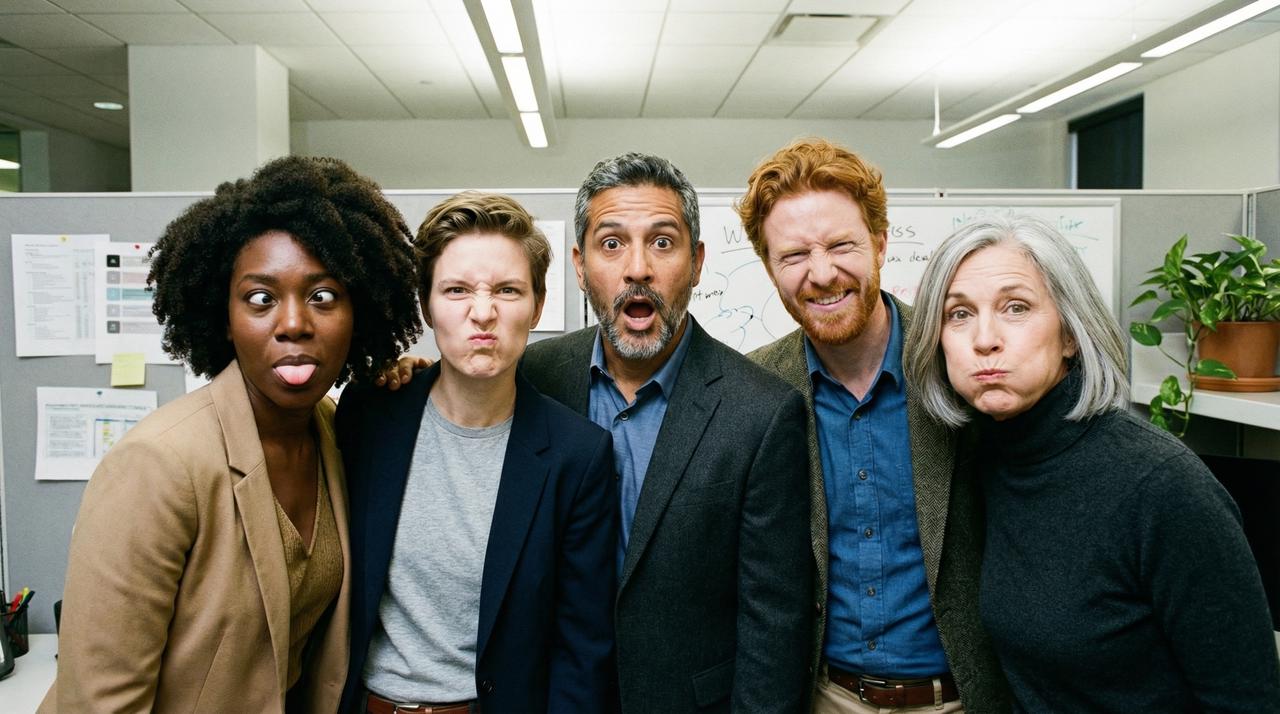
Google's original multi-reference example from its image generation guide shows an office group portrait assembled from reference inputs. Reproduced unchanged with attribution to Google; the guide is licensed CC BY 4.0 except where otherwise noted. This is an official workflow illustration, not a same-prompt comparison with GPT Image 2.5 or a measured quality result.
Nano Banana 2.1 supports multi-image fusion and conversational editing. Google's editing guidance describes semantic masking through instructions, which is distinct from assuming a dedicated binary-mask parameter on every endpoint. Google documents a maximum of 14 input images per prompt. This does not mean that any combination of 14 arbitrary references is supported: its guidance specifies up to 10 object references and up to 4 character references for this model. Check the applicable reference composition and the selected platform or API endpoint before sending a large image set; third-party gateways may impose different limits.
GPT Image 2.5 Editing Workflows
OpenAI emphasizes localized changes and subject preservation. Its image prompting guide encourages specifying both what must change and what must remain unchanged. Sunburst is best evaluated where expensive manual retouching would otherwise be required.
In one five-task comparison, Flare kept a product bottle and its label intact more faithfully during background replacement and better retained a referenced character's visual details. These are observations from a tiny sample, not an independent reproducible benchmark of Sunburst.
| Editing task | Observed or documented advantage | Caution |
|---|---|---|
| Replace background, retain product | GPT Image 2.5 Flare in one third-party test | Single run only |
| Repeated character references | Nano: many references; Flare: good fidelity | Need multiple repeated trials |
| Minor localized edits | GPT Image 2.5 Sunburst positioning | Check actual changed pixels |
| Multi-object visual fusion | Nano Banana 2.1 | Check object consistency |
Generation speed and test conditions
OpenAI states that GPT Image 2.5 cuts latency by up to 50% relative to Images 2.0. This claim does not compare OpenAI directly with Nano Banana 2.1. Flare is designed as the speed-oriented OpenAI variant; Sunburst prioritizes premium quality, with longer processing times.
Nano Banana 2.1 is positioned for efficient generation, but a comparable vendor-neutral latency benchmark has not been established. Test warm and cold requests at identical output sizes; report median, 95th-percentile latency, failure rate, and accepted outputs per minute.
| Speed factor | Nano Banana 2.1 | Flare | Sunburst |
|---|---|---|---|
| Market positioning | Efficiency | Speed | Fidelity |
| Official direct cross-vendor result | Not established | Not established | Not established |
| Recommended metric | Approved images/minute | Approved images/minute | Approved images/minute |
Nano Banana 2.1 vs GPT Image 2.5: Cost
Nano Banana 2.1 Pricing
Google's official Gemini API pricing publishes resolution-based image-output costs. These are output charges before any applicable input, thinking, grounding, retries, or other fees.
| Resolution | Standard/image | Batch/image | 1,000 Standard images |
|---|---|---|---|
| 1K | $0.0336 | $0.0168 | $33.60 |
| 2K | $0.0504 | $0.0252 | $50.40 |
| 4K | $0.1134 (token-derived) | $0.0567 | $113.40 |
At 4K, Google displays approximately $0.113 per output image. Its stated 3780 image tokens at $30 per million imply $0.1134, or $113.40 for 1000 outputs before other fees. The table's 4K Standard estimate uses this token calculation; 1K and 2K equivalents are $0.0336 and $0.0504.
GPT Image 2.5 Pricing
Flare token rates and Sunburst token rates match the table below as checked on October 8, 2026. Text and image inputs have different rates; image output is $30/MTok under Standard processing and $15/MTok under Batch. Actual per-image charges depend on output token usage, quality and size.
| Token category | Flare / Sunburst per 1M tokens |
|---|---|
| Text input | $5.00 |
| Cached text input | $1.25 |
| Image input | $8.00 |
| Cached image input | $2.00 |
| Image output | $30.00 |
| Batch image output | $15.00 |
Cost per accepted image
Do not convert these token rates to a universal per-image charge without a measured token count. High-quality images or reference-heavy editing workflows may have different actual costs.
For production economics, use Cost per accepted image = (all generation + editing + retry costs) / number of approved outputs. An apparently inexpensive image model may lose its advantage if it requires repeated corrections.
CometAPI Billing and Availability
The Nano Banana 2.1 API in CometAPI and GPT Image 2.5 Flare API in CometAPI listings show Available as checked on October 8, 2026. The Sunburst candidate URL redirects to the provider catalog, so its independent CometAPI route is not confirmed here. Confirm its model ID and account access before promising support. Gateway rates differ from provider rates; a displayed input-token price does not establish the image-output charge.
Nano Banana 2.1 vs GPT Image 2.5: Comparison and Selection
Architecture, multimodality, and API availability
The defensible comparison is operational: supported inputs and outputs, per-prompt image limits, thinking or quality controls, API access and measured results. The official model card confirms that Nano Banana 2.1 is based on Gemini 3.6 Flash. Nano Banana 2.1 accepts a broader set of input types, while GPT Image 2.5 produces image output from text/image inputs. The confirmed model lineage does not establish undisclosed parameter counts or justify assumptions about internal implementation. First-party support and CometAPI routing must be verified separately, particularly for Sunburst.
Workload-based selection
| Workflow | Good starting point | Reason |
|---|---|---|
| High-volume social artwork | Nano Banana 2.1 | Efficient and versatile output |
| Everyday creative iterations | GPT Image 2.5 Flare | Speed-oriented model |
| Premium advertising images | GPT Image 2.5 Sunburst | Fidelity and edit precision |
| Search-grounded infographic | Nano Banana 2.1 | Native grounding |
| Sensitive product edits | GPT Image 2.5 Sunburst | Preservation-oriented workflow |
| Brand characters with many references | Nano Banana 2.1 | Multi-image composition with up to 14 input images per prompt on supported Google routes; check the reference mix and gateway limit |
| Transparent-background assets | GPT Image 2.5 | Explicit transparent output controls |
Choose Nano Banana 2.1 for reference-rich creation, cost-sensitive production, and search-grounded content. Choose Flare for fast general creative tasks. Evaluate Sunburst when preserving original visual details matters more than the fastest result.
Where Can You Access Nano Banana 2.1 and GPT Image 2.5?
Choose the original provider for direct model access, or a supported gateway for a shared account and billing workflow. Provider availability and gateway availability are separate; check the exact model variant before choosing a route.
Official Provider Access
For Nano Banana 2.1, the official Google model page links to Google AI Studio for browser-based testing and provides Gemini API documentation for application access. Confirm the model is available to your account and review the applicable usage limits before starting.
For GPT Image 2.5, use the OpenAI API and consult the official documentation for the Flare or Sunburst variant. Choose Flare for faster iteration or evaluate Sunburst for fidelity-sensitive work; account access and rate limits should be checked separately.
CometAPI Access
CometAPI lists Nano Banana 2.1 and GPT Image 2.5 Flare. Open the relevant model page to review its current availability, price and API quickstart, then sign in to create an API key. This provides an alternative access route for comparing the two models through one gateway. Sunburst access through CometAPI has not been confirmed in this article.
To start a comparison, choose an available model, review its pricing and output limits, and try the same prompt and source images with each model. Record generation time, accepted outputs and actual usage cost. Detailed integration instructions belong in the linked API documentation rather than this model comparison.
| Model | API identifier |
|---|---|
| Nano Banana 2.1 | gemini-nano-banana-2.1 |
| GPT Image 2.5 Flare | gpt-image-2.5-flare |
| GPT Image 2.5 Sunburst | gpt-image-2.5-sunburst |
Conclusion
Nano Banana 2.1 is a compelling efficiency-oriented choice for reference fusion, grounded visuals, and scalable content pipelines. GPT Image 2.5 Flare provides broad creative utility, while Sunburst targets the most visually demanding generation and editing tasks. Rather than standardizing blindly on a single vendor, route routine requests to a suitable economical model and reserve premium precision for the outputs that truly benefit from it.
FAQ
How can Nano Banana 2.1 and GPT Image 2.5 be compared fairly?
Separate visual preference from task correctness. Use the same creative brief and references, define acceptable resolution and readable text before generating, then blind-review repeated outputs. Record every attempt, rejection and edit. Where API sizes differ, compare at the final delivery size and disclose any resizing; a one-off favorite does not establish a model-wide advantage.
How should failed image generations affect an API budget?
Count charges from rejected images, editing calls and retries in the numerator, and only approved assets in the denominator. Record failure status and actual billed usage separately because an unsuccessful request may not always be billable. Estimate a range from repeated batches instead of multiplying a headline price by the required number of final images.
Can Google Search grounding guarantee accurate infographic text?
No. Grounding supplies relevant information but does not guarantee every number, label or rendered letter is correct. Verify the source facts before generation and proofread the final image against them. For frequently changing data, preserve the research date and consider placing verified labels in a separate design layer.
Can one integration switch between Nano Banana 2.1 and GPT Image 2.5?
A shared gateway can simplify account management, but request and response schemas still differ. Keep model-specific adapters for references, thinking or quality settings, output size and image decoding. Test a small accepted request for each enabled route and handle sync, URL and async responses explicitly before relying on automatic fallback.