TL;DR: Alibaba released Qwen4-Max on November 16, 2026, as the flagship model of its Qwen4 generation. Official evaluations report better industry-task performance and lower execution costs than Qwen3.8-Max, reflecting improvements in token efficiency and reduced API pricing.
Key Takeaways
- Model size: Qwen4-Max has 2.4 trillion backbone parameters, with 71 billion activated per token.
- Context window: Qwen4-Max supports a one-million-token context window.
- Multimodal support: Qwen4-Max accepts text, images, and video and generates text.
- Developer features: Qwen4-Max supports function calling, structured outputs, context caching, and web search.
- Access options: Users can access Qwen4-Max through supported Qwen applications, the usage-based QwenCloud API, and Token Plan subscriptions.
What Is Qwen4-Max?
In Alibaba's official announcement, Qwen describes Qwen4-Max as an AI teammate for work, creation, and exploration. Its capabilities focus on understanding objectives, operating tools, responding to execution feedback, and delivering results through multiple stages.
For these workflows, the model provides reasoning and coordination. Connected applications, tools, and execution environments carry out the operations.
Qwen4-Max Specifications
The official QwenCloud model page lists the following specifications:
| Specification | Qwen4-Max |
|---|---|
| Model ID | qwen4-max |
| Backbone parameters | 2.4 trillion |
| Activated parameters per token | 71 billion |
| Context window | 1 million tokens |
| Input / output | Text, images, and video / Text |
| Standard mode limits | Maximum input: 991K; maximum output: 131K tokens |
| Thinking mode limits | Maximum input: 983K; maximum output: 262K tokens |
| Maximum reasoning length | 262K tokens |
| Developer capabilities | Function calling, structured outputs, context caching, and web search |
| API compatibility | OpenAI and Anthropic API protocols |
Context size, input limits, and output limits represent different constraints. Applications must satisfy them together and reserve sufficient capacity for generated answers and reasoning.
What Are the Main Features of Qwen4-Max?
Qwen4-Max’s capabilities are particularly relevant when a task spans multiple documents, tools, and execution steps. Long context preserves the working background, visual understanding expands the available evidence, and agent capabilities help move the task toward delivery.
One-Million-Token Context and Native Visual Understanding
The large context window allows related materials to be processed within a shared working context. Practical applications include comparing contracts, analyzing dependencies across code files, and reviewing reports alongside supporting documents.
Native visual understanding extends this to screenshots, diagrams, scanned pages, and video. A user can supply an engineering drawing or interface screenshot and ask the model to interpret it alongside written requirements.
For document-heavy tasks, preserving filenames, dates, and section labels helps organize the evidence and makes the resulting analysis easier to verify.
Coding and Professional Tool Use
Qwen4-Max supports function calling, allowing developers to connect it with databases, search services, file operations, and business systems. Structured outputs help pass model results into subsequent software processes.
Official demonstrations show broader software workflows. In game development, the model uses engines such as Unity, Unreal Engine, and Godot to build scenes, implement gameplay, and refine results through testing. In Blender, it coordinates geometry, materials, lighting, and rendering.
Reproducing these workflows requires the relevant software, assets, and execution permissions. The demonstrations show what the model can accomplish within those environments.
Long-Horizon Agents and Live Delivery
Long tasks become difficult to manage when users cannot inspect progress until completion. Qwen4-Max’s Live Delivery approach introduces an initial usable result followed by successive updates.
For a research assignment, an agent might first deliver preliminary findings and a source list, then expand the analysis and add charts. Users can review each version and redirect subsequent work.
Qwen also released the Qwen-Live-Delivery-Plugin. For workflows lasting hours or longer, staged delivery creates practical checkpoints for reviewing quality and correcting direction.
Architecture and Token Efficiency
Qwen4-Max introduces several changes to its sparse mixture-of-experts architecture:
- Gated DeltaNet and Qwen Sparse Attention: Combine historical information compression with selective attention to relevant context, reducing long-sequence computation.
- Gated Residual: Uses four parallel residual branches and dynamic gates to improve information transfer and training stability.
- N-gram Embedding: Adds 328 billion embedding parameters to represent local token patterns through lookup operations, expanding capacity with relatively low additional computation.
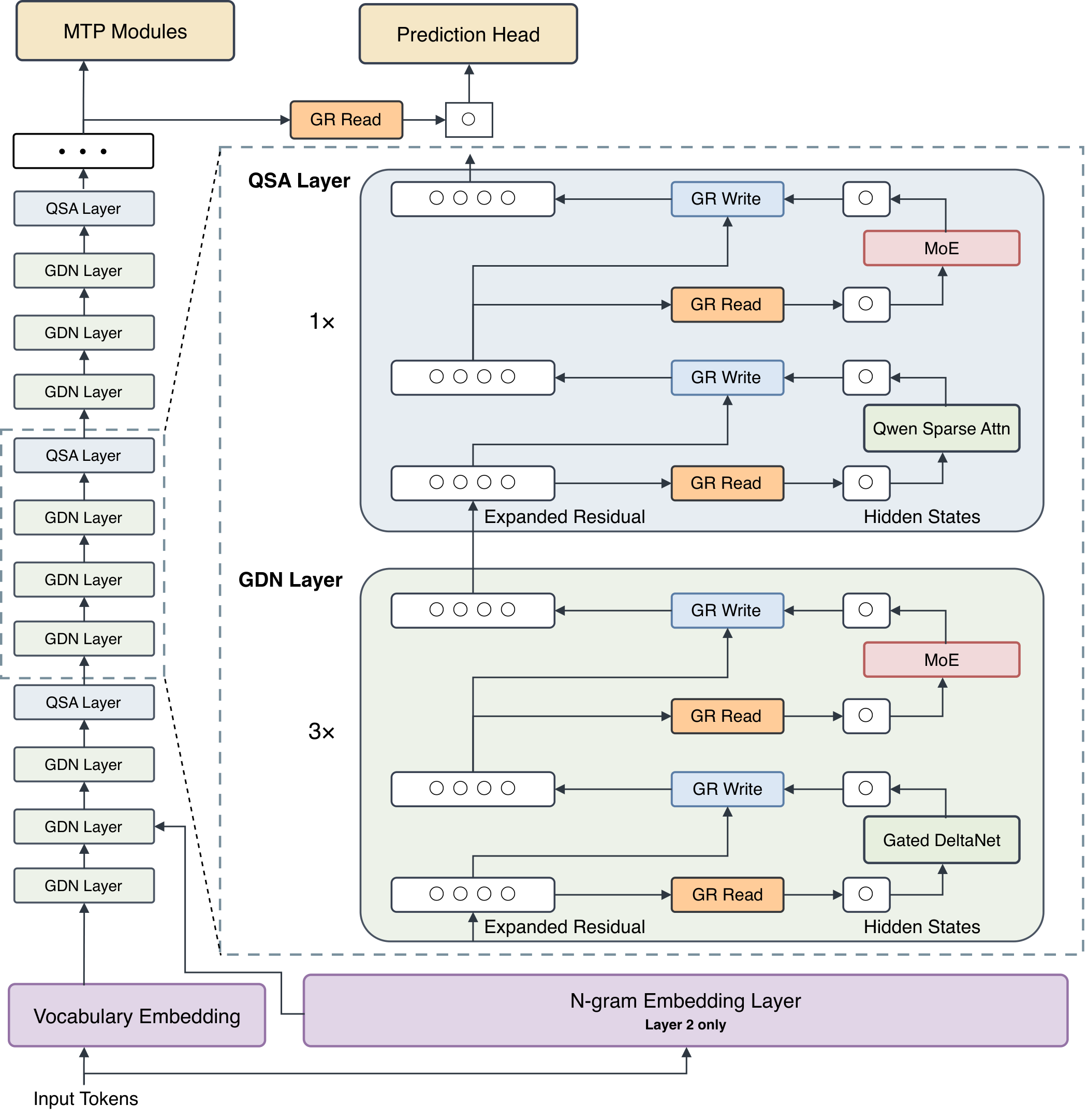
For users, the practical test is whether these changes reduce the resources needed to deliver an acceptable result. Qwen’s published token-consumption measurements provide evidence of improvements on the evaluated tasks.
How Does Qwen4-Max Perform? Official Benchmarks and Examples
Qwen’s published benchmarks measure task performance, token consumption, and execution costs, while its demonstrations illustrate practical workflows.
Qwen4-Max Benchmark Results
The following results compare Qwen4-Max with Qwen3.8-Max:
| Metric | Qwen4-Max vs. Qwen3.8-Max |
|---|---|
| Work360 score | Increased from 47.74 to 52.69 |
| Work360 token consumption | Reduced by approximately 24% at Xhigh and 35% at High |
| Terminal-Bench 4.0 token consumption | Reduced by approximately 48% at Xhigh and 49% at High |
| Average Work360 task cost | Fell from RMB 26.58 to RMB 11.16, approximately 58% lower |
The cost reduction reflects both lower token consumption and revised API pricing.
For applications that make repeated tool calls, cost per successfully completed task is a more useful comparison than token prices alone. A lower-priced request offers limited savings if the workflow requires extensive retries or manual correction.
Examples in Financial Research and Manufacturing
Several official examples provide concrete deliverables and measurable outcomes.
In financial research, the model combines market-data tools and search to produce Excel working papers and editable PowerPoint reports. Source links and aligned charts allow reviewers to trace report findings back to supporting data.
In a manufacturing example, the model combines parameterized modeling, toolpath generation, and simulation feedback. The reported human programming effort for one workpiece fell from approximately 475 minutes to 24 minutes. This result describes the demonstrated workpiece and tool environment and provides a useful starting point for evaluating similar processes.
How to Interpret the Results
Qwen4-Max’s Work360 score increased from 47.74 to 52.69, a gain of 4.95 points. This indicates stronger performance across the evaluated industry tasks, although individual task results can vary. The token-consumption reductions provide a separate measure of efficiency, with different savings at High and Xhigh reasoning settings.
The reported 58% reduction in average Work360 task cost combines lower token consumption with revised API pricing. For developers, the relevant question is whether those savings carry through to a successfully completed task after retries and manual corrections.
Application demonstrations add evidence about specific workflows and deliverables. Use them to identify tasks worth testing, then compare completion quality, review effort, and total cost under consistent tool conditions.
Qwen4-Max Pricing: API Costs and Token Plan Options
Qwen4-Max is available through usage-based API billing and Token Plan subscriptions. The appropriate option depends on whether you are building an application or using an interactive AI tool.
Official Usage-Based API Pricing
QwenCloud lists the following Singapore-region prices:
| Billing Item | Price per 1 Million Tokens |
|---|---|
| Standard input | $1.50 |
| Output | $4.50 |
| Implicit cache input | $0.075 |
| Explicit cache read | $0.075 |
Explicit cache creation costs $1.875 per million tokens for a five-minute cache and $3.00 for a one-hour cache.
A task using 100,000 uncached input tokens and 10,000 billable output tokens costs $0.195 in model token fees, excluding additional chargeable tools or services.
Cached input is priced 95% below standard input. Applications that repeatedly send the same instructions, tool definitions, or document prefixes can reduce input costs by improving cache usage.
How Token Plan Works
Token Plan uses subscription billing and Credits deductions. It currently lists qwen4-max among its supported models.
As of November 17, 2026, the Singapore-region page displays the following individual monthly plans:
| Plan | Monthly Price | Monthly Credits |
|---|---|---|
| Lite | $6 | 20,000 |
| Essential | $10 | 45,000 |
| Standard | $18 | 80,000 |
| Pro | $43 | 200,000 |
The page also advertises a new-user promotion starting at $3. Eligibility and the final amount are shown during checkout.
Credits are subscription billing units rather than a direct token allowance. Consumption depends on the applicable model and tool rules.
According to the Token Plan documentation, the service is intended for interactive use in compatible AI tools and is currently available in the Singapore region.
How to Access Qwen4-Max
There are three practical routes: use a Qwen product, connect directly through QwenCloud, or configure a compatible AI tool. Each has different setup requirements, particularly around credentials and endpoints.
Use Qwen Applications
The official announcement lists Qwen Studio, the Qwen app, QwenWork, and Qoder as access channels.
These products provide a convenient starting point for testing document analysis, coding assistance, and office workflows. Developers who need to control requests, tools, and result handling can move to direct API integration.
Access the QwenCloud API
To access Qwen4-Max, sign in to QwenCloud, obtain an API key for your selected region, and configure the corresponding endpoint with the model ID qwen4-max. QwenCloud provides OpenAI-compatible access. Users migrating from the preview should also review their request parameters and billing configuration.
Configure Coding and Agent Tools
Token Plan documentation provides integration guidance for tools including Qwen Code, Cline, Cursor, and OpenCode.
Configuration generally requires a dedicated API key, the appropriate Base URL, and the model name. Token Plan uses the separate endpoint domain token-plan.maas.qwencloudapi.com, and its keys cannot be exchanged with usage-based API keys.
Follow the guide for your chosen tool, then validate the setup with a task that includes reading material, performing an operation, and checking the result.
Who Should Use Qwen4-Max?
Qwen4-Max is worth evaluating when a recurring workflow requires extensive context, multiple tools, and a verifiable deliverable.
- Developers can evaluate Qwen4-Max for multi-file code changes, frontend development, and agents that use external tools.
- Office and research teams can use it to analyze documents, organize data, and prepare reports with traceable sources.
- Design and content teams can test it for 3D modeling, game prototypes, and video workflows connected to professional software.
- Enterprise teams can evaluate recurring processes with defined data access, tool interfaces, and acceptance criteria.
For financial, legal, and medical workflows, use it for evidence processing and analytical support, with qualified professionals reviewing consequential conclusions.
FAQ
Is Qwen4-Max’s Output Limit One Million Tokens?
No. The context window and maximum output length are separate limits. QwenCloud lists maximum outputs of 131K tokens in standard mode and 262K tokens in thinking mode. Requests must also satisfy the applicable input and context limits.
Should I Choose the Qwen4-Max API or Token Plan?
Choose the usage-based API when integrating Qwen4-Max into an application or backend service. Token Plan is intended for interactive use in compatible AI tools and uses subscription Credits. The two options require separate credentials and endpoints.
Can I Use Qwen4-Max for Free?
Official API access and Token Plan are paid services. Free access through Qwen applications, where offered, follows each product’s account and usage rules; it does not establish a free API allowance.
Can I Download Qwen4-Max for Local Deployment?
As of November 17, 2026, Qwen has not provided open weights for Qwen4-Max, so the official release does not offer a downloadable model for local deployment. Qwen has announced plans to progressively open-source smaller models in the Qwen4 series.
Conclusion
Qwen4-Max is a strong candidate for long-document analysis, complex coding, and workflows involving multiple tools. Official evaluations show higher scores and lower task costs than Qwen3.8-Max on the reported workloads.
Start with a representative task that already has clear acceptance criteria. Compare output quality, manual correction time, execution time, and total cost. Improvements across those measures provide a practical basis for expanding Qwen4-Max into similar workflows.