

TL;DR
Tencent Hunyuan introduced Hyra 2.0 on November 2, 2026 as a research Harness for developing scientific models, software tools, and reusable workflows. Its defining feature is persistent coordination across multi-day or multi-week experiments.
The public release currently consists of selected research artifacts—models, code, weights, and reports—rather than a generally available hosted Hyra 2.0 service. As of November 4, 2026, Tencent’s public materials do not document a general-purpose orchestration API or subscription plan.
Key Takeaways
- Research objective: Hyra 2.0 develops reusable scientific models and tools that can support more than one research project.
- Persistent coordination: Overall, Mission, and Worker agents divide responsibilities, while queues and research records preserve progress across long experiments.
- Reusable knowledge: Agent memory, Books, and research skills retain findings together with their supporting evidence and conditions of use.
- Task-specific results: The released protein, force-field, and cell models address different scientific workloads; speed and quality should be assessed together.
- Practical access: Start with the available research artifacts. The complete Hyra Harness and hosted Hunyuan model APIs are distinct offerings.
What Is Tencent Hunyuan Hyra 2.0?
Hyra 2.0 stands for Hunyuan Research Agent 2.0, a multi-agent system designed to automate complex scientific research and engineering workflows.
Tencent presents Hyra 2.0 as a shift from solving isolated problems toward developing the models, methods, and infrastructure used to investigate a broader class of questions.
Hyra 2.0 is not a standalone foundation model with a fixed parameter count or context window. It is an orchestration system that can use different AI models, execute code, manage scientific experiments, and coordinate specialized research agents.
Scientific research involves more than reasoning. A complete project may require experiment design, implementation, training, debugging, evaluation, and repeated revisions. These activities can run across several days or weeks, often involving parallel experiments and shared computing resources.
Hyra 2.0 addresses this operational challenge by combining model intelligence with persistent execution, structured collaboration, and evidence-based verification.
Hyra 2.0 Technical Specifications
The system's specifications describe its orchestration and research capabilities. Individual scientific models created by Hyra 2.0 have separate architectures, parameter counts, and performance benchmarks.
Why Hyra 2.0 Builds Tools
The shift from Hyra 1.0 to Hyra 2.0 addresses a fundamental limitation in automated research: successfully solving one problem does not necessarily improve the system's ability to solve the next one.
Hyra 1.0 used a relatively simple agent loop to generate solutions, run evaluations, and improve results through repeated attempts. Powered by Tencent’s open-source Hy3 model, Hyra 1.0 helped settle the optimal exponent relating sumsets and difference sets, with a machine-checked proof released alongside the result. The distinction matters: an evaluated mathematical result is a concrete output, while an improvement to the research process may be reused across later problems.
The next challenge is making research progress accumulate.
From Answers to Reusable Capabilities
Consider three levels of mathematical automation:
- An agent solves an individual mathematical problem.
- An agent develops a proof workflow that can solve similar problems.
- An agent improves the reasoning models and verification tools used by future research systems.
The first produces an answer. The second produces a reusable method. The third can improve the underlying research capability itself.
Hyra 2.0 targets the second and third levels.
Tencent describes two broad categories of reusable tools. Symbolic tools express capabilities through code, algorithms, rules, and workflows. Examples include automated verification systems, scientific search algorithms, and experiment-management pipelines. Parametric tools store learned capabilities in model weights, including protein design models and scientific foundation models.
Improving either category can benefit multiple downstream tasks without requiring every research project to begin from the same starting point.
The Direction Toward Recursive Self-Improvement
Hyra 2.0 also creates a pathway toward recursive self-improvement. Foundation-model research depends on training infrastructure, synthetic-data pipelines, optimization algorithms, and inference systems.
If AI agents improve these tools, they can help develop stronger models. Those stronger models can then participate in subsequent rounds of tool development.
Better research tools → stronger AI models → more capable research agents → better research tools.
Tencent describes applying Hyra to pretraining infrastructure, post-training data generation, and inference optimization. This creates a plausible feedback loop between tool development and model development. It does not by itself establish unlimited or fully autonomous recursive improvement; each proposed gain still needs an experiment that isolates its effect.
How Does the Hyra 2.0 Harness Architecture Work?
The Harness is Hyra 2.0's central engineering innovation. A conventional agent loop can execute tools, inspect results, and continue reasoning within a session. Scientific model development requires a more sophisticated execution environment.
Experiments may run for hours, training jobs may take days, and separate research directions may require different computing resources and validation methods. Hyra 2.0 addresses these requirements through three layers of agents, persistent task scheduling, structured research records, and independent verification.
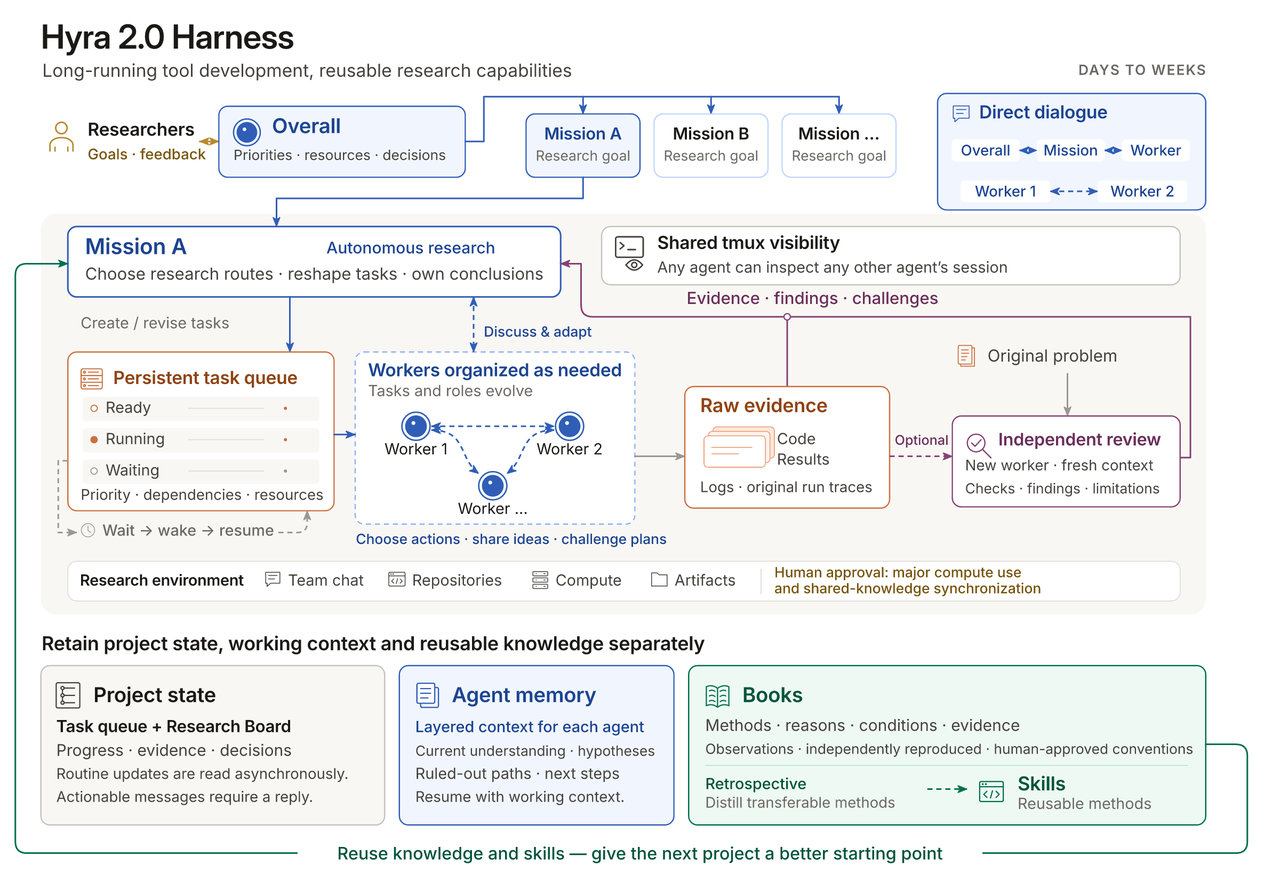
Tencent Hunyuan's official Hyra 2.0 architecture diagram shows the hierarchy, persistent work queue, review process, and separate stores for project state, agent memory, and shared knowledge.
Overall: Research Coordination and Resource Management
Overall is the highest coordination layer. It communicates with human researchers, maintains alignment with research objectives, manages priorities, and coordinates computing resources.
Its responsibilities include determining which projects should receive additional resources and identifying decisions that require human approval. Overall therefore functions as the coordination layer between autonomous research activities and human research management.
Mission: Long-Term Research Planning
Each Mission is responsible for a particular research problem. A Mission maintains the research direction across multiple experiments, organizes Workers, interprets results, and decides whether a hypothesis deserves further investigation.
It also determines when a research approach should be revised or abandoned. This creates continuity across a long-running project without requiring one agent session to retain every intermediate action.
Worker: Experiment Execution and Independent Exploration
Workers carry out specialized research tasks. Their responsibilities include reading code, implementing algorithms, running experiments, diagnosing failures, and proposing alternative approaches.
Workers can challenge a Mission's decisions, and different Workers may use different underlying AI models. This structure supports parallel exploration and reduces dependence on a single agent's reasoning path.
Persistent Scheduling and Research Board
Hyra 2.0 places research tasks into a persistent queue. The scheduler considers task priority, dependencies, and available resources when launching Workers.
When one experiment is waiting for training results or human approval, other tasks can continue. Agents may also schedule their next activation after an experiment finishes.
The Research Board records hypotheses, findings, evidence, and major decisions. This separates the research project's persistent state from individual agent conversations.
Independent Verification and Human Approval
Worker conclusions must be supported by experimental evidence, such as code versions, execution logs, evaluation results, or original traces.
When a result requires additional examination, a separate Review Worker can independently inspect the original problem and evidence. This process helps identify unsupported conclusions and implementation mistakes before they influence later research.
High-cost compute operations and changes to shared team knowledge remain subject to human approval. The architecture therefore combines autonomous execution with explicit checkpoints for consequential decisions.
Books: Turning Research Experience Into Skills
Hyra 2.0 separates information into three storage categories:
- Project state: Task queues, collaboration records, and research progress.
- Agent memory: Current understanding, hypotheses, rejected approaches, and future plans.
- Books: Reusable knowledge shared across research projects.
Books categorizes information into observations, verified findings, and conventions. A single experiment may produce an observation. Independently reproduced findings can become verified knowledge. Conventions that affect team behavior require human confirmation.
During project reviews, reusable methods can be converted into skills. A successful numerical verification procedure or a method for diagnosing training instability can become a reusable component of future research workflows.
This mechanism allows the system to preserve operational improvements beyond individual sessions.
What Research Results Has Hyra 2.0 Achieved?
Hyra 2.0's initial results cover scientific models, mathematical research, quantum computing, robotics, single-cell analysis, and hardware engineering.
The official research repository contains selected implementations, weights, reports, and verification artifacts. The overview below summarizes Tencent's reported results; the following subsections explain their test conditions and availability. These are different scientific tasks, not a single ranking of general-purpose agent ability.
These results demonstrate multiple types of research output rather than one general-purpose agent score.
HyInv: 57× Faster Protein Inverse Folding
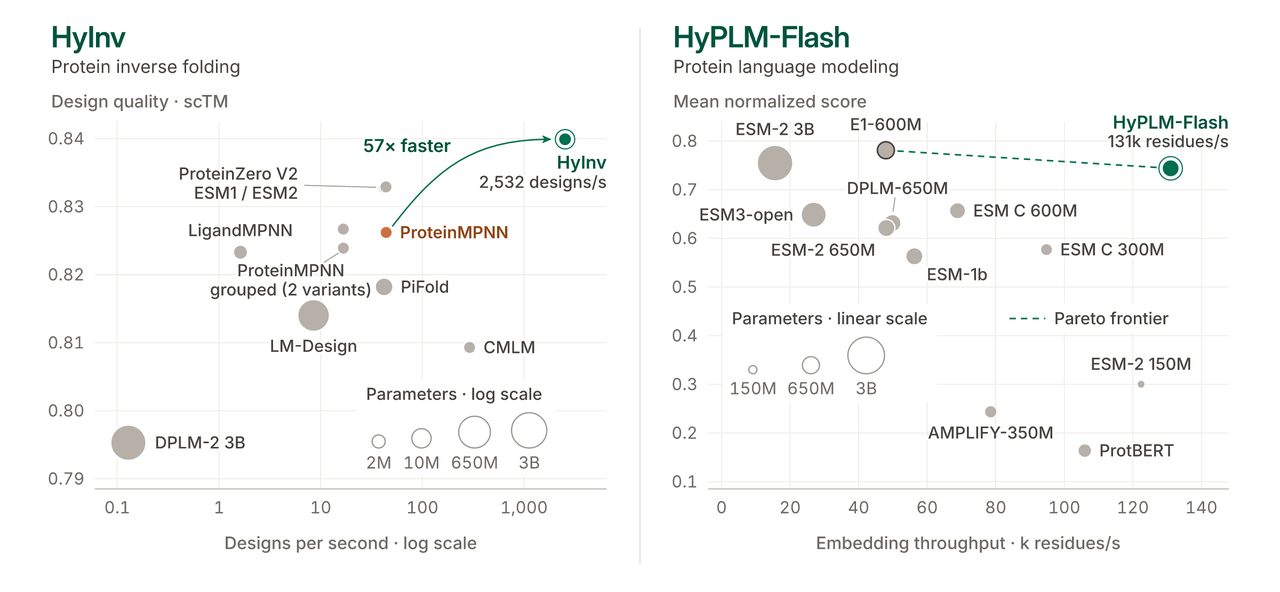
HyInv generates protein sequences for a target backbone. Its 1.96M-parameter model reportedly runs 57× faster than ProteinMPNN. The reported 50.6 ms for 128 designs uses a 402-residue backbone, one H20 and BF16, excluding compilation and CUDA graph capture. Treat this as warmed generation speed; structural screening still contributes to the full design cycle.
HyPLM-Flash: High-Throughput Protein Language Modeling
HyPLM-Flash is a 650M-parameter protein language model trained on 726B tokens. In the released 28-checkpoint, 32-task evaluation, its ProteinGym score was statistically tied with comparable encoders. INT8 inference reaches about 130,000 residues/s on one H20; BF16 is preferable when small representation differences affect downstream analysis. The launch figure below uses a different evaluation scope.
HyFF: Faster Molecular Simulation With Five Model Sizes
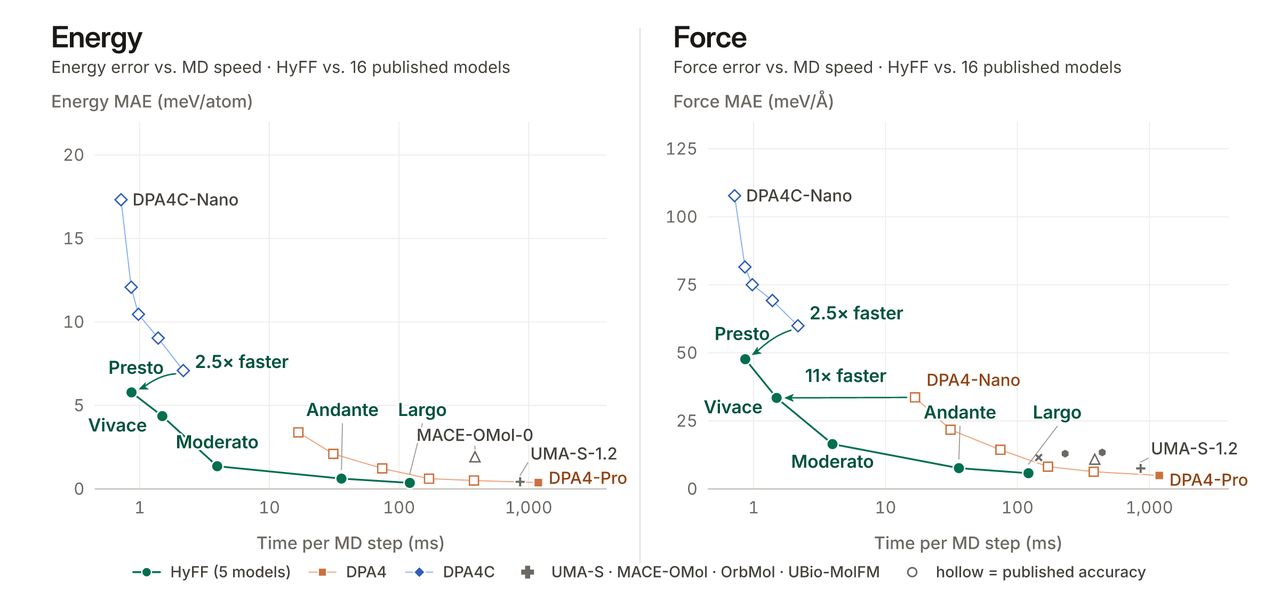
HyFF predicts molecular energies and atomic forces, with five model sizes spanning 2.3M–1.2B parameters. On the reported OMol25 comparison, Andante combines similar force error to UMA-S-1.2 (7.65 versus 7.55 meV/Å) with 29× faster molecular dynamics. Largo reports lower energy error than DPA4-Pro (0.364 versus 0.380 meV/atom) and 9.7× higher speed. Choose a size by testing both accuracy and runtime on the molecules you intend to simulate.
HyCell: A Single-Cell Embedding Model
HyCell maps human-cell gene-expression counts to 512-dimensional embeddings with a 16.1M-parameter model. Across seven held-out cell atlases, its composite score is 0.735, close to Stack’s 0.736. That score combines biological conservation, batch correction and annotation transfer; it is not classification accuracy. Check the component metrics relevant to your study.
HyProver: Reusable Workflows for Mathematical Research
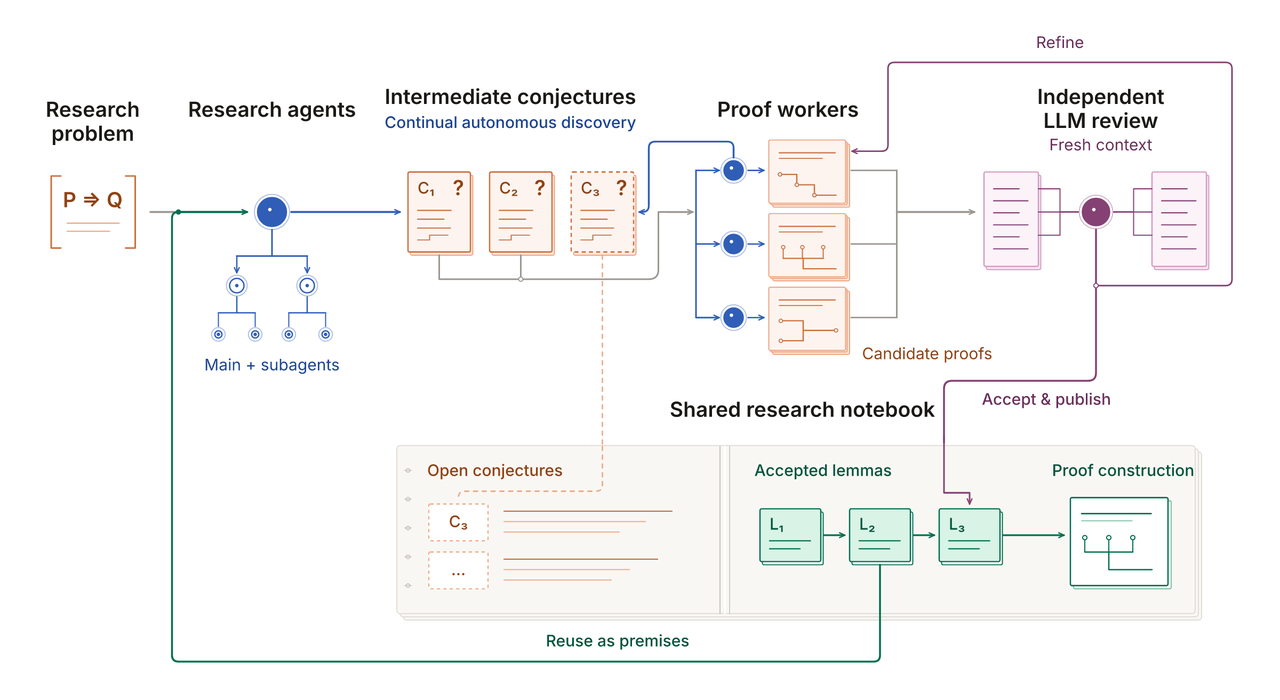
HyProver organizes mathematical work into exploration, proof development and review. Its reported results establish the five-dimensional case of Petty’s equilateral-set conjecture and give a counterexample to the unrestricted form of Yau’s circle-action conjecture. These results have specific boundaries: Petty’s conjecture is not settled in every dimension, and Yau’s simply connected formulation remains open.
HyQEC: A 48% Improvement in Quantum-Code Efficiency
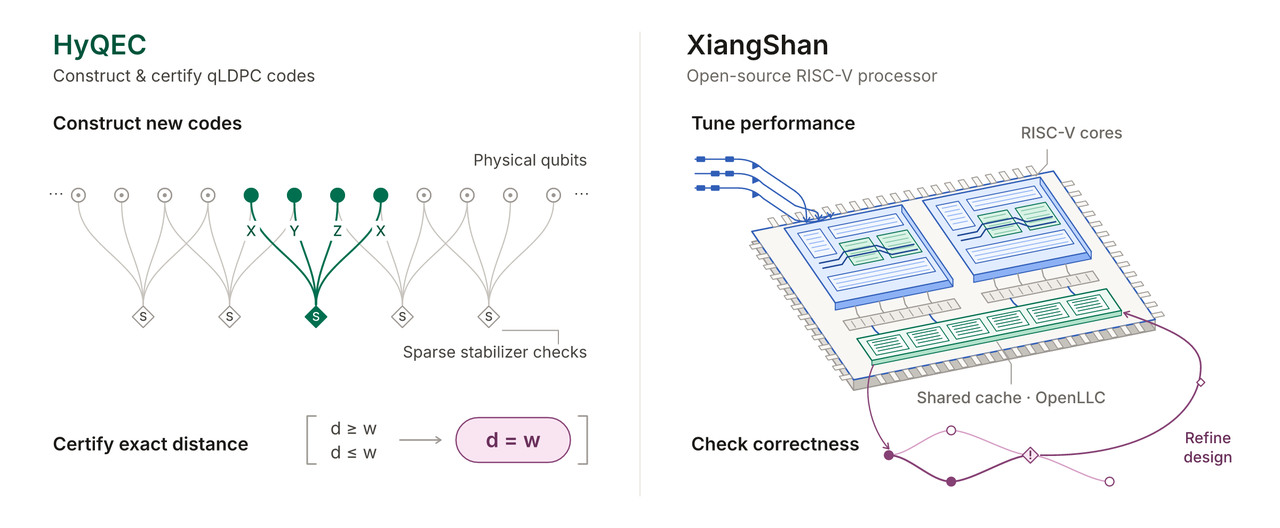
HyQEC searches for quantum error-correcting codes and checks their distances. Tencent reports a [[488,123,22]] construction with an efficiency metric kd²/n of 122.0, about 48% above the previous challenge leader under the stated constraints. This measures code efficiency, not quantum-hardware performance. As checked on November 5, 2026, the official release includes the hyqec-verify and hyqec-check tools, but still lists this particular construction’s code file and certificate as evidence to be released. Public tools and publicly reproducible evidence for a specific result are separate milestones.
Spiral Hand: AI-Designed Robotic Morphology
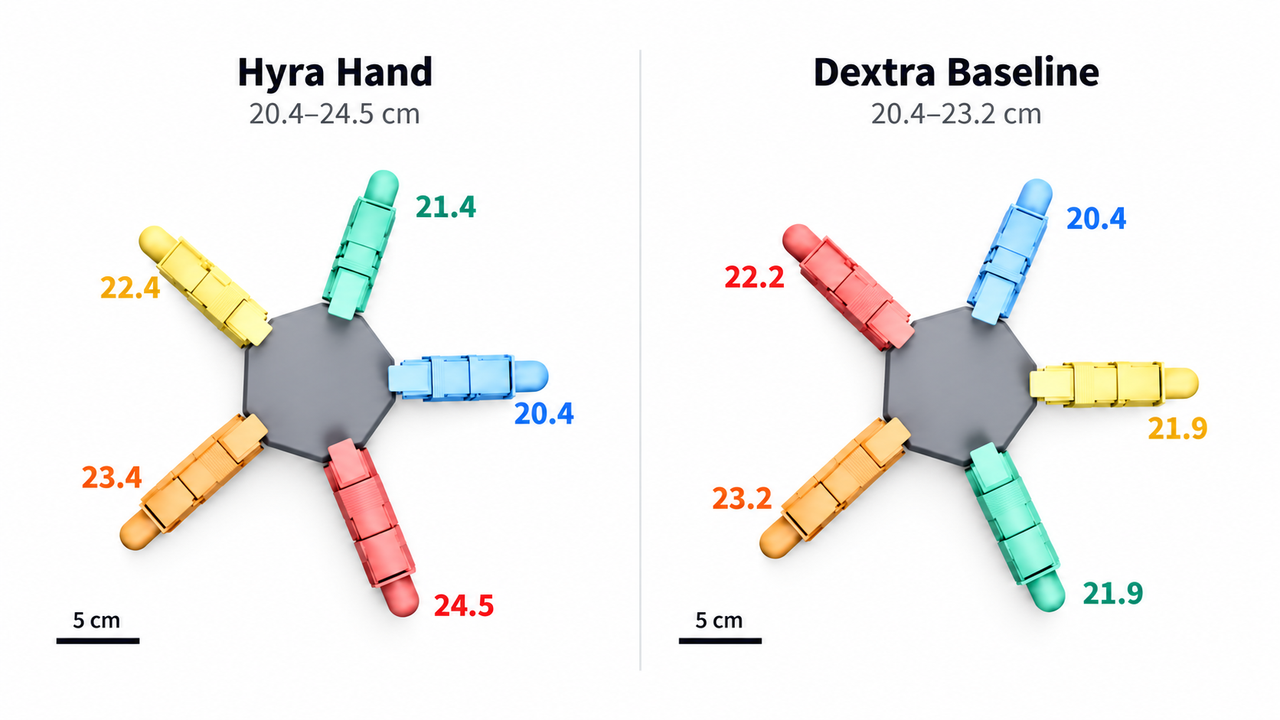
Hyra’s Spiral Staircase Hand uses progressively longer fingers around the palm. Tencent reports 28.6% faster object rotation and 21% more completed targets than the Dextra baseline in DR5 simulation after equal policy fine-tuning budgets. Physical-hardware validation remains outstanding.
XiangShan: Processor Optimization and Formal Verification
For the XiangShan RISC-V processor, Tencent reports a 5.79% improvement in SPEC CPU2006 score per GHz, unchanged core frequency and a 0.3% area increase. The work also found ten previously unreported bugs and a cache-coherence counterexample. These outcomes apply to the evaluated design and workloads, rather than all RISC-V systems.
How Should Researchers Interpret Hyra 2.0's Benchmarks?
Read each benchmark within its own workload. Compare the same inputs, hardware, precision and timing boundary, then assess output quality alongside runtime. For scientific claims, inspect the supporting code, data, proof or certificate: a reported result and an independently reproduced result provide different levels of evidence.
Can Developers Use Hyra 2.0 Through an API?
As of November 4, 2026, the public Hyra materials describe research outputs and selected releases. They do not document a generally available Hyra 2.0 orchestration API, subscription price, or complete deployment package. A research announcement and downloadable artifacts should therefore be distinguished from hosted access to the full system.
The publicly available materials focus on research results and selected artifacts. Developers can access certain models created through Hyra, including HyInv, HyPLM-Flash, HyFF, and HyCell, through the associated research repositories.
The complete Hyra 2.0 Harness should be distinguished from those downloadable outputs.
Hyra 2.0 and Hosted Hunyuan APIs
Developers can access Tencent Hy4 through CometAPI using the model ID hy4. This provides hosted model inference for applications such as coding, analysis and agent workflows. It does not provide the complete Hyra 2.0 research Harness; scientific models developed through Hyra are available separately through Tencent’s research repositories.
What Would Make Hyra 2.0 Useful in a Research Team?
Start with one released artifact and a small reference workload. Once that runs successfully, test representative local data with a fixed quality threshold and compute budget. Keep the repository revision, weights, environment, inputs and outputs together so colleagues can reproduce the result. Add persistent multi-agent coordination when long waits, dependent experiments or competing hypotheses make it useful.
Conclusion
Hyra 2.0 brings research planning, experiment execution and reusable knowledge into one persistent workflow. Its scientific outputs are promising starting points for further work. For a research team, the practical test is whether a released artifact improves a real experiment and produces evidence that others can inspect and reproduce.
FAQ
How should a lab budget its first Hyra artifact trial?
Budget for three stages: setting up a reproducible environment, running a small reference case, and evaluating a representative local workload. Include preparation and review time as well as accelerator use. Choose an acceptance criterion before starting, such as maintaining a required quality level while reducing turnaround time. An initial trial should be small enough to diagnose failures without committing the resources required for a full research campaign.
What should a reproducibility package contain?
Keep the repository revision, model-weight identifiers, environment versions, input-data provenance, configuration, random seeds where relevant, and evaluation outputs together. Record any changes to the published example. When a result relies on a proof or certificate, preserve the checker version and its output as well. The package should let another researcher distinguish a software problem, a changed input, and a genuine difference in the scientific result.
How can researchers avoid benchmark contamination?
Separate data used to choose models or tune settings from the data used for final evaluation. Freeze the final protocol before comparing candidates, and document any overlap with pretraining or development data that can be established. For new scientific datasets, use splits that reflect the intended deployment setting, such as a held-out study or experimental condition. A strong score is less informative if the evaluation examples repeatedly shaped the system being tested.
How should teams handle conflicting agent conclusions?
Compare the underlying experiments rather than combining the conclusions by majority vote. Check whether the agents used the same dataset version, assumptions, metric, and software configuration. Preserve both findings until the difference is explained, then run a focused experiment that discriminates between the competing explanations. Agreement between agents is useful, but it does not replace external measurements or a checkable argument.
When is a simpler research workflow preferable?
A short, deterministic task with a mature script and a clear evaluator may not benefit from persistent multi-agent coordination. The added scheduling, record keeping, and review can cost more than it saves. Introduce orchestration when experiments have meaningful dependencies, long waits, several competing hypotheses, or reusable outputs that need ongoing maintenance. The decision should follow the structure of the workload and the observed coordination cost.