
TL;DR
GLM-5.3-Flash is Z.ai's efficiency-first native multimodal model for coding agents, visual workflows, professional documents, and long-context applications. Its hybrid architecture is designed to reduce inference cost while retaining strong agentic capability.
Z.ai reports large gains on DeepSWE, Toolathlon, AutomationBench, and GDPval-AA v2. Open weights under the MIT license also make private deployment possible for teams with sufficient infrastructure.
Best fit: high-volume multimodal agents, repository work, browser or computer use, visual coding, document production, and other workflows where long prompts and repeated tool calls make token cost important.
What Is GLM-5.3-Flash?
GLM-5.3-Flash is an open-weight mixture-of-experts model from Z.ai. It contains 320B total parameters and activates 18B per token, retaining a large expert pool without paying dense-model compute on every token.
?Flash? does not mean a simple quantization or distillation of another release. The model starts from a newly trained multimodal base and uses a redesigned architecture and training recipe. Native visual understanding, efficient long-context serving, and lower deployment cost are foundational design goals.
Key Specifications
| Official specification | GLM-5.3-Flash |
|---|---|
| Model type | Native multimodal mixture-of-experts model |
| Total / active parameters | 320B / 18B |
| Context window | 1,048,576 tokens |
| Maximum output | Up to 131,072 tokens on supported API routes |
| Input | Text, images, video, and files |
| Output | Text |
| Attention | Hybrid sparse and linear attention with IndexPool |
| Reasoning | Always enabled; low, high, and max effort levels |
| Open weights | Yes, under the MIT license |
| API model ID | glm-5.3-flash |
How does GLM-5.3-Flash Work?
Hybrid Sparse + Linear Attention
Linear attention models local dependencies efficiently, while sparse attention uses a lightweight indexer to retrieve globally relevant context. IndexPool compresses four indexer key vectors into one before sparse retrieval, reducing memory and latency overhead at long context lengths.
Z.ai reports lower per-layer attention compute and a smaller KV cache relative to its flagship architecture. These savings help the model support a million-token context at unusually low token prices.
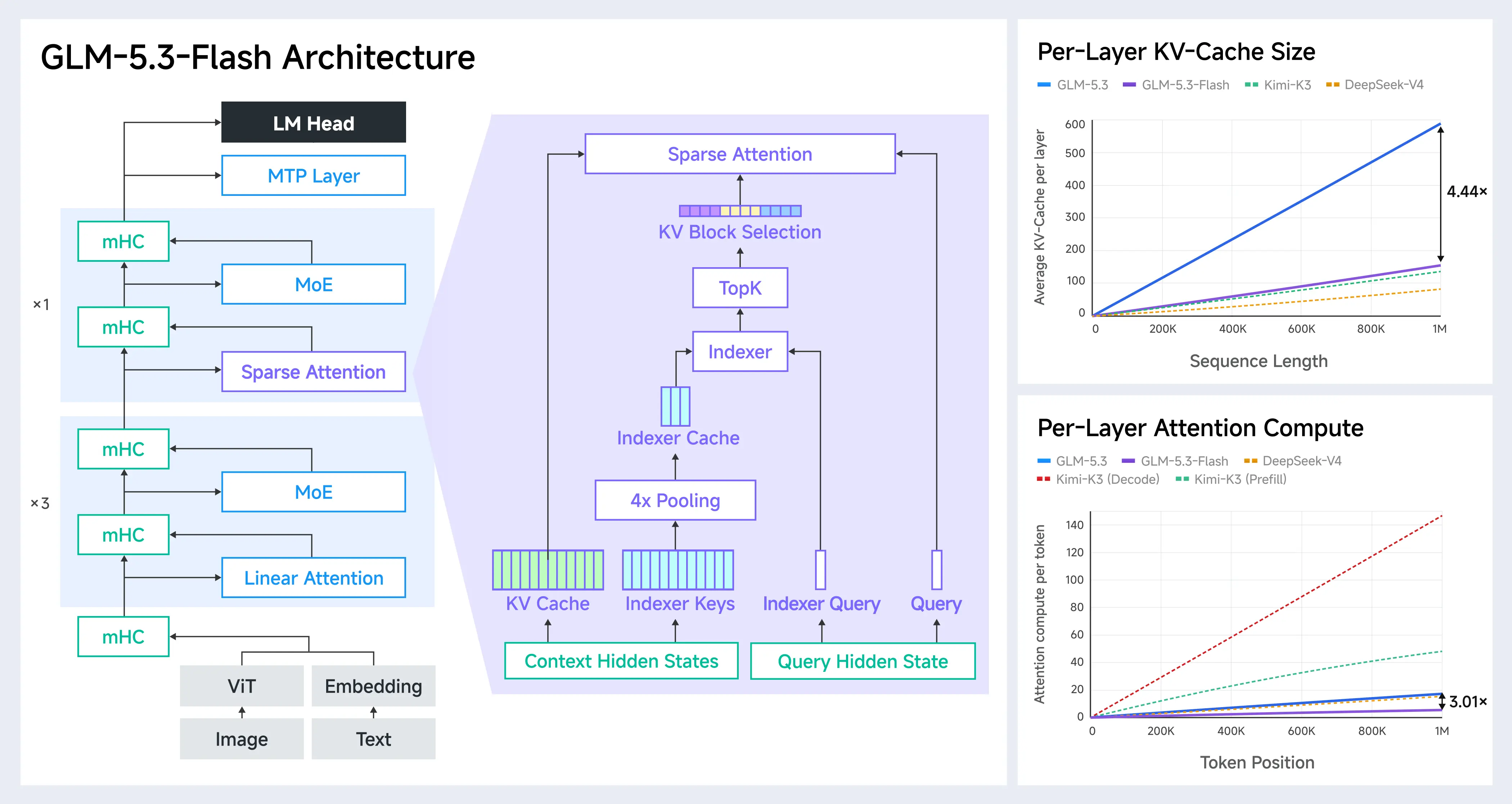
Official image: architecture and efficiency comparison**.Source: Z.ai official documentation
mHC and Multimodal Pre-Training
The model adopts Manifold-Constrained Hyper-Connections (mHC), a scaling-efficiency improvement that complements the attention redesign. Training uses a 30T-token multimodal corpus, making this a new multimodal base-model branch rather than a post-training-only update.
Native Vision in the Agent Loop
The model can use visual feedback inside an iterative workflow: observe a rendered interface or artifact, act on it, inspect the result, and revise. This makes vision useful for frontend implementation, browser and computer use, office deliverables, video workflows, 3D scenes, CAD reconstruction, and game development?not only one-time image description.
Benchmark Performance
Methodology note: the results below are reported by Z.ai. Evaluation harnesses, agent scaffolding, tool policies, context management, and timeouts can change outcomes, so the scores represent specific tasks rather than a universal model ranking.
Z.ai Official Coding and Agentic Benchmarks
| Benchmark | GLM-5.3-Flash | GLM-5.2 | Claude Opus 4.8 |
|---|---|---|---|
| Terminal-Bench 2.1 | 84.3 | 81.0 | 85.0 |
| DeepSWE v1.1 | 63.4 | 46.2 | 58.0 |
| Toolathlon Verified | 78.4 | 59.9 | 76.2 |
| AutomationBench | 48.8 | 26.2 | 41.0 |
| Agents' Last Exam | 26.3 | 20.4 | 27.0 |
| HLE w/ Tools | 55.3 | 54.7 | 57.9 |
| GDPval-AA v2 | 1773 | 1504 | 1582 |
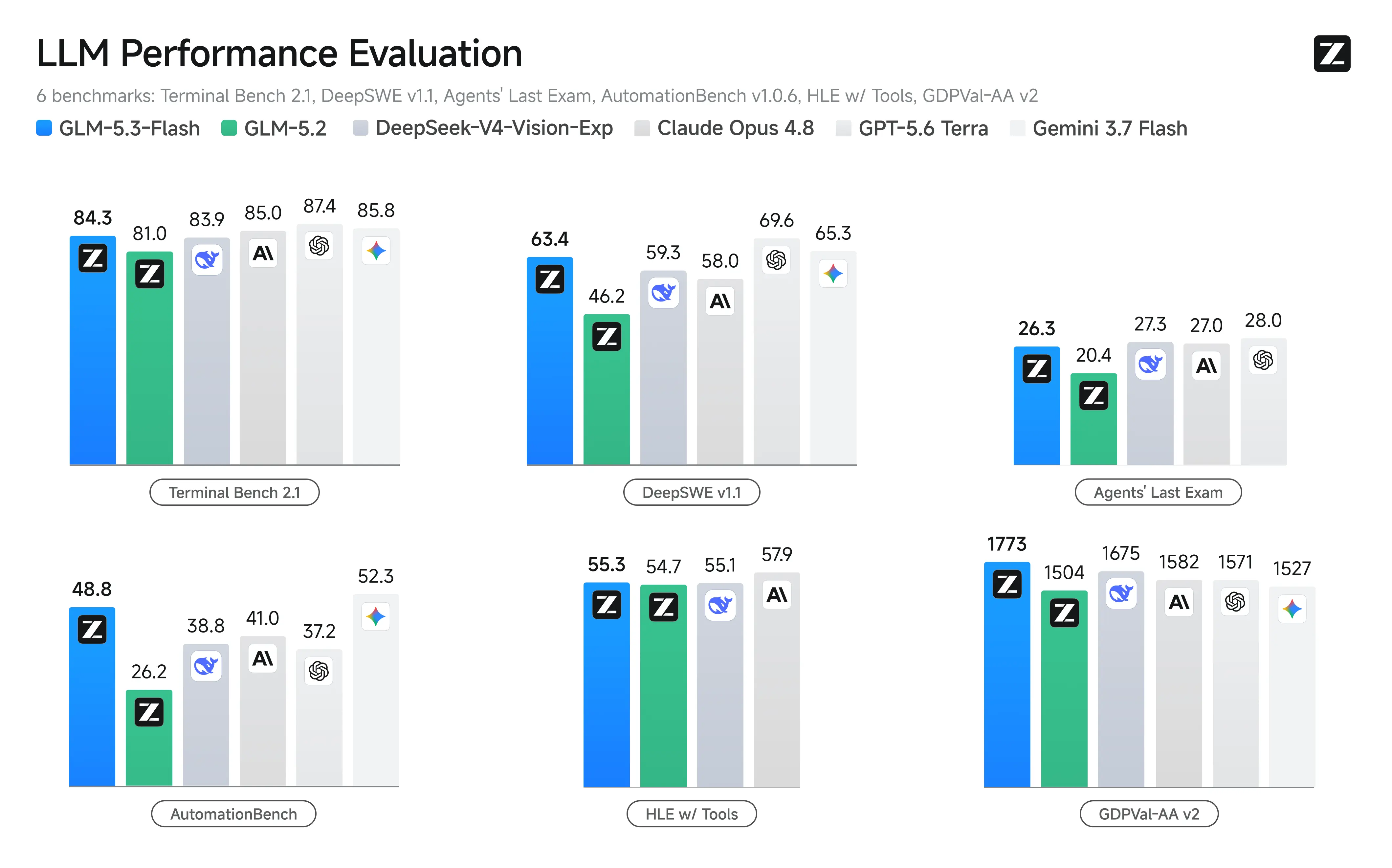
Official image: coding and agentic benchmark comparison.
The largest gains over GLM-5.2 appear in DeepSWE, Toolathlon, AutomationBench, and GDPval-AA v2. The launch matrix shows a 22.6-point AutomationBench gain and a 269-Elo GDPval-AA v2 gain. GLM-5.3-Flash is close to Claude Opus 4.8 on Terminal-Bench, exceeds it on several agentic tasks, and trails it on HLE with Tools.
GLM-5.3-Flash vs GLM-5.3 vs GLM-5.2
This comparison separates the efficiency-first GLM-5.3-Flash, the capability-focused GLM-5.3, and the earlier coding-and-agent model GLM-5.2.
| Dimension | GLM-5.3-Flash | GLM-5.3 | GLM-5.2 |
|---|---|---|---|
| Primary strategy | Efficiency-first multimodal model | Capability-focused flagship | Previous coding and agent model |
| Base-model lineage | New multimodal base | Post-training upgrade over the previous base | Earlier GLM-5 generation base |
| Native multimodal input | Yes | Not the release focus | Not the release focus |
| Architecture emphasis | Hybrid sparse + linear attention | Maximum text, coding, and agent capability | Long-horizon coding and agents |
| Open weights | Yes, MIT | Yes | Yes |
| Best fit | High-volume multimodal agents | Maximum GLM capability | Established GLM coding workflows |
The practical choice is workload-driven. GLM-5.3 remains the higher-ceiling option when absolute reasoning or software-engineering quality matters more than price. GLM-5.3-Flash is the more attractive default when native vision, open deployment, and lower operating cost matter together.
API Pricing: Z.ai vs CometAPI
| Usage | Z.ai list price | Z.ai launch promotion | CometAPI current price |
|---|---|---|---|
| Input | $0.15 / 1M | $0.075 / 1M | $0.06 / 1M |
| Cached input | $0.03 / 1M | $0.015 / 1M | Not separately listed |
| Output | $0.50 / 1M | $0.25 / 1M | $0.20 / 1M |
Time-sensitive pricing: the Z.ai 50% launch promotion ends at 24:00 on September 9, 2026 (UTC+8, Singapore time). CometAPI prices shown above were checked on August 27, 2026 and may change. Confirm live pricing before production budgeting.
During the launch window, CometAPI's listed input and output prices are 20% below Z.ai's promotional rates. The difference becomes meaningful for long-running agents that repeatedly call tools, inspect visual outputs, or retain large prompts.
What Can GLM-5.3-Flash Do?
Visual Coding and Frontend Development
The model can analyze screenshots, infer shared components and design-system rules, implement an application, render it, compare the result with the reference, and revise layout, typography, spacing, colors, cropping, and interactions.
Browser and Computer Use
When a structured API is unavailable, an agent can reason over visible software interfaces, decide where to click or type, inspect whether the action succeeded, and adapt its next step.
Office and Professional Documents
Z.ai highlights PPTX, PDF, DOCX, and XLSX workflows. The visual loop helps detect overflow, misalignment, overlapping elements, inconsistent styling, and other defects that text-only generation cannot reliably catch.
Research and Financial Analysis
Large evidence packages can be connected to auditable reports, source-backed conclusions, editable models, and structured assumptions. Users should still require source traceability and distinguish disclosures from analysis.
Video, 3D, CAD, and Game Workflows
Native multimodality supports iterative visual engineering in video editing, Blender scenes, parametric CAD, and game development. The value comes from repeated rendering and inspection rather than a single generation step.
Open Weights and Local Deployment
GLM-5.3-Flash has official weights on Hugging Face under the MIT license. Supported serving paths in the model card include SGLang, vLLM, TokenSpeed, Transformers, KTransformers, and Unsloth.
Open weights do not make deployment lightweight. The released checkpoint is roughly 321B parameters, so self-hosting requires substantial accelerator memory, distributed serving, quantization, or specialized inference infrastructure. Hosted API access may remain more economical unless privacy, customization, or infrastructure control justifies the burden.
How to Access GLM-5.3-Flash
Z.ai API
The official model ID is glm-5.3-flash. Z.ai recommends temperature 1, top_p 0.95, reasoning_effort max, and thinking enabled. Images are passed as image_url content blocks.
CometAPI
GLM-5.3-Flash is available through CometAPI with an OpenAI-compatible chat-completions workflow, allowing teams to test it alongside other providers without maintaining a separate integration for each vendor.
curl https://api.cometapi.com/v1/chat/completions \\ -H "Content-Type: application/json" \\ -H "Authorization: Bearer YOUR_COMETAPI_KEY" \\ -d '{ "model": "glm-5.3-flash", "messages": [ {"role": "user", "content": "Explain hybrid attention in three bullets."} ] }'
Next step: open the GLM-5.3-Flash model page, confirm current price and availability, and test a representative workload before changing production routing.
Final Verdict
GLM-5.3-Flash changes the cost-capability trade-off more than the absolute benchmark ceiling. Native multimodality, long-context support, open weights, strong agent results, and low token pricing make it compelling for high-volume systems that remain active across many steps.
Choose a higher-end flagship when maximum reasoning quality matters regardless of cost. Test a competing multimodal model when broad image or video perception is the primary requirement. Choose GLM-5.3-Flash when multimodal agents, open deployment, and operating efficiency must coexist.
FAQ
Is GLM-5.3-Flash open source?
The precise description is open-weight. GLM-5.3-Flash has weights published under the MIT license, enabling self-hosted deployment and broad reuse.
Is GLM-5.3-Flash good for coding agents?
GLM-5.3-Flash posts strong launch results on Terminal-Bench 2.1, DeepSWE, Toolathlon, AutomationBench, and GDPval-AA v2. Teams should validate it inside their own agent stack because tools and orchestration affect the final result.
How much does GLM-5.3-Flash cost?
GLM-5.3-Flash is listed by Z.ai at $0.15 per million input tokens, $0.03 per million cached-input tokens, and $0.50 per million output tokens. Temporary promotional and reseller prices appear in the pricing section above.
Can GLM-5.3-Flash be deployed locally?
Yes. GLM-5.3-Flash has public weights and support across multiple serving frameworks, but the checkpoint requires serious inference infrastructure.