
TL;DR
MiMo-V2.6 is Xiaomi's new open-weight, native multimodal, agent-oriented reasoning model family. MiMo-V2.6-Pro uses a sparse MoE design with 1.02 trillion total parameters and about 42 billion activated parameters per token, while MiMo-V2.6-Flash uses 309 billion total parameters and about 15 billion activated. Both support a 1M-token context window and multimodal inputs including text, images, video, and audio.
Key Takeaways
- MiMo-V2.6-Pro is a 1.02T-parameter sparse MoE model with about 42B parameters activated per token; Flash uses 309B total and about 15B active parameters.
- Both models support a 1M-token context window, multimodal input, and up to 128K output tokens through Xiaomi's API.
- The family is designed for reasoning, tool use, web search, structured output, and long-horizon agent workflows.
- Xiaomi trained V2.6 with mixed reinforcement learning across coding, general agents, visual tasks, and cybersecurity environments.
- Official results position Pro as the higher-capability option and Flash as the lower-cost, high-volume option; workload-specific evaluation remains necessary.
What Is Xiaomi MiMo-V2.6?
MiMo-V2.6 is the latest generation of Xiaomi's MiMo model family. Its emphasis is not merely generating better answers, but executing long sequences of actions: inspecting an environment, calling tools, observing results, correcting errors, and continuing until an objective is complete. Xiaomi frames the release around Recursive Self-Improvement (RSI), meaning an RL training loop in which the model repeatedly explores environments, receives richer reward signals, compares trajectories, and learns more effective strategies. This should not be interpreted as the model autonomously rewriting and training its own successor.
Pro vs Flash vs UltraSpeed: What is the differnence
| Feature | MiMo-V2.6-Pro | MiMo-V2.6-Flash | MiMo-V2.6-Pro-UltraSpeed |
|---|---|---|---|
| Positioning | Flagship reasoning | High-volume / value | Low-latency flagship |
| Total parameters | 1.02T | 309B | Same Pro model |
| Active parameters | 42B | 15B | Same Pro capability |
| Architecture | Sparse MoE | Sparse MoE | Pro serving mode |
| Context | 1M | 1M | 1M |
| Max output | 128K | 128K | 128K |
| Text / image / video / audio input | Yes | Yes | Yes |
| Deep reasoning / tool calling | Yes | Yes | Yes |
| Structured output / context caching | Yes | Yes | Yes |
| Main advantage | Maximum capability | Cost efficiency | Up to 20x faster serving |
MiMo-V2.6-Pro or Flash: Which One Should You Use?
Practical choice: choose MiMo-V2.6-Pro for difficult long-horizon engineering, research, cybersecurity, and high-value agent work; choose MiMo-V2.6-Flash for high-volume automation, document and multimodal processing, and cost-sensitive repeated calls; choose MiMo-V2.6-Pro-UltraSpeed when Pro-level reasoning is required but latency dominates. UltraSpeed is a serving tier rather than a different capability model and is advertised at up to 20× the output speed of standard Pro.
How Does Xiaomi MiMo-V2.6 Work?
Sparse Mixture-of-Experts architecture
MiMo-V2.6 does not activate its entire parameter set for every token. The flagship Pro checkpoint contains 1.02 trillion total parameters, but only about 42 billion are active for each token. Xiaomi's model card describes 70 Transformer layers, 384 routed experts, and eight experts activated at a time. Flash is substantially smaller at 309B total / 15B active, with 48 Transformer layers and 256 routed experts.
| Architecture specification | MiMo-V2.6-Pro | MiMo-V2.6-Flash |
|---|---|---|
| Total parameters | 1.02T | 309B |
| Activated parameters | 42B | 15B |
| Transformer layers | 70 | 48 |
| Hidden size | 6,144 | 4,096 |
| Routed experts | 384 | 256 |
| Experts activated | 8 | 8 |
| Maximum context | 1M | 1M |
| MiMo ViT | 681M params | 681M params |
| AudioTokenizer | 308M params | 308M params |
| Audio patch encoder | 127M params | 127M params |
| Speculative decoder | 5 layers | 5 layers |
The architecture combines sliding-window attention with global-attention layers and includes a five-layer multi-token-prediction speculative decoder. The practical implication is that headline parameter count and per-token compute are very different quantities: sparse routing lets Xiaomi maintain a large expert pool without performing dense inference across all weights for each token.
Native multimodal understanding
MiMo-V2.6 uses Xiaomi's 681M-parameter MiMo ViT for visual encoding together with dedicated audio components. This gives the same agent the ability to process text instructions, screenshots, photographs, video, and audio. For computer-use agents, native multimodality matters because perception and decision-making can happen inside the same reasoning loop rather than being separated into disconnected user-facing models.
Why Is Reinforcement Learning So Important to MiMo-V2.6?
Xiaomi reports that both Flash and Pro went through roughly 30 RL steps and around 750,000 trajectories in a six-day public training experiment. The reported training costs were about $850,000 for Flash and $2.62 million for Pro. Each update used 1,568 training samples, with individual training steps reaching roughly 3.5–3.7 billion tokens. The task mixture covered code, general agents, visual tasks, cybersecurity, and multiple agent harnesses.
During this RL process, Xiaomi reports that the out-of-sample DeepSWE v1.1 score rose from 48.8 to 65.7 for Flash and from 58.4 to 72.6 for Pro. These numbers describe the live RL experiment and should not be confused with every final benchmark score for the released checkpoints, because evaluation setup can differ.
Groupwise agentic grading
For agent training, a binary pass/fail reward can hide meaningful differences between two successful trajectories. One solution may finish quickly with a few tool calls, while another may waste dozens of steps. Xiaomi therefore describes Groupwise Reward Synthesis and Groupwise Advantage Redistribution as mechanisms for comparing trajectories within a group and redistributing learning signal toward cleaner solutions. The goal is to improve not only task completion but also efficiency of the path taken.
How Good Is Xiaomi MiMo-V2.6 on Agent Benchmarks?
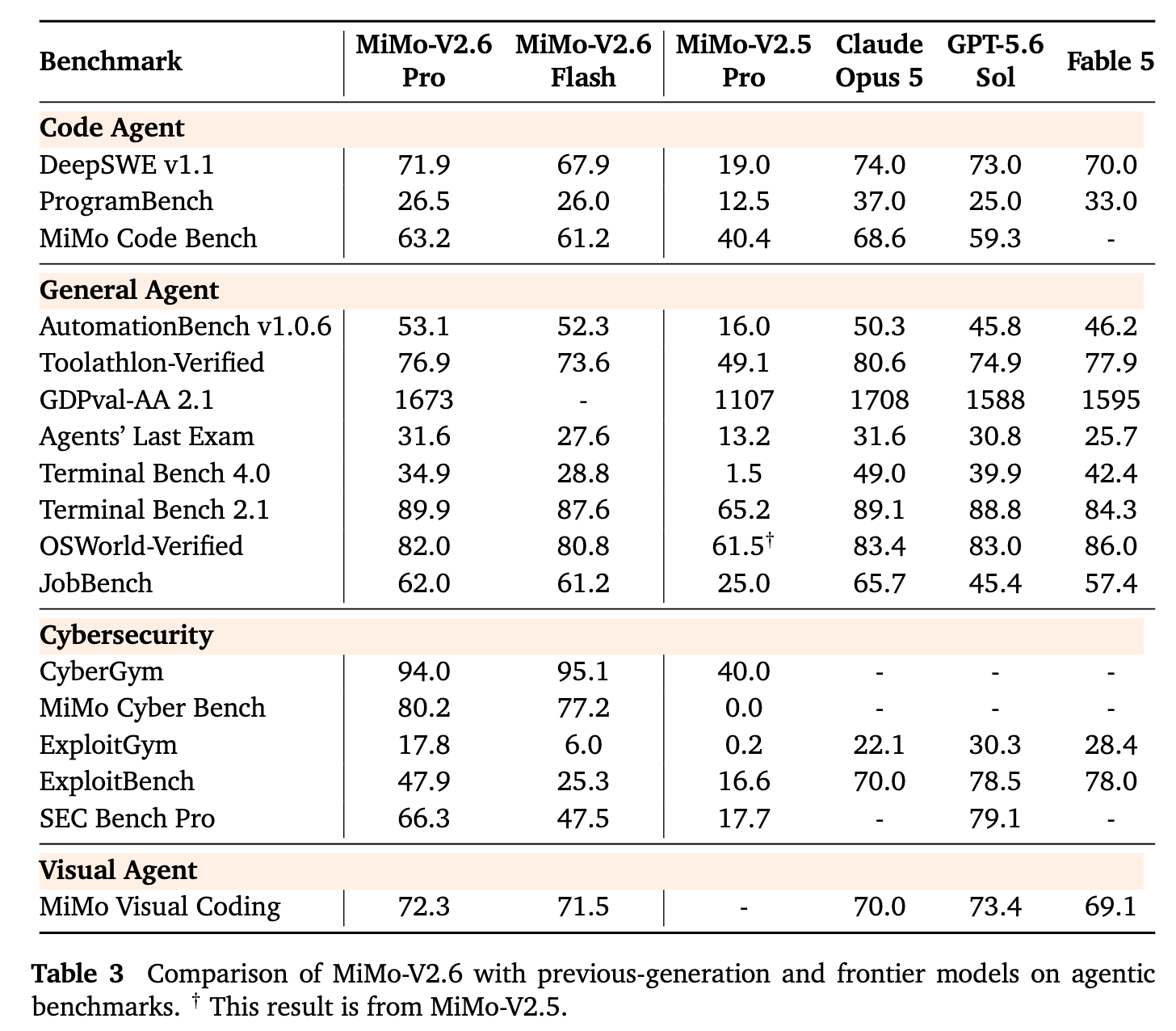
The strongest public evidence for V2.6 is concentrated in agentic benchmarks rather than conventional multiple-choice tests. Xiaomi's official chart compares Pro and Flash with MiMo-V2.5-Pro, Claude Opus 5, GPT-5.6 Sol, and Fable 5 across coding, general-agent, cybersecurity, and visual-agent tasks.
| Benchmark | MiMo-V2.6-Pro | MiMo-V2.6-Flash | Claude Opus 5 | GPT-5.6 Sol |
|---|---|---|---|---|
| DeepSWE v1.1 | 71.9 | 67.9 | 74.0 | 73.0 |
| ProgramBench | 26.5 | 26.0 | 37.0 | 25.0 |
| MiMo Code Bench | 63.2 | 61.2 | 68.6 | 59.3 |
| AutomationBench v1.0.6 | 53.1 | 52.3 | 50.3 | 45.8 |
| Toolathlon-Verified | 76.9 | 73.6 | 80.6 | 74.9 |
| Agents' Last Exam | 31.6 | 27.6 | 31.6 | 30.8 |
| Terminal Bench 2.1 | 89.9 | 87.6 | 89.1 | 88.8 |
| OSWorld-Verified | 82.0 | 80.8 | 83.4 | 83.0 |
| JobBench | 62.0 | 61.2 | 65.7 | 45.4 |
| MiMo Visual Coding | 72.3 | 71.5 | 70.0 | 73.4 |
Coding Progress
Coding gains are clearest in long-horizon execution. During the live RL run, Xiaomi reports that out-of-sample DeepSWE v1.1 improved from 48.8 to 65.7 for Flash and from 58.4 to 72.6 for Pro. In the released cross-model table, Pro reaches 71.9 on DeepSWE v1.1 and 63.2 on MiMo Code Bench, while Flash reaches 67.9 and 61.2. Pro does not win every coding test—Claude Opus 5 remains ahead on DeepSWE, ProgramBench, and MiMo Code Bench—but V2.6 combines competitive repository-scale performance with open weights and substantially lower API pricing.
Reasoning and Agentic Progress
The reasoning advance is better understood as improved planning, tool use, and recovery than as a single abstract intelligence score. Pro records 89.9 on Terminal Bench 2.1, 53.1 on AutomationBench, and 76.9 on Toolathlon-Verified; Flash records 87.6, 52.3, and 73.6. Pro slightly exceeds the listed Claude Opus 5 and GPT-5.6 Sol results on Terminal Bench 2.1, while both V2.6 models lead those comparators on AutomationBench. Xiaomi attributes the improvement to groupwise trajectory comparison, richer graders, multi-harness training, and reward signals that favor shorter, cleaner solution paths.
Knowledge and Research Progress
Knowledge-intensive progress is supported more by agent evaluations and demonstrations than by a conventional knowledge-exam suite. Pro matches Claude Opus 5 at 31.6 on Agents' Last Exam and reaches 62.0 on JobBench. Xiaomi also reports materials-research workflows involving literature and patent retrieval, hypothesis generation, and computational screening, plus a Lean 4 formalization project exceeding 6,000 verified lines. These examples suggest stronger retrieval, synthesis, formal reasoning, and tool-grounded knowledge work, but they should not be treated as independent proof of universal knowledge superiority.
Overall: V2.6's progress is broad but uneven. It is strongest as evidence of improved long-horizon coding and agent execution, while claims about general reasoning and knowledge should remain tied to the specific benchmark, harness, and demonstration.
Benchmark note: Unless otherwise stated, the cross-model results below are reported by Xiaomi in the MiMo-V2.6 model card. Scores may depend on benchmark versions, agent harnesses, tool configurations, inference budgets, and evaluation protocols, so they should not be interpreted as an independently reproduced ranking.
MiMo-V2.6 vs MiMo-V2.5: What Changed?
| Dimension | MiMo-V2.5 generation | MiMo-V2.6 breakthrough |
|---|---|---|
| Training focus | Strong multimodal agents, long context, and token efficiency | Much larger mixed RL program across code, general agents, vision, cybersecurity, and multiple harnesses |
| Agent capability | V2.5-Pro targeted difficult long-horizon work | Xiaomi reports that V2.6-Flash comprehensively outperforms V2.5-Pro on its agent benchmark suite |
| Learning efficiency | Previous production checkpoint | About 750,000 trajectories over 30 RL steps; held-out DeepSWE gains of roughly 17 points for Flash and 14 points for Pro during training |
| Openness | Open weights and ecosystem support | Adds full RL code, 7,000+ task environments, training framework, lightweight harnesses, and a 9B distillation checkpoint |
| Economics | Existing V2.5 API price level | Higher reported intelligence at the same official API prices, moving the capability-cost frontier outward |
Coding and agent execution
Relative to V2.5, the clearest change is a stronger agent policy rather than a longer context window. Xiaomi reports that V2.6-Flash outperforms V2.5-Pro across its agent benchmark suite. During the V2.6 training run, held-out DeepSWE v1.1 improved from 48.8 to 65.7 for Flash and from 58.4 to 72.6 for Pro; these training-run scores are not directly interchangeable with the released-model benchmark table above.
Reasoning, knowledge, and training breadth
V2.6 extends reinforcement learning across coding, general agents, vision, cybersecurity, and multiple harnesses. Xiaomi reports about 750,000 trajectories over roughly 30 RL steps. This supports broader planning, tool use, and recovery, but does not by itself establish a universal gain on every knowledge or reasoning benchmark; compare matched tasks and evaluation settings.
Migration and openness
The release also adds RL code, more than 7,000 task environments, training infrastructure, and a 9B distillation checkpoint. The 1M-token context and multimodal inputs are continuities from V2.5, not new V2.6 breakthroughs.
The practical change is therefore not a new context envelope—the 1M context and full multimodality already existed in V2.5—but a stronger agent policy trained with substantially more reinforcement-learning compute and broader verifiable environments. Xiaomi has announced that V2.5 and V2.5-Pro model names will stop working on October 21, 2026, so new deployments should target V2.6 and existing deployments should plan migration tests.
How V2.6 compares with other frontier models
| Dimension | MiMo-V2.6-Pro | Closed frontier models | Other open-weight models |
|---|---|---|---|
| Weights | Open weights | Typically closed | Model-dependent |
| Verified MiMo context | 1M tokens | Check each official model page | Check each official model card |
| Verified MiMo modalities | Text, image, video, audio | Provider-dependent | Model-dependent |
| Agent-focused RL | Strong release emphasis | Model and system dependent | Model and checkpoint dependent |
| Self-hosting | Yes, with substantial infrastructure | Generally no | Often possible for open checkpoints |
| Primary MiMo advantage | Open weights, native multimodality, low API cost | Provider ecosystem and managed tooling | Varies by license, size, and deployment stack |
For a current comparison set, evaluate MiMo-V2.6 against Claude Opus 5.5 for long-running agentic coding, Claude Fable 5.1 for the hardest autonomous work, GPT-6 Sol, and Gemini 4 Pro. Model availability and prices are dynamic, so production comparisons should use the live catalog and matched prompts, tools, effort budgets, and acceptance criteria.
What Can Xiaomi MiMo-V2.6 Actually Do?
Coding and software-engineering agents
MiMo-V2.6 is designed for long software-engineering trajectories: inspecting repositories, modifying code, using terminal tools, running tests, diagnosing failures, and continuing until an objective is satisfied. Its DeepSWE, Terminal Bench, AutomationBench, and Toolathlon results indicate that Xiaomi is optimizing for execution rather than code completion alone. Practical workloads include coding agents, automated debugging, repository refactoring, CI issue resolution, and multi-tool engineering workflows.
Computer use
Xiaomi explicitly demonstrates a Computer Use Agent (CUA). The model can interpret graphical interfaces, retrieve information, edit content, process data, inspect results, diagnose problems, and change subsequent actions based on visual feedback. In this workflow, the model output is often not the final product; it may instead determine the next software or browser action.
3D worlds and Blender workflows
Under the "Vibe World" concept, MiMo-V2.6 can take text, image, or video references and break a 3D request into scene construction, interaction programming, and visual verification tasks. Xiaomi also demonstrates the model controlling Blender to create 3D objects and scenes from descriptions or reference images. This extends vibe coding beyond application code into interactive environments.
Robotics and embodied agents
Xiaomi demonstrates MiMo-V2.6 in an embodied simulation environment using multi-view camera images and a Franka Panda robotic arm. Example tasks include grasping objects, color matching, and precise placement. This does not establish V2.6 as a universal robotics foundation model, but it shows how native vision and long-horizon decision-making can be connected to embodied control loops.
Scientific research and formal reasoning
Xiaomi reports a materials-science case in which MiMo-V2.6-Pro assisted researchers with metal-organic frameworks for PFAS adsorption, including literature and patent search, candidate formulation, and computational-tool calls. In another experiment, the model helped formalize the main theorem from "Period Three Implies Chaos" in Lean 4. Xiaomi reports a completed project exceeding 6,000 lines of Lean code, verified by the Lean kernel without unproven placeholders. These examples are best interpreted as demonstrations of agentic research workflows, not proof of autonomous scientific discovery.
Websites, presentations, video, and music
MiMo-V2.6 can coordinate front-end coding, design workflows, slides, SVG assets, video pipelines, and music-production tools. Xiaomi demonstrates orchestration with specialized media systems, including narration via MiMo-V2.5-TTS, rather than claiming that V2.6 itself replaces every image, video, or audio generator. The model therefore fits naturally as a creative-production orchestrator.
The use cases in this section are Xiaomi demonstrations, not independent evidence that every deployment will reproduce the same results. Production teams should test the model with their own tools, permissions, failure recovery, and evaluation criteria.
How Much Does Xiaomi MiMo-V2.6 Cost?
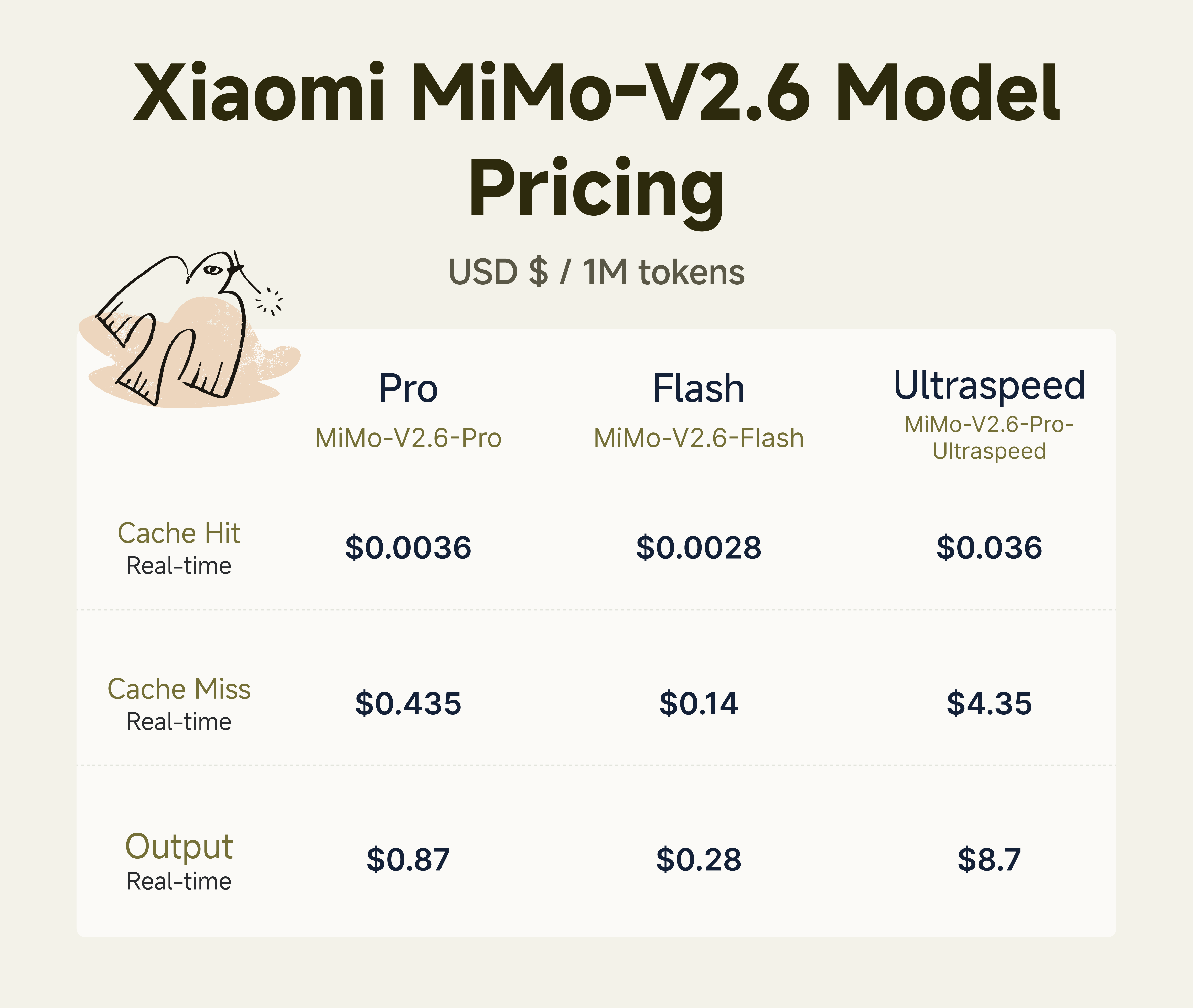
| Pricing | MiMo-V2.6-Pro | MiMo-V2.6-Flash | Pro UltraSpeed |
|---|---|---|---|
| Cached input / 1M tokens | $0.0036 | $0.0028 | $0.036 |
| Uncached input / 1M tokens | $0.435 | $0.14 | $4.35 |
| Output / 1M tokens | $0.87 | $0.28 | $8.70 |
Xiaomi keeps V2.6 API pricing at the same broad level as its V2.5 generation. Flash is especially notable for high-volume workloads: the official Xiaomi pricing shows $0.14 per million uncached input tokens and $0.28 per million output tokens.
CometAPI Pricing and Availability
| CometAPI route | Input / 1M | Output / 1M | Catalog status |
|---|---|---|---|
| mimo-v2.6-pro-ultraspeed | $3.48 | $6.96 | Available; 20% below the listed official uncached rates |
| mimo-v2.6-pro | $0.348 | $0.6960 | Available; 20% below the listed official uncached rates |
| mimo-v2.6-flash | $0.112 | $0.2240 | Available; 20% below the listed official uncached rates |
How Can Developers Access Xiaomi MiMo-V2.6?
Xiaomi exposes the models through an OpenAI-compatible API and documents compatibility with the Anthropic protocol on its official model pages. The official identifiers are mimo-v2.6-pro, mimo-v2.6-flash, and mimo-v2.6-pro-ultraspeed. Xiaomi documents tool calling, structured output, streaming, reasoning controls, context caching, and web search. The OpenAI-compatible interface uses thinking.type values such as enabled or disabled, with deep thinking enabled by default for V2.6 models.
Developers have three practical access paths. First, download the Pro or Flash open-weight checkpoint for a self-hosted integration, subject to substantial serving requirements. Second, use Xiaomi's managed API with a Xiaomi key and its documented endpoint. Third, use a supported CometAPI route with a CometAPI key and base URL; this can simplify multi-model evaluation and billing. Coding assistants such as Claude Code can use an Anthropic-compatible route when that route and model are supported, but compatibility must be tested rather than assumed.
Accessing MiMo-V2.6 through CometAPI
CometAPI provides a unified endpoint and billing layer for supported models. The main operational advantage is migration simplicity: teams can retain a familiar SDK, change the base URL and model ID, compare MiMo with other frontier models in the same account, and centralize usage, pricing, and availability checks. This is useful for multi-model routing, fallback strategies, consolidated invoices, and evaluations that need identical prompts across providers.
CometAPI documents three text-request formats at the platform level: OpenAI Chat Completions, Anthropic Messages, and OpenAI Responses. For a compatible SDK, migration generally means changing the base URL, API key, and model ID rather than rewriting the whole application. Endpoint and parameter support can vary by model, so test the exact MiMo-V2.6 variant and request format before claiming all three routes work for it.
As checked on September 23, 2026, MiMo-V2.6-Pro-UltraSpeed has an available catalog route with listed input and output prices. The dedicated Pro and Flash pages show Coming soon in their catalog snapshots even though their API-health panels say Available. Treat this as an inconsistent page signal, not confirmed production availability or pricing. Check the live catalog, dashboard, and a test request before deployment.
The following example follows CometAPI's published Anthropic-SDK pattern and calls the currently listed UltraSpeed route. Store the API key in an environment variable.
import Anthropic from '@anthropic-ai/sdk';

const client = new Anthropic({
  apiKey: process.env.COMETAPI_KEY,
  baseURL: 'https://api.cometapi.com',
});

const message = await client.messages.create({
  model: 'mimo-v2.6-pro-ultraspeed',
  max_tokens: 4096,
  messages: [{ role: 'user', content: 'Analyze this project and propose the next implementation steps.' }],
});
Is Xiaomi MiMo-V2.6 Open Source?
Xiaomi has released model weights, technical material, RL resources, training environments, and related infrastructure. The release includes more than 7,000 RL task environments spanning software engineering, vulnerability reproduction, knowledge-intensive work, and web design/development. Xiaomi also released MiMo-V2.6-Distill-Qwen-9B so researchers can study the RL pipeline at a much smaller scale.
Official model cards: MiMo-V2.6-Pro-RL | MiMo-V2.6-Flash-RL
What Are the Limitations of Xiaomi MiMo-V2.6?
The trillion-parameter headline should not be treated as proof that V2.6 is universally stronger than closed frontier systems. Xiaomi's own benchmark table shows a mixed picture: Claude Opus 5 remains ahead on some coding, tool-use, and OS benchmarks, while GPT-5.6 Sol also leads on selected tests. Workload-specific evaluation is therefore more meaningful than a blanket winner label.
Self-hosting the full Pro checkpoint is also an infrastructure-heavy task. Open weights do not mean easy workstation deployment. In addition, several headline demonstrations—research, embodied control, 3D worlds, and video production—depend on external tools and agent harnesses. MiMo-V2.6 should be evaluated as a model inside a system, not just as a standalone chat model.
Why Does Xiaomi MiMo-V2.6 Matter?
MiMo-V2.6 combines three important directions: very large sparse MoE models, native multimodality, and reinforcement learning over real agent environments. The 1.02T parameter figure attracts attention, but the more consequential design choice is Xiaomi's investment in repeated environment interaction, trajectory grading, tool use, and self-correction.
If this approach continues to scale, open models may increasingly be differentiated not only by how much static knowledge they contain, but by how effectively they act, evaluate, recover, and complete long tasks. MiMo-V2.6 is therefore best understood as an open agent-oriented foundation model rather than simply another trillion-parameter chatbot.
Conclusion
MiMo-V2.6 is a substantial open-weight release because it combines native text, image, video, and audio input with long context, sparse MoE inference, and reinforcement learning across real agent environments. Pro is the better fit for difficult long-horizon tasks, Flash targets high-volume and cost-sensitive workloads, and UltraSpeed trades a significantly higher API price for lower latency.
The model family is competitive on several vendor-reported agent benchmarks, but it does not lead every evaluation and should not be treated as a universal replacement for closed frontier models. The most reliable adoption path is to test MiMo-V2.6 against the exact tools, latency targets, failure modes, and cost profile of the intended production workflow.
FAQ
What should teams test before moving MiMo-V2.6 into production?
Test the complete system rather than the model alone. Measure task completion, tool-call accuracy, recovery from failed actions, latency, token consumption, context management, and permission boundaries. Agent benchmarks provide orientation, but internal evaluations should mirror the actual repository, browser, document, or research workflow.
Why can self-hosting MiMo-V2.6-Pro be difficult despite its sparse architecture?
Sparse activation reduces per-token compute relative to a dense trillion-parameter model, but the full checkpoint still has a very large memory and distributed-serving footprint. Production deployment may require multi-node inference, expert parallelism, specialized kernels, and careful capacity planning.
How should developers interpret Xiaomi's cross-model benchmark table?
Treat it as vendor-reported evidence, not an independently reproduced universal ranking. Results can change with the agent harness, inference budget, tools, environment image, sampling method, and benchmark version. Compare trends across multiple tasks and reproduce the most relevant workloads internally.
When is MiMo-V2.6-Flash a better choice than Pro?
Flash is the stronger default when call volume and cost dominate, especially for document processing, multimodal analysis, and repeated agent steps. Pro is more appropriate when difficult reasoning or long-horizon execution provides enough business value to justify the higher price.
Does a 1M-token context window eliminate the need for retrieval or prompt management?
No. A larger window increases capacity, but sending unnecessary history can raise latency and cost and may dilute relevant evidence. Retrieval, summarization, structured memory, and context pruning remain important for reliable production agents.