

TL;DR: Which Provider Is Cheapest?
For normal interactive GPT-6 Astra requests, GPT-6 Astra API in CometAPI has the lowest clearly published Standard short-context rate in this comparison at $8 per million input tokens and $40 per million output tokens. OpenAI Standard is $10/$50.
For delay-tolerant jobs, the economics change: OpenAI prices Batch and Flex at 50% of Standard, which works out to $5/M input and $25/M output for short-context Astra requests. OpenRouter also exposes a Batch route at $5/$25. Those routes are cheaper than interactive Standard inference, but they are not direct substitutes for latency-sensitive applications.
For testing before paying, CometAPI says new accounts receive free signup credits with no credit card required. Azure offers eligible new customers $200 in credit for 30 days, while AWS offers new customers up to $200 in credits under its Free Tier program. Credit eligibility and model access should be verified in the account before assuming Astra usage is covered.
Eligibility note: promotional credits and GPT-6 Astra access vary by account, region, and program. Verify both credit eligibility and model access before estimating a free trial.
Key Takeaways
- Cheapest verified interactive rate here: CometAPI Standard at $8/M input and $40/M output, 20% below OpenAI Standard.
- Cheapest delay-tolerant route: OpenAI Batch/Flex or OpenRouter Batch at $5/M input and $25/M output.
- OpenAI has no Free API tier for Astra; the official rate-limit table marks Free as unsupported.
- CometAPI is the lowest-friction trial in this comparison because signup credits are offered without a credit card; the current credit amount is intentionally not hard-coded.
- The 272K-input boundary matters: above it, Astra moves to long-context pricing for the entire request.
- Do not compare only token prices. Caching, tools, retries, latency, context growth, and accepted-task success can dominate total cost.
What Is GPT-6 Astra, and Why Is Its API Premium-Priced?
GPT-6 Astra is OpenAI’s flagship model for difficult end-to-end work rather than low-cost, high-volume chat. OpenAI positions it for complex reasoning, software engineering, research, computer use, professional workflows, and long-running agents.
The official model specification gives Astra a 1,050,000-token context window, a 128,000-token maximum output, an April 30, 2026 knowledge cutoff, text and image input, and text output. It supports five reasoning-effort settings: low, medium, high, xhigh, and max.
| GPT-6 Astra specification | Value |
|---|---|
| Developer | OpenAI |
| Model ID | gpt-6-astra |
| Context window | 1,050,000 tokens |
| Maximum output | 128,000 tokens |
| Knowledge cutoff | April 30, 2026 |
| Input | Text, images |
| Output | Text |
| Reasoning effort | Low, Medium, High, XHigh, Max |
| Function calling | Supported |
| Structured outputs | Supported |
| Computer use | Supported |
| Web / file search | Supported |
| Fine-tuning | Not supported |
| Standard short-context price | $10/M input; $50/M output |
| Cached input | $1/M |
| Cache write | $12.50/M |
| Long-context threshold | More than 272K input tokens |
The context limit is also a pricing boundary. For prompts above 272K input tokens, OpenAI applies 2× input/cache pricing and 1.5× output pricing to the full request. A request that grows only slightly past 272K can therefore jump materially in total cost.
Astra also introduces agent-oriented capabilities such as async tool calling and mid-turn steering. That is why a useful provider comparison has to consider tools, caching, processing tier, and task completion—not only the headline input price.
How Good Is GPT-6 Astra? Official Benchmark Performance
The official benchmark table records strong results across computer use, professional automation, long context, science, coding, and cybersecurity. It reports 97.6% on FrontierMath Tier 4 (v2), 99.9% on ARC-AGI-3, and 100% on ExploitBench. These are vendor-published evaluation results and should be interpreted with the stated methodology.
| Benchmark | GPT-6 Astra | Comparison / meaning |
|---|---|---|
| FrontierMath Tier 4 (v2) | 97.6% | Research-level mathematics |
| ARC-AGI-3 | 99.9% | Novel reasoning / adaptation |
| ExploitBench | 100.0% | Cybersecurity exploit capability |
| OSWorld 2.0 | 72.6% | Computer-use tasks |
| ScreenSpot-Pro | 92.7% | Visual UI grounding |
| AutomationBench | 41.4% | Professional workflow automation |
| BenchCAD | 95.9% | CAD / professional design tasks |
| BrowseComp | 91.5% | Browser-based information retrieval |
| MRCR v2, 512K–1M | 96.3% | Very-long-context retrieval |
| Terminal-Bench Science 0.1 | 64.6% | Scientific agent workflows |
For cost evaluation, OpenAI's OSWorld 2.0 results record 72.6% at roughly 40 minutes per task for Astra, versus 65.7% at roughly 75 minutes for GPT-5.6 Sol. This supports evaluating cost per completed task rather than treating per-token pricing as the entire cost model.
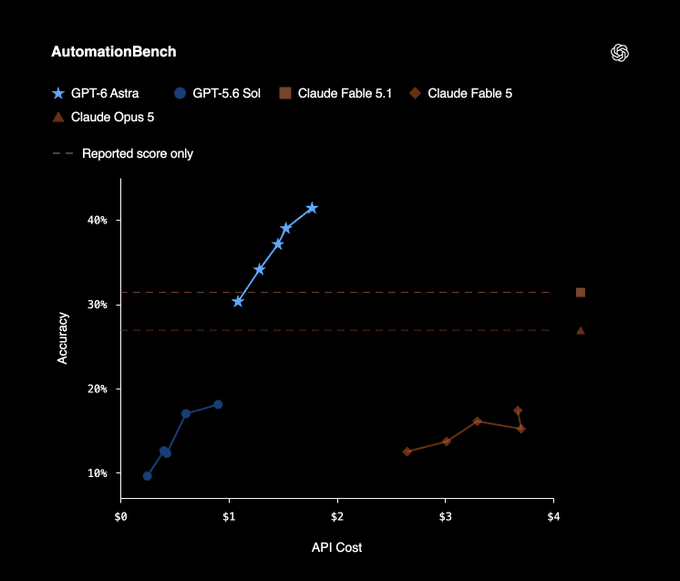
Official OpenAI AutomationBench benchmark graphic.
Which GPT-6 Astra API Provider Is Cheapest in 2026?
The table below compares publicly verifiable token pricing for the same GPT-6 Astra model. It excludes unusually cheap relay quotes when model provenance, context limits, privacy, or service behavior cannot be independently verified. CometAPI’s live model pricing shows $8/M input and $40/M output for short-context Standard access.
| Provider / route | Input / 1M | Output / 1M | Trial / credit | Best fit |
|---|---|---|---|---|
| CometAPI Standard | $8 | $40 | Signup credits | Lowest verified interactive rate here |
| OpenAI Standard | $10 | $50 | No Astra Free API tier | Direct first-party access |
| OpenAI Batch / Flex | $5 | $25 | Same API account | Lowest first-party delay-tolerant rate |
| OpenRouter Standard | $10 | $50 | No Astra-specific trial verified | Multi-provider routing |
| OpenRouter Batch | $5 | $25 | No Astra-specific trial verified | Low-cost async routing |
| Azure Global | $10 | $50 | $200 / 30 days for eligible new users | Microsoft cloud workloads |
| Azure US Data Zone | $11 | $55 | Azure credit subject to eligibility | Data-zone requirements |
| AWS Global CRIS | $10 | $50 | Up to $200 general AWS credits | AWS-native workloads |
| AWS In-Region | $11 | $55 | AWS credits subject to eligibility | Regional deployment |
Azure’s published Astra table confirms $10/$50 for Standard Global and $11/$55 for the US Data Zone. Microsoft Foundry pricing details also show the corresponding long-context bands. AWS publishes $10/$50 for Global CRIS and $11/$55 for In-Region/Geo CRIS. Amazon Bedrock pricing states that these are Standard-tier rates.
There are therefore two different “cheapest” answers. For interactive Standard inference, CometAPI is the price leader in this verified set. For asynchronous or flexible workloads, Batch/Flex at $5/$25 has the lower raw token rate.
Pricing note: provider rates and promotional credits can change. Recheck the linked provider documentation immediately before publication or production budgeting.
How Much Cheaper Is GPT-6 Astra API in CometAPI?
| Token category | OpenAI Standard | CometAPI | Difference |
|---|---|---|---|
| Input | $10.00/M | $8.00/M | 20% lower |
| Cached input | $1.00/M | $0.80/M | 20% lower |
| Cache write | $12.50/M | $10.00/M | 20% lower |
| Output | $50.00/M | $40.00/M | 20% lower |
| Long-context input | $20.00/M | $16.00/M | 20% lower |
| Long-context output | $75.00/M | $60.00/M | 20% lower |
The practical implication is simple: if your application needs Standard-style interactive inference rather than Batch/Flex, CometAPI’s published Astra rates reduce the token component by 20% across the matching categories.
Which GPT-6 Astra API Provider Has the Best Free Trial?
“Free GPT-6 Astra API” can mean either a permanent model free tier or temporary promotional credits. Those are not the same thing. OpenAI’s official Astra rate-limit table marks the Free API tier as unsupported.
CometAPI: the simplest no-card trial path
CometAPI’s quickstart states that new accounts receive free signup credits and that no credit card is required to start. Because the promotional amount can change, the live signup or pricing screen should be treated as the source of truth instead of hard-coding a dollar figure.
Azure: the clearest fixed-value cloud trial
Eligible new Azure customers can receive $200 in Azure credit for 30 days. If GPT-6 Astra is enabled for the account and region, that credit can make Azure useful for proof-of-concept testing before normal billing.
AWS: a longer general credit window
AWS offers new customers $100 in credits at signup and opportunities to earn another $100—up to $200 over six months. Because the AWS Free plan does not expose every AWS service and feature, verify account-plan eligibility and Bedrock model access before treating the credit as a guaranteed Astra trial.
When Is OpenAI Batch Cheaper for GPT-6 Astra?
The biggest cost mistake is comparing only providers while ignoring processing tier. OpenAI states that Batch and Flex cost 50% of Standard, while Fast mode costs 2× the applicable rate. For short-context Astra requests, the range is therefore $5/$25 at Batch/Flex, $10/$50 at Standard, and $20/$100 at Fast.
| Processing option | Input / 1M | Output / 1M | Relative to OpenAI Standard |
|---|---|---|---|
| Batch | $5 | $25 | 50% |
| Flex | $5 | $25 | 50% |
| CometAPI Standard | $8 | $40 | 80% of OpenAI Standard |
| OpenAI Standard | $10 | $50 | 100% |
| OpenAI Fast | $20 | $100 | 200% |
Batch/Flex should be evaluated first for nightly analysis, offline code review, dataset enrichment, evaluation runs, and non-urgent research. For applications where a user is actively waiting, the Standard comparison remains more relevant.
How Much Will GPT-6 Astra Actually Cost You?
Consider a short-context agent request using 100,000 input tokens and 10,000 output tokens. Ignoring cache and tool charges, the simplified cost is input tokens × input rate + output tokens × output rate.
| Provider / route | Cost per request | Cost for 1,000 equivalent requests |
|---|---|---|
| OpenAI Batch/Flex | $0.75 | $750 |
| CometAPI Standard | $1.20 | $1,200 |
| OpenAI Standard | $1.50 | $1,500 |
| OpenRouter Standard | $1.50 | $1,500 |
| Azure Global | $1.50 | $1,500 |
| AWS Global CRIS | $1.50 | $1,500 |
| AWS In-Region | $1.65 | $1,650 |
The $0.30 difference between CometAPI Standard and OpenAI Standard looks small on one request. At 10,000 equivalent requests, it becomes about $3,000 before tool costs or retries.
Long context changes the math again. At 300K input and 20K output, OpenAI Standard is about $7.50 at the published long-context rate, while the matching CometAPI rates yield about $6.00. This is why the 272K threshold should be explicitly monitored in production telemetry.
How Can You Reduce GPT-6 Astra API Costs Without Changing Providers?
Prompt caching is a major lever because Astra’s Standard cached-input rate is one tenth of fresh input. Stable system instructions, tool definitions, reusable reference material, and common prompt prefixes are strong candidates for cache-aware design.
Context control is the second lever. A 1.05M-token window is a capacity ceiling, not a target. Staying below the 272K pricing boundary when extra history is unnecessary can have a larger effect than minor prompt compression.
Processing tier is the third lever: Batch/Flex for delay-tolerant work, Standard for ordinary interactive production, and Fast only where lower latency has measurable business value. Finally, measure cost per accepted task—not only cost per token—because retries, tool calls, and human correction can reverse a simple rate-card comparison.
Which GPT-6 Astra API Provider Should You Choose?
| Your priority | Best starting option | Why |
|---|---|---|
| Lowest interactive token price | CometAPI | $8/$40 short-context Standard rate |
| Lowest delay-tolerant token price | OpenAI Batch/Flex or OpenRouter Batch | $5/$25 |
| No-card trial | CometAPI | Signup credits; no card required |
| Largest fixed short-term cloud trial | Azure | $200 for 30 days for eligible new users |
| Longer general cloud-credit window | AWS | Up to $200; verify Astra/Bedrock eligibility |
| Native first-party OpenAI access | OpenAI | Direct API and newest native capabilities |
| Existing Microsoft cloud architecture | Azure Foundry | Microsoft governance and procurement |
| Existing AWS architecture | Amazon Bedrock | AWS security, billing, and regional controls |
| Multi-provider routing | OpenRouter | One routing layer across providers |
For an independent developer or cost-sensitive team that needs interactive Astra inference, CometAPI is the strongest price-first starting point in this comparison. For large offline jobs, Batch/Flex should be evaluated before changing provider because its 50% processing-tier discount is larger than the 20% Standard-rate difference.
For enterprise teams, the lowest token rate may not produce the lowest total cost. Azure or AWS can still be the better economic choice when a team already depends on committed cloud spend, private networking, centralized procurement, or built-in security and compliance controls. Evaluate those operational savings separately from the model's per-token price.
How Do You Call the GPT-6 Astra API Through CometAPI?
CometAPI uses an OpenAI-compatible integration pattern. Create a CometAPI API key, point the OpenAI SDK at the CometAPI base URL, and call the `gpt-6-astra` model. The CometAPI Astra model documentation publishes both Chat Completions and Responses endpoints.
from openai import OpenAI
import os

client = OpenAI(
    api_key=os.environ["COMETAPI_KEY"],
    base_url="https://api.cometapi.com/v1",
)

response = client.responses.create(
    model="gpt-6-astra",
    reasoning={"effort": "medium"},
    input="Analyze this software architecture and identify the three highest-risk bottlenecks.",
)

print(response.output_text)
For new tool-heavy agents, the Responses API is the more important interface because Astra’s agentic capabilities are designed around that workflow.
Is an Ultra-Cheap GPT-6 Astra Relay Really Cheaper?
Price aggregators sometimes surface relays quoting Astra far below mainstream rates. Those offers should not automatically be treated as equivalent. Confirm model provenance, full context support, tool behavior, privacy terms, logging policy, uptime, rate limits, and how the provider sustains a price below normal upstream economics.
Relay-risk note: for production agents, source code, enterprise documents, customer data, or security-sensitive workloads, model provenance and data handling are part of the effective price. Verify context support, tool behavior, privacy terms, logging, uptime, and rate limits before using a low-cost relay.
GPT-6 Astra API FAQ: Pricing, Free Trials, and Providers
What is the cheapest GPT-6 Astra API provider?
For Standard interactive inference among the providers verified here, CometAPI is cheapest at $8/M input and $40/M output. For delay-tolerant workloads, OpenAI Batch/Flex and OpenRouter Batch are cheaper at $5/$25.
Is there a free GPT-6 Astra API?
There is no permanent OpenAI Free API tier for Astra. Promotional credits from CometAPI, Azure, or AWS can reduce or temporarily cover testing costs, subject to each program’s eligibility and model-access rules.
Does CometAPI offer a GPT-6 Astra free trial?
CometAPI states that new accounts receive free signup credits and that no credit card is required to start. Because promotions change, verify the current credit amount at signup.
How much does GPT-6 Astra cost through OpenAI?
OpenAI Standard short-context pricing is $10/M input, $1/M cached input, $12.50/M cache write, and $50/M output. Above 272K input tokens, Standard rates become $20/M input, $2/M cached input, $25/M cache write, and $75/M output for the full request.
Why can GPT-6 Astra Batch be cheaper than CometAPI?
Batch/Flex is a different processing tier, not simply a different provider. OpenAI prices it at half of Standard, or $5/M input and $25/M output for short-context Astra requests. CometAPI’s $8/$40 rate is an interactive Standard-style rate.
Is Azure cheaper than OpenAI for GPT-6 Astra?
Azure Standard Global aligns with OpenAI Standard at $10/M input and $50/M output. Azure may still be economically attractive because of new-account credit, enterprise agreements, Microsoft governance, and existing committed spend.
Is AWS Bedrock cheaper than OpenAI for GPT-6 Astra?
AWS Global CRIS is $10/$50, while In-Region and Geo CRIS are $11/$55 for short context. AWS may still be preferable for teams that value existing cloud billing, regional controls, and infrastructure integration.
Is OpenRouter cheaper for GPT-6 Astra?
OpenRouter Standard is $10/$50, so it does not beat OpenAI on the Standard token rate. Its Batch route is $5/$25; its broader advantage is multi-provider routing.
What is the biggest hidden GPT-6 Astra API cost?
The 272K input threshold is one of the most important hidden cost boundaries. Tool calls, web/file search, retries, cache misses, and unnecessarily long agent trajectories can also materially raise total task cost.
Should I choose a provider only by token price?
No. Compare successful-task cost, latency, uptime, context support, tool compatibility, caching behavior, data policy, account limits, and rate limits. The cheapest token is useful only if the route reliably delivers the workload you need.