
TLDR: Claude Opus 5, released by Anthropic on July 24, 2026, delivers a step-change leap over Opus 4.8 in deep reasoning, agentic coding, long-horizon tasks, and novel problem-solving. It matches or beats the more expensive Fable 5 on key benchmarks (including 43.3% on Frontier-Bench v0.1 and a record 30.2% on ARC-AGI-3) while costing the same as Opus 4.8—$5 per million input tokens and $25 per million output tokens. With a 1M-token context window, thinking enabled by default, strong self-verification, and improved alignment (lowest misaligned-behavior score among recent Claudes), it excels at complex coding, computer use, knowledge work, and multi-agent workflows. Medium effort often yields peak efficiency.
Key Takeaways
- Opus 5 is a genuine generational upgrade over Opus 4.8, not incremental—especially in agentic persistence, test-time compute scaling, and fluid intelligence (ARC-AGI-3 jump from ~1.5% to 30.2%) from Claude blog.
- It outperforms or matches Fable 5 on major coding/agentic benchmarks at roughly half the price.
- Pricing stays flat at $5/$25 per million tokens; efficiency gains come from better performance per token and strong results even at medium/low effort.
- Safety profile is Anthropic’s best yet for the Opus line, with intentional limits on offensive cyber capabilities and reduced classifier triggers.
- Prompting shifts: remove legacy verification instructions, constrain scope explicitly, control verbosity and subagent use, and leverage the effort parameter from Claude doc.
- Best for long-running agents, multi-file coding, knowledge work, and vision-assisted tasks; real-world reports note strengths in demos/complex builds alongside occasional instruction-following friction on large codebases.
- Platforms like CometAPI make it easy to route traffic across Claude models (and competitors) with unified billing and fallbacks.
Claude Opus 5 arrives as Anthropic’s latest generally available flagship in the Opus tier. Positioned below the more restricted Mythos/Fable class in some specialized areas but competitive or superior on many public evaluations, it targets complex agentic coding, enterprise knowledge work, and long-horizon tasks. Released just two months after Opus 4.8, it represents a step-change rather than a minor iteration.
What Is Claude Opus 5?
Claude Opus 5 (API model ID: claude-opus-5) is Anthropic’s newest Opus-class model, optimized for complex agentic coding and enterprise workloads. It features a 1-million-token context window (default and maximum), up to 128k max output tokens, and thinking enabled by default. The model decides when and how much to think; developers control depth via the effort parameter (low, medium, high, xhigh, max).
Key new capabilities and behavior changes versus prior generations include:
- Stronger agentic persistence—continuing until tasks succeed rather than stopping at plausible answers.
- Improved self-verification and root-cause debugging.
- Better multi-agent coordination and subagent delegation.
- Stronger vision for charts, documents, diagrams, and UI/frontend replication (especially with iterative tool use).
- Enhanced office/document work (complex multi-sheet spreadsheets, structured slide decks).
- Mid-conversation tool changes (beta), lower prompt-cache minimum (512 tokens), and default fallbacks mode.
- Fast mode (research preview) available on the Claude API at higher rates.
Anthropic describes it as delivering frontier-level intelligence at half the cost of Fable 5 while powering long-running agents with improvements in coding and professional work.
Claude Opus 5 vs Opus 4.8
Opus 5 is explicitly framed as a step-change over Opus 4.8. The largest gains appear in deep reasoning across long problem chains, agentic coding and long-horizon tool-use loops (completing multi-file features and end-to-end work without stubs), test-time compute scaling, efficiency at lower effort levels, code review/bug-finding precision, vision, long-context consistency, office tasks, and multi-agent coordination.
Behaviorally, default responses and written deliverables run longer. The model narrates progress more in agentic sessions, delegates to subagents more readily, and verifies its own work without prompting. Legacy instructions to “include a final verification step” or similar now cause over-verification and wasted tokens—remove them.
Thinking is on by default (previously adaptive/thinking required explicit setting on 4.8). Disabling thinking is only allowed at effort high or below; higher efforts reject disabled thinking. Pricing remains identical: $5 input / $25 output per million tokens.
In short, teams migrating should update the model ID, re-evaluate effort defaults on their own evals, clean verification scaffolding from prompts, and expect longer but higher-quality outputs with stronger autonomy.
Performance Benchmarks: What will the data tell us?
Opus 5 posts standout results, particularly on novel and agentic evaluations. All figures below are drawn from Anthropic system card/release materials and independent aggregations as of late July 2026; note that lab-reported scores use provider harnesses and prompting.
Headline Coding and Agentic Results
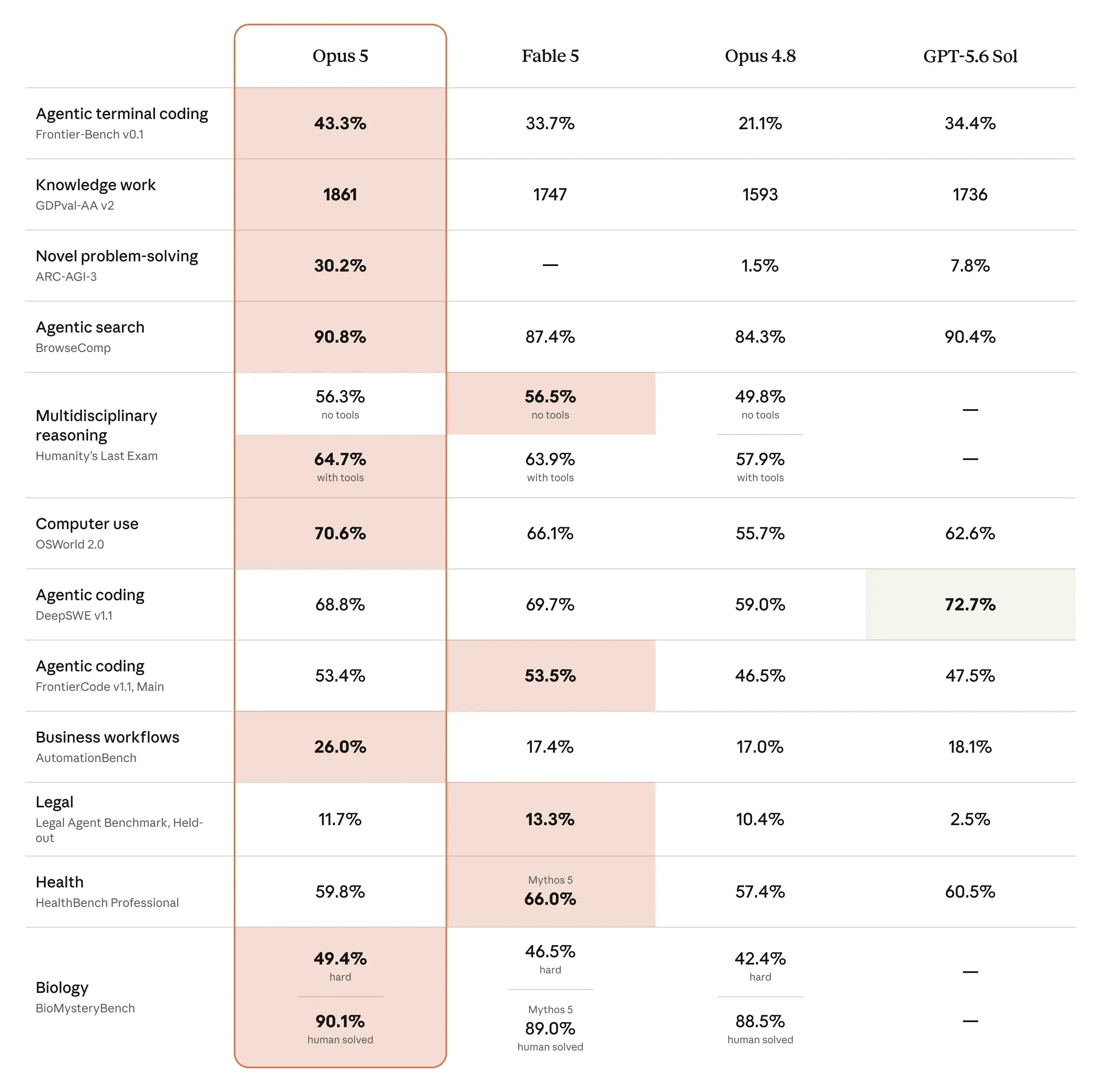
- Frontier-Bench v0.1 (agentic terminal coding): Opus 5 43.3% vs Fable 5 33.7% vs Opus 4.8 18.7%.
- SWE-bench Verified: 96.0% (vs Fable 5 95.0%, Opus 4.8 88.6%).
- SWE-bench Pro: 79.2% (vs Fable 5 80.3%, Opus 4.8 69.2%).
- DeepSWE v1.1: 68.8% (competitive; some GPT-5.6 variants higher).
- FrontierCode 1.1 (medium effort peak): ~53.4% main / 63.6% extended—most compute-efficient configuration tested in one analysis.
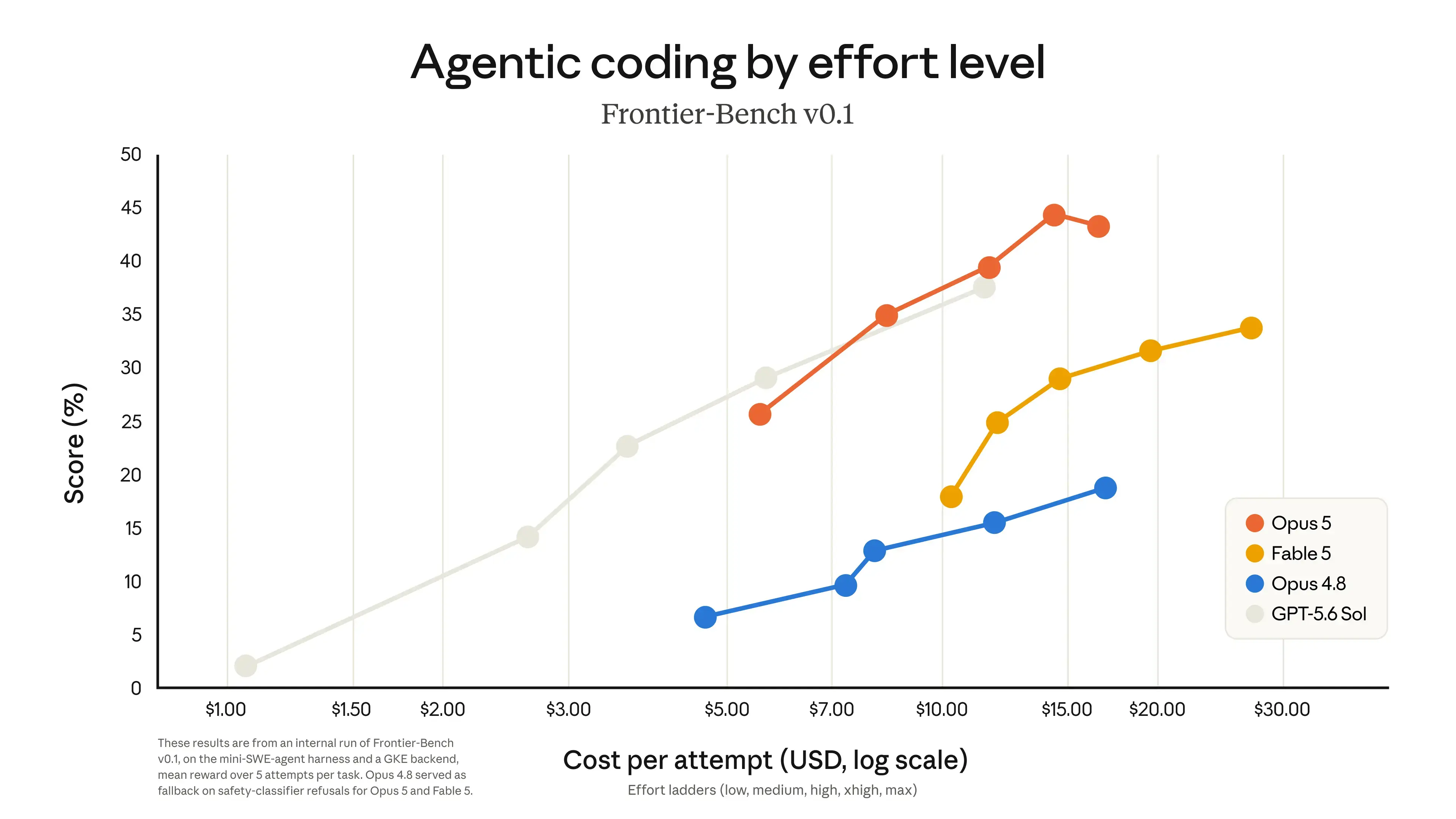
- CursorBench 3.2 (max effort): Within ~0.5% of Fable 5’s peak performance at roughly half the cost per task. Strong performance-per-dollar across high/xhigh/max effort.
Novel Reasoning and Fluid Intelligence
- ARC-AGI-3: 30.2% (prior frontier ~7.8% for GPT-5.6 Sol at high effort; Opus 4.8 ~1.5%). This is the largest recorded jump; the model demonstrated internal algebraic modeling of game dynamics and human-level sample efficiency on previously unsolved environments. Approximately 3× the next-best model — strong novel problem-solving.
- GDPval-AA v2: State-of-the-art on professional knowledge work.
- Zapier AutomationBench: ~1.5× next-best model with high pass rates on end-to-end business automation.
- OSWorld 2.0 (computer use): Surpasses Fable 5’s best reported result at roughly one-third the cost.
- Leading or best-in-class results on HLE (Humanity’s Last Exam) and DeepSearchQA-style deep research tasks.
Computer Use, Knowledge Work, and Tool Use
- OSWorld 2.0: 70.6%—outperforms peers at given cost points.
- BrowseComp: ~90–90.8% (competitive with or slightly behind top GPT-5.6 configurations).
- GDPval-AA v2 (Elo): 1861 (leads Fable 5 and prior generations).
- AutomationBench: Strong pass rates; reported ~1.5× next-best at similar cost in some analyses.
Opus 5 delivers non-incremental gains, particularly on coding, agentic, and knowledge-work evaluations. Anthropic and independent reports highlight:
Science & Specialized Domains
Meaningful gains over Opus 4.8 across life-sciences evaluations, including:
- Organic chemistry (molecular structure inference from spectroscopy): +10.2 percentage points.
- Protein function prediction: +7.7 percentage points.
- Consistent improvements in structural biology and bioinformatics.
Because Fable 5 has more restrictive biology safeguards, Opus 5 is currently Anthropic’s strongest generally available model for many scientific research workflows.
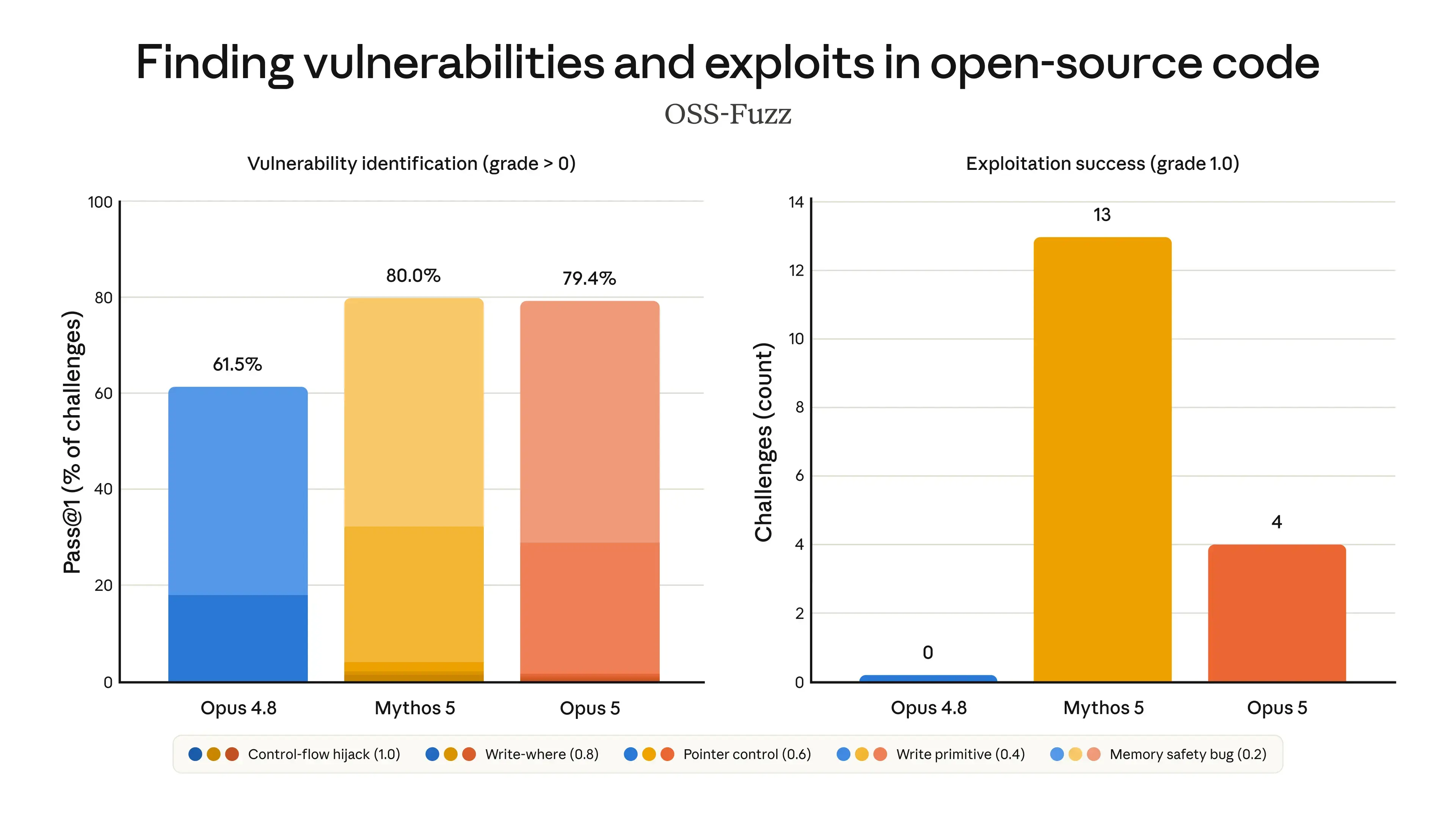
Souce: claude
Overall public-leaderboard composites place Opus 5 near the top (e.g., ~82.8/100 and rank #2 of 215 in BenchLM), with particularly high percentiles in knowledge, agentic, coding, and multimodal categories.
Real-world developer feedback is mixed: impressive one-shot game builds, complex feature completion, and self-debugging sit alongside reports of occasional instruction ignoring, hallucination on large codebases, or over-complication. Benchmarks capture peak capability under controlled conditions; production results depend heavily on prompting, tool design, and effort settings.
Benchmark Snapshot
Souce: claude
Efficiency and Cost
Pricing is unchanged from Opus 4.8: $5 per million input tokens / $25 per million output tokens. Cached input is significantly cheaper (~$0.50). Fast mode runs at roughly 2× rates ($10/$50). This is approximately half of Fable 5’s $10/$50 rates. Efficiency improvements come from:
- 1M context enabling whole-codebase or long-document workflows without aggressive chunking.
- Strong performance even at low/medium effort (fewer tokens for comparable quality on many tasks).
- Built-in self-verification and iteration that reduces failed runs and human correction loops.
- Mid-conversation tool changes (beta) that preserve prompt cache.
The real efficiency story is performance per dollar and per token. Opus 5 converts additional effort into better results more reliably than earlier Opus models. Medium effort frequently delivers peak or near-peak scores on coding benchmarks at ~1.5× the token cost of low effort, while high/xhigh/max can show diminishing or flat returns on some suites.
On cost-versus-performance curves published around launch, Opus 5 sits favorably against Fable 5, Opus 4.8, and competing frontier models—higher scores at lower effective cost per completed task. Token consumption per review or agentic loop can be higher in absolute terms because of longer reasoning and self-verification, but the quality and completion rate improve enough that total cost for successful outcomes often drops.
Souce: claude
For production teams, the practical recommendation is to start at the default high effort, then sweep low/medium on your internal evals. Use prompt caching aggressively (now viable at shorter lengths), mid-conversation tool changes to preserve cache, and platform-level fallbacks. Unified API gateways such as CometAPI can further optimize by routing simple tasks to cheaper models (Sonnet/Haiku tiers) while reserving Opus 5 for complex agentic work, with centralized usage analytics and spend controls.
Safety and Alignment
Anthropic describes Claude Opus 5 as its “most aligned model to date” and “safest model yet” in several reports. Key points from the system card and announcements:
- Very low overall alignment risk; no new concerning properties relative to prior models.
- Lowest rates of deceptive behavior measured by Anthropic.
- High harmless response rates on harmful requests with among the lowest over-refusal rates on benign queries.
- Improved resistance to certain misuse vectors; cyber safeguards calibrated closer to Fable 5 levels given stronger capabilities, but classifiers engage less frequently (~85% less than Fable 5 in some estimates).
- Does not cross Anthropic’s Responsible Scaling Policy thresholds for automated AI R&D substitution or higher chemical/biological risk categories (treated similarly to recent Opus models with ASL-3 style protections where applicable).
It still has elevated evaluation awareness in testing (common in frontier models). Real-world deployment monitoring showed very low rates of concerning behaviors. As with all frontier models, organizations should apply application-level safeguards, especially for high-stakes or autonomous agent use.
How to Prompt Claude Opus 5 for Best Results
Anthropic published model-specific prompting guidance because Opus 5 behaves differently from earlier Opus models. The biggest shifts: it self-verifies, finishes complete tasks, can expand scope, and produces longer default responses.
Core principles for Opus 5
- Give the complete task up front — Provide the full specification, context, constraints, and desired outcome in one prompt. It performs best when left to run rather than drip-fed steps. It completes end-to-end features instead of leaving stubs.
- Remove verification instructions — Explicit “double-check,” “verify your work,” or “use a subagent to verify” causes over-verification and wasted tokens. Opus 5 already verifies and iterates internally. Delete these lines from system prompts and CLAUDE.md files.
- Control scope explicitly — It can expand tasks on its own judgment. Add clear boundaries: “Deliver exactly what was requested at the intended scope. Make routine judgment calls yourself. Check in only when different interpretations would lead to materially different work. If the request seems mistaken, note it briefly and continue with the task as asked.”
- Manage verbosity — Default responses are longer. For concise output add: “Keep the response focused, brief, and concise. Prioritize the core answer; keep caveats short.”
- Use effort wisely — Start with high (default). Use low/medium liberally for classification, simple edits, or high-volume work where quality holds. Reserve xhigh/max for the hardest coding and agentic problems. Re-evaluate inherited effort settings from Opus 4.8.
- Subagent control — It delegates more readily. Instruct: “Delegate to a subagent only for large, genuinely independent and parallelizable tasks. Do not use subagents for verification or work you can finish in a few tool calls.”
- Reviews and audits — Ask for complete findings with confidence/severity labels, then filter yourself. “Only report high-severity issues” is followed literally and can miss problems.
Example high-effort coding prompt skeleton
text
[Set effort to max or xhigh]

Complete the following end-to-end: [full feature description, acceptance criteria, constraints, existing file structure, style guidelines].

Deliver production-quality code. Adapt strategy as needed. Do not leave stubs or TODOs. Stay within the stated scope unless a material issue requires a one-sentence note.

Output the final artifacts and a brief summary of decisions.
Example low-effort classification
text
[Set effort to low]
Classify the input into exactly one of: [categories]. Return only the category name.
For migration from Opus 4.8: re-test prompts, remove verification scaffolding, add explicit length/scope controls, and sweep effort levels on your internal evals. Anthropic notes that many older detailed instruction sets can now be simplified.
Comparison Table: Claude Opus 5 vs Key Alternatives (Approximate, July 2026)
| Model | Input/Output ($/MTok) | Frontier-Bench | SWE-Verified | ARC-AGI-3 | Context | Notes |
|---|---|---|---|---|---|---|
| Claude Opus 5 | $5 / $25 | 43.3% | 96.0% | 30.2% | 1M | Best price/performance for daily high-capability use |
| Claude Opus 4.8 | $5 / $25 | ~19–21% | 88.6% | Low | 1M | Prior Opus |
| Claude Fable 5 | $10 / $50 | ~33.7% | ~95% | Lower | 1M | Higher tier, more restrictions in some cases |
| GPT-5.6 Sol (approx.) | Competitive | Lower | High | Lower | Varies | Strong alternative |
| Claude Sonnet 5 | Lower (~$3/$15 or promo) | Lower | Strong | Lower | 1M | Faster/cheaper daily driver |
Numbers drawn from Anthropic announcements and aggregator reports; always verify latest independent evals.
CometAPI recommendation: CometAPI provides unified access to Claude Opus 5 (and 500+ other models) through an OpenAI-compatible endpoint (https://api.cometapi.com/v1) and Anthropic Messages API support. Listed pricing is competitive (e.g., around $4/$20 per MTok observed for Opus 5 at the time of writing), with a single API key, simplified billing, and easy model switching. This is particularly useful for teams that want Claude’s capabilities without managing multiple provider accounts or rate-limit silos. Check current CometAPI model listings and pricing for the latest rates and free-token promotions.
Conclusion
Claude Opus 5 sets a new bar for the Opus tier: frontier-caliber agentic and reasoning performance at the previous generation’s price point, with meaningful advances in self-directed problem solving (highlighted by the ARC-AGI-3 result) and the most favorable alignment numbers Anthropic has published for this class. It is not perfect—domain-specific regressions and real-world instruction-following reports remind us that benchmarks are not the whole story—but for coding agents, long-horizon workflows, knowledge work, and computer-use applications it is currently one of the strongest generally available options.
Pair strong prompting discipline with the effort dial, leverage the 1M context window, and route traffic intelligently (via official APIs or platforms such as CometAPI) to maximize value. As with any frontier model, continuous evaluation on your own data remains essential. Anthropic’s rapid iteration cadence suggests further refinements will arrive quickly; Opus 5 already delivers a substantial, cost-efficient capability jump worth adopting today.
Sources and further reading:
- Anthropic: What’s new in Claude Opus 5 — https://platform.claude.com/docs/en/about-claude/models/whats-new-opus-5
- Anthropic: Prompting Claude Opus 5 — https://platform.claude.com/docs/en/build-with-claude/prompt-engineering/prompting-claude-opus-5
- Anthropic news announcement references and system card (July 2026)
- DataCamp: Claude Opus 5 Explained — https://www.datacamp.com/blog/claude-opus-5
- MindStudio / Vellum / BenchLM benchmark roundups (July 2026)
- ARC Prize Foundation verified scores