
TL;DR
Claude Fable 5.1 has the stronger benchmark case for difficult autonomous coding and long-horizon work. GPT-5.6 Sol offers lower ordinary token costs, a broad native tool stack, and lower time to first token in the independent maximum-effort comparison. The right default depends on the cost of a failed task, not just the highest benchmark score.
In the September 8, 2026 Intelligence Index snapshot, Fable 5.1 scores 53, versus 47 for GPT-5.6 Sol. Output throughput is effectively tied at 69.9 versus 69.8 tokens/s. These results support a quality-versus-cost decision; They do not establish a universal speed winner.
Key Takeaways
- Choose Fable 5.1 for the hardest autonomous tasks when your own evaluations justify the higher price.
- Start with GPT-5.6 Sol for cost-sensitive frontier inference and applications that benefit from its integrated tools.
- Compare startup delay separately from output speed: GPT-5.6 Sol has lower measured time to first token, while throughput is nearly equal.
- Model cache writes, reads, retention, and long-context rates separately. Headline input/output prices do not describe every agent workload.
Data checked September 8, 2026. Independent results use GPT-5.6 Sol at max effort and Fable 5.1 with Adaptive Reasoning, Max Effort, Default Fallback. Vendor benchmarks and independent benchmarks use different evaluation setups. Prices are USD per million tokens (MTok), unless stated otherwise.
GPT-5.6 Sol vs Fable 5.1: quick verdict
| Dimension | GPT-5.6 Sol | Claude Fable 5.1 | Better choice |
|---|---|---|---|
| Independent Intelligence Index v4.3 (Sep 8) | 47 | 53 | Fable 5.1 |
| Independent Terminal-Bench 4.0 (Sep 7) | 39.9% | 52.0% | Fable 5.1 |
| Anthropic-run Terminal-Bench 4.0 | 37.3% | 55.8% | Fable 5.1 |
| Context window | 1.05M | 1M | Effectively tied |
| Maximum output | 128K | 128K | Tie |
| Text/image input | Yes | Yes | Tie |
| Official input price / MTok | $4 | $10 | Sol |
| Official output price / MTok | $20 | $50 | Sol |
| Official cache read / MTok | $0.40 | $0.25 | Fable 5.1 |
| Independent output speed (Sep 8) | 69.8 tok/s | 69.9 tok/s | Effectively tied |
| API tool breadth | Very broad | Strong | Sol |
| Long-running autonomous work | Excellent | Core strength | Fable 5.1 |
| Cost-sensitive production | Better default | Premium escalation | Sol |
A useful starting policy is Sol for routine frontier work, with Fable 5.1 as an escalation route when a task fails your quality or autonomy threshold. Validate that policy against the cost per successful task.
GPT-5.6 Sol exposes six reasoning effort levels, from none through max, with medium as the default. Fable 5.1 uses always-on adaptive thinking; effort controls reasoning depth, and the default is high.
The extra 50,000 tokens in GPT-5.6 Sol’s context are unlikely to decide most architectures. Billing and cache reuse become more consequential as a request approaches one million tokens; the long-context section below shows why.
What is GPT-5.6 Sol?
GPT-5.6 Sol is a high-capability tier in OpenAI’s GPT-5.6 family for demanding coding, research, planning, and agent workflows. Its main appeal in this comparison is the combination of reasoning controls and the surrounding execution environment.
Through the Responses API, GPT-5.6 Sol supports a broad native tool portfolio: web search, file search, code interpreter, hosted shell, apply patch, computer use, MCP, skills, and tool search. This can reduce the number of separate runtime components an application needs to integrate.
OpenAI also describes programmatic tool calling and multi-agent execution for the family. These platform features matter when a model must coordinate work across tools rather than return a single answer.
What is Claude Fable 5.1?
Claude Fable 5.1 targets demanding coding, professional knowledge work, research, and long-running agents. Its direct benchmark results make it a strong candidate for tasks where recovery, persistence, and successful completion matter more than a short response.
Anthropic emphasizes sustained autonomous execution across applications, including planning, recovering from failed steps, and communicating progress. Treat that positioning as a reason to test longer tasks, not a guarantee that every workflow will finish correctly.
Fable 5.1 also differs from GPT-5.6 Sol in API behavior: its forced tool-choice restrictions matter for workflows that require the model to call a specific tool. Check supported tool_choice modes when migrating a deterministic agent loop.
The integration question is therefore practical: can your application tolerate a more autonomous reasoning loop, or does it require finer control over each step? Test the exact tool behavior before choosing a route.
Benchmark comparison: Fable 5.1 has the stronger direct evidence
Benchmark comparisons between competing vendors are easy to misuse. OpenAI’s original GPT-5.6 launch evaluations predate Fable 5.1, while Anthropic’s Fable 5.1 release contains newer direct GPT-5.6 Sol comparisons.
The cleanest way to read the evidence is therefore in three layers: Anthropic’s direct comparison, current independent testing, and OpenAI’s own GPT-5.6 Sol capability profile.
Anthropic’s direct Fable 5.1 vs GPT-5.6 Sol results
The official benchmark results include five tasks with reported scores for both models. Percentage-point and Elo differences below are calculated from those published values.
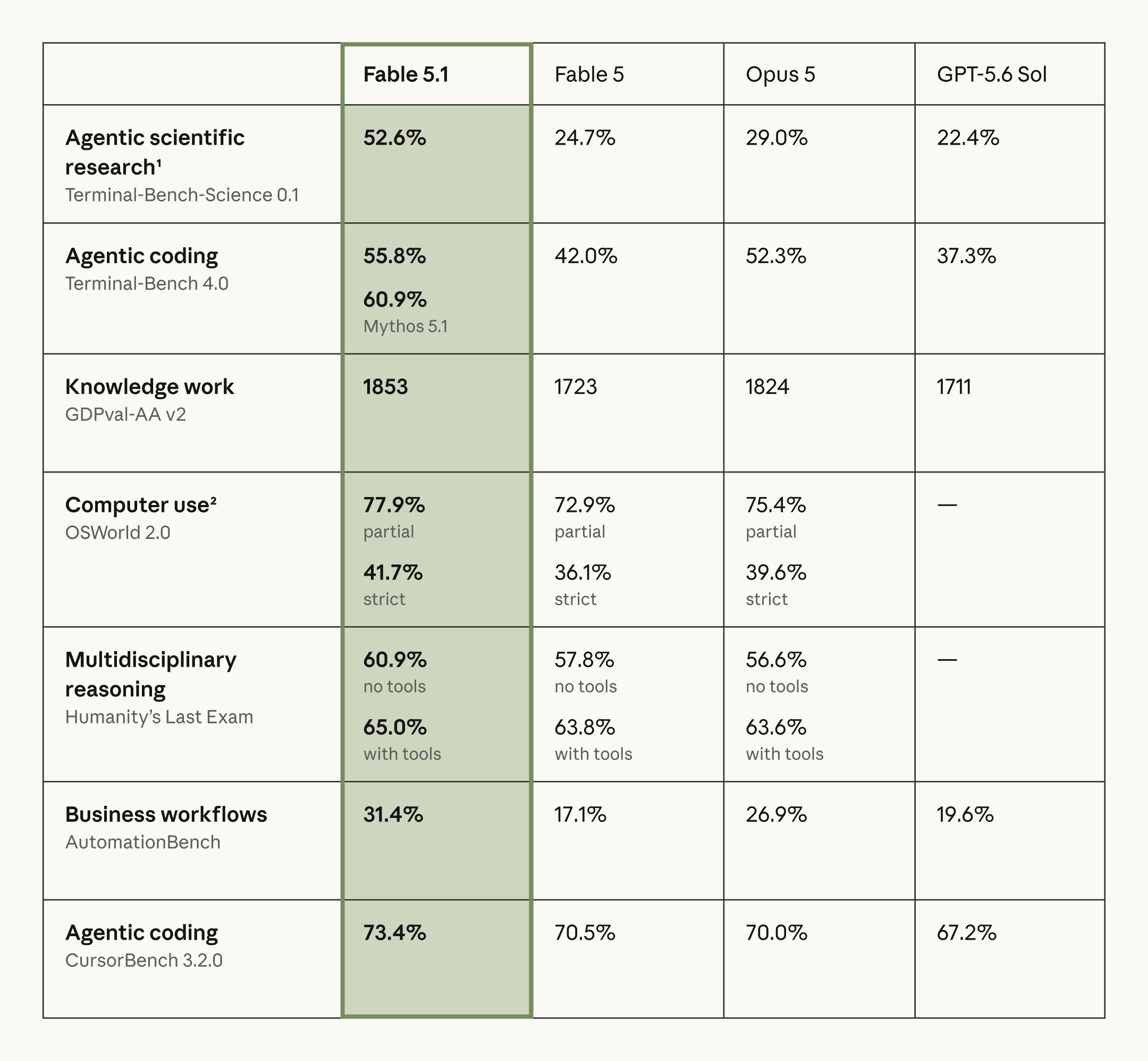
| Benchmark | GPT-5.6 Sol | Claude Fable 5.1 | Fable 5.1 lead |
|---|---|---|---|
| Terminal-Bench-Science 0.1 | 22.4% | 52.6% | +30.2 pts |
| Terminal-Bench 4.0 | 37.3% | 55.8% | +18.5 pts |
| GDPval-AA v2 | 1711 Elo | 1853 Elo | +142 Elo |
| AutomationBench | 19.6% | 31.4% | +11.8 pts |
| CursorBench 3.2.0 | 67.2% | 73.4% | +6.2 pts |
The result is unusually consistent: Fable 5.1 leads GPT-5.6 Sol in every direct row Anthropic published. The largest differences appear in agentic scientific research and terminal-based coding rather than ordinary short-form reasoning.
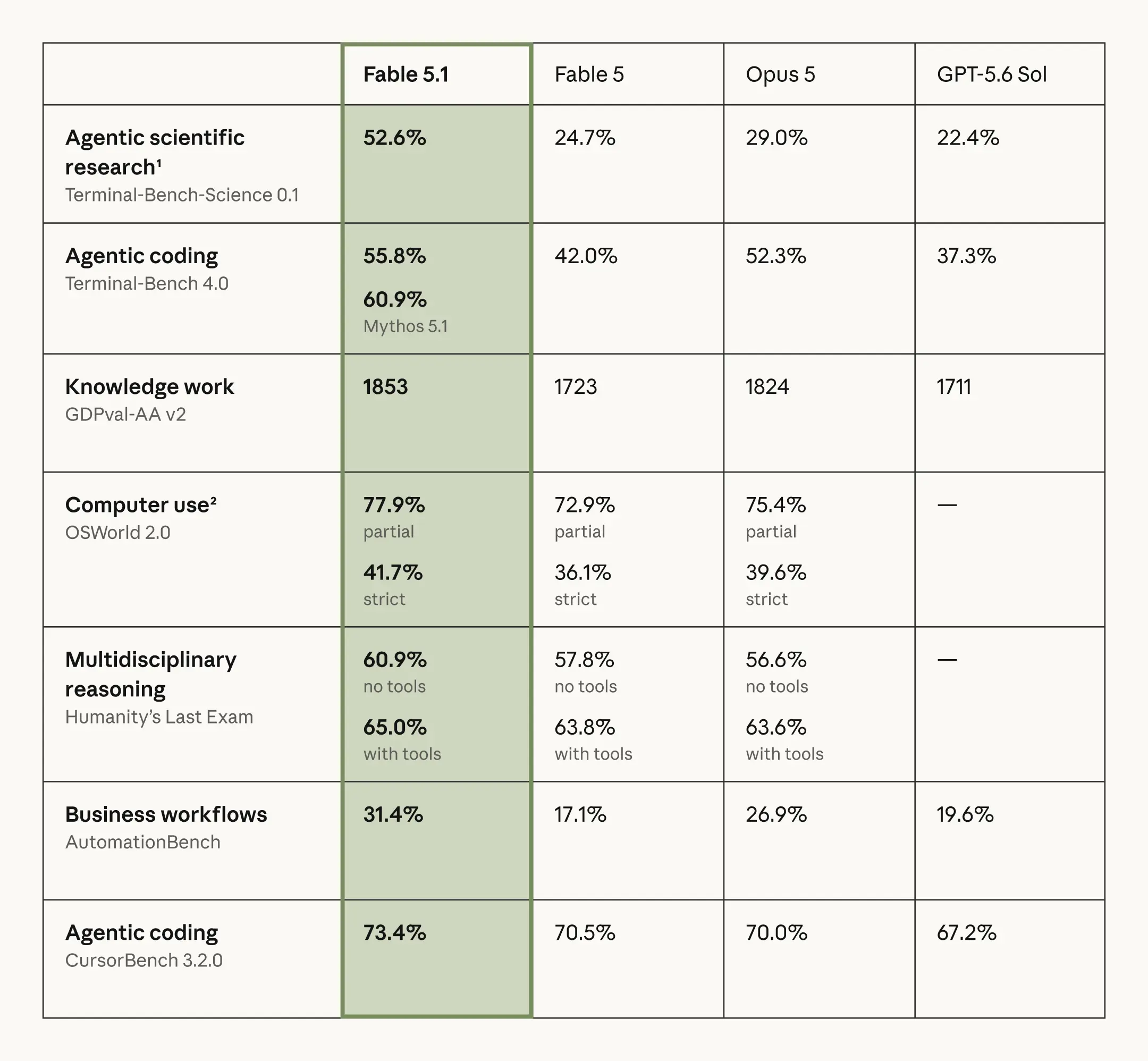
Source: Anthropic — original benchmark graphic.
These are vendor-run evaluations: Anthropic tested both its model and the competing model. They provide direct comparative evidence, but they are not independent tests. Anthropic reports a ±3.5–4.5 percentage-point standard error per model on Terminal-Bench-Science; the table above shows point estimates, not confidence intervals.
The vendor results favor Fable 5.1, but the independent evidence needs its own dates and configurations.
Independent benchmarks: separate dated results from live measurements
Artificial Analysis introduced Intelligence Index v4.3 on September 7, replacing Terminal-Bench 2.1 with Terminal-Bench 4.0 and adding AutomationBench-AA. The release reported 53 for Fable 5.1 and 47 for GPT-5.6 Sol, matching the rounded scores shown in the September 8 comparison. The table distinguishes the release’s terminal results from the later performance snapshot.
| Independent metric AA comparison / v4.3 release | GPT-5.6 Sol (max) | Claude Fable 5.1 (max) | Result |
|---|---|---|---|
| Intelligence Index v4.3 (Sep 8) | 47 | 53 | Fable |
| Terminal-Bench 4.0 (Sep 7 release) | 39.9% | 52.0% | Fable |
| OSWorld 2.0 | 62.6% | 41.7% | |
| Output speed (Sep 8) | 69.8 tok/s | 69.9 tok/s | Effectively tied |
| Time to first token (Sep 8) | 132.10 s | 277.47 s | Sol |
| AA normalized token-mix price / MTok | $3.08 | $7.175 | Sol |
Snapshot: September 8, 2026, except the explicitly dated September 7 Terminal-Bench row. Fable 5.1 uses Adaptive Reasoning, Max Effort, Default Fallback; Sol uses max. Live measurements can change. AA’s normalized token-mix price uses a 7:2:1 cache-hit/input/output ratio; it is not the cost of every API request.
OSWorld 2.0 is the largest reported advantage for Sol in this comparison: 62.6% versus 41.7% for Fable 5.1, a 20.9-point lead. This counterbalances the stronger Fable results on the Intelligence Index and Terminal-Bench.
The evidence supports a specific trade-off: Fable 5.1 has the higher Intelligence Index, while Sol has lower time to first token and a lower normalized price. Output throughput is effectively tied. These measurements support different choices for quality-sensitive batch work and interactive applications.
The dated independent Terminal-Bench comparison points in the same direction as Anthropic’s test: 52.0% versus 39.9%, compared with the vendor’s 55.8% versus 37.3%. The two gaps are not interchangeable because the evaluation setups differ.
What OpenAI’s benchmarks still tell us about GPT-5.6 Sol
OpenAI’s launch evaluations provide additional context for GPT-5.6 Sol’s capabilities. They predate the newer head-to-head results discussed above, so they should not be used as a direct comparison with Fable 5.1.
OpenAI reports 88.8% on Terminal-Bench 2.1 for GPT-5.6 Sol. That is evidence of strong agentic coding capability under the launch setup; the older benchmark version should not be compared numerically with Terminal-Bench 4.0 scores.
GPT-5.6 Sol vs Fable 5.1 for coding
For straightforward code generation, either model is overqualified for many production workloads. The separation becomes clearer when coding turns into agentic software engineering: inspecting a large repository, editing multiple files, running commands, diagnosing failures, writing tests, and iterating until the task passes.
Here, Claude Fable 5.1 has the stronger current benchmark case. It leads both the vendor-run and independent Terminal-Bench 4.0 comparisons, and Anthropic’s CursorBench result also favors it 73.4% to 67.2%.
For a practical coding evaluation, include repository-wide changes, tests, review, and performance work. A successful short code snippet is a weak proxy for completing a task that spans several files and failed attempts.
GPT-5.6 Sol remains compelling when the surrounding execution environment matters as much as raw model quality. Native support for shell execution, apply-patch, code interpreter, file search, computer use and MCP can reduce the amount of orchestration infrastructure you have to build yourself.
Coding verdict: choose Fable 5.1 when your evals emphasize the hardest autonomous repository work. Choose GPT-5.6 Sol when slightly lower benchmark capability is acceptable in exchange for lower cost and a broad integrated execution stack.
Reasoning controls and developer experience
The two APIs expose intelligence differently.
Sol’s none-to-max reasoning range lets a team test quality and delay at several settings. Lower effort can reduce reasoning work, but the right setting depends on the task’s failure cost.
Fable’s always-on adaptive thinking makes effort tuning a different exercise. Compare settings that your application will deploy instead of treating identical effort labels as identical compute budgets.
There is consequently no universally fair comparison between “default Sol” and “default Fable.” Their default reasoning configurations differ. Production evaluations should compare either equivalent effort budgets or the exact settings your application will actually deploy.
GPT-5.6 Sol vs Fable 5.1:Which is better for AI agents?
The choice depends on whether the bottleneck is difficult reasoning or the runtime that surrounds it.
Fable’s lead in the cited terminal, automation, and professional-work benchmarks makes it a sensible candidate for the hardest tasks. Measure completion rate and recovery from failed steps before generalizing that lead to your agent.
GPT-5.6 Sol’s documented Responses tool portfolio makes it attractive for applications built around search, files, shell execution, and patches. That is an integration advantage to evaluate alongside task accuracy, not a substitute for it.
| Agent requirement | GPT-5.6 Sol | Claude Fable 5.1 |
|---|---|---|
| Hard long-horizon reasoning | Excellent | Best fit |
| Terminal/repository autonomy | Excellent | Stronger evidence |
| Native integrated tool portfolio | Stronger | Strong |
| Forced tool selection | Supported; check chosen API | Restricted; check tool_choice modes |
| Multi-agent platform integration | Strong advantage | Available through agent architecture |
| Progress communication during long jobs | Good | Core behavior |
| Cost-sensitive high-volume agents | Better | Premium |
| Repeated massive cached context | Good | Potentially very attractive |
Using both can be economical when only a small share of tasks need escalation. Measure whether the extra successful completions offset the second model’s higher price and startup delay.
Long context: 1.05M vs 1M is not the important difference
The headline numbers look almost identical: GPT-5.6 Sol offers 1.05M tokens and Fable offers 1M. A 5% capacity difference is unlikely to determine whether you can analyze a large repository, legal corpus, research archive, or multi-hour agent history. Both are already in the million-token class.
For GPT-5.6 Sol, input above 272K triggers higher long-context rates for the request: $8/MTok input, $0.80/MTok cached input, and $30/MTok output. Cache writes also rise from $5 to $10/MTok.
Fable 5.1 keeps its standard 1M-context rates: $10/MTok input, $50/MTok output, and $0.25/MTok cache reads. There is no separate premium above 272K in this documented configuration.
Consider a turn with 100K uncached input tokens, 900K cache-read tokens, and 20K total billed output tokens. GPT-5.6 Sol costs 0.1 × $8 + 0.9 × $0.80 + 0.02 × $30 = $2.12. Fable 5.1 costs 0.1 × $10 + 0.9 × $0.25 + 0.02 × $50 = $2.225.
This cache-heavy turn nearly closes the price gap because Fable has cheaper cache reads. The result depends on the workload’s token mix; it does not mean the two models cost the same for a full agent session.
Cost assumptions: the 900K-token prefix is already cached, and the 100K fresh input is not billed as a new cache write. The estimate excludes the initial cache write and tool fees. The 20K output allowance includes all billed output, including any billed reasoning tokens.
Pricing: Sol wins ordinary workloads, Fable wins one important cache metric
At the checked rates, Sol costs $4 input / $20 output per MTok, with $0.40 cache reads. Fable 5.1 costs $10 input, $50 output, and $0.25 cache reads. The table separates provider prices from the GPT-5.6 Sol API in CometAPI and Claude Fable 5.1 API in CometAPI rates.
| Price component | GPT-5.6 Sol Official prices | Claude Fable 5.1 Official prices |
|---|---|---|
| Official input / MTok | $4.00 | $10.00 |
| Official output / MTok | $20.00 | $50.00 |
| Official cache read / MTok | $0.40 | $0.25 |
| Official cache write / MTok | $5.00 (30 minutes) | $12.50 (5 minutes) |
| Above 272K input: input / cache read / cache write / output | $8 / $0.80 / $10 / $30 | Same documented base rates |
| CometAPI input / MTok | $3.20 | $8.00 |
| CometAPI output / MTok | $16.00 | $40.00 |
Cache-write durations differ: Sol uses a 30-minute default retention period, while the Fable 5.1 rate shown is for a 5-minute write. Check cache creation, refresh, and expiration behavior for the provider and route you actually use.
At the checked direct-provider rates, Fable 5.1 costs 2.5× as much as Sol for both uncached input ($10 vs $4/MTok) and output ($50 vs $20/MTok). Treat these checked rates as a dated comparison, since provider promotions and gateway prices can change.
A short-context request with 100K input and 10K total billed output costs about $0.60 with Sol or $1.50 with Fable at direct-provider rates. At the CometAPI rates shown above, the same mix costs $0.48 or $1.20. These examples exclude cache writes and tool fees.
Fable’s short-context cache-read rate is 37.5% lower: ($0.40 − $0.25) ÷ $0.40. That can matter for agents reusing a large stable prefix, but the total saving still depends on fresh input, write frequency, and output volume.
Pricing verdict: Sol is the cheaper starting point for fresh-context traffic. Fable becomes more competitive as the cache-read share grows; compare the full session cost, including creating and refreshing the cache.
Speed and latency
Maximum-effort tests can spend substantial time reasoning before the first visible token.
The September 8 throughput and latency measurements show 69.9 output tokens/s for Fable and 69.8 for Sol. Time to first token is 277.47 seconds versus 132.10 seconds. Output throughput is practically equal; Sol starts producing visible output sooner in this configuration.
These are maximum-effort benchmark measurements, not promised latency for every API call. Prompt length, reasoning configuration, provider load, tools, and cache state can change the result. Time to first token and full response time are different metrics.
For interactive work, the lower observed startup delay may favor Sol. For asynchronous research or overnight repository work, successful completion can matter more than waiting for the first token. Benchmark both models at the settings and concurrency you intend to use.
Safeguards are a production difference
Both models apply stronger safeguards because their capabilities extend into sensitive cybersecurity and scientific domains, but they implement them differently.
OpenAI describes layered protections and monitoring for the GPT-5.6 family. Applications in sensitive domains should evaluate the relevant safeguards as part of their deployment behavior.
Anthropic’s rerouting and retention terms describe routing some sensitive cybersecurity or biology requests to less capable models, without charging the Fable rate for those rerouted requests. The default data-retention period is 30 days, with exceptions for eligible enterprise arrangements.
For ordinary coding and knowledge work, these differences may never appear. For security products, regulated workloads or privacy-sensitive deployments, they belong in the evaluation checklist alongside benchmark quality and price.
Which model should you choose?
The overall comparison can be reduced to workload shape.
| Workload | GPT-5.6 Sol | Claude Fable 5.1 | Recommendation |
|---|---|---|---|
| Difficult autonomous coding | Excellent | Stronger current benchmarks | Fable 5.1 |
| Long-horizon research | Excellent | Core strength | Fable 5.1 |
| High-volume frontier API | Much cheaper | Expensive | Sol |
| Interactive coding assistant | Lower measured max-effort TTFT | Higher measured max-effort TTFT | Test deployed settings |
| Tool-heavy API agent | Broader native tool stack | Strong | Sol |
| Million-token cached agent | Competitive | Very low cache-read price | Test both |
| Maximum reasoning quality | Excellent | Independent lead | Fable 5.1 |
| Cost per ordinary request | Clear advantage | Premium | Sol |
| Image/document reasoning | Strong | Strong | Test on workload |
| Single-provider OpenAI stack | Natural fit | Requires migration/gateway | Sol |
| Model-independent routing | Strong | Strong | Use both through CometAPI |
A routing policy should earn its complexity. Compare a single-model baseline with a Sol-first policy that escalates difficult tasks to Fable 5.1, and keep the router only if it improves cost per successful task at the required quality.
How to compare GPT-5.6 Sol and Fable 5.1 through CometAPI
CometAPI already integrates GPT-5.6 Sol and Claude Fable 5.1. Access both models with their native request formats, send the same evaluation set, and compare the returned results under matched settings.
Use native-format requests for each model and hold prompts, datasets, effort settings, concurrency, and scoring rules constant. Repeat the runs; a single sequential request per model is not enough to estimate reliable latency or quality.
For a production evaluation, use a fixed prompt set, repeat runs in alternating order, record the effort setting, and score correctness, test pass rate, tool success, retries, token usage, elapsed time, and total cost per successful task. Tune each model separately after the common baseline.
Final verdict: GPT-5.6 Sol or Claude Fable 5.1?
Fable 5.1 has the stronger direct evidence for the hardest autonomous coding and long-horizon work. It leads the five shared vendor benchmark rows and the dated independent terminal comparison. That makes it a strong escalation candidate, subject to validation on your own tasks.
Sol has the lower ordinary token prices, finer reasoning controls, and a broad native tool stack. In the checked independent maximum-effort configuration, it also has lower time to first token; output throughput is effectively tied.
Prioritize Fable 5.1 when the hardest autonomous tasks determine your success rate. Start with Sol for cost-conscious frontier inference or tool-heavy applications. For interactive workloads, test the deployed effort settings to confirm whether its observed startup-delay advantage persists.
Choose a single model when it meets your requirements simply. Add routing when evaluation results show that switching between the two improves quality or cost per successful task.
FAQ
Is Claude Fable 5.1 better than GPT-5.6 Sol?
It has the higher independent Intelligence Index in the September 8 snapshot: 53, versus 47 for Sol. It also leads the dated independent terminal test. That supports a quality advantage on these evaluations, not a claim that it is better for every workload.
Is GPT-5.6 Sol cheaper than Claude Fable 5.1?
For ordinary uncached API traffic, yes: the checked direct-provider input/output rates are $4/$20 per MTok for Sol and $10/$50 for Fable 5.1. Cache-heavy workloads can narrow that gap because Fable’s cache-read rate is lower. Include write and expiration behavior in the estimate.
Which model is better for coding?
Fable 5.1 has the stronger autonomous-coding benchmark evidence in this comparison. Sol remains attractive for lower-cost workflows and its integrated execution tools. Use repository tasks with runnable tests to decide whether the measured capability gap matters for your application.
Which model has the larger context window?
Sol technically leads at 1.05M versus Fable 5.1’s 1M tokens, while both allow up to 128K output. In practice, Sol’s >272K pricing threshold and Fable’s inexpensive cache reads are usually more important than the 50K-token capacity difference.
Can I access both models through CometAPI?
Yes. The GPT-5.6 Sol API in CometAPI and Claude Fable 5.1 API in CometAPI support a common starting point for text evaluations. Check route-specific reasoning, caching, and tool support before extending the baseline to a production agent.