
TL;DR
MiniMax H3 Max is optimized for fast, high-volume iteration, while Seedance 2.5 is built for longer, reference-heavy scenes and editing workflows. The practical choice depends on whether your main production cost comes from repeated drafts or from maintaining continuity across a larger finished scene.
Key Takeaways
- H3 Max prioritizes low latency, short-form iteration, and lower draft cost.
- Seedance 2.5 supports up to 30-second generations and larger multimodal reference packs.
- Both models generate synchronized audio, but their provider-specific controls differ.
- Resolution, reference limits, and billing should be evaluated at the API-route level.
- A hybrid workflow can use H3 Max for ideation and Seedance 2.5 for longer, editing-intensive production.
MiniMax H3 Max vs. Seedance 2.5 at a Glance
| Category | MiniMax H3 Max | Seedance 2.5 |
|---|---|---|
| Developer / origin | H3 Max is a fal-post-trained variant of the open-weight MiniMax H3 model, not simply the official MiniMax H3 endpoint with a higher speed tier. | ByteDance Seed |
| Primary operating point | Fast iteration and throughput | Longer, reference-heavy production |
| CometAPI model ID | minimax-h3-max | seedance-2-5 |
| Current CometAPI duration | 5–15 seconds | 4–30 seconds |
| Current CometAPI resolution | 480P / 768P | 480p / 720p |
| Native / synchronized audio | Yes | Yes |
| Reference capacity | Up to 12 total on documented H3 Max route | Up to 50 at model level (30 images + 10 video + 10 audio) |
| First / last frame | Supported | Provider-specific: fal documents start/end-frame control; verify availability on the CometAPI route used in production. |
| Editing / extension | Not the core differentiator on current H3 Max route | Core Seedance 2.5 capability |
| Headline CometAPI starting price | $0.064 / second | $0.0824 / second |
| Best-fit workflow | Short-form iteration, variants, batch generation | Longer scenes, complex references, editing |
The resolution row above is deliberately route-specific. fal exposes a 1080P H3 Max option as a latent refinement of a 768P render, but the current CometAPI H3 Max documentation lists 480P and 768P. Likewise, the current CometAPI Seedance 2.5 route documents 480p and 720p even though other providers may expose additional tiers.
Why Compare MiniMax H3 Max and Seedance 2.5?
MiniMax H3 Max and Seedance 2.5 look similar on a feature checklist: both generate video from text or images, both can produce synchronized audio, and both expose reference-driven workflows. The more useful comparison starts after that checklist. H3 Max is optimized around low-latency iteration, while Seedance 2.5 is designed to keep more of a finished scene inside one generation.
The distinction is rooted in how the models were built. fal Research describes H3 Max as a post-trained version of MiniMax H3, with additional data focused on prompt adherence and aesthetics and an inference stack optimized for throughput. ByteDance, by contrast, positions Seedance 2.5 around 30-second single-pass storytelling, larger multimodal reference packs, and more precise editing.
That means the practical question is not simply which model is “better.” It is where the expensive part of your workflow sits. If the bottleneck is waiting for drafts, discarded takes, and prompt iteration, H3 Max attacks that cost. If the bottleneck is stitching short clips, preserving identity across a longer scene, or coordinating many references, Seedance 2.5 attacks a different cost.
Official Seedance 2.5 launch visual published by ByteDance Seed.
What Is MiniMax H3 Max?
MiniMax H3 Max is not simply a “larger H3” tier. fal says it started from MiniMax H3 open weights and applied post-training targeted at prompt adherence and visual quality while co-designing the serving stack for much higher throughput.
Its most visible result is latency. fal reports that a five-second 768p clip can be generated in under three seconds on its infrastructure. For the CometAPI route, the API documentation specifies 5–15 seconds, 24 FPS, synchronized audio, six aspect ratios, and 480P/768P output tiers.
That speed changes the economics of creative exploration. A video model does not need to be the final renderer for latency to matter: every rejected take, alternate camera move, product angle, and hook is part of the cost of reaching the accepted clip. Lower turnaround can therefore matter more than a higher maximum duration when a team is still searching for the idea.
H3 Max specifications that matter for this comparison
| Specification | MiniMax H3 Max |
|---|---|
| Origin | MiniMax H3 open weights + fal Research post-training |
| CometAPI model ID | minimax-h3-max |
| Duration | 5–15 seconds |
| Resolution on current CometAPI route | 480P / 768P |
| Frame rate | 24 FPS |
| Audio | Synchronized stereo audio |
| Input modes | Text, image, reference media, first/last frame |
| Reference cap | 12 total; documented limits include up to 3 video and 3 audio references |
| Aspect ratios | 21:9, 16:9, 4:3, 1:1, 3:4, 9:16 |
| CometAPI starting price | $0.064 / second |
What Is Seedance 2.5?
Seedance 2.5 is ByteDance Seed’s next-generation audio-video model, officially launched on July 31, 2026. The official release emphasizes three distinct capabilities: single-pass clips up to 30 seconds, larger multimodal reference packs, and timestamp-level editing controls.
The 30-second ceiling is not just a bigger number. It lets a creator keep setup, development, transitions, and payoff inside one generation instead of forcing a mid-scene seam. ByteDance explicitly describes Seedance 2.5 as organizing multiple connected shots within that window and supporting multi-round extensions when the story needs to continue.
Reference capacity is equally important. ByteDance documents up to 30 images, 10 video clips, and 10 audio clips in a single pass, with reference modes for motion, clay/3D blocking, characters, props, scene style, and audio. The current CometAPI route exposes Seedance 2.5 through the asynchronous Video API with 4–30 second generation and 480p/720p output.
Seedance 2.5 specifications that matter for this comparison
| Specification | Seedance 2.5 |
|---|---|
| Developer | ByteDance Seed |
| CometAPI model ID | seedance-2-5 |
| Duration | 4–30 seconds on current CometAPI route |
| Resolution on current CometAPI route | 480p / 720p |
| Audio | Joint audio-video generation / synchronized audio |
| Input modes | Text, image; broader model-level image/video/audio reference workflows |
| Reference cap at model level | 50 total: 30 image + 10 video + 10 audio |
| Editing | Timestamp-level targeted editing; green-screen, perspective and reference-based workflows described by ByteDance |
| Extension | Multi-round extension |
| CometAPI headline starting price | $0.0824 / second |
MiniMax H3 Max vs. Seedance 2.5: Detailed Comparison
1. Generation speed: H3 Max changes the iteration loop
fal reports approximately 2.8–3 seconds of inference for a five-second 768p clip on fal infrastructure. There is no equally clean, current public latency figure for Seedance 2.5 that can be compared under the same hardware and queue conditions, so a numeric “X times faster” claim would be misleading.
The workflow implication is still clear. H3 Max is the more natural fit for interactive prompt exploration, ad variants, rapid storyboarding, and batch jobs where many outputs will be discarded. A creator can evaluate more hypotheses per hour, which is often the relevant metric during pre-production.
2. Duration and narrative continuity: Seedance 2.5 keeps more story in one render
The current CometAPI H3 Max route runs from 5 to 15 seconds, while Seedance 2.5 runs from 4 to 30 seconds. ByteDance also supports multi-round extension at the model level.
For a ten-second product hook, that difference may not matter. For a 25- or 30-second brand film, it changes the production topology. H3 Max requires multiple generations and an edit point; Seedance 2.5 can keep the scene within one generation, reducing the number of continuity boundaries where character appearance, lighting, camera language, or audio can drift.
3. Resolution: compare the API route, not the marketing ceiling
On CometAPI today, H3 Max is documented at 480P and 768P, while Seedance 2.5 is documented at 480p and 720p. fal separately exposes a 1080P H3 Max option and describes it as a latent refinement of a native 768P render.
This is why resolution claims should always name the provider or endpoint. “The model supports 1080p” can mean native model output, a refinement pass, or provider-side post-processing. For production evaluation, use the dimensions and billing rules of the route you will actually call.
4. Reference control and editing: Seedance 2.5 has the larger production envelope
CometAPI’s H3 documentation allows up to 12 total reference inputs, including images plus documented video/audio limits. ByteDance’s Seedance 2.5 launch materials support up to 50 references in a single pass.
The difference matters when a scene is driven by multiple constraints: a lead character, secondary character, product packshot, location, camera-motion example, soundtrack, voice, and styling references. H3 Max can cover compact reference packs efficiently; Seedance 2.5 is architecturally better aligned with reference-heavy production and targeted editing.
Seedance 2.5 also treats editing as a first-class workflow. ByteDance describes timestamp-level changes plus green-screen, camera-perspective, and reference-based edits. That makes it closer to an iterative production system than a generate-once endpoint.
5. Native audio: both reduce the need for a second synchronization pass
Both models generate sound in the same overall video workflow. fal’s head-to-head notes that audio is composed with the picture on both models, while ByteDance describes Seedance 2.5 as building on a unified multimodal audio-video architecture.
That does not make their audio behavior identical. Dialogue, effects, ambience, musical structure, controllability, and provider-exposed toggles still need prompt-by-prompt testing. But for developers, the key architectural benefit is that both can avoid a separate “generate silent video, then align audio” stage for many use cases.
6. Benchmarks: H3 Max has stronger public point-in-time numbers, but the comparison is asymmetric
Public results are not symmetric enough to support a universal ranking: H3 Max has provider-reported and third-party preference results, but those tests do not measure Seedance 2.5’s longer-scene continuity, larger reference workflows, and editing controls under matched conditions.
There is not a clean, symmetric public table where every important Seedance 2.5 capability is evaluated against H3 Max under the same duration, resolution, prompt set, reference inputs, audio conditions, and provider latency. That gap is important. A 30-second continuity model can be disadvantaged by a benchmark built around short blind preference clips, while a speed-first model can be disadvantaged by a test that only measures long-scene continuity.
The closest useful public controlled comparison is fal’s six-scenario head-to-head using matched prompts across text-to-video, image-to-video, and reference-to-video. Treat it as a provider-run test rather than a universal leaderboard.
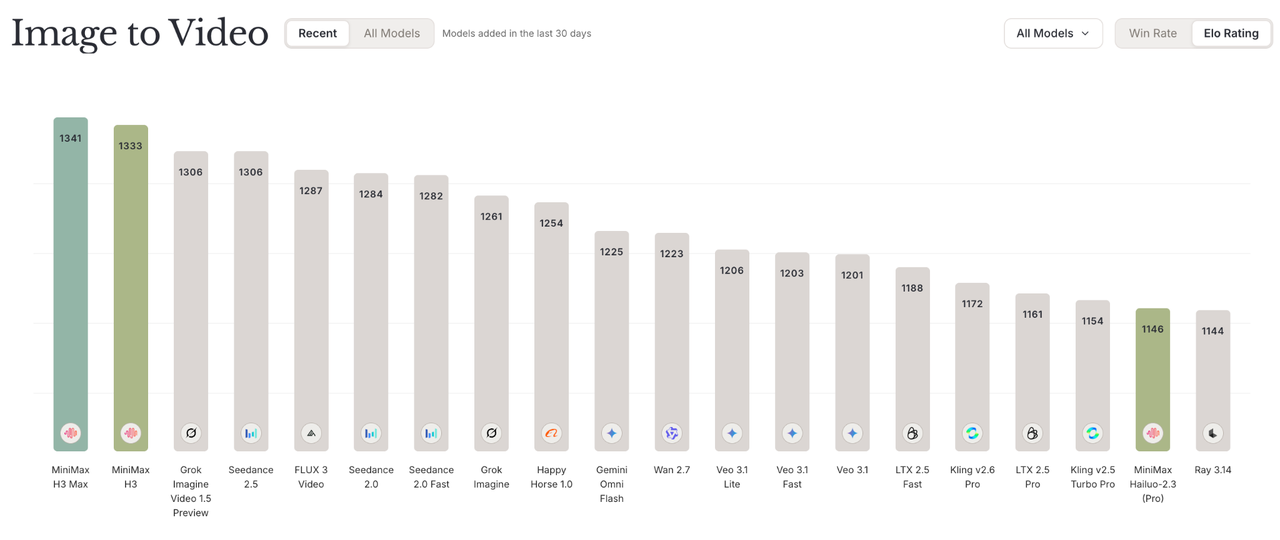
Image-to-Video Elo chart reproduced from fal Research’s official H3 Max launch article.
MiniMax H3 Max vs Seedance 2.5 Pricing on CometAPI
| Pricing view | H3 Max | Seedance 2.5 |
|---|---|---|
| CometAPI headline starting rate | $0.064/s | $0.0824/s |
| 480p documented route rate | Verify live route | $0.103/s |
| 720p documented route rate | — | $0.231/s |
| Billing basis | per generated second | resolution-dependent |
| Production recommendation | Check live route | Check live route |
Prices are provider-route prices, not intrinsic model prices, and may change independently of the underlying model release.
For video workloads, cost per accepted clip is usually more useful than cost per generated second. If an ad team needs eight attempts before approving one ten-second shot, H3 Max’s low unit cost and turnaround compound across seven discarded outputs. Conversely, if Seedance 2.5 can produce one coherent 30-second shot that would otherwise require two or three clips plus editing, the higher per-second rate may still reduce total production effort.
Which Model Fits Different Video Workflows?
| Workflow | Better fit | Why |
|---|---|---|
| Five-second social hook | H3 Max | Low latency and low per-draft cost make rapid variation practical. |
| A/B testing 10 ad concepts | H3 Max | Throughput matters more than a 30-second ceiling. |
| 15-second product teaser | Depends | H3 Max favors rapid drafts; Seedance helps if references/editing are complex. |
| 20–30 second brand story | Seedance 2.5 | Keeps the scene in one generation and reduces stitching boundaries. |
| Large character/product reference pack | Seedance 2.5 | Up to 50 model-level references gives more room for complex creative direction. |
| Reference-heavy shot with editing | Seedance 2.5 | Editing and extension are central features of the model design. |
| Storyboard / camera concept exploration | H3 Max | Faster feedback loop makes it easier to reject and refine ideas. |
| High-volume short-video API | H3 Max | Unit economics and throughput favor repeated short generations. |
H3 Max and Seedance 2.5 Can Be Complementary
A useful production architecture does not have to route every job to one model. H3 Max can sit earlier in the creative loop, where teams explore prompts, shot structures, camera moves, and hooks. Once the concept is stable, Seedance 2.5 can take over for the longer, reference-heavy, or editing-intensive version of the scene.
This hybrid approach is especially relevant for API products because model routing can be automated. A system can select H3 Max for short drafts and high-volume variants, then route jobs that exceed 15 seconds or require a large reference pack to Seedance 2.5.
How to Use H3 Max and Seedance 2.5 Through CometAPI
Developers can access the MiniMax H3 Max API and Seedance 2.5 API in CometAPI through the same asynchronous video-task pattern. Publication-date claims should link directly to the relevant changelog entries.
The core production pattern is: submit a multipart POST to /v1/videos, save the returned task ID, poll the task, and retrieve the completed video. The model ID and supported parameters change, but the application-level job architecture can stay largely the same.
H3 Max example
The MiniMax H3 API reference documents minimax-h3-max with 5–15 second output and 480P/768P request sizes.
Create a five-second 768P H3 Max video:
curl https://api.cometapi.com/v1/videos \
  -H "Authorization: Bearer $COMETAPI_KEY" \
  --form-string 'model=minimax-h3-max' \
  --form-string 'prompt=A premium product shot, slow dolly-in, soft daylight, no text.' \
  --form-string 'seconds=5' \
  --form-string 'size=1360x768'
Seedance 2.5 example
The Seedance video API uses model ID seedance-2-5 and the same asynchronous POST /v1/videos workflow.
Create a 20-second 720p Seedance 2.5 video:
curl https://api.cometapi.com/v1/videos \
  -H "Authorization: Bearer $COMETAPI_KEY" \
  --form-string 'model=seedance-2-5' \
  --form-string 'prompt=A continuous cinematic tracking shot through a rain-lit night market.' \
  --form-string 'seconds=20' \
  --form-string 'size=1280x720'
For production, read the current model page and API reference before hard-coding resolution or reference limits. Video endpoints evolve quickly, and provider-specific capabilities do not always appear in every aggregator route on the same day.
MiniMax H3 Max vs. Seedance 2.5: Final Verdict
MiniMax H3 Max and Seedance 2.5 optimize different parts of the AI-video pipeline. H3 Max is compelling when the job is measured by how many useful iterations a team can evaluate in a fixed amount of time. Its short 5–15 second window, low starting price, and unusually low provider-reported latency make it a natural engine for concepts, ad variants, storyboards, and high-volume short-form generation.
Seedance 2.5 becomes more attractive as the production brief gets structurally heavier: a scene longer than 15 seconds, many image/video/audio references, targeted editing, or multi-round extension. Its 30-second single-generation ceiling changes the number of seams a creator must manage, and its 50-reference model-level capacity gives more room for character, product, environment, motion, and sound constraints.
The simplest decision rule is therefore about the bottleneck. H3 Max reduces the cost of trying an idea. Seedance 2.5 reduces the cost of keeping a larger finished scene coherent. Teams building through CometAPI can use that distinction as a routing rule instead of forcing every workload through the same model.