Choose your path
Blog Gemini 4 carbon
Gemini 4 Carbon vs Claude Fable 5.2: Model manakah yang patut anda pilih?
我是多语言翻译助手,仅支持将已有文本精准翻译为 Bahasa Melayu。请提供需要翻译的原文内容(可为纯文本、HTML、Markdown、JSON、XML、代码片段等)。
Gemini 4 Hydrogen vs Carbon: Model manakah yang patut anda pilih?
Bandingkan Gemini 4 Hydrogen dan Gemini 4 Carbon dari segi kelajuan, penanda aras, tetingkap konteks, harga, keupayaan pengaturcaraan, penyelidikan, keselamatan siber, dan akses API.
Gemini 4 Carbon vs Kimi K3.1 Pro: Mana Satu Patut Anda Pilih?
Bandingkan Gemini 4 Carbon dan Kimi K3.1 Pro dari segi spesifikasi, penanda aras, harga, pilihan penyebaran, dan akses API untuk memilih model bagi aliran kerja anda.
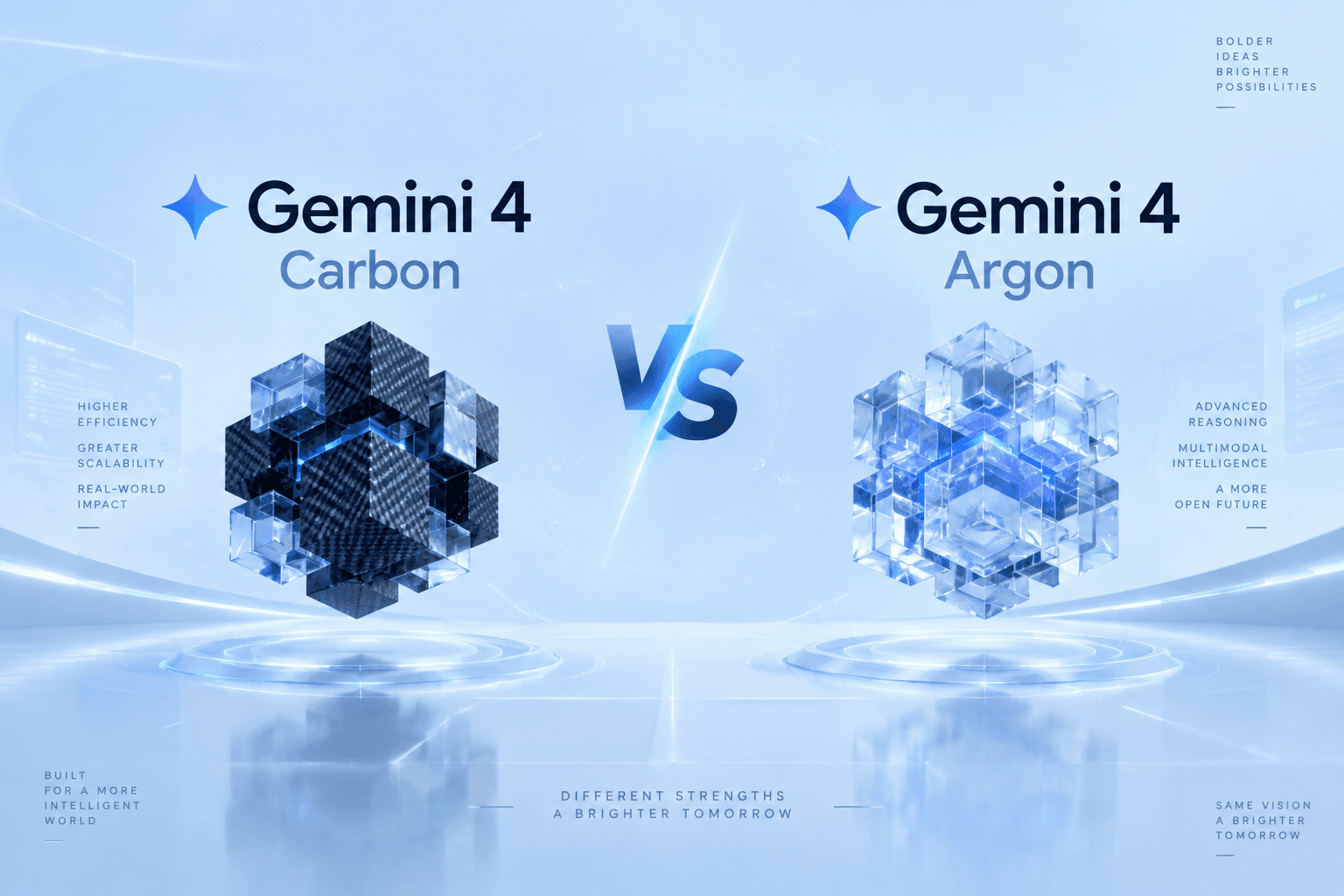
Gemini 4 Carbon vs Gemini 4 Argon: Penanda Aras, Harga dan Yang Mana Patut Dipilih
I don’t have verified details on models named “Gemini 4 Carbon” or “Gemini 4 Argon” in my knowledge base (updated to Oct 2024). If these are newer releases, please share a link to their official model cards or docs, and I can produce a precise head‑to‑head. In the meantime, here’s a clear framework you can use to compare them across the dimensions you listed: - Benchmarks - Reasoning/knowledge: MMLU, MMLU-Pro, BIG-bench Hard - Math: GSM8K, MATH, SVAMP - Coding: HumanEval, MBPP, Codeforces-style evals, SWE-bench (if supported) - Multimodal (if applicable): MMMU, Chart QA, DocVQA - Safety/robustness: adversarial prompts, jailbreak resistance suites - Note dataset versions, evaluation harness, temperature, decoding params, and context size for reproducibility. - Coding - Language coverage: Python, JS/TS, Java, C/C++, Go, Rust, SQL, shell - Tasks: code generation, refactoring, unit tests, bug fixing, docstring→code, repo-level reasoning - Tools: function calling, toolformer-style planning, file edits, multi-step “write-run-fix” loops - Constraints: adherence to specs, deterministic runs, latency under compile/run loops - Hallucination rate and security in code suggestions (e.g., unsafe patterns) - Cybersecurity - Secure-by-default behaviors: secrets handling, unsafe API patterns, dependency pinning - Vulnerability reasoning: CWE coverage, ability to detect/patch vulns - Red-teaming: prompt injection resilience, data exfiltration barriers, jailbreak hardness - Policy controls: safety toggles, content filters, audit logs, allow/deny lists - Eval sets: SecEval, AISafetyBench, PromptInjectionBench; custom org-specific tests - Context windows - Max tokens in, tokens out; effective context retention vs nominal - Long-context retrieval accuracy (Needle-in-a-Haystack, RAG docs, long code files) - Sliding-window or recurrence mechanics, memory features, context caching - Cost/latency scaling with context length - API pricing - Per‑million tokens: input vs output; region-specific variations - Billing granularity and rounding; context caching discounts; streaming discounts - Specialized SKUs: “thinking”/tool-use modes, batch pricing, committed use - Rate limits, burst quotas, overage behavior - Speed - Latency: p50/p95 for short (1–2k tok) and long (100–500k tok) prompts - Throughput under concurrency; streaming first-token time - Deterministic vs stochastic decoding cost; tool-calls overhead - Hardware/backends: regions, accelerators, “fast” vs “quality” routes - Availability - Regions and data residency; on-prem/private VPC options - SLA/uptime; failover; version pinning and deprecation policies - Feature availability (function calling, batch, fine-tuning, vision/audio) - Compliance: SOC 2, ISO 27001, HIPAA, GDPR, model/data governance If you share the official specs or any benchmark sheets for Carbon and Argon, I’ll fill this framework with concrete numbers and a concise recommendation by use case (e.g., coding assistant vs long-context RAG vs security analysis).
Apakah itu Gemini 4 Carbon? Penanda Aras, Ciri-ciri & Harga
Temui Gemini 4 Carbon, model AI termaju baharu Google. Terokai penanda aras keselamatan siber, ciri, harga, perbandingan dan ketersediaan.