
Alibaba and ByteDance now offer two unusually complete 30-second AI video systems. One prioritizes an all-in-one pipeline that can turn documents and webpages into video; the other prioritizes long-form storytelling, dense reference control, and surgical audiovisual editing. This guide separates verified specifications from independent benchmark evidence so developers can choose on production fit rather than launch claims.
TL;DR
Bottom line: Wan 3.0 is the stronger default when you want the clearest independent quality signal, 1080p output, document/webpage inputs, and lower current starting API cost. Seedance 2.5 is the more specialized creative-production choice when you need up to 50 references, multi-round continuation, timestamp-level editing, green-screen workflows, or white-model previsualization.
There is not yet a clean public head-to-head benchmark. Artificial Analysis currently ranks the Alibaba model first in its audio-enabled text-to-video arena, while the ByteDance release is not yet listed under the same evaluation. Because Seedance 2.5 has not yet been evaluated in the same arena, this leaderboard cannot support a direct quality comparison between the two models.
Wan 3.0 vs Seedance 2.5: Quick Comparison
| Category | Wan 3.0 | Seedance 2.5 |
|---|---|---|
| Developer | Alibaba Tongyi / Wan | ByteDance Seed |
| Release / availability | Public API release: Aug 24, 2026 | Official launch: Jul 31; CometAPI route: Aug 6, 2026 |
| Core design | All-in-one multimodal video production | Audio-video joint generation for controlled storytelling |
| Maximum native duration | 2-30 seconds | 4–30 seconds. |
| Output resolution | 480p, 720p, 1080p | CometAPI currently documents 480p and 720p routes |
| Reference capacity | Up to 10 images + 5 video clips + 5 audio clips; plus either 1 document or 1 public webpage. | 30 images + 10 videos + 10 audio clips |
| Input types | Text, image, video, audio, documents, webpages | Text, image, video, audio |
| Native audio | Dialogue, BGM, sound effects | Joint audio-video generation with synchronized sound |
| Editing | Instruction editing, extension, first/last-frame control | Timestamp edits, green screen, camera and reference editing |
| Independent benchmark | #1 T2V with audio; 1,241 Elo | Not yet listed under the same benchmark |
| CometAPI starting price | $0.04 per generated second | $0.0824 per generated second |
| Best starting use case | Product demos, explainers, document-to-video, quality-led default | Reference-heavy narrative, film/advertising control, targeted edits |
What Is Wan 3.0?
Alibaba's latest hosted video model consolidates text-to-video, image-to-video, reference generation, editing, extension, and native audio inside one system. Its defining feature is not only the 30-second ceiling: it accepts creative context from images, video, audio, office documents, and public webpages, letting a product brief or slide deck become part of the generation instruction.
The official Wan 3.0 API guide specifies up to 30 seconds at 30 fps, 480p/720p/1080p output, and native dialogue/BGM/sound effects. Its documented per-request limits are up to 10 reference images, 5 reference videos, and 5 reference audio clips; the request may also include either one supported document or one public webpage. It also documents first-frame and first-and-last-frame control, video continuation, and natural-language editing.
Source: Alibaba Tongyi Wan official showcase
Alibaba Model Specifications
| Specification | Verified value |
|---|---|
| Model status | Hosted commercial model; API available |
| Generation modes | Text-to-video, image-to-video, reference-to-video, editing, continuation |
| Maximum duration | 30 seconds per generation; 2-30 seconds documented |
| Frame rate | 30 fps |
| Resolution | 480p, 720p, 1080p |
| Aspect ratios | Adaptive, 16:9, 4:3, 1:1, 3:4, 9:16 |
| References | Up to 10 reference images, 5 reference videos, and 5 reference audio clips; a request may also use either 1 document or 1 public webpage. |
| Documents | DOC, XLS, PPT, PDF, TXT, KEY, PAGES, NUMBERS, MD |
| Document limits | Up to 100 MB and 50 pages |
| Audio | Native speech/dialogue, BGM, and sound effects |
| CometAPI model ID | wan3.0 |
| CometAPI endpoint | POST /v1/videos; asynchronous create-and-poll workflow |
Where Alibaba's Model Stands Out
- Document-to-video and webpage-to-video remove a preprocessing step for presentations, reports, product pages, training material, and corporate explainers.
- A 1080p route and 30 fps output provide a clearly documented final-delivery path.
- The same model covers generation, reference conditioning, editing, and extension, reducing model-specific orchestration.
- Its current independent T2V and video-editing results provide stronger public evidence than vendor demos alone.
What Is Seedance 2.5?
ByteDance's new-generation audio-video model is built around complete 30-second stories, large multimodal reference sets, and production editing. The model can organize multiple related shots in a single generation, continue an existing output across additional rounds, and maintain a consistent audiovisual language over longer narratives.
In the official launch announcement, ByteDance documents up to 30 images, 10 video clips, and 10 audio clips in one pass. It also describes timestamp-level audiovisual edits, green-screen replacement, camera-perspective editing, motion references, creative references, and clay-render control for composition, blocking, lighting, and camera planning.

Source: ByteDance Seedance 2.5 official showcase
ByteDance Model Specifications
| Specification | Verified value |
|---|---|
| Model status | Officially launched; commercial platform and API access |
| Generation modes | Text-to-video, image-to-video, reference-to-video, extension, editing |
| Maximum duration | ByteDance officially confirms up to 30 seconds per generation; the currently documented CometAPI route accepts 4–30 seconds. |
| Continuation | Multi-round extension; product page describes up to two extensions |
| Resolution | CometAPI currently documents 480p and 720p priced routes |
| References | Up to 30 images, 10 video clips, and 10 audio clips |
| Input types | Text, image, video, audio |
| Documents | Not listed as a native reference input in the official Seedance 2.5 materials. |
| Document limits | Not applicable / not documented for the current Seedance 2.5 route. |
| Audio | Joint audio-video generation and reference audio |
| Editing | Timestamp control, green screen, camera perspective, reference editing |
| Previsualization | Clay-render / white-model control |
| CometAPI model ID | seedance-2-5 |
| CometAPI endpoint | POST /v1/videos; asynchronous create-and-poll workflow |
Where ByteDance's Model Stands Out
- Fifty total references give creators more room for multi-character, multi-location, brand, prop, voice, and movement constraints.
- Timestamp-level changes allow a specific beat, action, sound, or camera segment to be revised without treating the whole video as a disposable draft.
- Green-screen and clay-render workflows connect generative video with conventional previsualization and compositing practices.
- Multi-round continuation is designed to extend a coherent visual and audio language beyond the initial 30-second clip.
Wan 3.0 vs Seedance 2.5: Benchmark Results
Benchmark rule: Only results produced under the same leaderboard, task, audio mode, and voting method are directly comparable. Vendor demonstrations and older model scores are useful context, but they are not substitutes for a missing head-to-head result.
The current Artificial Analysis Text to Video Leaderboard places the Alibaba model first in the with-audio arena at 1,241 Elo, with a 95% confidence interval of +/-9 and 6,195 blind-comparison samples. The same evaluator also places it first in audio-enabled video editing at 1,189 Elo, with a +/-7 interval and 5,231 samples.
The ByteDance release is not yet listed in those two tables. Artificial Analysis does list an older Seedance generation, but using that older score as if it represented the new model would be methodologically wrong. Therefore, the fairest conclusion is that Alibaba currently has the stronger independent evidence, not that ByteDance has been independently proven weaker.
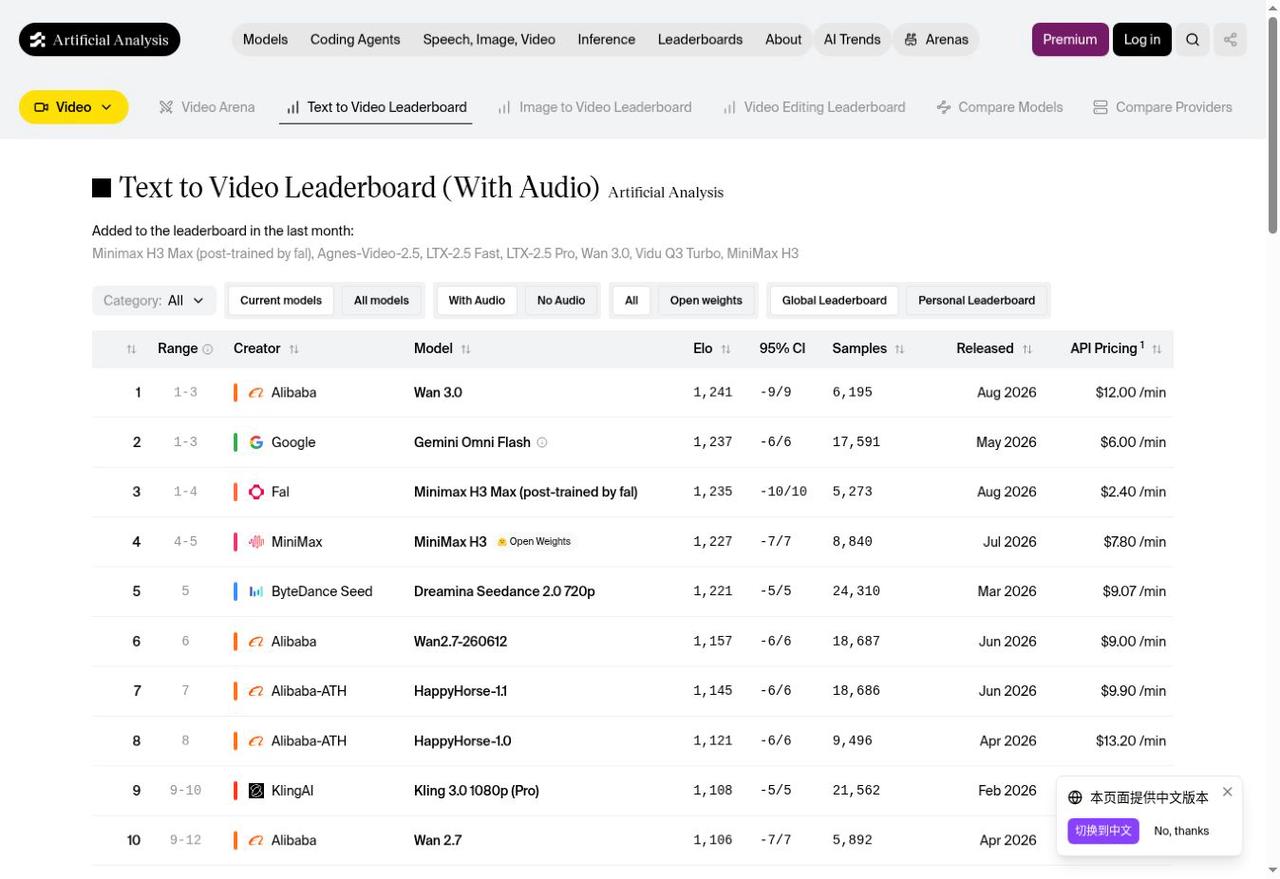
Source: Artificial Analysis Text to Video Leaderboard
| Evidence type | Alibaba model | ByteDance model | Interpretation |
|---|---|---|---|
| Text-to-video with audio | 1,241 Elo; rank #1; +/-9; 6,195 samples | Not listed | Independent direct comparison unavailable |
| Video editing with audio | 1,189 Elo; rank #1; +/-7; 5,231 samples | Not listed | Independent direct comparison unavailable |
| Official qualitative evidence | Reality-grade rendering, long-form consistency, omni-reference | Long-form storytelling, dense reference control, timestamp editing | Different demos and claims; not directly scored |
Wan 3.0 vs Seedance 2.5: Key Differences Compared
1. Long-Form Storytelling and Temporal Coherence
Both models can generate up to 30 seconds in one pass. The official Wan 3.0 API range is 2–30 seconds, while BytePlus official API documentation specifies 4–30 seconds for Seedance 2.5; the current CometAPI Seedance route also documents 4–30 seconds. Wan is therefore the documented option for native 2–3-second shots on these routes. Alibaba's approach is strongest when the clip must absorb varied source material and turn it into one coherent output. ByteDance's approach is strongest when the 30 seconds must contain a planned narrative arc, multiple connected shots, and later continuation with consistent characters, settings, pacing, and sound.
Result: choose Alibaba for a self-contained multimodal production request; choose ByteDance for episodic or multi-round narrative construction.
2. Visual Quality, Motion, and Physical Plausibility
Alibaba has the clearer public quality signal because its output currently leads the blind-preference T2V-with-audio arena. The product materials also emphasize faces, micro-expressions, product details, text, spatial layout, and physical interactions. ByteDance emphasizes smoother transitions, subject stability across cuts, more realistic textures and lighting, and motion that follows the spatial structure of clay-render references.
Result: Alibaba is the evidence-backed first test for general visual preference. ByteDance remains highly compelling for directed blocking, camera choreography, and scenes planned from previsualization assets.
3. Reference Control and Character Consistency
Wan 3.0 accepts up to 10 reference images, 5 reference videos, and 5 reference audio clips, plus either one supported document or one public webpage. Seedance 2.5 accepts the larger conventional set: up to 30 images, 10 videos, and 10 audio clips, but its official materials do not list documents or webpages as native reference inputs. This higher conventional-reference ceiling matters when the brief contains a cast, multiple environments, product variants, wardrobe, props, voice samples, camera references, and motion examples.
Result: ByteDance wins on reference density; Alibaba wins on reference breadth.
4. Native Audio, Dialogue, and Sound Design
Both generate sound with the image rather than requiring a separate dubbing pass. Alibaba explicitly documents dialogue, background music, and sound effects. ByteDance builds on a unified audio-video architecture and supports audio references, voice consistency, and targeted audiovisual edits.
Result: the specification-level contest is close. Test dialogue intelligibility, lip synchronization, speaker identity, background-music stability, and sound-effect timing with the same script before choosing a production route.
5. Editing and Iteration
Alibaba covers natural-language editing, extension, and frame-conditioned workflows inside its all-in-one model. ByteDance goes deeper into an editor-like workflow: prompts can target specific timestamps, replace backgrounds through green-screen editing, adjust camera perspective, and revise characters, actions, plot, or audio while preserving surrounding continuity.
Result: ByteDance has the stronger documented control surface for surgical creative revision; Alibaba offers the simpler unified pipeline.
6. Documents, Webpages, and Business Content
This is Alibaba's clearest uncontested advantage. A PDF, presentation, spreadsheet, text document, Apple productivity file, Markdown document, or webpage can become source material for a generated explainer, product video, training clip, or executive summary. ByteDance's published model overview focuses on text, images, video, and audio rather than document parsing.
Result: choose Alibaba for document-to-video, webpage-to-video, corporate knowledge, and automated content-repurposing pipelines.
7. Resolution and Delivery Workflow
Alibaba documents 480p, 720p, and 1080p routes. This supports a clean ladder: iterate at 480p, review at 720p, and generate accepted shots at 1080p. CometAPI currently documents 480p and 720p pricing for the ByteDance route; the official ByteDance launch article does not provide an equivalent route-by-route resolution table.
Result: Alibaba has the clearer documented high-resolution delivery path. Confirm the active ByteDance route before making resolution a hard product promise.
Pricing Comparison
The live CometAPI model cards display a starting price of $0.04 per generated second for Alibaba and $0.0824 per second for ByteDance. Their detailed pricing sections also show upstream route prices: Alibaba lists $0.05/$0.10/$0.20 per second for 480p/720p/1080p, while ByteDance lists $0.103 and $0.231 per second for 480p and 720p. Because model pages and route discounts can change independently, production estimates should use the exact route selected at submission.
| Cost item | Wan 3.0 | Seedance 2.5 | Notes |
|---|---|---|---|
| CometAPI headline starting price | $0.04/s | $0.0824/s | Alibaba is about 51% lower at the displayed floor |
| 10-second clip at starting price | $0.40 | $0.824 | Before retries |
| 30-second clip at starting price | $1.20 | $2.472 | Before retries |
| Published 480p route price | $0.05/s | $0.103/s | Upstream/listed route |
| Published 720p route price | $0.10/s | $0.231/s | Upstream/listed route |
| Published 1080p route price | $0.20/s | Not shown in current CometAPI table | Verify route availability |
Production cost rule: Compare cost per accepted clip, not price per second. Include rejected outputs, retries, upscaling, storage, editing time, and the human review needed to make a clip publishable.
Wan 3.0 vs Seedance 2.5: Strengths and Trade-Offs
| Model | Strengths | Trade-offs |
|---|---|---|
| Alibaba model | Independent #1 T2V-with-audio signal; #1 editing signal; document/web inputs; 1080p; lower starting price; unified workflow | 20-reference ceiling; hosted closed weights; longer clips can still drift; audio/text may need post-production |
| ByteDance model | 50 references; multi-round extension; timestamp edits; green screen; camera editing; clay-render previsualization | No same-generation independent Elo yet; current CometAPI resolution table stops at 720p; official materials acknowledge complex-motion and multi-subject limits |
Which Model Should You Choose?
| Use case | Starting choice | Why |
|---|---|---|
| Best default for a new video feature | Alibaba model | Stronger independent evidence and lower current starting price |
| 30-second product commercial | Alibaba model | Document/product inputs, 1080p route, lower iteration floor |
| PDF or webpage to explainer video | Alibaba model | Native document and webpage parsing |
| Reference-heavy branded campaign | ByteDance model | Up to 50 creative references |
| Multi-character short drama | ByteDance model | Narrative continuity, dense references, extension |
| Precise revision of one time range | ByteDance model | Timestamp-level audiovisual editing |
| Green-screen or clay-render workflow | ByteDance model | Explicit professional production controls |
| Evidence-led quality benchmark | Alibaba model | Current blind-preference and editing leadership |
| Final deployment decision | Test both | Use the same assets, duration, rubric, and acceptance threshold |
How to Run a Fair A/B Test
- Build a 20-40 prompt suite covering product shots, human dialogue, multi-character scenes, camera motion, physics, text/UI, and reference-heavy generation.
- Use matched duration, resolution, aspect ratio, audio requirement, and source assets wherever both routes support equivalent settings.
- Blind the reviewers to model identity and score visual quality, prompt adherence, subject consistency, motion, audio timing, dialogue quality, and editing effort separately.
- Record failures, retries, safety rejections, generation latency, and post-production minutes in addition to the successful output.
- Choose the route with the lowest cost per accepted clip for each workload, rather than forcing one universal winner.
How to Access Both Models Through CometAPI
Both routes are available through CometAPI, which lets teams keep one account, API key, billing layer, and asynchronous video lifecycle while evaluating different providers. The current customer-facing model IDs are wan3.0 and seedance-2-5.
- Create an account and generate an API key. Store it in a server-side environment variable.
- Open the video API documentation and confirm the exact fields supported by the selected model route.
- Submit POST /v1/videos, save the returned video task ID, and poll GET /v1/videos/{id} until the task reaches a terminal status.
- Download the completed asset and store the model ID, route, duration, resolution, latency, price, and review outcome with the result.
Language: Bash
export COMETAPI_KEY="your_api_key"

curl -X POST "https://api.cometapi.com/v1/videos" \
  -H "Authorization: Bearer $COMETAPI_KEY" \
  -F 'model=wan3.0' \
  -F 'prompt=A cinematic product reveal with synchronized ambient audio.' \
  -F 'seconds=10' \
  -F 'size=1280x720'

# For an A/B test, submit a validated Seedance payload with:
# -F 'model=seedance-2-5'
Do not assume every media parameter is portable merely because both models share an endpoint. Reference fields, supported resolutions, editing controls, and callback behavior can remain route-specific. Validate each payload before switching production traffic.
Wan 3.0 vs Seedance 2.5: Limitations and Caveats
- Independent benchmarks change as new votes arrive; Elo is a relative preference signal, not an absolute measure of factual prompt compliance or commercial usability.
- The lack of a ByteDance score under the current independent framework prevents a statistically defensible direct quality ranking.
- Official demonstrations use curated prompts and assets. Real-world results may vary with subject complexity, safety filters, language, aspect ratio, and reference quality.
- ByteDance's own launch post acknowledges room for improvement in complex-motion physical plausibility and multi-subject interaction stability.
- Alibaba's longer outputs can still exhibit identity drift, object deformation, text errors, or audio defects; 30 seconds is a capacity limit, not a quality guarantee.
- Pricing and route availability can change. Re-check the live CometAPI model page before publishing fixed price claims or committing unit economics.
Conclusion
The most defensible answer is workload-specific. Alibaba currently offers the stronger default package: independent blind-preference leadership, a first-place editing signal, document and webpage inputs, a documented 1080p route, and a lower displayed starting price. It is the logical first test for product video, explainers, automated business-content conversion, and general-purpose API deployment.
ByteDance offers the more specialized creative-control system. Its 50-reference ceiling, multi-round continuation, timestamp-level changes, green-screen workflow, camera editing, and clay-render previsualization can outweigh the missing benchmark when professional story construction and surgical iteration are the actual acceptance criteria.
For production, do not choose from the headline alone. Run the same brief through both models, measure accepted outputs rather than first attempts, and route each job to the system that delivers the required quality with fewer retries and less editing.
FAQs
Is Wan 3.0 better than Seedance 2.5?
Alibaba currently has the stronger independent benchmark evidence and broader business-input support. ByteDance can be better for dense references, extended storytelling, and precise creative editing. There is no same-framework direct Elo comparison yet.
Which model is cheaper?
The current CometAPI pages show starting prices of $0.04 per second for Alibaba and $0.0824 per second for ByteDance. Final cost depends on route, resolution, retries, and acceptance rate.
Which model supports more references?
Seedance 2.5 supports the larger conventional reference set: up to 30 images, 10 videos, and 10 audio clips. Wan 3.0 supports up to 10 images, 5 videos, and 5 audio clips, and may additionally use either one supported document or one public webpage.
Which model is better for video editing?
Alibaba currently leads the independent audio-enabled video-editing arena. ByteDance documents a more granular creative workflow with timestamp editing, green-screen replacement, camera-perspective changes, and reference-based editing. The best choice depends on whether preference quality or control depth matters more.
Can both models generate native audio?
Yes. Both are designed to generate synchronized audio and video. Evaluate dialogue clarity, lip sync, sound effects, music stability, and voice consistency on your own prompts.
Can I access both with one API key?
Yes. Both are currently listed on CometAPI and use its asynchronous video-generation workflow, although the valid request fields must still be checked per route.