
Answer first
GPT-6 Astra is OpenAI’s new flagship model for difficult end-to-end work. OpenAI released GPT-6 Astra on September 3, 2026, positioning it around complex reasoning, computer use, coding, research, scientific work, and professional artifact creation. The API model has a 1.05M-token context window and 128K maximum output, accepts text and image input, and supports reasoning effort from low through max. Standard API pricing starts at $10 input / $50 output per million tokens. The most important practical change is not a uniform jump on every general-intelligence benchmark: Astra’s largest gains appear in agentic execution, computer use, long-context retrieval, coding workflows, science, and cybersecurity.
This matters because the older CometAPI article GPT-6 Is Coming Soon — What Will It Look Like? was necessarily speculative. Now that Astra is public, this guide focuses on confirmed model behavior, benchmark trade-offs, API economics, and where the model is actually a better choice than cheaper frontier alternatives.
What Is GPT-6 Astra?
GPT-6 Astra is the successor to OpenAI’s GPT-5.6 Sol flagship. OpenAI describes Astra as its most capable model for the hardest end-to-end work, with an emphasis on workflows that require the model to reason, use tools, interact with software, revise intermediate work, and carry a task from an initial request to a finished result. That positioning is important: Astra is not simply a larger chat model. It is designed to act as the reasoning engine inside agents that work across browsers, terminals, documents, spreadsheets, development environments, and enterprise software.
The launch post highlights state-of-the-art results across computer use, browsing, software engineering, cybersecurity, science, and professional work. It reports 97.6% / 99.9% / 100% on FrontierMath Tier 4, ARC-AGI-3, and ExploitBench respectively. Those headline scores are striking, but they should not be interpreted as “Astra wins every benchmark.” On the Artificial Analysis Intelligence Index used in OpenAI’s own comparison table, Astra scores 61.2 while Claude Fable 5.1 scores 65.7. The release is therefore better understood as a step change in execution and agentic work than as a clean sweep of all measures of intelligence.
What Changed From GPT-5.6 Sol?
Computer use became a first-class capability
Astra’s clearest generational gain is computer use. On OSWorld 2.0, OpenAI reports 72.6% for Astra versus 65.7% for GPT-5.6 Sol. In the same latency simulation, Astra completed tasks in roughly 40 minutes compared with about 75 minutes for Sol, a reduction of around 47%. Combined with an updated Codex harness, OpenAI reports 1.9× faster completion on Mind2Web. The practical point is not merely that Astra can see a screen; it can keep a multistep software task coherent for longer while making fewer costly detours.
Professional artifact creation is more deliberate
OpenAI explicitly trained Astra for professional workflows that end in usable artifacts rather than raw prose. The launch materials describe stronger performance on documents, spreadsheets, presentations, data analysis, design work, and template adherence. Astra is also better at staying oriented as requirements change mid-task, so a steering message is less likely to overwrite the original goal. This is particularly useful in long-running enterprise agents, where new instructions often arrive after the workflow has already started.
Long sessions retain more useful working context
For long coding sessions, Astra introduces a new way for Codex to preserve and retrieve notes after the active context fills. Earlier approaches relied heavily on compaction, which can omit why an attempted fix failed or which constraints were already tested. OpenAI says Astra can keep notes across context windows, improving continuity during large refactors and debugging sessions.
Reasoning effort now extends to max
Developers can choose low, medium, high, xhigh, or max reasoning effort. This creates a wider quality-cost curve than treating Astra as a single fixed operating point. The official model guidance recommends selecting the lowest effort that meets your eval target, because the model’s best economics often come from token efficiency rather than from always running at maximum reasoning.
GPT-6 Astra Benchmark Performance
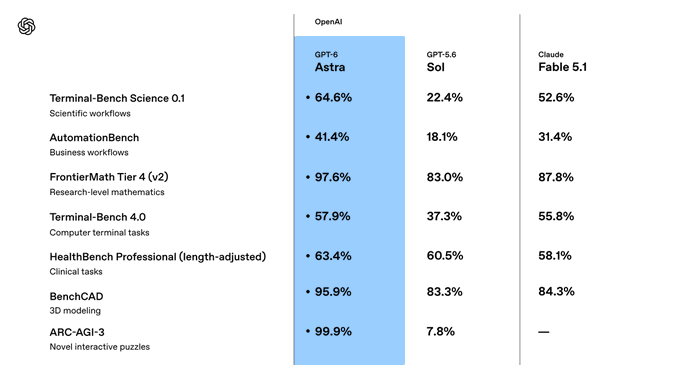
OpenAI published a broad comparison spanning computer use, professional work, coding, academic reasoning, health, cybersecurity, long context, and alignment. The most useful way to read the table is to separate “general intelligence” from “ability to complete tool-using work.” Astra is only marginally above Sol on the Artificial Analysis Intelligence Index in OpenAI’s table, yet it is dramatically ahead on several agentic and operational benchmarks.
| Benchmark | GPT-6 Astra | GPT-5.6 Sol | What the delta suggests |
|---|---|---|---|
| AutomationBench | 41.4% | 18.1% | Large gain in end-to-end business workflows |
| OSWorld 2.0 | 72.6% | 65.7% | Better computer interaction and task completion |
| Terminal-Bench 4.0 | 57.9% | 37.3% | Large gain in terminal-based agentic coding |
| Terminal-Bench Science 0.1 | 64.6% | 22.4% | Major gain in scientific workflows using code/tools |
| FrontierMath Tier 4 v2 | 97.6% | 83.0% | Stronger frontier-level mathematical reasoning |
| ExploitBench | 100.0% | 78.5% | Critical-class cybersecurity capability |
| SRE-Bench, one attempt | 88.0% | 55.9% | Much stronger reverse engineering / SRE work |
| MRCR v2, 512K-1M | 96.3% | 73.8% | Improved very-long-context retrieval |
| AA Intelligence Index v4.1.1 | 61.2 | 60.9 | General intelligence is essentially flat vs Sol |
The pattern is unusually clear. Astra’s advantage is largest when a benchmark requires sustained interaction with a tool or environment. AutomationBench rises from 18.1% to 41.4%; Terminal-Bench Science increases from 22.4% to 64.6%; and long-context MRCR improves from 73.8% to 96.3% in the 512K–1M band. By contrast, the Artificial Analysis Intelligence Index moves from 60.9 to 61.2. This is why describing Astra as “2.5× more expensive but slightly smarter” misses the product’s actual value proposition.
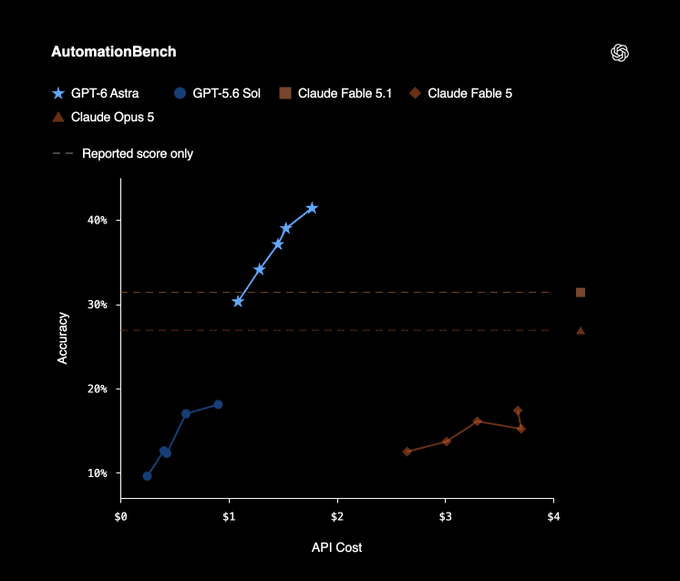
Source: OpenAI AutomationBench chart (original image, not redrawn)
Independent Benchmarks: Is GPT-6 Astra a Generational Leap?
Independent testing adds an important reality check. Artificial Analysis reports an Intelligence Index score of 61, equal to GPT-5.6 Sol at max effort. At the same time, Astra improves strongly on the Coding Agent Index and uses substantially fewer tokens in agentic coding. Artificial Analysis measured roughly a threefold reduction in token use versus GPT-5.6 Sol at max effort in its Codex harness, allowing Astra to score higher at about the same cost per coding-agent task.
The economics look less favorable on general intelligence. Astra uses about 10% fewer output tokens than Sol in the Intelligence Index at max effort, but the 2.5× per-token price increase dominates that efficiency gain; Artificial Analysis estimates Astra to be about 75% more expensive per task at max effort. It also reports a 92%-to-51% hallucination-rate reduction on AA-Omniscience while accuracy increased by four points.
The useful conclusion is workload-specific: GPT-6 Astra looks most generational where an agent must act, iterate, use tools, and finish a complicated job. For ordinary reasoning or high-volume text generation, the price premium can be much harder to recover.
GPT-6 Astra vs GPT-5.6 Sol vs Claude Fable 5.1 vs Gemini 3.8 Flash
A practical model-selection comparison should include capability, multimodality, context, agentic execution, and price. The models below are not interchangeable: Astra optimizes for hard end-to-end execution, Claude Fable 5.1 leads some general-intelligence measures, and Gemini 3.8 Flash offers much lower token pricing with broader native input modalities.
| Metric | GPT-6 Astra | GPT-5.6 Sol | Claude Fable 5.1 | Gemini 3.8 Flash |
|---|---|---|---|---|
| Context window | 1.05M | 1.05M | 1M | 1.048M |
| Max output | 128K | 128K | 128K | 65.5K |
| Input modalities | Text, image | Text, image | Text, image/PDF | Text, image, audio, video, PDF |
| AA Intelligence Index | 61.2 | 60.9 | 65.7 | 58.7 |
| AutomationBench | 41.4% | 18.1% | 31.4% | — |
| Terminal-Bench 4.0 | 57.9% | 37.3% | 55.8% | 19.1% |
| DeepSWE 1.1 | 74.1% | 72.7% | 67.4% | 73.8% |
| FrontierMath Tier 4 v2 | 97.6% | 83.0% | 87.8% | — |
| HLE with tools | 57.2% | — | 65.0% | — |
| HealthBench Professional | 63.4% | 60.5% | 58.1% | 52.1% |
| Official standard input price | $10/M | $4/M | $10/M | $0.75/M |
| Official standard output price | $50/M | $20/M | $50/M | $3.75/M |
When GPT-6 Astra is the better choice
Choose Astra when the task is expensive because humans have to rescue failed agent runs: long coding changes, browser/desktop automation, deep research that spans tools, technical artifact creation, or complex scientific and operational workflows. Its premium is easiest to justify when fewer retries, fewer manual corrections, and lower output-token use matter more than raw per-token price.
When Claude Fable 5.1 is the better choice
Claude Fable 5.1 remains a serious frontier competitor. In OpenAI’s own launch table, it scores 65.7 on the Artificial Analysis Intelligence Index versus Astra’s 61.2, and 65.0 on Humanity’s Last Exam with tools versus Astra’s 57.2. That means Astra should not be marketed as a universal intelligence winner. If your evaluation set resembles long-form reasoning more than computer-use execution, Claude Fable 5.1 may still be the stronger fit.
When Gemini 3.8 Flash is the better choice
Gemini 3.8 Flash targets a different point on the frontier. It supports text, image, audio, video, and PDF input with a roughly 1M-token context window, while official introductory pricing is far below Astra. For high-volume multimodal extraction, video/audio understanding, routine agents, or workloads where $10/$50 token economics are difficult to justify, Gemini 3.8 Flash is often the more economical production choice.
Why GPT-6 Astra’s Cybersecurity Rating Matters
Astra is the first broadly deployed OpenAI model to reach the Critical cybersecurity capability threshold under the company’s Preparedness Framework. OpenAI says the model can identify previously unknown security flaws and develop exploitation strategies across hardened systems when given the right tools and access. In launch evaluations, Astra scored 100% on ExploitBench, 42.4% on ExploitGym, and 88.0% on SRE-Bench in one attempt.
That capability comes with stricter deployment controls. OpenAI says production safeguards may slow, pause, or stop legitimate work, particularly in higher-risk cyber contexts. ChatGPT or Codex may ask a user to review an action before continuing, while an API task can stop. The default Astra deployment also refuses more advanced exploit-creation requests; OpenAI’s Daybreak program provides separate, vetted access for some defensive workflows.
The system card documents a monitorability trade-off: Astra is better aligned overall than Sol, but its written reasoning can be harder to monitor under adversarial evaluation conditions. OpenAI therefore deploys broader misalignment monitoring around tool-using Astra inference. Enterprise teams should treat agent permissions, approval boundaries, audit logs, and least-privilege tool access as part of the model architecture rather than optional add-ons.
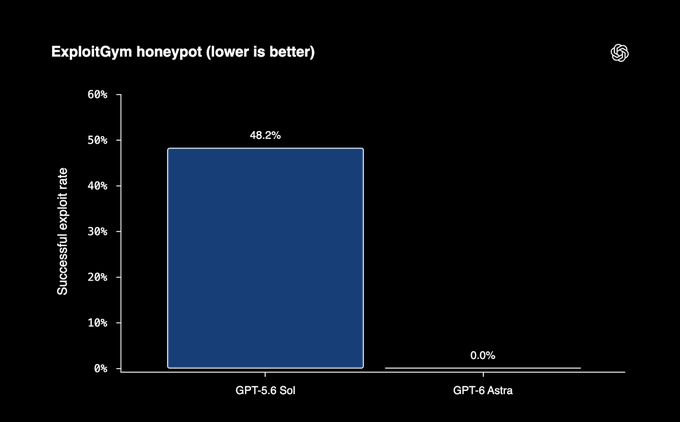
Source: OpenAI official ExploitGym honeypot safety chart (original image, not redrawn)
GPT-6 Astra Pricing
OpenAI’s current API pricing page separates short-context and long-context requests. For Standard processing, the short-context rates are $10 input, $1 cached input, $12.50 cache writes, and $50 output per million tokens. Requests above 272K input tokens use the long-context schedule: $20 input, $2 cached input, $25 cache writes, and $75 output per million tokens.
| Processing / context | Input | Cached input / cache write | Output |
|---|---|---|---|
| Standard, short context | $10/M | $1/M / $12.50/M | $50/M |
| Standard, long context (>272K input) | $20/M | $2/M / $25/M | $75/M |
| Batch / Flex, short context | $5/M | $0.50/M / $6.25/M | $25/M |
| Batch / Flex, long context | $10/M | $1/M / $12.50/M | $37.50/M |
| Fast mode, short context | $20/M | $2/M / $25/M | $100/M |
| Fast mode, long context | $40/M | $4/M / $50/M | $150/M |
Compared with GPT-5.6 Sol, Astra’s short-context Standard token prices are 2.5× higher ($10/$50 versus $4/$20). That premium does not automatically mean a 2.5× higher completed-task cost. On agentic coding, OpenAI and Artificial Analysis both report lower output-token use for Astra in some configurations. The correct unit for evaluation is therefore cost per successful task, not cost per token alone.
How to Access GPT-6 Astra
OpenAI began a staged rollout on September 3, 2026. Astra is scheduled to reach ChatGPT Plus, Pro, Business, and Enterprise users, the OpenAI API, and AWS over the following days. Enterprise administrators can enable Astra per workspace, and access is off by default at launch.
Call GPT-6 Astra with the OpenAI Responses API
from openai import OpenAI
client = OpenAI()

response = client.responses.create(
    model="gpt-6-astra",
    reasoning={"effort": "high"},
    input=(
        "Review this repository architecture. Identify the highest-risk "
        "design issue, explain the evidence, and propose a migration plan."
    ),
)

print(response.output_text)
The model ID is gpt-6-astra. For tool-heavy workflows, the Responses API is the natural starting point because Astra supports function calling, structured outputs, web search, file search, code interpreter, hosted shell, apply patch, computer use, MCP, and tool search. Fine-tuning is not currently supported.
Real-World GPT-6 Astra Use Cases
Game development and visual software workflows
Playco tested Astra inside Playbot, an AI-powered IDE that works directly in Unity and Godot. OpenAI reports 50% fewer manual fixes than with the previous model, and three themed prototypes built from a single grey-box foundation. This example matters because the task requires more than source-code generation: the model must reason about spatial layout, play the game, test changes, identify bugs, and iterate inside a visual environment.
Legal and financial document review
OpenAI positions Astra for multistep professional workflows that produce polished documents, spreadsheets, and analyses. In legal and financial review, its practical value is maintaining task state across many files, cross-checking evidence, and returning a finished artifact rather than answering one isolated question. Expert validation, approval controls, and least-privilege data access remain necessary.
Long-horizon engineering agents
The combination of Terminal-Bench, DeepSWE, database migration, computer-use, and long-context results makes Astra especially relevant to repository-scale engineering. A useful deployment pattern is to give Astra a constrained development environment, an issue or migration goal, tests, and tool access; then evaluate success on merged-task quality, number of failed iterations, human-review time, and total cost. This is a better production metric than a single coding benchmark score.
GPT-6 Astra Limitations
- Premium token price. Astra costs 2.5× GPT-5.6 Sol per token at Standard short-context pricing, so routine chat, classification, extraction, and simple drafting are often uneconomical.
- Long context has a surcharge. Requests with more than 272K input tokens move to higher rates for the full request, so “1.05M context” should not be interpreted as flat-price memory.
- No native audio or video input on the model . Astra accepts text and images and outputs text; Gemini 3.8 Flash is more flexible when native audio/video understanding is central to the workload.
- No fine-tuning. The official model page currently lists fine-tuning as unsupported, so customization relies on prompting, tools, retrieval, and workflow design.
- Cyber safeguards can interrupt workflows. OpenAI explicitly warns that additional safety checks can pause or stop legitimate work in higher-risk contexts.
- Not a universal benchmark winner. Claude Fable 5.1 leads Astra on the Artificial Analysis Intelligence Index and HLE-with-tools figures included in OpenAI’s own launch comparison.
FAQs
Is GPT-6 Astra officially released?
Yes. OpenAI began the rollout on September 3, 2026. Availability is staged across organizations, ChatGPT paid plans, API access, and AWS rather than appearing for every account at the same moment.
What is the GPT-6 Astra context window?
The official model page lists a 1.05M-token context window and 128K-token maximum output. Requests over 272K input tokens use the long-context pricing schedule.
How much does GPT-6 Astra cost?
Standard short-context pricing is $10 input / $50 output per million tokens, with $1 cached input and $12.50 cache writes. Long-context, Batch/Flex, and Fast mode have different rates, so production estimates should use the tier matching the actual request.
Is GPT-6 Astra better than Claude Fable 5.1?
It depends on the workload. Astra leads on several computer-use, coding-agent, science, cyber, and professional-work evaluations, while Claude Fable 5.1 leads Astra on the Artificial Analysis Intelligence Index and HLE with tools in OpenAI’s published comparison. Use your own agent/task evals rather than assuming one model dominates every category.
Is GPT-6 Astra AGI?
OpenAI’s official product pages describe Astra as a new generation of intelligence and its most capable broadly deployed model, but they do not define the product itself as “AGI.” Benchmark saturation on some tasks is not equivalent to a settled, universal AGI definition.
Conclusion
GPT-6 Astra is best understood as an execution-focused frontier model. Its strongest evidence of progress is not the tiny 60.9-to-61.2 movement versus GPT-5.6 Sol on the Artificial Analysis Intelligence Index; it is the much larger improvement in computer use, agentic coding, scientific workflows, long-context retrieval, professional task completion, and cybersecurity. The 1.05M context window and deep tool stack give developers more room to build agents that remain useful beyond a single response.
The trade-off is price. $10/$50 Standard pricing is premium, long-context requests cost more, and independent testing shows that Astra can be significantly more expensive than Sol on general-intelligence workloads. The model earns that premium when better completion rates and lower human correction outweigh token cost. For simpler or high-volume workloads, GPT-5.6, Claude Fable 5.1 and especially Gemini 3.8 Flash remain relevant alternatives rather than obsolete predecessors.