TL;DR
Grok 5 is SpaceXAI’s next-generation frontier model. xAI confirmed in January 2026 that the model was in training, and a later SpaceX filing with the U.S. Securities and Exchange Commission identified COLOSSUS II as the training platform.
Elon Musk has publicly discussed a target of roughly 6 trillion parameters and multimodal support spanning text, images, video, and audio. During SpaceX’s August 2026 earnings call, he said Grok 5 was planned for release before the end of 2026 and would incorporate about 25 years of SpaceX data. The update was reported by CLS and ME News.
What is not public is just as important: xAI has not released a model card, benchmark results, API pricing, context-window specifications, active-parameter counts, or a final access plan. Those open questions are consolidated in What We Don’t Know Yet rather than being presented throughout the article as settled specifications.
Key Takeaways
- xAI has confirmed that Grok 5 is in training.
- Musk has described a target scale of approximately 6 trillion parameters and support for text, image, video, and audio inputs.
- A SpaceX SEC filing links Grok 5 to COLOSSUS II and describes continued expansion using NVIDIA GB200 and GB300 systems.
- SpaceX has said the next COLOSSUS II expansion phase is designed to add at least 220,000 GB300 processors and more than 400 megawatts of compute capacity.
- Musk has said Grok 5 will be trained on the SpaceX data corpus accumulated over roughly 25 years.
- The latest public target is a release before the end of 2026, after the planned Grok 4.6 and Grok 4.7 updates.
- Architecture, context length, benchmark performance, API pricing, product tiers, and the exact launch date remain undisclosed.
What Is Grok 5?
Grok 5 is the next major foundation model in the Grok family. It follows Grok 4.5, which SpaceXAI positions around coding, agentic tasks, and knowledge work.
The first detailed public description emerged during Elon Musk’s 2025 discussion at the Baron Investment Conference. Musk discussed a model targeting approximately 6 trillion parameters and operating across text, images, video, and audio. Secondary summaries later appeared on NxCode and the Grokipedia Grok 5 reference page.
More formal confirmation arrived when xAI announced that Grok 5 was in training. The subsequent SpaceX securities filing connected the model to COLOSSUS II and described next-generation Grok systems as targeting stronger reasoning accuracy, deeper multimodal integration, and better performance in specialized domains.
The most recent public update came during SpaceX’s August 4, 2026 earnings call. Musk said Grok 5 was intended to arrive before year-end and would use the full SpaceX data corpus produced over approximately a quarter century. This places the model at the intersection of xAI’s general-purpose AI work, X’s real-time information environment, and SpaceX’s engineering operations.
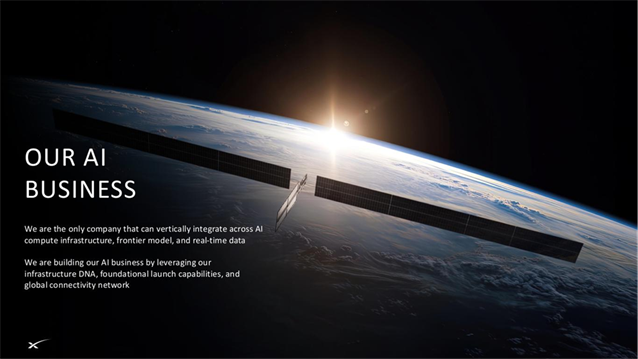
Figure 1. SpaceX’s official AI business overview links compute infrastructure, frontier models, and real-time data. Source: SpaceX SEC roadshow presentation
What Is New in Grok 5?
A 6-Trillion-Parameter Target
Musk’s reported target of roughly 6 trillion parameters would place Grok 5 far above the scale publicly discussed for earlier Grok generations. The figure should be read as a development target: xAI has not yet published the final parameter count, active-parameter count, or deployment configuration.
xAI has prior experience with sparse expert models. Its open Grok-1 release was a 314-billion-parameter mixture-of-experts model that activated only a portion of its weights for each token. That history is relevant to Grok 5, but it does not establish the architecture of the unreleased model.
COLOSSUS II and SpaceX Engineering Data
The SpaceX SEC filing states that COLOSSUS II is being used for next-generation frontier-model training, including Grok 5. It also describes large-scale GB200 and GB300 deployments and a further expansion designed to add at least 220,000 GB300 processors.
Musk has also said the model will incorporate about 25 years of SpaceX data. That corpus is significant because it may contain not only finished technical documents, but also design decisions, test results, failure investigations, software revisions, manufacturing records, and verification work.
The disclosure provides a clear reason for xAI to emphasize engineering and specialized-domain performance. It does not, however, reveal which datasets will be included, how they will be filtered, or how much of the corpus will be used during pretraining, post-training, or retrieval.
Multimodal Direction
Musk has described Grok 5 as spanning text, images, video, and audio. SpaceX’s filing separately identifies deeper multimodal integration as a goal for its next generation of frontier models.
This direction aligns with xAI’s broader product ecosystem, which already includes voice, image, and video features. The public disclosures establish multimodality as a target, but they do not specify whether Grok 5 will use one unified model for all modalities or coordinate several specialized components.
Reinforcement Learning, Search, and Agents
The official Grok 4.5 announcement shows the direction of xAI’s post-training work. Grok 4.5 was trained on hundreds of thousands of tasks, with emphasis on multi-step software engineering and technical work. Some agentic rollouts lasted for hours and were evaluated through automated and model-based grading.
Current Grok products also support web search, X search, function calling, and code execution. The Grok developer documentation presents these tools as part of the existing model ecosystem, while xAI’s multi-agent documentation describes parallel research agents that search, analyze, cross-check, and synthesize information.
These capabilities provide a factual baseline for understanding xAI’s direction. Whether Grok 5 integrates them natively, expands them, or packages them as separate services has not been disclosed.
What We Don’t Know Yet
Grok 5 has been publicly confirmed, but its final product specifications remain largely undisclosed. The following points are informed projections based on xAI’s existing models, current pricing, public infrastructure, and product strategy. They should not be read as announced Grok 5 specifications.
| Area | What Is Public | Current Projection |
|---|---|---|
| Architecture | No Grok 5 architecture has been published. | A sparse MoE design is plausible, but unconfirmed. |
| Context window | No official Grok 5 context length. | 500K–1M tokens is a reasonable planning range. |
| Performance | No Grok 5 benchmarks. | Largest gains may appear in long-horizon agents and engineering tasks. |
| API pricing | No pricing or rate card. | A premium above Grok 4.5 is likely, with higher-cost Heavy or agent modes. |
| Product variants | No Grok 5 lineup announced. | Standard, Heavy, and multi-agent tiers are plausible. |
| Release and access | Targeted before the end of 2026. | A staged preview followed by API and enterprise access is likely. |
Architecture and Active Parameters
A sparse mixture-of-experts architecture is the leading hypothesis because it would make a multi-trillion-parameter model more practical to train and serve. Grok-1 provides precedent, but xAI may have changed its routing, attention, memory, or multimodal design substantially since that release.
The 6-trillion-parameter figure also does not reveal how many parameters would be active for each token. That distinction will determine inference cost, latency, hardware requirements, and the real meaning of the model’s scale.
Context Window
Grok 4.5 supports a 500,000-token context window, while xAI’s multi-agent research system has operated at the million-token level. A 500,000- to 1-million-token range is therefore a reasonable projection for Grok 5, especially for large codebases, multimodal files, and long-running tasks.
The final number may be less important than effective recall, context compression, latency, and price. A nominal million-token window would add limited value if the model could not reliably retrieve details from it or if long-context use carried prohibitive cost.
Performance
Grok 5 has no published benchmark results. Grok 4.5’s official scores provide a baseline: 83.3% on Terminal-Bench 2.1, 64.7% on SWE-bench Pro, 62.0% on DeepSWE 1.0, 53.0% on DeepSWE 1.1, and 29.0% on SWE Marathon.
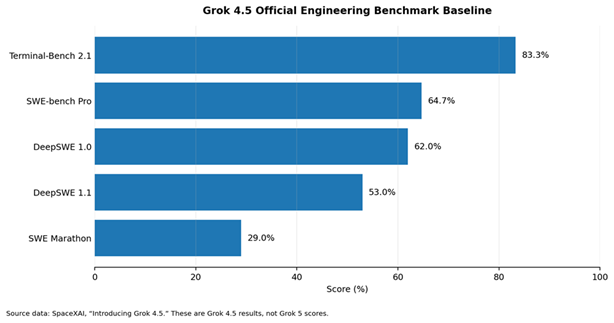
Figure 4. Grok 4.5 engineering benchmark baseline, recreated from the official results published by SpaceXAI. Source: Introducing Grok 4.5 These are Grok 4.5 results, not Grok 5 scores.
A reasonable launch expectation would be improved reliability on terminal work, multi-file software changes, and long-running engineering tasks. The most meaningful gains may appear in task completion, error recovery, repeated tool use, and multimodal evidence synthesis rather than in conventional single-turn benchmarks.
Specific score targets—such as the high 80s on Terminal-Bench or the low-to-mid 70s on SWE-bench Pro—remain speculative until xAI releases evaluation results and testing details.
API Pricing
Grok 4.5 currently costs $2 per million input tokens and $6 per million output tokens, with higher long-context rates above the published threshold.
Grok 5 will probably command a premium because of its scale and likely reasoning workload. A standard-model planning range of roughly $3–$5 per million input tokens and $10–$15 per million output tokens is defensible, but it is not an announced rate.
Heavy or multi-agent use may be priced through higher token rates, aggregate agent usage, reasoning effort, or compute time. xAI could also price the standard model aggressively to compete on price-performance, as it has done with Grok 4.5.
Product Variants and Multi-Agent Modes
xAI already operates Heavy reasoning and multi-agent research products, so a tiered Grok 5 lineup is plausible. A standard model could handle everyday requests, while a Heavy or multi-agent mode could allocate more reasoning tokens and parallel agents to difficult research, coding, or engineering work.
The number of agents may become dynamic rather than fixed. However, xAI has not announced whether these capabilities will be part of the base Grok 5 model, separate endpoints, subscription features, or an orchestration layer outside the model.
Competitive Position and Likely Use Cases
Grok 5 is likely to compete most directly in software engineering, technical research, real-time information analysis, and multimodal agent workflows. SpaceX data could differentiate it in physical engineering and systems analysis, while native access to X could strengthen real-time research.
Likely use cases include large-repository coding, test and failure analysis, design reviews, technical-document synthesis, multimodal diagnostics, market and news research, and workflows that combine search, code execution, files, and long-running agents.
Those advantages will depend on execution. Specialized data does not automatically guarantee better engineering judgment, and real-time information does not automatically guarantee factual accuracy. Reliability, source verification, latency, and cost will determine whether Grok 5 becomes a practical alternative to other frontier models.
Exact Release Date and Access
The public target is a release before the end of 2026. Reports from CLS and ME News state that Grok 4.6 and Grok 4.7 are expected to arrive first.
That sequence points to a fourth-quarter launch, but it does not establish a specific month or day. A November or December release is plausible rather than confirmed.
Based on earlier Grok launches, access may begin through grok.com, Grok mobile apps, X Premium+ or SuperGrok tiers, and selected partners before broader API and enterprise availability. CometAPI and other model gateways could add the model once official API access exists, but no integration schedule has been announced.
The central distinction is straightforward: Grok 5’s existence, training platform, parameter target, multimodal ambition, SpaceX data plan, and year-end release target are public. Its final architecture, context length, performance, pricing, product packaging, and launch mechanics are not.