
TLDR: Google’s Gemini 3.5 Pro, isIt will be released no later than August, and as early as July 17th. after a reported full rebuild. It is not available yet. Rumored specs include a groundbreaking 2-million-token context window (double 3.5 Flash’s 1M), a Deep Think reasoning layer for advanced multi-step logic, superior agentic capabilities, and strong performance against rivals like Claude Fable 5 and GPT-5.6 Sol .
While Gemini 3.5 Flash is already delivering excellent coding and agent workflows, Pro promises deeper reasoning for complex, long-horizon tasks. Developers can prepare today via unified platforms like CometAPI for seamless access to the full Gemini family (and 500+ other models) without vendor lock-in.
Key Takeaways
- Release Status: Targeting July 17, 2026; not publicly available as of mid-July. Limited enterprise previews exist on Vertex AI.
- Rumored Standout Features: On Youtube's video, 2M token context window, Deep Think inference layer, autonomous multi-file coding and tool-use workflows.
- Performance Edge: Leaked benchmarks from x's new suggest it tops rivals in zero-shot, agentic, and tool-use tasks.
- Positioning: Expected to excel in long-context analysis, complex reasoning, and agentic systems—building on 3.5 Flash’s proven agentic strengths.
- Why It Matters: A potential Google comeback in frontier AI, pressuring competitors on reasoning depth and context scale.
- Practical Advice: Start building with Gemini 3.5 Flash today on CometAPI for cost-effective, high-volume workloads; switch to Pro seamlessly upon release.
What is Gemini 3.5 Pro?
Gemini 3.5 Pro represents Google DeepMind’s next flagship frontier model in the Gemini 3.5 series, building on the recently released Gemini 3.5 Flash. Positioned as a high-capability model optimized for complex, agentic workflows, it combines frontier-level intelligence with enhanced action-oriented capabilities.
Unlike lighter “Flash” variants designed for speed and efficiency, the Pro tier targets demanding use cases: advanced coding, long-horizon agentic tasks, deep multimodal analysis (text, images, video, audio, code), and sophisticated reasoning that requires holding vast amounts of information in context. Google has framed the entire 3.5 series around “frontier intelligence with action,” emphasizing real-world utility over raw benchmark chasing in I/O 20026.
The model builds on previous generations like Gemini 3.1 Pro (with 1M token context) but introduces architectural refinements, including potential test-time compute optimizations and improved tool integration. Leaks from Youtube highlight a fresh pre-training run, suggesting it’s not merely an incremental update but a more substantial evolution.
The Importance of the Gemini 3.5 Pro Release
In a rapidly evolving AI landscape dominated by models like Anthropic’s Claude Fable 5, OpenAI’s GPT-5.6 Sol, and xAI’s Grok variants, Gemini 3.5 Pro represents Google’s strategic push to reclaim leadership in multimodal reasoning, long-context understanding, and agentic AI.
Why this release is pivotal:
- Agentic AI Maturity: Modern applications demand models that don’t just respond but orchestrate workflows, use tools recursively, and maintain coherence over long horizons. Flash already outperforms prior Pro models on benchmarks like Terminal-Bench 2.1 (76.2% vs. 70.3% for 3.1 Pro) and MCP Atlas (83.6% vs. 78.2%). Pro is expected to amplify this.
- Enterprise Adoption: Businesses need reliable long-context processing for legal review, code migration, research synthesis, and financial modeling. A true 2M-token effective window could transform these use cases.
- Competitive Pressure: With rivals shipping advanced models in July 2026, Pro’s timing is critical. Leaks suggest it could lead in zero-shot tasks, agentic workflows, and multimodal integration.
- Developer Ecosystem: Integration via Google’s Gemini API (and aggregators like CometAPI) lowers barriers, enabling hybrid stacks that combine the best of Gemini, Claude, GPT, and others.
The rebuild decision—reportedly scrapping a near-complete base model due to issues in complex SVG generation and recursive tool-calling—signals Google’s commitment to quality over rushed timelines. This could yield a more robust model, though it delayed the launch from June.
When Will the Gemini 3.5 Pro Be Released? Is It Available Now?
Short answer: No, it is not publicly available as of July 15, 2026. According to the latest X news leak, the Gemini 3.5 Pro will be delayed again until August. Before targeted release is July 17, 2026, based on that Polymarket predicts the 3.5 Pro will ship on July 17th, with an implied probability of approximately 62%. The model's serial number has appeared on Google Cloud servers for at least two weeks.but Google has not officially confirmed the date or specs.
- Timeline Context: Teased at I/O 2026 with “next month” (June) expectations from Sundar Pichai. Delayed for additional testing and a Hackernoon reported full rebuild.
- Current Access: Gemini 3.5 Flash is GA via Gemini API and platforms like CometAPI. Gemini 3.1 Pro previews and limited 3.5 Pro enterprise access on Vertex AI exist, but no public gemini-3.5-pro model ID.
- Watch Signals: Model slug sightings in Google Cloud, “coming soon” cards, and Polymarket odds favoring July 17, The news of X being postponed to August.
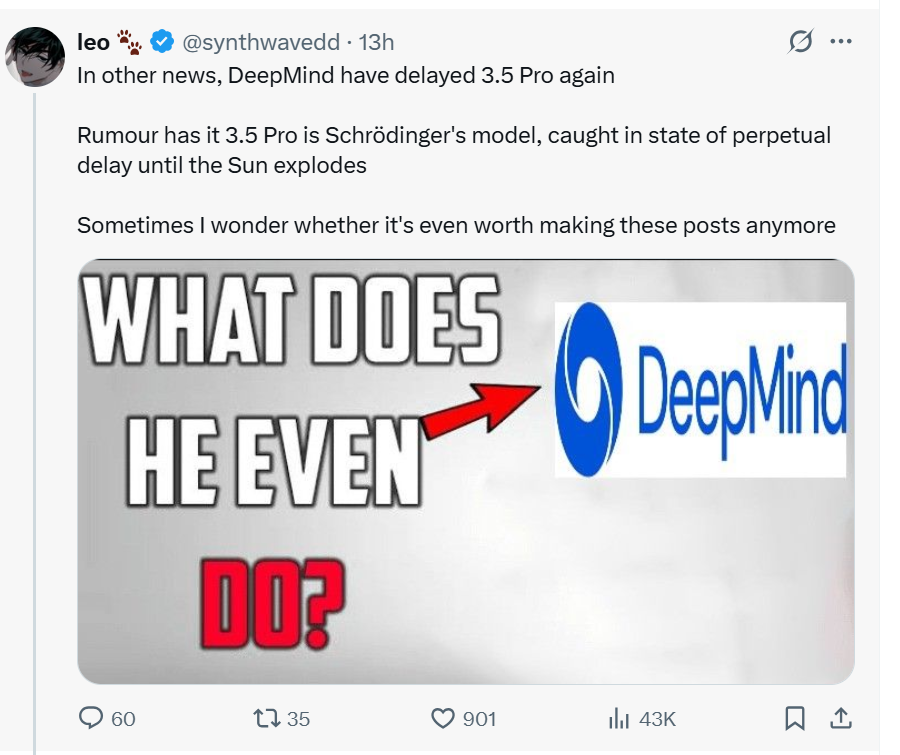
Source: Leo
Recommendation: Use CometAPI today for instant access to Gemini 3.5 Flash (and hundreds of other models) with unified billing, no vendor lock-in, and often competitive or lower pricing. When Pro drops, swap model names effortlessly.
Key Features and Innovations of Gemini 3.5 Pro (2026 Update)
Gemini 3.5 Pro represents Google DeepMind’s most ambitious reasoning model in the 3.5 series. While full official specifications remain under wraps pending the expected July 17, 2026 launch, leaks, internal previews, Flash performance data, and Google’s framing of the 3.5 family provide a clear picture of its anticipated breakthroughs.
1. Massive 2 Million Token Context Window
- Innovation: Reportedly doubles the 1M context of Gemini 3.5 Flash, enabling the model to process entire large codebases, book-length documents, hours of video transcripts, or massive multimodal datasets in a single prompt.
- Practical Impact: True long-horizon understanding for tasks like repository-wide refactoring, legal contract analysis across thousands of pages, or synthesizing research corpora.
- Caveat: Effective context (reasoning quality across length) is what matters. Prior models show degradation; Pro’s rebuild reportedly targets better long-context coherence.
2. Deep Think Reasoning Layer
- Innovation: An advanced multi-step inference mechanism (building on existing Deep Think capabilities) designed for complex logical chaining, recursive problem-solving, and sustained “thinking” before responding.
- Proven Pedigree: Related Deep Think systems have achieved high scores on ARC-AGI-2 (~84.6%) and gold-medal performance at the 2025 International Mathematical Olympiad.
- Benefit: Superior performance on hard reasoning, math, science, and planning tasks where previous models falter on depth or consistency.
3. Enhanced Agentic and Autonomous Workflows
- Innovation: Native support for autonomous multi-agent orchestration, recursive tool calling, and long-running workflows with minimal human oversight.
- Key Capabilities:
- Multi-file code understanding and editing.
- Complex tool chains (search, code execution, external APIs).
- Self-correction and iterative improvement loops.
- Flash Foundation: 3.5 Flash already leads on Terminal-Bench (76.2%), MCP Atlas (83.6%), and Finance Agent benchmarks. Pro is expected to extend this to more demanding, sustained agent scenarios.
4. Superior Multimodal Understanding and Generation
- Innovation: Seamless integration of text, image, video, audio, and code with deeper cross-modal reasoning.
- Expected Advances: Better video analysis, document understanding (thousands of pages), and native generation/editing capabilities (leveraging tools like Veo and Nano Banana).
5. Improved Efficiency and Production Readiness
- Hybrid Architecture: Balances raw intelligence with practical deployment (speed/quality trade-offs informed by Flash).
- Enterprise Features: Structured outputs, function calling, context caching, and Vertex AI integration for scalable agents.
6. Other Notable Innovations (Rumored/Expected)
- Rebuilt Base Model: Google reportedly scrapped an earlier version due to weaknesses in complex generation and tool stability, opting for a full pre-training restart for structural improvements.
- Zero-Shot and Generalization: Leaks suggest leading performance in zero-shot tasks and broad generalization.
- Safety and Reliability: Enhanced consistency in long chains, reduced hallucinations in technical domains.
Comparison: Gemini 3.5 Pro vs. 3.5 Flash
| Feature | Gemini 3.5 Pro (Expected) | Gemini 3.5 Flash (Current) |
|---|---|---|
| Context Window | 2M tokens | 1M tokens |
| Primary Strength | Deep reasoning, long-horizon agents | Speed, high-volume agentic tasks |
| Reasoning Depth | Deep Think + advanced chaining | Strong (but lighter) |
| Use Cases | Complex coding, research synthesis, heavy inference | Real-time agents, coding loops, cost-sensitive workloads |
| Availability | July 17 target | Generally Available |
Expected Pricing and Cost Considerations
Pricing remains unconfirmed for Pro, but patterns from 3.5 Flash and prior Pros provide clues:
- Gemini 3.5 Flash: ~$1.50 / $9 per 1M input/output tokens (notably higher than previous Flash tiers).
- Pro tiers historically cost more (e.g., 2-4x Flash in some brackets).
- Potential premium for Deep Think or extended context (e.g., context caching fees).
- Enterprise plans via Vertex AI may include higher limits and SLAs.
Rumors: A facebook post about $250/month Ultra access for top features about gemini 3.5 pro, but treat as unverified.
Effective Cost Tip: Newer models often consume more tokens on agentic tasks, raising total spend. Measure by task completion cost, not just per-token rates.
Gemini 3.5 Pro vs Gemini 3.5 Flash vs Gemini 3.1 Pro Preview
| Feature | Gemini 3.5 Flash | Gemini 3.1 Pro Preview | Gemini 3.5 Pro |
|---|---|---|---|
| Status | Generally available | Preview | Coming soon / not broadly public |
| Public API model ID | gemini-3.5-flash | gemini-3.1-pro-preview | Not officially published |
| Best current role | Fast agentic coding, multimodal automation, high-volume workflows | Current Pro-style Gemini baseline for complex reasoning | Expected flagship Pro-tier reasoning and agentic model |
| Input limit | 1,048,576 tokens | 1,048,576 tokens | Rumored 2M, not confirmed |
| Output limit | 65,536 tokens | 65,536 tokens | Not confirmed |
| Inputs | Text, image, video, audio, PDF | Text, image, video, audio, PDF | Expected multimodal, not confirmed |
| Thinking support | Supported | Supported | Deep Think rumored, not confirmed |
| Google standard price | $1.50 input / $9 output per 1M | $2/$12 up to 200K, $4/$18 above 200K | Not published |
| CometAPI listed price | $1.2 input / $7.2 output per 1M | $1.6 input / $9.6 output per 1M | Coming-soon page displays $60/$240, treat as provisional |
| Published benchmarks | Yes | Yes | No official public benchmark table |
| Production recommendation | Use now after evaluation | Use carefully as preview | Watchlist until model ID, price, and model card land |
CometAPI Recommendations
Note: Table based on leaks and comparisons; official head-to-heads pending release.
What We Know (and Don’t Know) About Gemini 3.5 Pro
Confirmed (via official channels or Flash data):
- The 3.5 series emphasizes agentic capabilities, tool use, and multimodal inputs (text, image, video, audio, code).
- Gemini 3.5 Pro exists as a coming model and is already being used internally. Gemini 3.5 Pro is in testing and expected after Flash.
- Deep Think reasoning exists in the Gemini ecosystem with impressive results (e.g., high ARC-AGI-2 scores, IMO gold).
Rumored / Leaked (unconfirmed by Google):
- 2M Token Context Window: Double Flash’s; potentially industry-leading for processing massive codebases or document corpora. Note: Effective performance often degrades before the max limit (context rot studies show 30-40% drops).
- Deep Think Inference Layer: For enhanced multi-step logical problem-solving and sustained reasoning.
- Autonomous Workflows: Better multi-file coding, tool chaining, and minimal human intervention in complex tasks.
- Benchmarks: Internal leaks suggest leadership over Claude Fable 5 and GPT-5.6 in zero-shot, agentic, and certain reasoning tasks.
Unknowns: Official model card, exact pricing, confirmed benchmarks, output token limits, multimodal specifics, and real-world effective context quality. Expect these post-launch.
How to Prepare and Access Gemini Models Today
While waiting for 3.5 Pro:
- For production: Integrate via official Gemini API or unified platforms
- Experiment with Gemini 3.5 Flash via Google AI Studio (free tier available) or CometAPI.
Start with Gemini 3.5 Flash through CometAPI when you need speed, multimodal input, coding support, and cost-effective agent loops. CometAPI's Gemini 3.5 Flash lists input at $1.2/M and output at $7.2/M, a 20% discount from the official $1.5/$9 standard price shown by Google. Use this model for workflows where throughput matters: support automation, coding helpers, document extraction, search-grounded answers, classification, and draft generation.
Use Gemini 3.1 Pro Preview when you need a Pro-style Gemini baseline today. It is still a preview, so avoid treating it as a permanent default without monitoring behavior and migration notes. But it is useful for testing whether your workload benefits from deeper reasoning before Gemini 3.5 Pro appears.
Example integration is straightforward with OpenAI-compatible endpoints. This future-proofs your apps for when Gemini 3.5 Pro drops — just update the model name. Ideal for testing long-context apps, agents, or scaling without multiple accounts.
What to Check the Day Gemini 3.5 Pro Appears
When Gemini 3.5 Pro becomes available, verify these items before publishing your own docs or changing production routing:
| Launch checklist | Why it matters |
|---|---|
| Official model ID | Prevents routing to a fake, stale, or placeholder endpoint |
| Availability surface | Gemini app, AI Studio, Gemini API, Vertex AI, Antigravity, and CometAPI may roll out at different times |
| Input and output limits | Confirms or disproves the 2M-token rumor |
| Standard, Batch, Flex, and Priority pricing | Determines whether Pro is a default model or escalation-only |
| Cached input pricing | Critical for long-context applications |
| Tool support | Function calling, code execution, search grounding, URL context, file search, and computer use affect agent design |
| Model card | Confirms intended usage, safety profile, known limitations, and evaluation data |
| Independent benchmarks | Helps separate launch marketing from real-world performance |
| CometAPI dashboard price | Public pages can lag; the dashboard is what matters for actual billing |
Suggested Routing Strategy
For most teams, the best Gemini 3.5 Pro architecture will be a router, not a one-model migration:
- Default to Gemini 3.5 Flash for fast, high-volume agent steps.
- Escalate to Gemini 3.5 Pro only when tasks are hard, long, ambiguous, or expensive to get wrong.
- Keep another frontier model as fallback during the first weeks of availability.
- Use cheaper models for classification, extraction, and routing.
- Track cost per successful task, not only cost per token.
This is where CometAPI's value is strongest. If your application can switch between Gemini, GPT, Claude, Grok, DeepSeek, and other models through one API layer, you can treat Gemini 3.5 Pro as a measurable option rather than a risky full migration.
Conclusion: A Major Leap Forward?
Gemini 3.5 Pro, if leaks hold, positions Google as a strong contender — or leader — in the 2026 AI race. Its combination of enormous context, deliberate reasoning, and agentic focus addresses key pain points in current models. For those on Cometapi.com, the timing is perfect to build flexible, multi-model systems ready for this evolution.
Stay tuned for the official July launch. In the meantime, start experimenting with available Gemini models through CometAPI to gain a competitive edge.