Spesifikasi Teknis GLM-5.3-Flash
| Spesifikasi | GLM-5.3-Flash |
|---|---|
| Penyedia | Z.ai (Zhipu AI) |
| Keluarga model | GLM-5 |
| Jenis model | Model Mixture-of-Experts multimodal native |
| Total parameter | 320B |
| Parameter aktif | 18B |
| Arsitektur | Atensi hibrida sparse + linear |
| Jendela konteks | 1,048,576 token (1M) |
| Output maksimum | 131,072 token |
| Modalitas input | Teks, gambar, video |
| Modalitas output | Teks |
| Penalaran | Didukung |
| Visi | Didukung |
| Pemanggilan fungsi | Didukung |
| Penggunaan alat | Didukung |
| Pencarian web | Didukung melalui integrasi API yang didukung |
| Bobot terbuka | Ya |
| Lisensi | MIT |
| Rilis | 26 Agustus 2026 |
Z.ai menggambarkan GLM-5.3-Flash sebagai model pertama yang secara native multimodal dalam keluarga GLM-5. Model ini memiliki total 320B parameter namun hanya mengaktifkan 18B parameter per langkah inferensi. Model ini memperkenalkan arsitektur hibrida yang menggabungkan atensi sparse dan linear serta menggunakan mHC untuk meningkatkan efisiensi penskalaan.
Apa Itu GLM-5.3-Flash?
GLM-5.3-Flash adalah anggota GLM-5 berorientasi efisiensi dari Z.ai, dirancang untuk menggabungkan kemampuan penalaran tingkat terdepan dan pengodean agenik dengan biaya inferensi yang secara signifikan lebih rendah.
Pembedaan terpenting dari model "Flash" konvensional adalah bahwa Flash tidak berarti model kecil. GLM-5.3-Flash memiliki total 320B parameter, tetapi arsitektur MoE-nya hanya mengaktifkan 18B parameter per token. Ini memungkinkan Z.ai menargetkan komputasi inferensi yang jauh lebih rendah sambil mempertahankan kumpulan parameter besar untuk kapasitas model.
Ini juga merupakan model GLM-5 pertama dengan kemampuan multimodal native. Model ini mendukung input visual selain teks dan diposisikan untuk pengodean, interaksi peramban, pemahaman dokumen, pengodean visual, dan workflow agenik.
Z.ai menyatakan GLM-5.3-Flash dilatih dari model dasar yang baru dilatih alih-alih versi terkompresi sederhana dari GLM-5.2. Pelatihannya menggunakan korpus pra-pelatihan multimodal 30 triliun token, sementara arsitekturnya didesain ulang dengan fokus pada kapabilitas dan efisiensi inferensi.
Fitur Utama GLM-5.3-Flash
- 320B MoE dengan 18B parameter aktif: GLM-5.3-Flash menggabungkan kapasitas parameter total yang sangat besar dengan jejak parameter aktif yang relatif kecil, membuat model ini jauh lebih efisien untuk dilayani dibanding model dense 320B.
- Pemahaman multimodal native: Tidak seperti model GLM-5 sebelumnya, GLM-5.3-Flash memproses input visual secara native. Kartu modelnya menyediakan contoh pemahaman gambar dan mengidentifikasi model ini sebagai multimodal.
- Konteks 1M token: Model ini dirancang untuk aplikasi konteks panjang yang melibatkan repositori besar, dokumen ekstensif, trajektori agen panjang, dan workflow multi-langkah yang kompleks. Cloudflare dan Vercel sama-sama mencantumkan jendela konteks 1,048,576 token.
- Atensi hibrida sparse + linear: GLM-5.3-Flash adalah model GLM pertama yang menggabungkan atensi sparse dan atensi linear. Z.ai menyatakan arsitektur ini mengurangi biaya penyajian konteks panjang sambil mempertahankan kapabilitas konteks panjang yang presisi.
- Pengodean agenik dan penggunaan alat: Model ini dioptimalkan untuk rekayasa perangkat lunak, tugas terminal, interaksi peramban, dan workflow berbasis alat. Skor Terminal-Bench 2.1 yang dilaporkan adalah 84.3.
- Deploy bobot terbuka: Bobot berlisensi MIT dapat dideploy dengan Transformers, vLLM, SGLang, TokenSpeed, dan KTransformers, memberi pengembang opsi untuk self-hosting dan optimasi inferensi.
Kinerja Benchmark GLM-5.3-Flash
GLM-5.3-Flash memiliki profil yang sangat kuat pada benchmark pengodean dan agenik.
| Benchmark | GLM-5.3-Flash | GLM-5.2 | Catatan |
|---|---|---|---|
| Terminal-Bench 2.1 | 84.3 | 81.0 | Terminal / pengodean agenik |
| DeepSWE v1.1 | 63.4 | 46.2 | Rekayasa perangkat lunak |
| AutomationBench | 48.8 | 26.2 | Otomasi penggunaan komputer |
| Toolathlon-Verified | 78.4 | 59.9 | Kapabilitas penggunaan alat |
| NL2Repo-Bench | 56.3 | 48.9 | Pengodean bahasa natural ke repositori |
| Agent's Last Exam | 26.3 | 20.4 | Penalaran agenik |
| Humanity's Last Exam | 55.3 | — | Dengan alat |
| GDPval-AA v2 | 1773 Elo | 1504 Elo | Produktivitas / pekerjaan pengetahuan |
| OfficeQA-Pro | 62.4 | — | Produktivitas multimodal |
| CharXiv RQ | 89.4 | — | Penalaran multimodal |
Bagian evaluasi resmi Hugging Face mencantumkan 84.3 pada Terminal-Bench 2.1, 63.4 pada DeepSWE, dan 55.3 pada HLE. Materi peluncuran Z.ai melaporkan hasil tambahan termasuk AutomationBench, Toolathlon, NL2Repo, dan GDPval.
Independent Artificial Analysis saat ini memberikan GLM-5.3-Flash Indeks Kecerdasan 57, menempatkannya di peringkat #3 dari 108 model dalam set perbandingan saat ini.
Angka-angka ini tetap harus ditafsirkan dengan catatan khusus benchmark: beberapa hasil dilaporkan vendor, kerangka evaluasi berbeda, dan skor benchmark tidak boleh dianggap sebagai peringkat universal kualitas model.
GLM-5.3-Flash vs GLM-5.3 vs GLM-5.2
| Fitur | GLM-5.3-Flash | GLM-5.3 | GLM-5.2 |
|---|---|---|---|
| Generasi model | GLM-5 | GLM-5 | GLM-5 |
| Posisi | Model efisien multimodal / agenik | Model penalaran umum high-end | Model generasi sebelumnya yang umum |
| Visi native | Ya | Tidak | Bergantung pada model |
| Total parameter | 320B | Konfigurasi flagship lebih besar | Model skala besar |
| Parameter aktif | 18B | — | — |
| Konteks | 1M | Deployment kelas 200K | Deployment kelas 200K |
| Atensi hibrida sparse/linear | Ya | Tidak | Tidak |
| Pengodean agenik | Sangat baik | Sangat baik | Kuat |
| Bobot terbuka | Ya | Bergantung pada deployment | Bergantung pada deployment |
| Keunggulan utama | Kapabilitas per unit komputasi inferensi | Kapabilitas penalaran GLM-5 maksimum | Generasi GLM yang matang dan lebih murah |
Perbedaan kunci adalah bahwa GLM-5.3-Flash bukan sekadar GLM-5.3 dengan ukuran lebih kecil. Z.ai menyatakan model ini dimulai dari model dasar yang baru dilatih dan memperkenalkan arsitektur atensi hibrida yang didesain ulang, mHC, serta pra-pelatihan multimodal.
GLM-5.3-Flash vs DeepSeek V4 Flash — Ringkasan Perbandingan
| Dimensi | GLM-5.3-Flash (Z.ai / Zhipu) | DeepSeek V4 Flash (DeepSeek) | Keunggulan |
|---|---|---|---|
| Tanggal Rilis | 26 Agustus 2026 | Pratinjau April 2026; checkpoint utama (0731) 31 Juli 2026 | — |
| Total / Parameter Aktif | 320B / 18B | 284B / 13B | GLM sedikit lebih besar |
| Jendela Konteks | 1M token | 1M token | Seri |
| Output Maksimum | ~131K token | Hingga 384K token | DeepSeek |
| Modalitas | Multimodal native (input teks + gambar + video) | Primarily text (varian visi eksperimental tersedia) | GLM |
| Sorotan Arsitektur | Atensi hibrida sparse + linear (~3× komputasi atensi lebih rendah, ~4.4× KV cache lebih kecil vs GLM-5.3 penuh) | Compressed Sparse Attention (CSA) + Heavily Compressed Attention (HCA) | Masing-masing punya keunggulan |
| Lisensi | MIT (bobot di Hugging Face) | MIT (bobot tersedia) | Seri |
| Harga API Standar ($ / 1M token) | Input $0.15 / Output $0.50 (input cache ~ $0.03) | Rentang umum $0.14–$0.44 input / $0.28–$1.32 output (bervariasi menurut jam puncak/non-puncak) | GLM lebih murah |
| Harga Promo Peluncuran | ~$0.075 input / $0.25 output (waktu terbatas, ~awal Sep 2026) | Tidak ada promosi setara | GLM |
| AA Intelligence Index | 57 (dilaporkan vendor) | ~50 (pengukuran independen) | GLM |
| Terminal-Bench 2.1 | 84.3 | 82.7 | GLM |
| DeepSWE | 63.4 | 54.4 | GLM |
| SWE-bench Verified | Data independen terbatas sejauh ini | ~79% (hasil independen kuat) | DeepSeek |
| Kekuatan Utama | Harga lebih rendah, multimodal native, unggul pada beberapa skor agenik/pengodean, efisien pada konteks panjang | Validasi independen lebih matang, rekam jejak coding/agent sangat baik, desain konteks panjang sangat efisien, ekosistem kuat | — |
| Kelemahan Utama | Rilisan lebih baru (beberapa skor masih dilaporkan vendor); kecepatan rata-rata | Dukungan multimodal lebih lemah; harga efektif lebih tinggi di banyak rute | — |
| Terbaik Untuk | Penggunaan umum, workload multimodal, proyek sensitif biaya, kapabilitas agen seimbang | Agen fokus coding murni, penalaran teks konteks panjang, skenario yang membutuhkan benchmark independen yang terbukti | — |
Ringkasan satu kalimat:
Per akhir Agustus 2026, GLM-5.3-Flash unggul pada harga, kemampuan multimodal, dan beberapa benchmark tumpang tindih, menawarkan nilai keseluruhan yang lebih baik. DeepSeek V4 Flash tetap pilihan yang sangat andal untuk agen fokus coding berkat validasi independen yang lebih kuat dan efisiensi konteks panjang. Uji keduanya pada workload spesifik Anda sebelum memutuskan.
Use Case GLM-5.3-Flash
1. Rekayasa perangkat lunak agenik
GLM-5.3-Flash sangat cocok untuk agen pengodean yang perlu memeriksa repositori, memodifikasi banyak file, menjalankan perintah terminal, menjalankan tes, dan beriterasi pada implementasi.
Skor Terminal-Bench 2.1 sebesar 84.3 dan hasil DeepSWE 63.4 menunjukkan bahwa rekayasa perangkat lunak adalah salah satu area aplikasi terkuatnya.
2. Pengodean visual
Karena GLM-5.3-Flash bersifat multimodal native, pengembang dapat menyediakan tangkapan layar, diagram, dan input visual lainnya bersama instruksi pengodean. Ini berguna untuk implementasi UI, debugging visual, dan workflow desain-ke-kode.
3. Analisis dokumen konteks panjang
Jendela konteks 1M token membuat model ini cocok untuk set dokumentasi teknis besar, repositori, laporan panjang, dan riwayat agen multi-tahap.
4. Agen peramban dan penggunaan komputer
Kapabilitas penggunaan alat dan multimodal model ini membuatnya cocok untuk workflow yang melibatkan peramban, antarmuka grafis, dan alat eksternal.
5. Pekerjaan pengetahuan enterprise
GLM-5.3-Flash dapat memproses volume besar informasi terstruktur dan tidak terstruktur sambil menggunakan alat untuk melakukan tugas multi-langkah, sehingga cocok untuk analisis dokumen, bantuan riset, dan automasi workflow.
6. Infrastruktur AI self-hosted
Lisensi MIT dan bobot yang tersedia secara publik membuat GLM-5.3-Flash menarik bagi organisasi yang membutuhkan kontrol atas deployment, pemrosesan data, dan infrastruktur inferensi.
Parameter API GLM-5.3-Flash
| Parameter | Deskripsi |
|---|---|
| model | Pengenal model spesifik penyedia |
| messages | Input percakapan terstruktur |
| prompt | Input prompt tunggal pada API yang didukung |
| max_tokens / max_completion_tokens | Batas token output |
| temperature | Mengontrol kerandoman sampling |
| tools | Definisi alat/fungsi |
| stream | Mengaktifkan output streaming |
| reasoning | Mengontrol upaya penalaran pada gateway yang didukung |
| Image content | Didukung |
| Function calling | Didukung |
| Context | Hingga 1M token |
Vercel AI Gateway saat ini mendokumentasikan maksimum 131,000 token output, dengan token penalaran dihitung ke batas output.
Cara Menggunakan API GLM-5.3-Flash di CometAPI
Langkah 1: Dapatkan Akses API
Login ke cometAPI. Jika Anda belum menjadi pengguna kami, silakan daftar terlebih dahulu. Masuk ke konsol CometAPI. Dapatkan kredensial akses kunci API antarmuka. Klik “Add Token” pada API token di pusat personal, dapatkan token key: sk-xxxxx dan kirim.
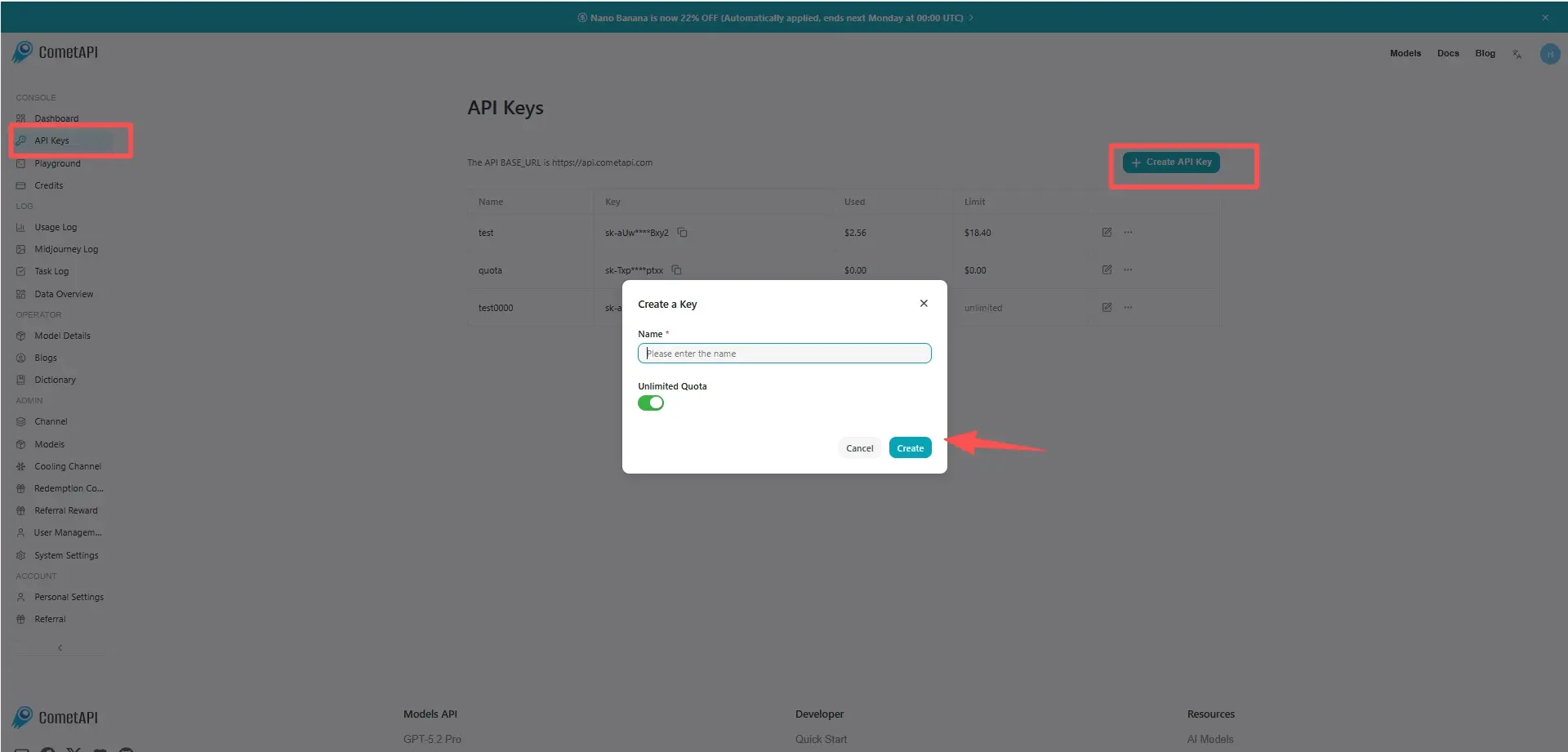
Langkah 2: Kirim Permintaan ke API GLM-5.3-Flash
Pilih endpoint “GLM-5.3-Flash” untuk mengirim permintaan API dan atur body permintaan. Metode dan body permintaan diperoleh dari dokumentasi API situs kami. Situs kami juga menyediakan Apifox untuk pengujian demi kenyamanan Anda. Ganti <YOUR_API_KEY> dengan kunci CometAPI Anda yang sebenarnya dari akun Anda.
Masukkan pertanyaan atau permintaan Anda ke bidang content—ini adalah yang akan direspons oleh model. Proses respons API untuk mendapatkan jawaban yang dihasilkan.
Langkah 3: Proses Respons
API mengembalikan kandidat respons terstruktur termasuk teks yang dihasilkan, sitasi, metadata keamanan, dan output alat opsional. Untuk permintaan multimodal, konten pesan dapat distrukturkan dengan input teks dan gambar ketika endpoint CometAPI yang dipilih mengekspos kapabilitas visi model.
Endpoint CometAPI yang tepat, parameter yang didukung, dan ketersediaan saat ini harus diambil dari dokumentasi API CometAPI live alih-alih disimpulkan dari API native Z.ai.
Untuk CometAPI, integrasi harus menggunakan model ID yang ditampilkan pada endpoint model CometAPI live, bukan menyalin otomatis ID spesifik penyedia dari Z.ai, Cloudflare, atau Vercel.
Keterbatasan GLM-5.3-Flash
- Jejak model besar: Meskipun hanya 18B parameter yang aktif, model yang dirilis berisi sekitar 321B parameter, membuat self-hosting jauh lebih menuntut dibandingkan deploy model konvensional 7B–70B.
- Kecepatan inferensi tidak selalu “flash” secara absolut: Artificial Analysis saat ini mengukur sekitar 50 token output/detik dalam lingkungan perbandingannya, menempatkan model ini jauh di bawah model kecil tercepat.
- Konteks sangat panjang meningkatkan kebutuhan infrastruktur: Jendela konteks 1M token berguna tetapi dapat meningkatkan memori dan kompleksitas penyajian.
- Kinerja benchmark bervariasi menurut tugas: GLM-5.3-Flash sangat kuat dalam benchmark pengodean agenik dan penggunaan alat, tetapi tidak ada satu benchmark pun yang menetapkan superioritas universal atas model proprietary frontier.
- Output multimodal terbatas: Kapabilitas multimodal native model ini terutama pada sisi input; output standarnya adalah teks, bukan gambar atau video yang dihasilkan.