
Featured Snippet Answer
GPT-5.6 is OpenAI's new model family, announced on June 26, 2026, and now available only through a limited preview for selected trusted partners via the OpenAI API and Codex. The family has three tiers: GPT-5.6 Sol, the flagship model for the hardest reasoning, coding, cyber, and scientific workflows; GPT-5.6 Terra, a balanced model positioned near GPT-5.5-level performance at lower cost; and GPT-5.6 Luna, the fastest and most cost-efficient option. OpenAI says Sol introduces a new max reasoning effort and an ultra mode that can use subagents for complex work.
Introduction
OpenAI has unveiled GPT-5.6, a new family of models featuring GPT-5.6 Sol (flagship), GPT-5.6 Terra (balanced), and GPT-5.6 Luna (fast and affordable). Announced on June 26, 2026, it is currently in a limited preview for select trusted partners via the OpenAI API and Codex, with broader availability expected in ChatGPT, Codex, and the API in the coming weeks.
This release introduces a tiered naming system (generation number + capability tier), advanced reasoning modes like Max Reasoning Effort and Ultra Mode, significant gains in agentic coding, biology workflows, and cybersecurity, plus a robust new safety stack. It arrives amid heightened scrutiny, with a government-coordinated rollout.
For developers, enterprises, and AI enthusiasts integrating frontier models, GPT-5.6 promises higher performance on complex, long-horizon tasks while offering cost-efficient options. CometAPI provides a unified, OpenAI-compatible API for accessing 500+ models from OpenAI, Anthropic, Google, xAI, and others—often at 20-40% lower costs—making it easier to experiment with GPT-5.6 alternatives or route tasks intelligently as broader access rolls out.
What Is GPT-5.6? Understanding Sol, Terra, and Luna
GPT-5.6 marks a shift to a multi-model family under one generation. The "5.6" denotes the generation, while Sol, Terra, and Luna represent capability tiers optimized for different use cases.
- GPT-5.6 Sol: The flagship, most capable model for frontier-level work in software engineering, scientific research, cybersecurity, and complex agentic tasks. It unlocks the highest reasoning capabilities and leads benchmarks.
- GPT-5.6 Terra: A balanced, everyday-work model delivering performance competitive with GPT-5.5 at roughly 2x lower cost. Ideal for general professional knowledge work and efficient scaling.
- GPT-5.6 Luna: The fastest, most cost-efficient option for high-volume, latency-sensitive workloads. It offers strong capabilities without the premium price of higher tiers.
This tiered approach allows users to match models to needs—high-intelligence for hard problems, efficiency for volume—similar to how cloud providers offer instance families. OpenAI plans general availability soon, but the initial preview is restricted due to U.S. government coordination on capabilities.
Key Capabilities That Make GPT-5.6 Stand Out
GPT-5.6 excels in agentic (goal-oriented, tool-using) scenarios, with targeted improvements across domains.
Max Reasoning Effort and Ultra Mode
- Max Reasoning Effort: A new setting that allocates more inference-time compute for deeper thinking on complex problems. Available primarily on Sol.
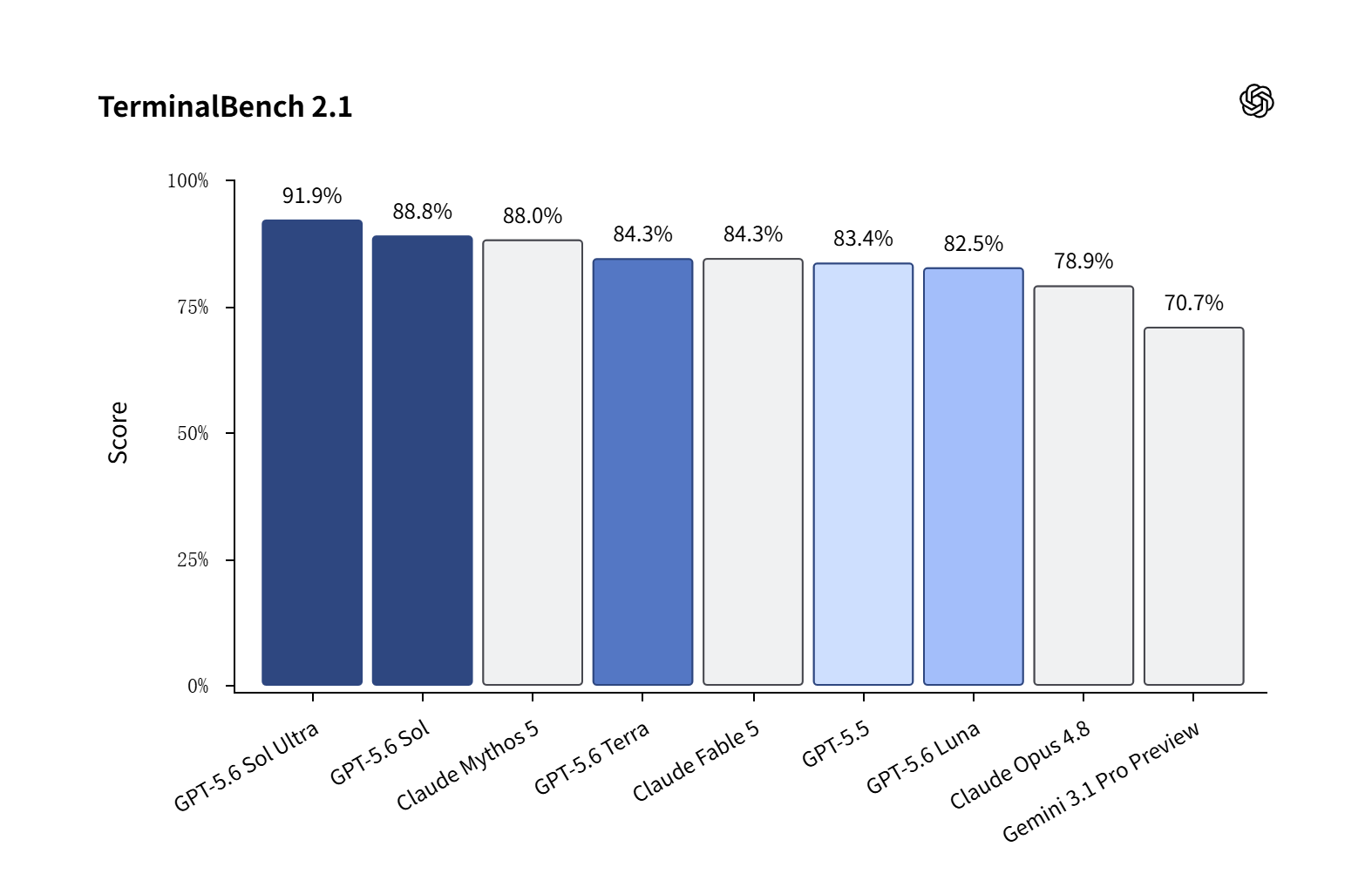
- Ultra Mode: Goes further by deploying sub-agents for collaborative problem-solving. This multi-agent approach shines on long-horizon tasks, pushing Sol Ultra to top benchmark scores (e.g., 91.9% on Terminal-Bench 2.1).
These modes enable better performance on iterative, multi-step workflows where single-pass generation falls short.
Agentic Coding Benchmarks
GPT-5.6 Sol sets a new state-of-the-art on Terminal-Bench 2.1, which evaluates command-line workflows requiring planning, iteration, tool use, and coordination:
| Model | Terminal-Bench 2.1 Score |
|---|---|
| GPT-5.6 Sol Ultra | 91.9% |
| GPT-5.6 Sol | 88.8% |
| GPT-5.5 | ~88.0% |
| GPT-5.6 Luna | 84.3% |
| Claude Mythos 5 | 84.3% |
| Claude Fable 5 | 83.4% |
| GPT-5.6 Terra | 82.5% |
| Claude Opus 4.8 | 78.9% |
| Gemini 3.1 Pro Preview | 70.7% |
Sol demonstrates meaningful gains in real-world coding agents, vulnerability research, and multi-file refactoring. Terra offers solid everyday coding at lower cost, while Luna suits high-throughput scripting.
Stronger Safeguards
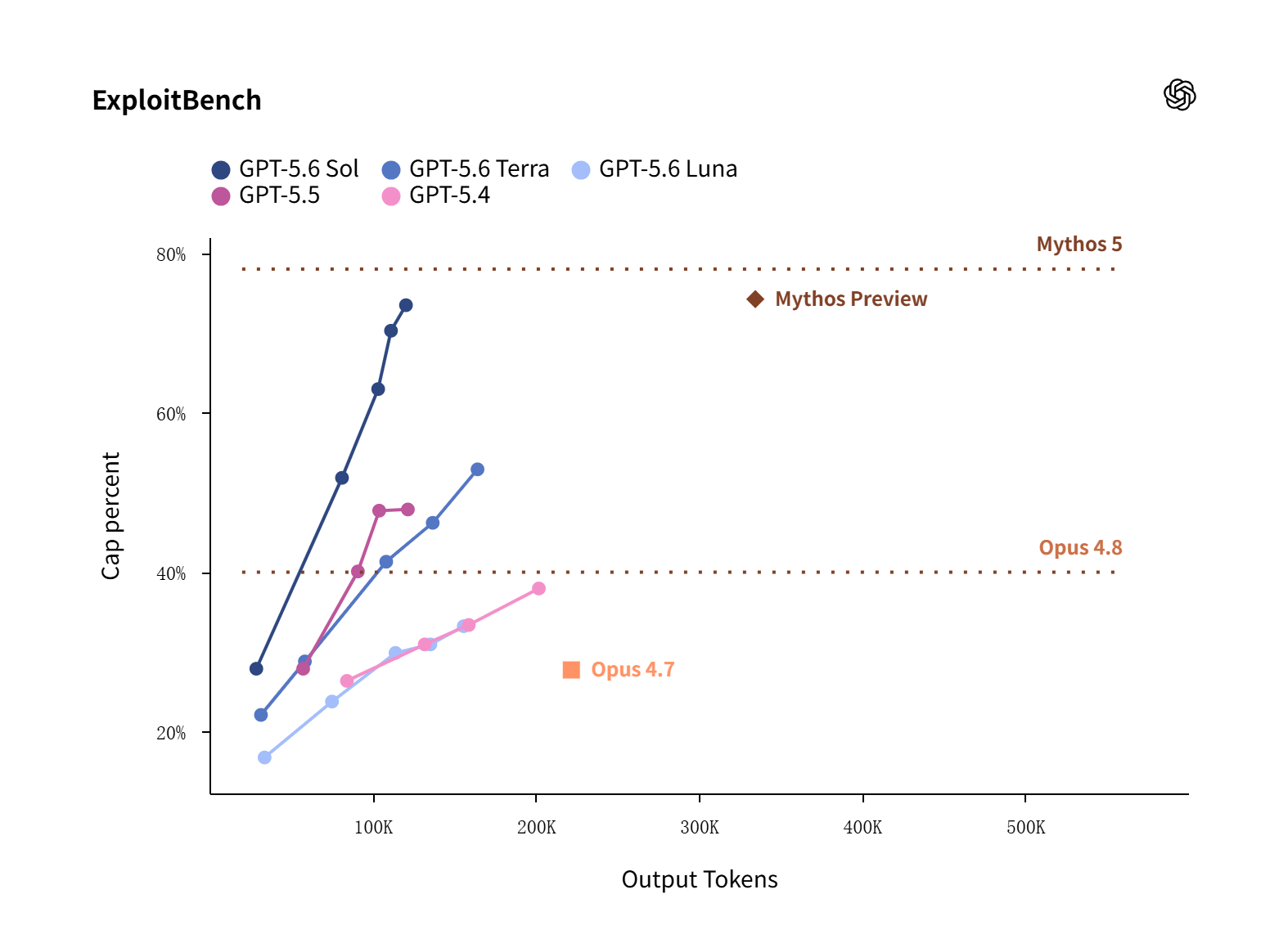
GPT-5.6 launches with OpenAI's most robust safety stack:
- Model-level training to refuse prohibited requests.
- Real-time classifiers for cyber and biology risks, with pauses for deeper review.
- Account-level monitoring for persistent misuse.
- Extensive red-teaming (over 700,000 A100-equivalent GPU hours).
Support for Biology Workflows
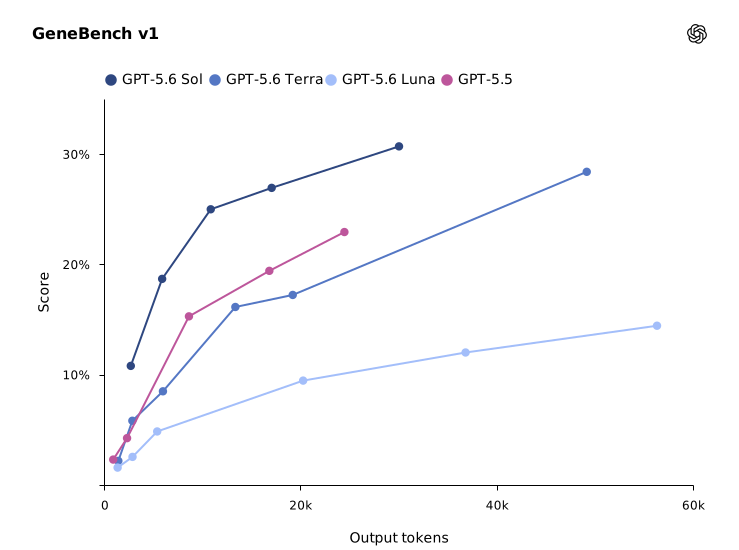
GPT-5.6 shows gains in scientific domains: GeneBench v1 (long-horizon genomics and quantitative biology): Sol outperforms GPT-5.5 with fewer tokens, aiding analyses in genomics and computational biology.
These capabilities accelerate research but come with strict safeguards for sensitive biological/chemical queries. Not for direct medical or lab use without expert oversight.
GPT-5.6 Model Family Comparison: Sol vs Terra vs Luna
Here's a detailed comparison table for quick reference:
| Feature / Model | GPT-5.6 Sol (Flagship) | GPT-5.6 Terra (Balanced) | GPT-5.6 Luna (Fast/Affordable) |
|---|---|---|---|
| Primary Use Cases | Complex reasoning, agentic coding, cyber, biology | Everyday business tasks, high-volume workflows | Summarization, drafting, routine automation |
| Performance (Terminal-Bench 2.1) | 88.8% (Ultra: 91.9%) | 82.5% | 84.3% (strong for cost) |
| Reasoning Modes | Max Effort + Ultra Mode | Standard + Effort options | Optimized for speed |
| Cost Efficiency | Premium (higher latency for power) | ~2x cheaper than GPT-5.5 equivalent | Lowest cost, highest throughput |
| Context & Speed | Deepest context for long tasks | Balanced | Fastest inference |
| Safety Classification | High (Cyber/Bio) | High (Cyber/Bio) | High (Cyber/Bio) |
| Best For | Frontier research, hard problems | Production apps, cost-performance balance | Scale, high-volume ops |
Key Insight: Choose based on task complexity—Sol for maximum intelligence, Luna for volume, Terra for the sweet spot. This family enables intelligent routing in applications.
How to Access GPT-5.6 and Pricing Details
Current Access (Limited Preview): Available only to select trusted partners via OpenAI API and Codex. No public waitlist; OpenAI reaches out directly. Not yet in ChatGPT. Government review applies for participants.
Upcoming: Broader rollout to ChatGPT, Codex, and API in coming weeks. Expect tiered ChatGPT plans (e.g., Plus/Pro) for consumer access.
Pricing (per 1M tokens):
- Sol: $5 input / $30 output
- Terra: $2.50 input / $15 output
- Luna: $1 input / $6 output
Enhanced prompt caching (explicit breakpoints, 30-min minimum life) reduces costs for repeated contexts. Cache writes at 1.25x uncached input; reads at 90% discount.
Pro Tip for Cost Savings and Flexibility: Use CometAPI as your unified gateway. It offers OpenAI-compatible endpoints (https://api.cometapi.com/v1), access to 500+ models (including current GPT variants and competitors like Claude Mythos 5 or Grok), competitive pricing, and easy model routing. Swap base URL and key in your OpenAI SDK code for instant integration—ideal while waiting for GPT-5.6 GA or for hybrid workflows. New users often get free tokens to test.
Example CometAPI-style setup once your dashboard confirms access:
import os
from openai import OpenAI

client = OpenAI(
    api_key=os.environ["COMETAPI_KEY"],
    base_url="https://api.cometapi.com/v1",
)

response = client.chat.completions.create(
    model="gpt-5.6",  # Confirm the live CometAPI model ID before use.
    messages=[
        {
            "role": "user",
            "content": "Review this release checklist and identify the top risks.",
        }
    ],
)

print(response.choices[0].message.content)
Why GPT-5.6 Matters: Real-World Impact and Future Outlook
GPT-5.6 advances agentic AI, enabling more autonomous systems in coding, science, and security. Its tiered design and safeguards address scalability and responsibility concerns amid regulatory scrutiny.
Enterprise Benefits:
- Faster development cycles with superior coding agents.
- Enhanced research in biology/genomics.
- Defensible cybersecurity tools.
Challenges: Limited initial access, higher costs for premium tiers, and the need for responsible governance.
As broader availability rolls out, expect integration into tools, agents, and workflows. For readers building AI-powered apps, combining GPT-5.6 access via official channels or CometAPI will drive innovation while optimizing spend.
Conclusion: Embracing the GPT-5.6 Era
GPT-5.6 Sol, Terra, and Luna deliver a powerful, flexible model family that pushes boundaries in reasoning, coding, and specialized domains while prioritizing safety. With Sol's benchmark leadership, Terra's efficiency, and Luna's accessibility, OpenAI democratizes frontier AI thoughtfully.
Stay ahead by experimenting via available previews or platforms like CometAPI.
FAQs
Is GPT-5.6 released?
Yes. OpenAI announced GPT-5.6 on June 26, 2026, but it is currently a limited preview rather than broad self-service availability.
Is GPT-5.6 available in ChatGPT?
Not during the preview. OpenAI says GPT-5.6 is available through API and Codex only for approved trusted partners, with ChatGPT availability planned later.
What is GPT-5.6 Sol?
GPT-5.6 Sol is the flagship model in the GPT-5.6 family. It is optimized for the hardest reasoning, coding, cybersecurity, biology, research, and agentic workflows.
What is GPT-5.6 Terra?
GPT-5.6 Terra is the balanced model. OpenAI positions it as competitive with GPT-5.5 while being 2x cheaper.
What is GPT-5.6 Luna?
GPT-5.6 Luna is the fastest and most cost-efficient GPT-5.6 model. It is best suited to lower-latency and lower-cost tasks where maximum reasoning is not required.
How much does GPT-5.6 cost?
OpenAI's official preview price is $5 input / $30 output per 1M tokens for Sol, $2.50 / $15 for Terra, and $1 / $6 for Luna. Prompt cache writes cost 1.25x uncached input, while cached reads receive a 90% discount.
Can I access GPT-5.6 through CometAPI?
Yes. Check the live CometAPI dashboard for your account's exact access, model ID, and price before use.