

Answer first. Claude Opus 6 has not been officially announced or released. There is currently no confirmed model ID, release date, API endpoint, pricing, context window, or benchmark score for Claude Opus 6. Developers should treat claude-opus-6 as an unverified placeholder rather than a production model. Until Anthropic announces a successor, Claude Opus 5 is the appropriate baseline for evaluating the next Opus generation.
What Is Claude Opus 6?
Claude Opus 6 is best understood as a market label for a possible future member of Anthropic's Opus family, not as a confirmed product. The official Claude model catalog lists Claude Opus 5 as the current Opus model and recommends it for complex agentic coding and enterprise work. No official page currently documents a product named Claude Opus 6.
That distinction matters because the Opus name describes a product tier rather than a public architectural blueprint. Anthropic does not disclose parameter counts for its proprietary Claude models, and a new generation does not automatically imply a larger context window, lower price, or a specific benchmark gain. The most defensible way to discuss Opus 6 is to separate the confirmed Claude Opus 5 baseline from reasonable product-direction inferences and from details that remain completely unknown.
Has Anthropic Announced Claude Opus 6?
No. Anthropic has not published an announcement, API model ID, system card, pricing table, or availability page for Claude Opus 6. The current official documentation lists Claude Opus 5, Claude Sonnet 5, Claude Fable 5, and Claude Haiku 4.5 among the latest generally described models. An absent announcement cannot prove what Anthropic will call its next model, so exact claims about Opus 6 should be treated as unsupported.
A responsible preview can still be useful. The Opus 5 release shows what Anthropic currently values: long-horizon agency, careful verification, test-time effort scaling, professional output quality, computer use, and cost per successful task. Those priorities provide a stronger foundation for analysis than social-media rumors or invented specification sheets.
Claude Opus 6 Release Date
Anthropic has not provided a release date or launch window for Claude Opus 6. Previous Opus timing is not a reliable schedule because model names, release cadence, and platform rollout can change. The date should remain unconfirmed until Anthropic publishes an announcement or updates the official model catalog.
Expected Claude Opus 6 Specifications
The safest specification table starts with what is known about Opus 5 and leaves Opus 6 fields unknown. Phrases such as likely or expected indicate inference, not confirmation.
| Specification | Claude Opus 5 confirmed baseline | Claude Opus 6 status |
|---|---|---|
| Release status | Available | Not officially announced |
| Official model ID | claude-opus-5 | Not available |
| Input modalities | Text and images | Unknown |
| Output modality | Text | Unknown |
| Context window | 1 million tokens | Unknown |
| Maximum synchronous output | 128K tokens | Unknown |
| Adaptive thinking | Enabled by default | Likely to continue, but unconfirmed |
| Effort controls | Low, medium, high, xhigh, max | Unknown |
| Official list price | $5/M input; $25/M output | Unknown |
| Fast mode | About 2.5x speed at 2x price | Unknown |
| Parameter count | Not disclosed | Unknown |
Source: Anthropic model overview and Opus 5 documentation. Opus 6 values are intentionally not invented.
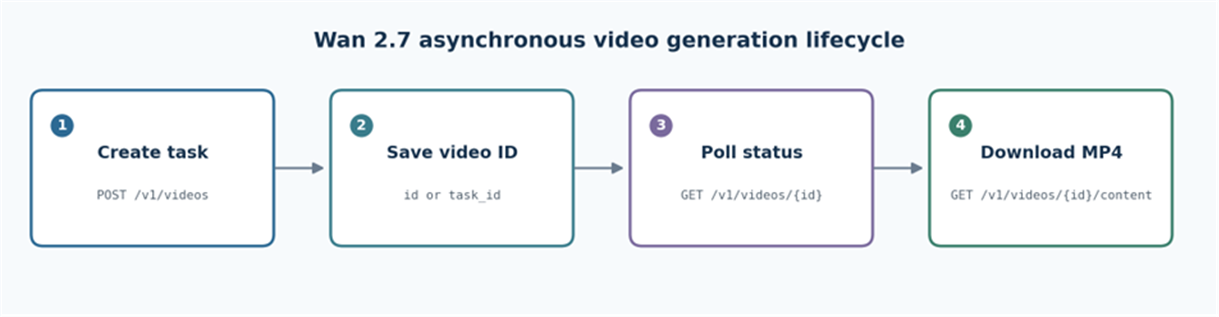
Confirmed evidence, reasonable expectations, and unknowns for Claude Opus 6. Expectations are inferences from the published Opus 5 trajectory.
These Opus 5 results provide a reference baseline for evaluating a future Opus generation. A meaningful successor should be assessed not only by benchmark gains, but also by reliability, latency, tool efficiency, and cost per successful task.
What Features Could Claude Opus 6 Introduce?
More Reliable Long-Horizon Agents
Opus 5 is designed for work that unfolds across many steps, tools, and verification cycles. A future Opus model would be most valuable if it could preserve goals longer, recover from failed tool calls, avoid repeating completed work, and know when a result is ready to hand back. The meaningful metric is not how long the model can keep generating; it is how often the agent reaches a correct, usable outcome with limited human intervention.
Stronger Agentic Coding
The clearest Opus trajectory is repository-scale software engineering. The next generation could improve codebase navigation, multi-file refactoring, root-cause debugging, test execution, browser-based verification, and the ability to revise an implementation after observing real failures. It would also need to reduce unnecessary edits and produce cleaner diffs, because reliability matters more than code volume in production workflows.
Better Effort Scaling
Claude Opus 5 already supports low, medium, high, xhigh, and max effort. Anthropic says the model converts additional effort into better results more reliably than earlier Opus models. Opus 6 could make that curve more efficient: stronger low-effort answers for routine work, more dependable gains at the top end, and better automatic allocation of reasoning tokens to difficult subproblems.
Stronger Professional and Scientific Work
Opus 5 reports gains in financial analysis, legal review, enterprise automation, scientific reasoning, and polished artifacts. A future Opus release could extend those strengths by checking calculations more consistently, reconciling conflicting evidence, handling larger structured files, and generating more editable presentations, spreadsheets, reports, and visual explanations.
Safety That Scales with Capability
A more autonomous model also increases the cost of an incorrect action. Opus 6 would need stronger safeguards for high-impact tool use, clearer confirmation boundaries, better resistance to prompt injection, and more reliable escalation when evidence is incomplete. The goal should be useful defensive and scientific assistance without converting general reasoning gains into uncontrolled high-risk execution.
Claude Opus 5 Benchmark Baseline
There are no authentic Claude Opus 6 benchmark scores. The numbers below are public Opus 5 results that a future Opus generation would need to match or exceed. They cover coding, abstract reasoning, business automation, scientific work, computer use, and alignment rather than relying on one composite leaderboard.
| Area | Evaluation | Claude Opus 5 public baseline | What it measures |
|---|---|---|---|
| Agentic coding | Frontier-Bench v0.1 | >2x Opus 4.8 at lower cost per task | End-to-end software work |
| Coding value | CursorBench 3.2 | Within 0.5% of Fable 5 peak at about half the cost | Quality per task cost |
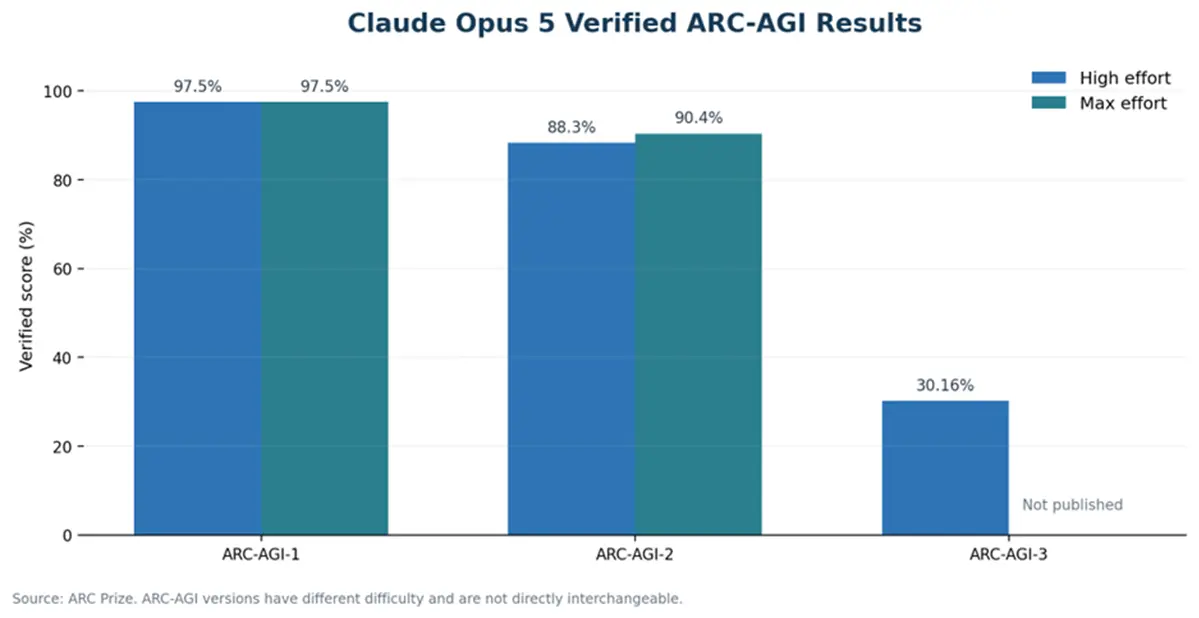
| Novel reasoning | ARC-AGI-3 Public Demo | 30.16% at High effort | Adaptation to unfamiliar rules |
| Abstract reasoning | ARC-AGI-2 Semi-Private | 90.4% at Max effort | Hard generalization |
| Automation | AutomationBench | About 1.5x the next-best pass rate at comparable cost | Business task completion |
| Computer use | OSWorld 2.0 | Above Fable 5's best result at just over one-third the cost | GUI and application control |
| Science | Organic chemistry internal eval | +10.2 percentage points vs Opus 4.8 | Molecular structure inference |
| Science | Protein-function internal eval | +7.7 percentage points vs Opus 4.8 | Sequence-to-function reasoning |
| Alignment | Automated behavioral audit | 2.3 overall misaligned-behavior score | Lower harmful or deceptive behavior |
Sources: Anthropic launch evaluation notes and the ARC Prize verified results. Internal and third-party evaluations may use different harnesses.
Claude Opus 5 verified ARC-AGI results at High and Max effort. Source: ARC Prize. The benchmark versions have different difficulty and should not be treated as one continuous scale.
The ARC results also show why an Opus 6 preview should avoid invented percentages. Opus 5 reaches 97.5% on ARC-AGI-1 and 90.4% on ARC-AGI-2 Semi-Private at Max effort, while the substantially harder ARC-AGI-3 Public Demo remains at 30.16% for High effort. A credible next-generation claim would require both better scores and transparent evaluation conditions.
Claude Opus 6 vs Current Frontier Models
Opus 6 is unannounced, the comparison below evaluates possible positioning rather than declaring a winner. It uses Opus 5 as the same-family baseline, GPT-5.6 Sol as a flagship coding and computer-use competitor, and Gemini 3.7 Flash as a lower-cost multimodal agent model with strong coding performance.
| Metric | Claude Opus 6 | Claude Opus 5 | GPT-5.6 Sol | Gemini 3.7 Flash |
|---|---|---|---|---|
| Status | Unconfirmed | Available | Available | Available |
| Role | Possible next Opus generation | Careful agentic and enterprise work | Frontier reasoning and multi-agent execution | Efficient multimodal workhorse |
| Context | Unknown | 1M tokens | 1M-class workflows | 1,048,576 tokens |
| Inputs | Unknown | Text, image | Text, image | Text, image, video, audio, PDF |
| Thinking | Unknown | Five effort levels | Effort, max, and multi-agent ultra | Low, medium, high thinking |
| Coding focus | Expected to improve | Long-horizon coding and verification | Coding, terminal, computer use | Coding and long-horizon agents at Flash economics |
| Official price | Unknown | $5/M input; $25/M output | $5/M input; $30/M output | $0.75/M input; $3.75/M output (introductory) |
| Edge | Cannot be judged | Judgment and careful execution | Breadth, efficiency, parallel agents | Speed, multimodal breadth, and low unit cost |
Sources: provider documentation for GPT-5.6 and Gemini 3.7 Flash. Opus 6 cells remain unconfirmed.
Comparison Result
No overall winner can be named while Opus 6 is unannounced. The comparison instead shows three optimization targets: careful execution from Opus 5, broad coding and parallel-agent efficiency from GPT-5.6 Sol, and strong coding plus multimodal breadth at Flash economics from Gemini 3.7 Flash. A future Opus model would need to improve accepted-task reliability without losing latency or cost.
How Much Will Claude Opus 6 Cost?
No price has been announced for Opus 6. Anthropic's published pricing sets the standard Claude Opus 5 API at $5 per million input tokens and $25 per million output tokens; Fast mode costs $10 and $50, respectively. These figures define a forecasting baseline, not an Opus 6 quote.
Scenario 1: More Performance at the Same Standard Price
Anthropic kept the current Opus release at its predecessor's list price while improving capability. A plausible Opus 6 strategy would therefore retain the $5/$25 standard rates and deliver more performance per token. Users would receive a same-price capability upgrade, although actual savings would still depend on output length and reasoning use.
Scenario 2: Lower Cost per Successful Task
Even with unchanged token rates, better first-pass accuracy, fewer retries, and shorter agent loops could reduce the cost of an accepted result. This operational measure is more useful than list price alone because it includes failed attempts and human correction time.
Scenario 3: Standard, Reasoning, and Fast-Mode Tiers
Anthropic could keep a standard rate for routine workloads while charging more for high-effort reasoning or low-latency fast mode. The current structure already separates $5/$25 standard pricing from $10/$50 Fast mode; a successor could preserve that split or introduce finer effort-based routing. This remains speculative until an official pricing table appears.
How to Prepare for Claude Opus 6
There is no verified Claude Opus 6 endpoint, and developers should not place claude-opus-6 in production code. While waiting for an official release, teams can evaluate current Opus behavior using Claude Opus 5 through CometAPI. The model supports the native Anthropic Messages pattern and an OpenAI-compatible integration path, making it possible to establish evaluation sets before a future model becomes available.
A practical preparation plan is to record task success rate, cost per successful task, tool-call count, latency, retry rate, and human correction time on Opus 5. When Anthropic eventually announces a successor, the same evaluation harness can test whether the new model delivers a real operational improvement.
Try Claude Opus 5 Through CometAPI While Waiting
Create a CometAPI key, store it in the COMETAPI_KEY environment variable, and use the current claude-opus-5 model ID. The examples below intentionally do not use a fictional Opus 6 identifier.
Bash (cURL)
curl https://api.cometapi.com/v1/messages \ -H "Authorization: Bearer $COMETAPI_KEY" \ -H "Content-Type: application/json" \ -d '{ "model": "claude-opus-5", "max_tokens": 1024, "messages": [ {"role": "user", "content": "Review this implementation plan and identify hidden risks."} ] }'
Python
import os import anthropic client = anthropic.Anthropic( api_key=os.environ["COMETAPI_KEY"], base_url="https://api.cometapi.com", ) message = client.messages.create( model="claude-opus-5", max_tokens=1024, messages=[ { "role": "user", "content": "Review this implementation plan and identify hidden risks.", } ], ) print(message.content[0].text)
JavaScript (Node.js)
import Anthropic from "@anthropic-ai/sdk"; const client = new Anthropic({ apiKey: process.env.COMETAPI_KEY, baseURL: "https://api.cometapi.com", }); const message = await client.messages.create({ model: "claude-opus-5", max_tokens: 1024, messages: [ { role: "user", content: "Review this implementation plan and identify hidden risks.", }, ], }); console.log(message.content[0].text);
For production use, consult the CometAPI API documentation for supported parameters, error handling, streaming, and endpoint details. Do not assume that a future Opus model will use identical defaults or accept every Opus 5 parameter without migration testing.
What We Don't Know Yet
| Unknown area | What can be said responsibly |
|---|---|
| Official name | Anthropic may not use the Claude Opus 6 label. |
| Release schedule | No confirmed launch window has been published. |
| Model ID | There is no documented claude-opus-6 identifier. |
| Context and output limits | A larger window or output limit cannot be assumed. |
| Modalities | Native audio, video, or richer output support is unknown. |
| Reasoning controls | Effort levels and thinking behavior may change. |
| Pricing | Input, output, caching, batch, and fast-mode prices are unknown. |
| Benchmarks | No authentic Opus 6 scores or system card exist. |
| Availability | Claude, Claude Code, cloud, and API rollout details are unknown. |
Editorial rule: update this table only after Anthropic publishes primary documentation.
Frequently Asked Questions
Is Claude Opus 6 available?
No. Anthropic has not announced or documented a model named Claude Opus 6. Claude Opus 5 is the current Opus model described in the official catalog.
What is the Claude Opus 6 model ID?
There is no official model ID. Developers should not assume that claude-opus-6 is valid. The current documented identifier is claude-opus-5.
Will Claude Opus 6 have a larger context window?
That is unknown. Opus 5 already provides a 1M-token context window, but Anthropic could prioritize reliability, latency, or cost efficiency instead of increasing the headline limit.
Will Claude Opus 6 be better than GPT-5.6 Sol?
There is no evidence for a winner. GPT-5.6 Sol is an available model with published results, while Opus 6 is unannounced. A future comparison should use the same harness, effort level, tools, and cost assumptions.
Can developers prepare before release?
Yes. Build repeatable evaluations on Opus 5, track cost per completed task, isolate model IDs in configuration, and avoid hard-coding behavior that may change between generations.
Final Thoughts
Claude Opus 6 remains a plausible but unannounced successor. Its practical value should be judged by a small set of operational outcomes: accepted-task rate, end-to-end cost, latency, and human correction time, rather than by a repeated list of expected features.
If Anthropic releases a successor, rerun the same workload through CometAPI.