
TLDR As of early September 2026, DeepSeek has not officially announced DeepSeek V5. The current flagship lineup remains the V4 series (V4-Pro released around August 13, 2026, and V4-Flash on July 31), plus an experimental multimodal V4-Flash-Vision-Exp. Community leaks, X posts, and secondary reports from mid-to-late August 2026 speculate about a possible September release of V5, describing it as a from-scratch foundation model with stronger coding/agentic performance, potential visual upgrades, and continued cost efficiency.
Key Takeaways
- No official DeepSeek V5 announcement or model card exists as of September 7, 2026. Current production models are V4-Pro and V4-Flash (MIT open weights, 1M context).
- V4 already delivers competitive open-weight agentic coding, reasoning, and long-context performance at aggressive pricing (Flash especially cost-effective; Pro higher capability).
- Expected V5 improvements (based on x): Built on a completely new foundation / architecture (not just an incremental upgrade over V4).
- Rumored to reach “GPT-6 Astra” level performance — this is the headline claim being repeated across posts. “Astra” appears to refer to a high-end OpenAI model/version circulating in the community at the time.
- DeepSeek V5 is Expected to be a huge jump over DeepSeek V4. Stronger reasoning, coding, and agentic capabilities. Could be significantly cheaper to run than competing frontier models.
- Targeting a launch as early as “next week” (i.e., around mid-September 2026 relative to the September 6 posts).
What Is DeepSeek V5?
DeepSeek V5 would be the next major generation in the DeepSeek large language model family if/when it launches. DeepSeek (founded 2023, Hangzhou-based, backed by High-Flyer) has built a reputation for strong open-weight Mixture-of-Experts (MoE) models that deliver competitive performance at significantly lower training and inference cost than many closed frontier systems.
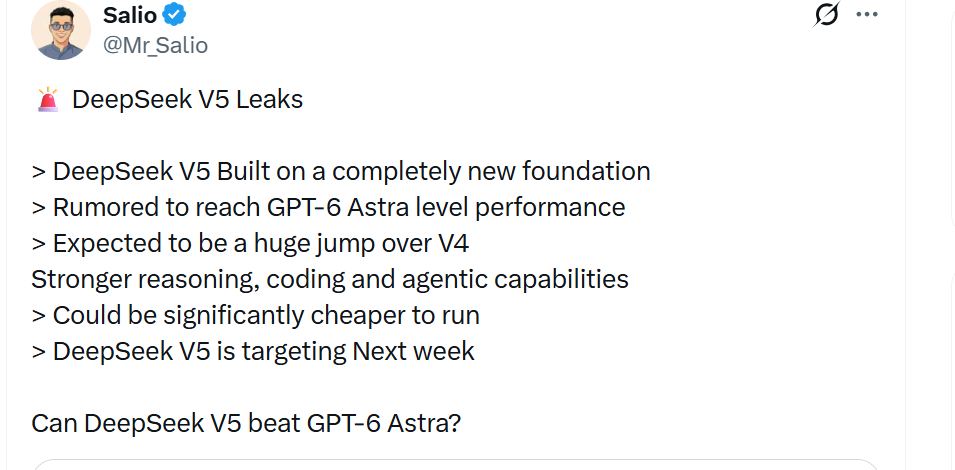
V5, according to community discussion, is expected to continue this pattern: These claims typically describe V5 as:
- Possibly cheaper to run
- Built on a new architecture/foundation
- A significant jump over V4
- Stronger in reasoning, coding, and agentic capabilities
- Potentially competitive with high-end closed models (specifically referenced as “GPT-6 Astra” level)
Until official confirmation, “DeepSeek V5” remains a placeholder for the next major leap rather than a shipping product.
What exists is secondary reporting and social-media leaks:
The most widely shared version (originating from accounts tracking AI leaks such as @Mr_Salio and quickly amplified by others) states:
- X posts and aggregators (e.g., accounts tracking AI leaks) claimed DeepSeek V5 was targeting a September release, built “from scratch on a new foundation,” aiming for “Mythos-class” and GPT-6 GPT-6 Astra performance (a reference to high-end closed models around that period), while remaining more powerful yet significantly cheaper to run, and continuing the open-weight push.
- Geeky Gadgets reported rumors of extensive A/B testing, upgrades focused on visual coding workflows, backend efficiency, and potential competition with tools such as Fable 5 / Opus-class systems in precision web-development and coding tasks.
- Competition in AI coding agents, and typical 4–5 month development cycles after the April V4 preview made a late-August to early-September window logical, possibly paired with a native coding agent (“DeepSeek Code”).
- Related context: DeepSeek has been active with DeepSeek Harness (open-source agent runtime, August 2026 developer preview), API price adjustments (peak/off-peak structures), multimodal experiments, and reported IPO preparation / valuation discussions. These signal continued investment but do not confirm V5 timing.
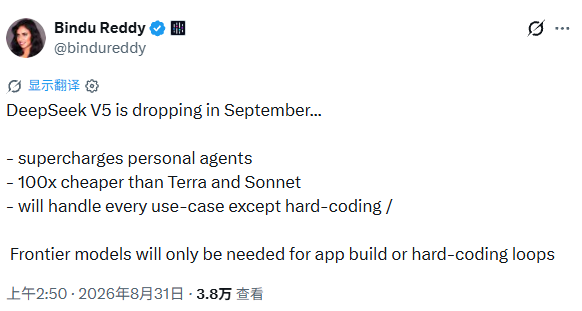
Important caveats: These are unconfirmed community reports and . DeepSeek has a history of relatively quiet or weekend-timed releases rather than heavy pre-announcement marketing. Precise dates, parameter counts, exact benchmarks, or “Mythos-class” claims should be treated as speculative until an official technical report or API listing appears. Independent verification of any leaked benchmarks is still lacking.
When Will DeepSeek V5 Be Released?
Recent posts circulating on X (primarily from September 6, 2026) claim that DeepSeek V5 is “targeting next week.” That would place a potential launch roughly in the mid-September 2026 window (around September 13–20, depending on the exact interpretation of “next week”).
Broader community speculation throughout late August and early September 2026 has consistently pointed to September 2026 as the most commonly mentioned timeframe, with some earlier predictions suggesting late August to early September.
Expected Pricing for DeepSeek V5
No official V5 pricing exists. Reasonable expectations can be extrapolated from V4 trends and DeepSeek’s historical positioning:
Current approximate V4 official rates (subject to peak/off-peak and provider variation as of late August 2026):
- V4-Flash: roughly $0.22 input / $0.66 output per 1M tokens (off-peak); cache hits far lower.
- V4-Pro: roughly $0.66 input / $1.98 output per 1M tokens (off-peak); higher at peak hours.
DeepSeek has repeatedly undercut closed frontier pricing while raising rates modestly as models mature (and introduced peak/off-peak). V5 is widely expected to remain highly competitive—likely positioned as a strong value alternative even if absolute prices rise with capability. Open weights (historically MIT) would further enable self-hosting and third-party hosting competition, putting downward pressure on API rates.
Unified gateways such as CometAPI already list DeepSeek V4 models (often with discounts relative to direct rates) and would be natural early hosts for any V5 endpoint, simplifying multi-model experimentation.
Summary of Expected Performance & Capabilities (per the leaks)
| Claimed Aspect | Details from X Leaks |
|---|---|
| Architecture | Completely new foundation |
| Overall Performance | GPT-6 Astra level |
| Reasoning | Stronger than V4 |
| Coding | Significantly improved |
| Agentic capabilities | Major upgrade |
| Cost / Efficiency | Significantly cheaper to run |
| Release window | Targeting “next week” (mid-September 2026) |
Bottom line: The current X discourse positions DeepSeek V5 as a potential major leap—new architecture, frontier-level performance (specifically “GPT-6 Astra”), stronger coding/reasoning/agent skills, and continued cost advantage—with a possible near-term launch.
What Features Could DeepSeek V5 Introduce?
Stronger Long-Horizon Agents
Agent reliability is the clearest path to a generational improvement. V4's strongest updates already emphasize software engineering and tool use, so V5 would be expected to extend the task horizon: planning more steps, maintaining state across tool calls, detecting when an approach has failed, and verifying the final artifact before returning it.
- Fewer repeated or unnecessary tool calls during long workflows.
- More reliable recovery from terminal, browser, and API failures.
- Better memory management when tool output expands the context.
- Stronger writer-verifier or planner-executor patterns for multi-agent work.
Better Coding and Repository-Level Engineering
Repository-level engineering requires more than generating a correct function. The model must map dependencies, follow local conventions, modify several files without creating regressions, run tests, interpret failures, and produce a reviewable diff. A credible V5 upgrade should improve the full issue-to-patch loop rather than only raise short-form code completion scores.
Possible Native Multimodality
Native image, document, audio, or video understanding would make V5 more competitive with multimodal frontier systems. It could also improve software agents that need to read screenshots, inspect diagrams, or operate graphical interfaces. However, DeepSeek has not confirmed a multimodal V5, so this remains one of the lowest-confidence expectations in the article.
Open Weights and Deployment Efficiency
V4's MIT-licensed weights make the current family relevant to organizations that need local inference, model inspection, or data-residency control. That precedent makes an open-weight V5 plausible, but not guaranteed. Even if weights are released, a flagship checkpoint could still be impractical for many teams to serve; a smaller efficiency tier may have greater real-world deployment impact than the largest model.
What to Do While You Wait
- Maximize V4 today — V4-Pro for maximum capability agentic/coding work; V4-Flash for high-throughput or cost-sensitive workloads. Experiment with thinking modes and the experimental vision variant.
- Adopt DeepSeek Harness — The open-source agent runtime (everything-is-a-plugin) pairs naturally with V4 models and can already call other strong models as sub-agents.
- Use a unified API gateway — Platforms such as CometAPI provide single-key, OpenAI-compatible access to DeepSeek V4 models (often at competitive or discounted rates) alongside Claude, other open-weight models, and proprietary options. This makes A/B testing effortless and reduces vendor lock-in friction when V5 eventually appears.
- Benchmark your real workloads — Run your actual coding, agent, and long-context tasks on current V4 rather than waiting for idealized future scores.
- Monitor primary sources — Official API docs, Hugging Face, and verified DeepSeek channels. Ignore unsubstantiated social claims.
- Prepare infrastructure — Ensure your tooling supports easy model swapping (OpenAI-compatible endpoints, configurable base URLs) so a V5 drop requires minimal code changes.
Conclusion
DeepSeek V5 remains an anticipated but unconfirmed next step as of September 2026. The August rumor cycle—September timing, new foundation, stronger coding and visual capabilities, continued cost leadership—aligns with DeepSeek’s historical velocity and the competitive pressure in agentic AI. Until primary sources confirm details, the responsible stance is cautious optimism grounded in the very real strengths of the current V4 series and the open Harness ecosystem.
For developers and teams, the practical path is clear: deploy and optimize on V4 today, leverage flexible infrastructure (including unified gateways like CometAPI), and stay ready to adopt V5 the moment official artifacts appear. DeepSeek’s track record suggests that when the next model does arrive, it will once again raise the bar for what open-weight, cost-efficient AI can achieve.