Choisissez votre plan
Blog Qwen
Comment utiliser l’API Qwen3.8-Omni-Flash
请提供需要翻译成法语的原始文本或文件(可包含 Python 与 cURL 示例、图像/音频/视频处理说明、生产环境指引与 CometAPI 可用性检查等)。我将严格保留原始结构与技术元素,仅翻译可读文本。
Comment utiliser l'API Qwen3.8-Flash : guide complet du développeur
Découvrez comment utiliser l’API Qwen3.8-Flash avec CometAPI, y compris Python, JavaScript, cURL, diffusion en continu, mode de réflexion, entrée multimodale, sortie structurée.
Comment déployer Qwen 3.8 Max en local : guide du matériel, de vLLM, de SGLang et de la quantification
Objectif Déployer localement Qwen 3.8 Max (poids ouverts Qwen3.8-2.4T-A95B) avec prise en charge GPU, quantification FP8/FP4, moteurs vLLM et SGLang, contexte 1M, et bonnes pratiques de production. 1) Prérequis matériels et logiciels - OS et runtime - Linux x86_64 (Ubuntu 20.04/22.04 recommandé) - Python 3.10+ (virtualenv/conda conseillé) - CUDA 12.x et cuDNN compatibles, pilote NVIDIA récent (>= 535) - NCCL et UCX récents pour parallélisme multi-GPU/multi-nœuds - GPU - Cartes recommandées: NVIDIA A100 80GB, H100 80GB/94GB, ou L40S 48GB (selon quantification) - Interconnexions rapides: NVLink/NVSwitch pour intra-nœud, InfiniBand (EFA/IB) pour inter-nœuds - Mémoire modèle (ordre de grandeur pour un ~95B) - FP16/BF16 poids: ≈ 2 octets/paramètre → ~190 Go pour les poids seuls - FP8 poids: ≈ 1 octet/paramètre → ~95 Go - 4 bits (AWQ/GPTQ): ≈ 0,5 octet/paramètre → ~47,5 Go - Remarque KV cache: la mémoire du cache KV domine avec de très longues séquences; à 1M de tokens, même en FP8 KV, l’empreinte dépasse très largement un seul GPU. Prévoyez du sharding multi-GPU, éventuellement multi-nœuds, et du offloading CPU/host. 2) Téléchargement des poids - Via Hugging Face (adapter le repo exact aux poids ouverts Qwen3.8-2.4T-A95B) - huggingface-cli download Qwen/Qwen3.8-2.4T-A95B --local-dir /models/qwen38max - Vérifiez la présence des fichiers de config (config.json, tokenizer, safetensors) et, si vous ciblez 4 bits, un repo quantifié AWQ/GPTQ distinct ou quantifiez en local. 3) Choix du moteur de service - vLLM - Points forts: forte efficacité batch/paged attention, scheduler performant, intégration OpenAI compatible, KV cache quantifiable. - Parallélisme: support du tensor parallel (TP) intra-nœud; pipeline parallel limité. - SGLang - Points forts: pipeline orienté très long contexte et pré-remplissage, intégration FlashAttention/FlashInfer, KV quantisation, scheduling favorisant le streaming de contextes longs. 4) Quantification et précisions - Poids FP8 - Requiert des checkpoints FP8 ou une conversion prise en charge. On ne peut pas « activer » FP8 poids sans un checkpoint/format compatible. Vérifiez la disponibilité des poids FP8 du modèle. - Poids 4 bits (FP4/INT4) - Option standard: AWQ ou GPTQ. Pré-quantifier avec AutoAWQ ou utiliser un repo déjà quantifié. - AWQ réduit fortement l’empreinte VRAM des poids et facilite un déploiement sur 1×80GB ou 2×48GB (hors KV). - KV cache - vLLM et SGLang supportent des dtypes KV compressés (ex.: fp8). FP4/int4 KV peut être disponible selon le moteur et la build (FlashInfer), sinon rester en fp8/bf16. - Le KV cache croît avec la longueur de séquence; à 1M, utilisez kv-quantization et pagination. 5) Déploiement avec vLLM (exemples) - Installation - pip install -U vllm transformers accelerate bitsandbytes autoawq flash-attn - Assurez la compatibilité CUDA/FlashAttention. - Service en poids d’origine (BF16/FP16) avec KV en FP8, 1M contexte, 4×GPU - vllm serve /models/qwen38max --host 0.0.0.0 --port 8000 --tensor-parallel-size 4 --max-model-len 1048576 --kv-cache-dtype fp8 --gpu-memory-utilization 0.90 --swap-space 64 - Ajustez --tensor-parallel-size selon le nombre de GPUs. --swap-space en Go pour le paged attention hors GPU. - Service avec poids AWQ 4 bits (répertoire quantifié) - vllm serve /models/qwen38max-awq --quantization awq --host 0.0.0.0 --port 8000 --tensor-parallel-size 2 --max-model-len 1048576 --kv-cache-dtype fp8 --gpu-memory-utilization 0.95 --swap-space 96 - Paramètres utiles vLLM - --max-num-seqs: limiter/conduire la concurrence - --block-size: taille de bloc du paged attention (ex.: 16/128) pour réduire la fragmentation - --enable-chunked-prefill: pipeline de pré-remplissage plus stable pour contextes longs - --distributed-executor-backend nccl: communication GPU - --revision pour épingler une version HF - Appel client (OpenAI-compatible) - export OPENAI_BASE_URL=http://localhost:8000/v1 - Utilisez une bibliothèque OpenAI-compatible et définissez le modèle via son chemin. 6) Déploiement avec SGLang (exemples) - Installation - pip install -U sglang flash-attn autoawq - Service en poids d’origine avec KV en FP8, 1M contexte, 4×GPU - python -m sglang.launcher --model-path /models/qwen38max --tp 4 --max-seq-len 1048576 --kv-quantization fp8 --host 0.0.0.0 --port 30000 - Service avec poids AWQ 4 bits - python -m sglang.launcher --model-path /models/qwen38max-awq --tp 2 --max-seq-len 1048576 --kv-quantization fp8 --host 0.0.0.0 --port 30000 --quantization awq - Paramètres utiles SGLang - --enable-chunked-prefill ou options analogues pour le streaming - --max-num-batched-tokens pour contrôler la latence vs débit - --pipeline configs pour long context et scheduling 7) 1M de contexte: considérations critiques - Prérequis - Utiliser une variante/poids explicitement entraînés ou calibrés pour long contexte (1M). Sinon, appliquer un RoPE scaling correct (rope_base, rope_scale) et vérifier la compatibilité. - Mémoire KV - Mémoire KV ≈ L × N_layers × 2 × hidden_size × bytes_per_element × facteur (K+V). À L=1 000 000 tokens, c’est extrêmement volumineux. Même en fp8 KV, planifiez multi-GPU et offloading. - Techniques pour rendre cela praticable - KV cache quantisé (fp8) et paged attention avec block size optimisée - Chunked prefill, streaming, et limitation du window d’attention effectif si l’architecture le permet (ex.: attention glissante/sparse si disponible) - Prompt caching/re-use; éviter de reconstruire le KV pour les prompts récurrents - RAG et indexation: pousser les documents vers un système de recherche et n’injecter que les passages pertinents - Si possible, modèles à MQA/GQA réduisant l’empreinte KV 8) Exigences GPU typiques par configuration (ordre de grandeur) - FP16/BF16 poids, sans KV massif - 190 Go pour les poids → 3×80GB minimum (peu de marge), 4×80GB conseillé; avec KV, 8×80GB ou plus selon débit et longueur - FP8 poids - ~95 Go → 2×80GB minimum pour les poids; ajoutez de la marge pour KV; souvent 4×80GB - 4 bits (AWQ) - ~47,5 Go → 1×80GB possible pour les poids, mais KV pour 1M dépasse un seul GPU; vous devrez shard/offload - Multi-nœuds - Prévoir NCCL/IB, topologie homogène, et partitionnement TP cohérent 9) Optimisations de production - Scheduling et QoS - Définir des SLA par file/queue, séparer les workloads (long context vs court) pour éviter l’inversion de priorité - Limiter max_tokens_output et max_input_tokens par route - Paramétrage moteur - vLLM: tuner --block-size, --max-num-seqs, --gpu-memory-utilization; activer chunked prefill - SGLang: ajuster max-seq-len, batch tokens, policies de scheduling - Kernels et libs - FlashAttention 2/Flash-Decoding à jour; builds correspondantes à votre CUDA - Activer FP8 KV si stable sur votre stack; sinon BF16 KV pour fiabilité - Mémoire et offloading - Pinned memory pour swap CPU; SSD NVMe rapide; surveiller la fragmentation du paged attention - Sur multi-nœuds, minimiser les allers-retours host via NVLink/IB - Observabilité - Export métriques (latence préfill/decoding, taux de fragmentation KV, OOM, throughput tok/s) - Traces par requêtes, journaux d’erreurs CUDA - Robustesse - Warmup, chargement lazy des poids, redémarrage sans interruption (systemd, supervisor) - Health checks, timeouts, retries, backpressure - Sécurité et gouvernance - Contrôles d’accès, limitation de débit, chiffrement en transit, isolation des environnements 10) Validation et tests - Tests unitaires sur des prompts courts, puis scaling vers 128k, 256k, etc., avant 1M - Mesure mémoire: VRAM par GPU, mémoire host, taille KV par requête - Test de charge: throughput, latence P50/P95/P99, stabilité sur longue durée - Fallbacks: switch automatique vers un moteur plus petit pour requests hors budget Notes importantes - FP8 poids requiert un checkpoint FP8; sans cela, préférez 4 bits AWQ pour réduire l’empreinte. - 1M de contexte sur un modèle ~95B n’est réaliste que via sharding massif, KV quantisé, paged attention et stratégies d’injection de contexte (RAG, streaming). Ne pas tenter un 1M full-KV purement GPU sur un seul nœud. - Choisissez vLLM si vous ciblez un débit élevé multi-clients; SGLang est très efficace pour du très long contexte avec pré-remplissage streamé. Dans beaucoup de déploiements, on teste les deux et on retient celui qui tient le mieux vos SLA. Checklist rapide - Pilote/CUDA/FA2 cohérents et testés - Poids disponibles (BF16/FP8/AWQ) et tokenizer vérifié - KV cache en fp8 et paged attention activés - TP configuré selon vos GPUs; NCCL opérationnel - --max-model-len à 1048576 et tests progressifs avant production - Observabilité et limites de ressources en place
Qwen4 arrive bientôt : Ce que Qwen3.8-Flash-Next révèle
Explorez ce que Qwen3.8-Flash-Next révèle à propos de l'architecture de Qwen4, des fonctionnalités attendues, de l'orientation des benchmarks, des perspectives de sortie
Qu'est-ce que Qwen3.8-Flash ? Spécifications, benchmarks, architecture, tarification et guide de l'API
Apprenez ce qu'est Qwen3.8-Flash, y compris son architecture MoE à 6B actifs, son contexte 1M, des benchmarks, la tarification, des comparaisons et l'utilisation de CometAPI.
Pouvez-vous préciser ce que vous entendez par « Qwen3.8 Max » ? Qwen est la famille de modèles de langage d’Alibaba (souvent proposée en API sous des noms comme Qwen-Max, Qwen-Plus, etc.). L’élément « 3.8 » ne correspond pas à une dénomination officielle courante, sauf s’il s’agit d’indiquer une taille d’environ 3,8 milliards de paramètres (p. ex. « Qwen-3.8B »). Si vous pouvez donner le contexte (API Alibaba Cloud, modèle open source, lien), je pourrai vous répondre précisément.
Qwen3.8-Max expliqué : fonctionnalités, benchmarks et comparaison avec Kimi K3 et DeepSeek V4 Flash
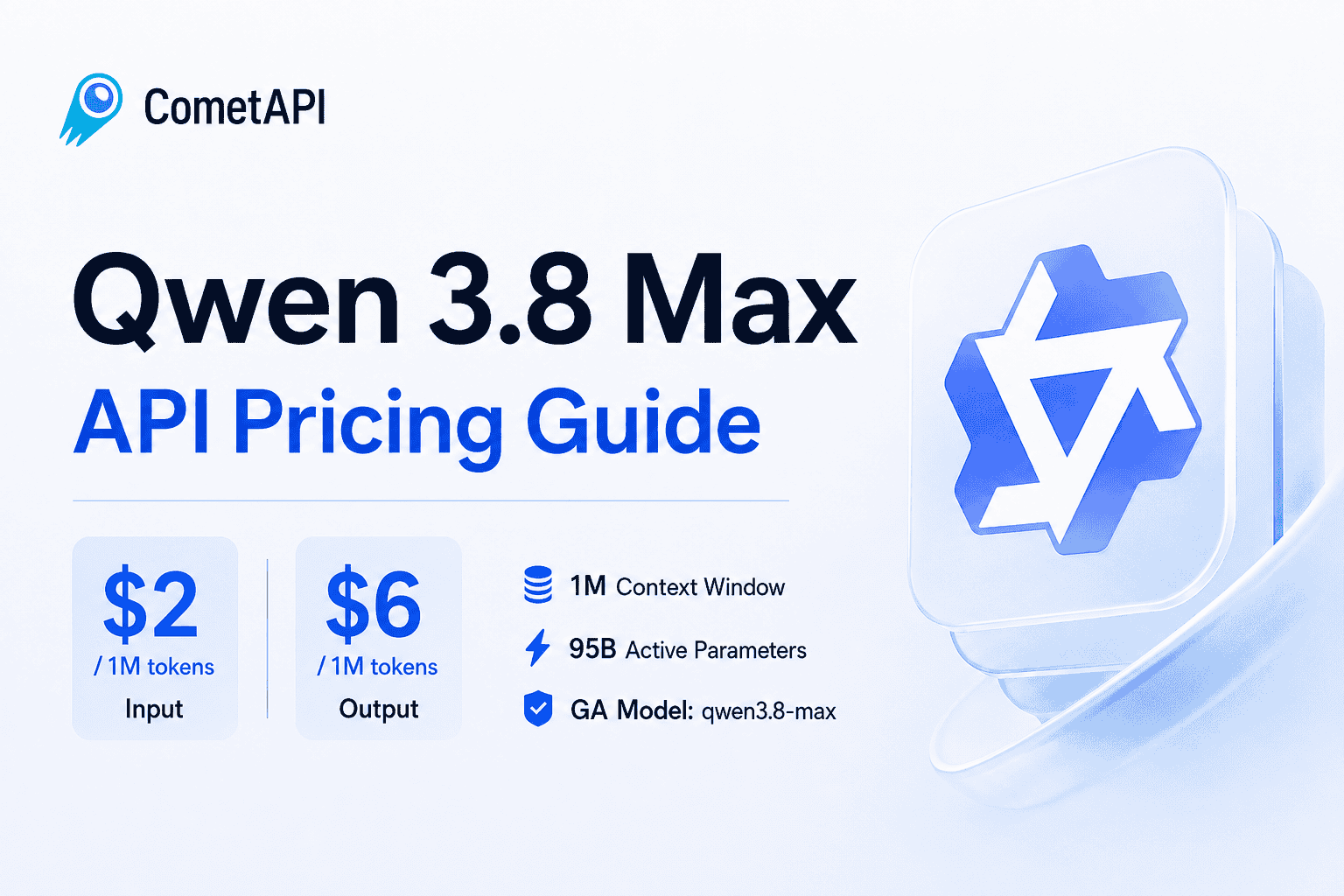
Tarification de l'API Qwen 3.8 Max : $2 en entrée, $6 en sortie, contexte de 1M
Qwen 3.8 Max coûte 2 $/M en entrée et 6 $/M en sortie. Comparez les frais de cache, les coûts des outils, des exemples concrets, les limites, ainsi que les conseils de migration depuis Qwen 3.7.
API Qwen3.8 Max en préversion : accès, disponibilité et guide de migration
Short answer - I can’t verify real‑time availability or pricing beyond Oct 2024. As of my last update, there wasn’t a publicly announced model specifically named “Qwen3.8 Max.” Please confirm via Alibaba Cloud DashScope (Lingji/Bailian) model catalog and pricing pages before making decisions. How to check current status (availability and pricing) - Model catalog: https://dashscope.aliyun.com/model (search for “Qwen Max”, “Qwen 3.x Max”) - Pricing: https://dashscope.aliyun.com/pricing (look for per‑1K‑token input/output rates, free tiers, and regional differences) - Changelog/Announcements: DashScope console “Release notes,” Alibaba Cloud blog, Qwen GitHub org (https://github.com/QwenLM), and @Alibaba_Cloud/@QwenAI official channels - Support ticket: open a ticket in Alibaba Cloud console if the model ID isn’t visible but mentioned in announcements Likely access methods (if/when Qwen3.8 Max exists) - REST API via DashScope - Standard endpoint (DashScope native) with Bearer API key - OpenAI‑compatible endpoint (often /compatible‑mode/v1/chat/completions) that works with many OpenAI SDKs by changing base URL and key - SDKs - Python, JavaScript/TypeScript, Java DashScope SDKs - OpenAI SDK pointed to the compatible endpoint (set base URL + API key) - Console and notebooks - Playground in DashScope console for quick trials - Serverless inference integration and workflow builders within Alibaba Cloud - Enterprise integrations - ECS/PAI deployment options, Function Compute, API Gateway, and VPC peering if needed Key specs to confirm before adopting “Qwen3.8 Max” - Model ID and aliases (exact string you must pass to the API) - Context window (max tokens), supported modalities (text only vs. multi‑modal), and maximum output tokens - Supported features: tool/function calling, JSON mode, streaming, logprobs, batching, system prompt controls, seed/reproducibility - Safety/guardrails defaults and configuration knobs - Rate limits (RPM/TPM/QPS), regional availability, and SLA - Tokenization compatibility with prior Qwen Max versions (can affect token counts and cost) - Pricing: input/output cost per 1K tokens, free quota, overage, enterprise discounts Should you migrate from “Qwen3.7 Max” to “Qwen3.8 Max”? - Migrate if - There is a documented improvement in accuracy, reliability, latency, or context length that matters to your workloads - Pricing is equal or lower on your usage pattern, or the quality gains justify higher cost - There is a deprecation or end‑of‑support timeline for 3.7 Max - Hold/validate first if - Behavior changes might impact deterministic workflows, function‑calling schemas, or compliance - Guardrail/policy shifts increase refusals or false positives - Tokenization/context changes alter costs or truncate prompts Practical migration plan (low risk) - A/B test - Run 100–500 representative prompts through both models with identical parameters (temperature, top_p, max_tokens, seed if supported) - Score task success, factuality, format adherence (esp. JSON), harmful‑content pass rates, latency, and cost - Tool/JSON validation - Verify function/tool calling schemas and strict JSON mode adherence; update validators if return shapes change - Prompt and guardrails - Re‑tune system prompts if refusals or style shifts appear; check safety policy prompts and allowlists - Context and costs - Recalculate token counts with the new tokenizer; confirm no truncation for your longest contexts - Rollout and fallback - Feature‑flag the new model, monitor post‑deploy metrics, and keep a rollback path to 3.7 Max - Compliance and data handling - Confirm region, logging settings, and data‑retention defaults meet your requirements If “Qwen3.8 Max” isn’t available yet - Keep using the latest “Qwen Max”/“Qwen‑Max‑LongContext” (or “Qwen‑Plus”) models that meet your requirements - Track DashScope release notes and pricing updates weekly - Prepare migration test suites now so you can evaluate 3.8 Max quickly upon release Next steps - Check the DashScope model list and pricing pages above for “Qwen3.8 Max” by name - If listed, note the exact model ID, context limit, and per‑1K‑token prices; run a small bench using your production prompts - If not listed, subscribe to release notes and keep your A/B harness ready for a fast evaluation when it appears