
Answer First
Kimi K4 has not been officially released, and Moonshot AI has not published its final specifications, benchmark results, API pricing, or release date. The strongest public signal so far comes from reporting that Moonshot is seeking additional Nvidia Blackwell capacity for a successor expected to be significantly larger than Kimi K3. That is meaningful evidence that a next-generation model is being prepared, but it is not an official product announcement.
What can be discussed responsibly is the direction K4 may take. Moonshot's current 2.8-trillion-parameter Kimi K3 already combines sparse Mixture-of-Experts scaling, native vision, a one-million-token context window, and long-horizon agent capabilities. Kimi K4 is therefore more likely to be judged by reliable agentic execution, coding depth, multimodal reasoning, and scaling efficiency than by parameter count alone.
The central conclusion is simple: Kimi K4 appears to be in development, but almost every numerical specification circulating outside the company remains unconfirmed. Any credible preview must separate verified K3 facts, K4 reporting, and forward-looking inference.
What Is Kimi K4?4
Kimi K4 is the public name being used for Moonshot AI's expected successor to Kimi K3. It should currently be treated as an in-development model rather than an announced API product. Moonshot AI has not published a K4 model card, technical report, API identifier, pricing page, license, or benchmark table.
The Information reports that Moonshot AI is discussing plans for Kimi K4. Citing two people with knowledge of the matter, the report describes K4 as significantly larger than K3 and says Moonshot is seeking access to additional Nvidia Blackwell chips to prepare for the model. However, it does not confirm a five-trillion, six-trillion, or any other exact parameter count, nor does it establish whether K4 will be released as open weights, offered only through hosted products, or split into multiple variants.
This uncertainty matters because Kimi releases have historically combined model weights, hosted APIs, end-user products, and specialized agent systems. A future K4 announcement could refer to one model, a family of models, or a broader system built around routing, tools, memory, and multimodal components.
Why Is Kimi K4 Attracting Attention So Early?
Kimi K3 Raised the Open-Weight Scaling Ceiling
Kimi K3 established an unusually ambitious baseline. Its official model summary lists 2.8 trillion total parameters, 104 billion activated parameters, 93 layers, 896 routed experts, 16 selected experts per token, two shared experts, and a context length of 1,048,576 tokens. The model also includes a 401-million-parameter MoonViT-V2 vision encoder.
That combination makes K3 important for two different reasons. First, it shows that open-weight models can scale into the same broad capability class as leading proprietary systems. Second, its sparse design demonstrates that total parameter count and inference cost are not the same thing: only a subset of experts is active for each token.
Reports Point to an Even Larger Successor
Industry reporting says Moonshot AI is looking for more Blackwell-class compute for K4 and describes the planned model as significantly larger than K3. The report is the best public evidence that K4 is more than community speculation, but it leaves the final architecture, training schedule, model size, and deployment plan unresolved.
The compute story is relevant because scale creates two separate bottlenecks. Training requires enough accelerators, networking, storage, and engineering stability to complete a frontier run. Serving then requires a separate inference strategy that can deliver acceptable latency and cost. A larger K4 would therefore need architectural and systems improvements, not just more hardware.
K3's Architecture Was Designed to Scale Further
Moonshot's Kimi K3 technical blog describes Kimi Delta Attention and Attention Residuals as the architectural backbone of a model designed to scale beyond the trillion-parameter regime. Kimi Delta Attention provides an efficient attention foundation, while Attention Residuals selectively retrieves representations across model depth instead of accumulating them uniformly.
K3 also uses Stable LatentMoE, effectively activating 16 of 896 routed experts. Quantile Balancing derives expert allocation from router-score quantiles, and Per-Head Muon optimizes attention heads independently. These choices point toward the problems K4 must solve: stable routing, balanced expert utilization, efficient long-context attention, and predictable training at extreme scale.
Why Would Kimi K4 Matter If Kimi K3 Is Already a 2.8T Model?
Kimi K3 already operates at an unusually large scale, so K4 cannot be evaluated simply by asking whether it has more parameters. The more meaningful question is whether additional training compute produces better task completion, stronger long-horizon reliability, and lower effective inference cost.
A useful K4 evaluation should therefore focus on four metrics:
- Task completion rate
- Long-horizon agent reliability
- Coding success rate
- Cost per successfully completed task
That last metric is especially important for developers. A model that costs less per successful repository fix can be more valuable than a model with a higher benchmark score but significantly more failed trajectories.
Expected Kimi K4 Specifications
The table below distinguishes K3's confirmed technical baseline from K4 reporting and inference. Expected does not mean announced. Unknown fields should remain unknown until Moonshot AI publishes a model card or API documentation.
| Specification basis | Kimi K3 confirmed | Kimi K4 public reporting | Confidence |
|---|---|---|---|
| Model status | Released | In development | Reported |
| Architecture | Sparse MoE | Not disclosed; likely a sparse MoE evolution | Inference |
| Total parameters | 2.8T | Reportedly significantly larger than K3 | Reported; exact value unknown |
| Activated parameters | 104B | Not disclosed | Unknown |
| Expert configuration | 896 routed; 16 selected; 2 shared | Not disclosed | Unknown |
| Context window | 1,048,576 tokens | Likely at least 1M, but not confirmed | Expected |
| Attention | KDA plus Gated MLA | Possible next-generation KDA | Inference |
| Native vision | MoonViT-V2 | Multimodal continuation likely | Expected |
| Open weights | Available | Not confirmed | Unknown |
| API model ID | kimi-k3 | Not announced | Unknown |
| Release date | Available | Not announced | Unknown |
The most important restraint is the parameter row. Significantly larger does not establish an exact size. Likewise, K3's one-million-token context, multimodal design, and open-weight release cannot be copied into K4's specification sheet as confirmed facts. They are directionally plausible expectations, not published product commitments.
What Features Could Kimi K4 Introduce?
-
Larger but More Efficient Sparse MoE Scaling
The obvious expectation is a larger Mixture-of-Experts model. The more important question is whether K4 improves the relationship between total capacity, activated capacity, and serving cost. Increasing the expert pool without improving routing could create underused specialists, hot experts, communication bottlenecks, and unstable training.
A credible K4 advance would combine additional capacity with better load balancing, more specialized experts, lower activation ratios, or stronger cross-expert coordination. None of those details has been disclosed, so an article should describe them as engineering targets rather than leaked features.
A More Advanced Kimi Delta Attention
Kimi Delta Attention is central to K3's long-context design. A next-generation version could improve retrieval across million-token inputs, reduce attention-state memory, and preserve important information during long agent runs. The practical test would not be context-window size alone, but whether the model can find, combine, and act on distant evidence without aggressive chunking or repeated retrieval.
More Reliable Long-Horizon Agents
Kimi K3 is already positioned for long-running technical and knowledge work. Its official demonstrations include compiler development, GPU kernel optimization, scientific coding, interactive research, game development, and chip-design workflows. K4 would need to turn these impressive demonstrations into more consistent everyday execution.
The metrics that matter are fewer unnecessary tool calls, stronger goal retention, better recovery after failed actions, more reliable verification, and lower variance between runs. A model that completes a difficult benchmark once but behaves unpredictably in production is less useful than a slightly weaker model with dependable execution.
Stronger Coding and Software Engineering
K4 is likely to remain heavily focused on coding, but the frontier has moved beyond generating isolated functions. Competitive software-engineering models must map repositories, understand dependencies, operate terminals, modify multiple files, run tests, diagnose failures, and revise their approach.
K3 is already strong on ProgramBench, SWE-Marathon, FrontierSWE, and terminal tasks. K4's clearest opportunity is to close the remaining gap on deep repository repair while preserving K3's advantage in sustained multi-step work.
Deeper Native Multimodality
K3 combines text and vision at the model level, and Moonshot's product examples extend that capability into video editing and vision-in-the-loop development. K4 could improve screenshot-to-code workflows, chart and document reasoning, video temporal understanding, interface testing, and agents that inspect visual results before continuing.
The key distinction is between accepting images and using perception inside a closed loop. A multimodal agent must observe a rendered result, identify the mismatch, edit its work, and verify the revision. This is more demanding than answering a single image question.
Better Inference and Deployment Efficiency
A model larger than K3 could be difficult to self-host even if its weights are released. K4 would benefit from quantization-aware training, efficient expert parallelism, speculative decoding, optimized KV-state management, and smaller companion variants. For most teams, hosted API access may remain more practical than operating a frontier-scale sparse model directly.
What Benchmark Performance Would Kimi K4 Need?
K4 has no published benchmark results. The responsible approach is to establish the performance bar created by K3 and current frontier competitors, then identify where a successor would need to improve. The expanded baseline below covers reasoning, coding, terminal operation, deep research, agentic knowledge work, and spreadsheet tasks. All values come from the official Kimi K3 model card linked in the table header.
| Official benchmark suite | Kimi K3 | GPT-5.6 Sol | Claude Fable 5 | Claude Opus 4.8 |
|---|---|---|---|---|
| GPQA Diamond | 93.5 | 94.1 | 92.6 | 91.0 |
| DeepSWE | 67.5 | 73.0 | 70.0 | 59.0 |
| ProgramBench | 77.8 | 77.6 | 76.8 | 71.9 |
| Terminal-Bench 2.1 | 88.3 | 88.8 | 88.0 | 84.6 |
| FrontierSWE | 81.2 | 71.3 | 86.6 | 66.7 |
| SWE-Marathon | 42.0 | 39.0 | 35.0 | 40.0 |
| Kimi Code Bench 2.0 | 72.9 | 64.8 | 76.9 | 71.7 |
| BrowseComp | 91.2 | 90.4 | 88.0 | 84.3 |
| DeepSearchQA (F1) | 95.0 | Not reported | 94.2 | 93.1 |
| ResearchRubrics | 76.2 | 73.8 | Not reported | 73.5 |
| GDPval-AA v2 (Elo) | 1686 | 1736 | 1747 | 1593 |
| SpreadsheetBench 2 | 34.8 | 32.4 | 34.7 | 31.6 |
These are Moonshot-reported comparison results rather than a single controlled independent leaderboard. Some models were evaluated through different agent harnesses, and the official footnotes describe fallbacks, cyberguards, hardware substitutions, reasoning settings, and benchmark-specific procedures. GDPval-AA v2 is an Elo rating and should not be compared numerically with percentage-based rows. Small score differences should not be interpreted as universal superiority.
Official Coding Benchmark Snapshot
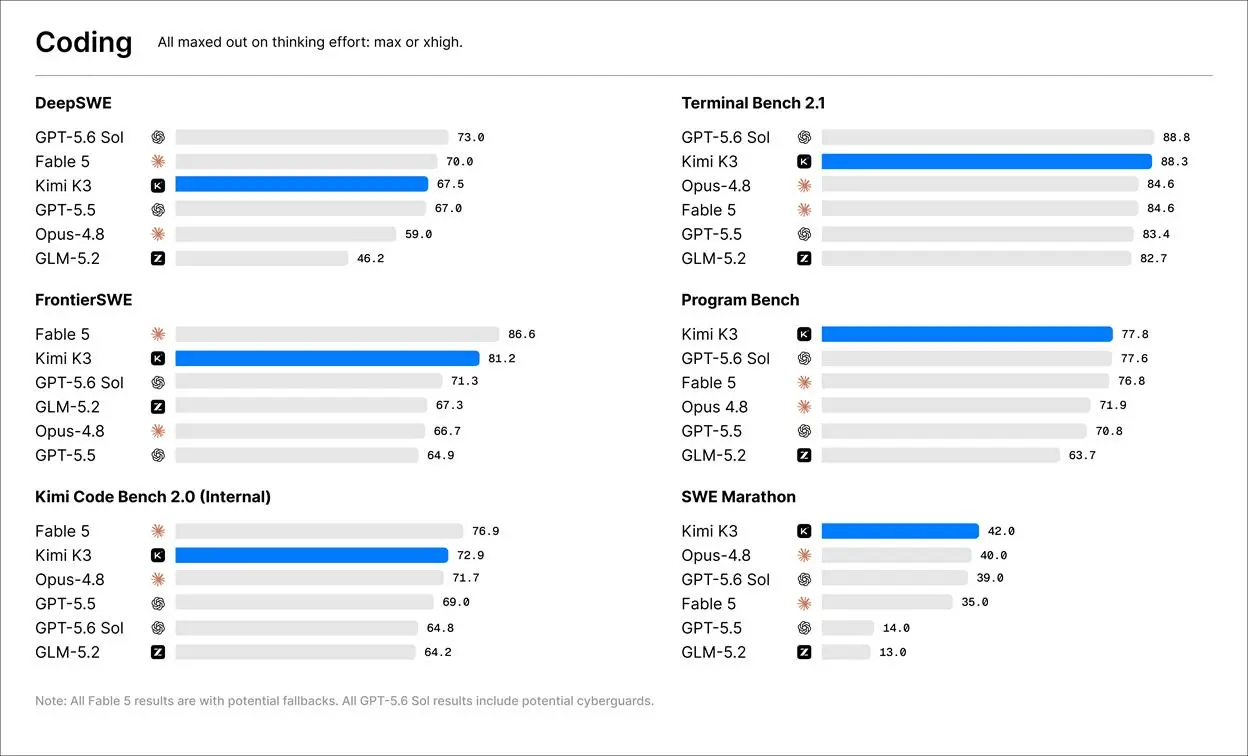
Official Kimi K3 coding comparison. The image is a Moonshot publication graphic; consult the current model card and footnotes for the latest numeric table and evaluation methodology.
Benchmark Results and Interpretation
GPT-5.6 Sol leads Kimi K3 on DeepSWE, indicating an advantage on difficult repository-level software repair. Claude Fable 5 leads FrontierSWE, while K3 remains comfortably ahead of GPT-5.6 Sol and Claude Opus 4.8 on that benchmark.
K3's profile becomes more distinctive on sustained work. It slightly leads ProgramBench and records the strongest SWE-Marathon result in the selected comparison. It also leads BrowseComp and essentially ties Claude Fable 5 on SpreadsheetBench 2.
For K4, the goal should not be a fixed percentage increase on every chart. The more useful target is to improve deep codebase repair and computer-use reliability without losing K3's strengths in long-horizon coding, browsing, and agentic knowledge work.
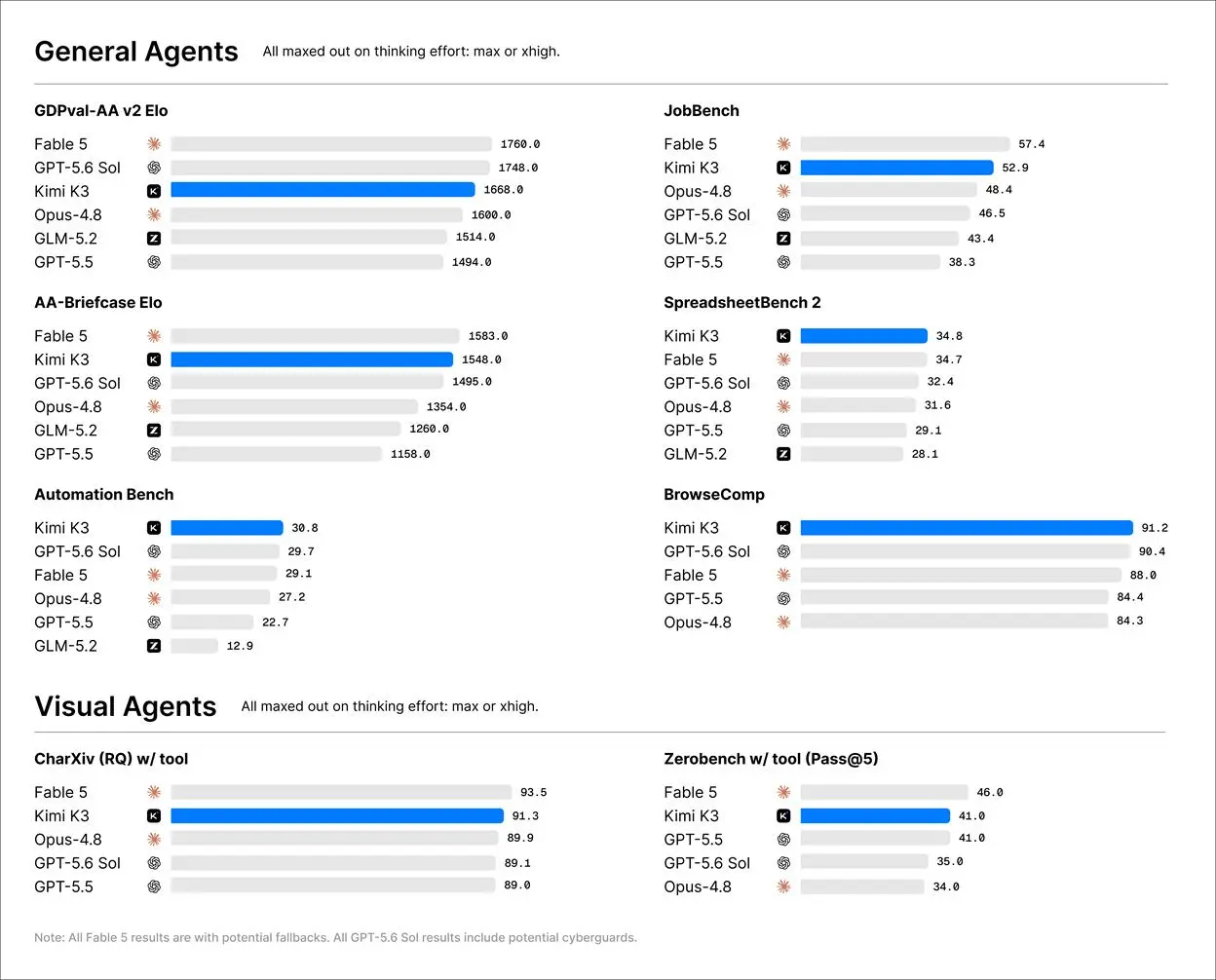
Official Kimi K3 general and visual agent comparison. Source: Moonshot AI Kimi K3 model page.
Kimi K4 vs Kimi K3, GPT-5.6 Sol, and Claude Fable 5
A pre-release comparison cannot assign K4 scores that do not exist. It can, however, show the competitive position K4 would be expected to occupy if it extends the K3 line.
| Dimension | Kimi K4 expected position | Kimi K3 confirmed | Closed references: GPT-5.6 Sol and Claude Fable 5 |
|---|---|---|---|
| Availability | In development | Available | Available |
| Model openness | Unknown | Open weights | Proprietary |
| Confirmed context | Unknown | 1M tokens | Provider-defined or 1M-class |
| Primary strength | Expected larger-scale frontier intelligence | Long-horizon coding and knowledge work | Frontier reasoning, coding, and computer use |
| Multimodality | Expected; not confirmed | Native vision | Multimodal |
| Self-hosting | Unknown | Possible with substantial infrastructure | Not available |
| Agent maturity | Expected to improve | Strong | Strong |
| Deployment cost | Unknown and potentially high | High for self-hosting; hosted API available | Hosted API only |
| Main reason to watch | Scale plus possible openness | Verified open frontier baseline | Maximum closed-model capability |
Comparison Result
Kimi K3 is differentiated by open weights, a one-million-token context window, and strong long-horizon performance. GPT-5.6 Sol remains stronger on some difficult reasoning and repository-repair tasks, while Claude Fable 5 is particularly competitive in software engineering and computer-use agents.
If K4 remains open or broadly accessible while closing these capability gaps, its significance would extend beyond a larger parameter count. It would show that open or semi-open systems can approach the reliability of the strongest proprietary agent platforms. If K4 becomes closed and extremely expensive to serve, the practical distinction would be much smaller.
What Could Kimi K4 Mean for Open-Weight AI?
K3 already demonstrates that open-weight development is entering a scale once associated almost exclusively with proprietary laboratories. K4 could push that boundary further, but openness has several layers: downloadable weights, usable code, a workable license, reproducible inference, affordable hardware requirements, and accessible hosted APIs.
A model can be technically open yet economically inaccessible. K3's 2.8T scale means serious self-hosting requires substantial infrastructure even with sparse activation and quantization. A still larger K4 could widen the gap between researchers who can inspect the weights and organizations that can operate the model efficiently.
For the broader ecosystem, the ideal K4 release would combine transparent weights, efficient inference recipes, strong tool-use behavior, and a hosted API. That combination would let researchers study the model, enterprises deploy it through an API, and specialized teams adapt it for private or regulated workloads.
When Will Kimi K4 Be Released?
Moonshot AI has not announced a Kimi K4 release date. Public reporting connects the model to compute procurement and development planning. That makes a precise month, quarter, or countdown unreliable.
It is also unknown whether K4 will appear simultaneously in the Kimi web product, Kimi Code, Kimi Work, the Moonshot API, and an open-weight repository. K3 is available across several of those surfaces, but K4 may follow a staged rollout or a different distribution strategy.
The signals worth watching are an official Moonshot technical blog, a verified model repository, Kimi Platform documentation, a published license, and a model card with reproducible evaluation details. Social posts and parameter rumors should remain secondary until one of those sources appears.
How to Access Kimi Models While Waiting for K4
K4 is not currently callable. Developers can instead evaluate the current architecture through Kimi K3 on CometAPI. The current model ID is plain code text: kimi-k3. The request uses POST /v1/chat/completions. Do not send production requests to a speculative kimi-k4 identifier until an official integration page publishes it.
Create a CometAPI account and generate an API key. Store the key in an environment variable rather than hard-coding it in application source.
from openai import OpenAI client = OpenAI( api_key="YOUR_COMETAPI_KEY", base_url="https://api.cometapi.com/v1", ) response = client.chat.completions.create( model="kimi-k3", messages=[ { "role": "user", "content": "Analyze the architecture of this software project." } ], ) print(response.choices[0].message.content)
The code block is Python. The endpoint, model ID, parameter names, and code keywords are intentionally presented as code rather than hyperlinks. When K4 becomes available, developers should confirm its real model identifier, endpoint compatibility, supported modalities, and pricing before changing production routing.
What We Still Do Not Know About Kimi K4
A responsible pre-release article should preserve the following unknowns rather than filling them with community estimates:
- Final total and activated parameter counts
- Number of experts, shared experts, and routing strategy
- Context window and maximum output length
- Supported input and output modalities
- Open-weight status, repository, and license
- API model ID, endpoints, reasoning modes, and pricing
- Official benchmark results and evaluation harnesses
- Quantization formats and self-hosting hardware requirements
- Product availability and release date
Keeping this section explicit prevents predicted specifications from being repeated later as official facts. It also makes the article easier to update when Moonshot AI publishes primary documentation.
FAQ
Has Kimi K4 been released?
No. There is no official Kimi K4 model card, API documentation, or public release announcement. Current discussion is based mainly on reporting that Moonshot AI is preparing a larger successor to K3.
How large will Kimi K4 be?
The exact size is unknown. Reporting says it may be significantly larger than K3, but specific multi-trillion parameter claims have not been confirmed by Moonshot AI.
Will Kimi K4 be open source?
That has not been confirmed. K3 has open weights under the Kimi K3 License, but a previous release strategy does not guarantee the same distribution for K4.
Will Kimi K4 have a one-million-token context window?
It is reasonable to expect K4 to retain or improve K3's long-context capability, but Moonshot AI has not published a K4 context limit.
Can developers use Kimi K4 through CometAPI now?
No confirmed K4 model route is available. Developers can currently test Kimi K3 and compare it with other frontier models through the same integration layer.
Conclusion
Kimi K4 should not be reduced to a rumored parameter count. K3 already proves that Moonshot AI can combine extreme sparse-model scale, million-token context, native vision, open weights, and long-horizon agent behavior. The real question is whether K4 can turn that scale into more reliable software engineering, stronger computer use, better multimodal feedback loops, and more efficient inference.
The most important details remain unknown: exact architecture, release date, benchmark scores, license, API access, and serving cost. Until Moonshot publishes primary documentation, every K4 specification beyond the reported development signal should be labeled as expectation or inference.
Developers do not need to wait to evaluate Moonshot AI's current direction. Kimi K3 is already available through CometAPI, providing a practical baseline for coding, long-context reasoning, multimodal analysis, and agent workflows before Kimi K4 arrives.