Qwen Blog
What is Qwen3.8 Max
Qwen3.8-Max Explained: Features, Benchmarks, Kimi K3 and DeepSeek V4 Flash Comparison
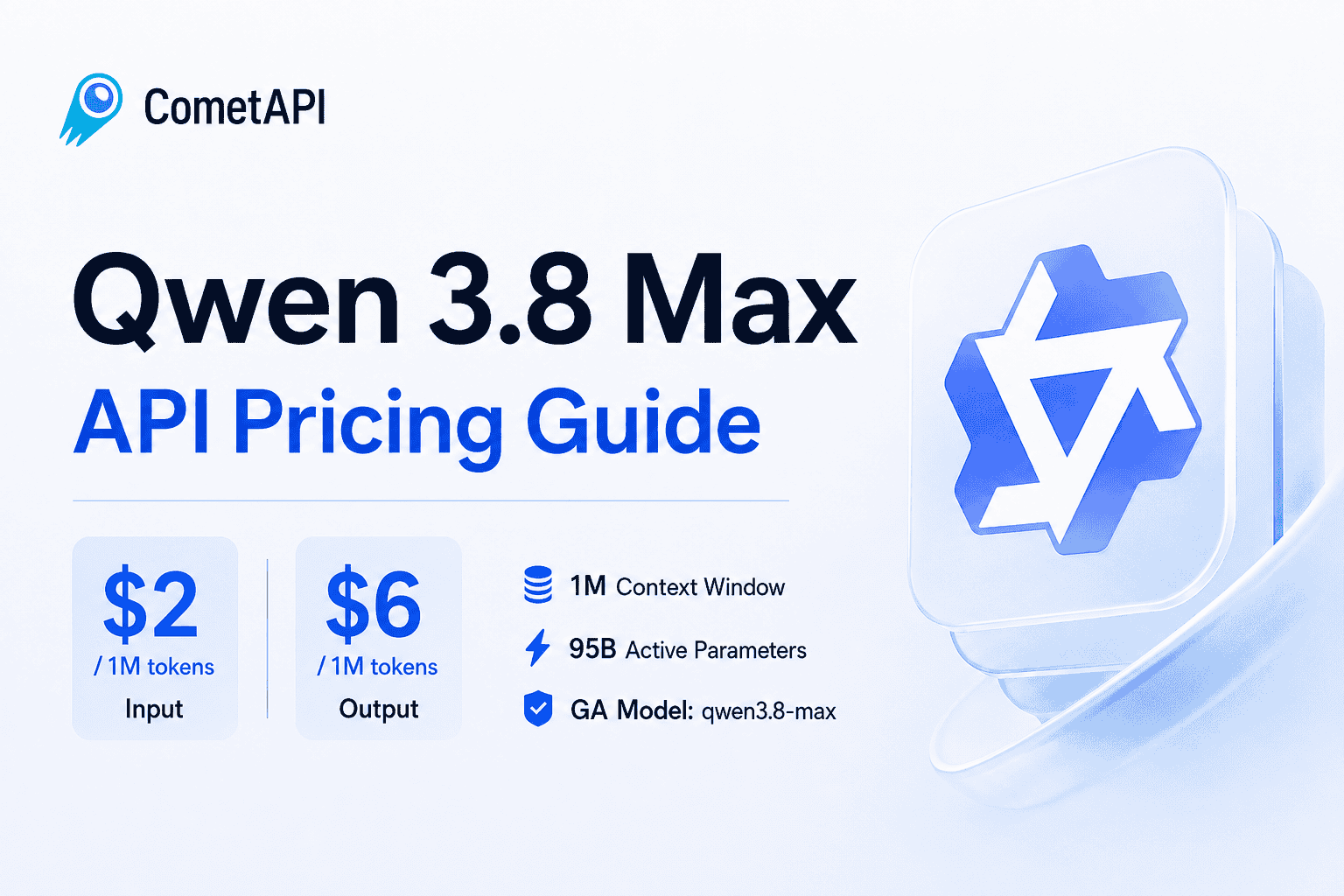
Qwen 3.8 Max API Pricing: $2 Input, $6 Output, 1M Context
Qwen 3.8 Max costs $2/M input and $6/M output. Compare cache fees, tool costs, real examples, limits, and Qwen 3.7 migration advice.
Qwen3.8 Max Preview API: Access, Availability, and Migration Guide
Is the Qwen3.8 Max API available? Check current pricing status, access methods, key specifications, and whether to migrate from Qwen3.7 Max.
Qwen3.7 Plus API Pricing 2026: Costs, Cache & Batch
See how Qwen3.7 Plus API costs vary by Alibaba route, context length, cache usage, Batch jobs, with CometAPI pricing included for comparison.
How to Connect Open WebUI to AI models using CometAPI
Learn how to connect Open WebUI to 500+ AI models using CometAPI. Configure the OpenAI-compatible gateway to save 20-40% on production API costs.
What Is Qwen 3.5-Max? Makes a Stunning Debut: Jumps to Fifth Place in Global Ranking
Qwen 3.5-Max is a next-generation large language model (LLM) developed by Alibaba under the Qwen 3.5 family. It leverages Mixture-of-Experts (MoE) architecture, advanced reasoning capabilities, and agentic AI features to deliver state-of-the-art performance across coding, mathematics, multimodal reasoning, and autonomous task execution. Early benchmarks show it outperforming many competing models and ranking among the top global AI systems in 2026.
.webp&w=3840&q=75)
Qwen image 2.0: Feature, Performance benchmarks & Practical Prompts (2026)
Alibaba’s next-generation image model — Qwen Image 2.0 — arrived as a pragmatic, production-oriented step in multimodal foundation models: native 2K generation, professional-grade text rendering, and an architecture that unifies generation and editing to simplify pipelines. The goal: give designers, product teams, and engineers a single model that can create publication-ready graphics (infographics, posters, PPT slides) and also perform high-fidelity editing — without stitching together three or four separate models.
How to Use Qwen 3.5 API
On Lunar New Year’s Eve (Feb 16–17, 2026), Alibaba Group released its next-generation model, Qwen 3.5 — a multimodal, agent-capable model positioned for what the company calls an “agentic AI” era. Industry coverage highlighted claims of large gains in efficiency and cost, and rapid support from hardware and cloud vendors. CometAPI is options for developers who want hosted API access or an OpenAI-compatible integration, while AMD announced Day-0 GPU support for the model on its Instinct line. ByteDance is one of the principal domestic competitors that released upgrades around the same holiday window. OpenAI remains a reference point for comparison in benchmarks and integration style.