
.png&w=3840&q=75)
Figure 1. Seedream 5.0 Pro official launch visual. Source: ByteDance Seed official launch article
TL;DR
Seedream 5.0 Pro is ByteDance Seed's professional multimodal image creation model, officially launched on July 8, 2026. It unifies image generation and editing around a production-oriented workflow rather than treating editing as a secondary afterthought. ByteDance positions the model around stronger image-text alignment, structural coherence, text rendering, and visual aesthetics, while adding new controls for professional creative work.
Its most important upgrade is controllability. ByteDance highlights four core capability breakthroughs: complex information visualization, interactive precision editing, realistic imagery and portrait textures, and native multilingual generation. The editing stack can combine point, lasso, box and sketch guidance with color or material replacement, layer separation, and multi-image fusion, making the model closer to an AI design system than a one-shot image generator.
Current independent results show a nuanced competitive position. In the Artificial Analysis Image Arena snapshot used for this article, Seedream 5.0 Pro scores 1,275 Elo and ranks #8 in text-to-image, but 1,246 Elo and ranks #6 in image editing. That editing score is slightly above Nano Banana Pro and only 12 Elo below GPT Image 2. On CometAPI, the current model ID is `seedream-5-0-pro-260628`, with a listed starting price of $0.045 per request.
Key Takeaways
- ByteDance officially released the model on July 8, 2026 and describes it as a multimodal image model for advanced reasoning, efficient content creation, and professional production.
- The official launch emphasizes high-density infographics and complex information visualization rather than only aesthetic image generation.
- Its editing system supports point selection, lasso selection, box selection, sketch guidance, color and material replacement, layer separation, and multi-image fusion.
- ByteDance says the model natively supports more than ten commonly used languages, including French, German, Russian, Japanese, Korean, Spanish, and Arabic.
- The current Artificial Analysis snapshot places Seedream 5.0 Pro at #8 for text-to-image with 1,275 Elo and #6 for editing with 1,246 Elo.
- On the current CometAPI endpoint, Seedream 5.0 Pro supports text, single-image, and multi-reference inputs, with up to 10 reference images and up to approximately 2K output.
- ByteDance also acknowledges that finer-grained text rendering and pixel-level editing consistency still have room to improve, so professional users should keep a human QA step in production workflows.
What Is Seedream 5.0 Pro?
Seedream 5.0 Pro is the newest professional model in ByteDance Seed's image-generation family. The company describes it as a multimodal image generation model with advanced reasoning, efficient content creation, and professional production capabilities. That positioning matters because the model is not presented simply as a higher-quality successor to Seedream 4.5 or Seedream 5.0 Lite. Its central goal is to make generated images easier to structure, edit, localize, and reuse in real creative workflows.
The transition can be summarized as a move from image generation toward design understanding. Earlier Seedream releases already focused on unified generation and editing, and Seedream 4.5 was positioned around stronger composition, typography, prompt adherence, and image-editing consistency. Seedream 5.0 Pro extends that direction by making spatial control and professional asset manipulation first-class capabilities. ByteDance's launch material explicitly frames the problem as closing the gap between a creator's intent and a final visual output that is actually usable in production.
This changes how the model should be evaluated. A conventional image model can look impressive if it generates one attractive image from one prompt. A professional design model has a harder job: it must place text where intended, respect object relationships, modify only selected regions, preserve the rest of the composition, accept reference assets, and remain useful after the first draft. Seedream 5.0 Pro is built around that second definition of quality.
Seedream 5.0 Pro Technical Specifications
ByteDance has published the model's capability direction, while the current CometAPI integration exposes concrete API limits and parameters. The table below therefore separates core model positioning from access-path specifications where appropriate. CometAPI's current technical page should be treated as the source of truth for its own endpoint limits, because those limits are not necessarily the absolute ceiling of every ByteDance deployment.
| Specification | Seedream 5.0 Pro |
|---|---|
| Developer | ByteDance Seed Team |
| Official launch | July 8, 2026 |
| Model type | Multimodal image generation and image editing |
| Primary positioning | Professional visual production, structured design, and precision editing |
| Inputs | Text prompt, single image, multiple reference images |
| Core modes | Text-to-image, image editing, multi-reference image fusion |
| Precision controls | Point, lasso, box, sketch, color/material replacement, layer separation |
| Native multilingual support | More than 10 commonly used languages |
| CometAPI model ID | seedream-5-0-pro-260628 |
| Max reference images on current CometAPI endpoint | 10 |
| Output formats on current CometAPI endpoint | PNG, JPEG |
| Max output resolution on current CometAPI endpoint | Up to approximately 2K |
| Streaming / batch on current CometAPI endpoint | Not supported / not supported |
| Current CometAPI starting price | $0.045 per request |
What Is New in Seedream 5.0 Pro?
High-Density Infographics
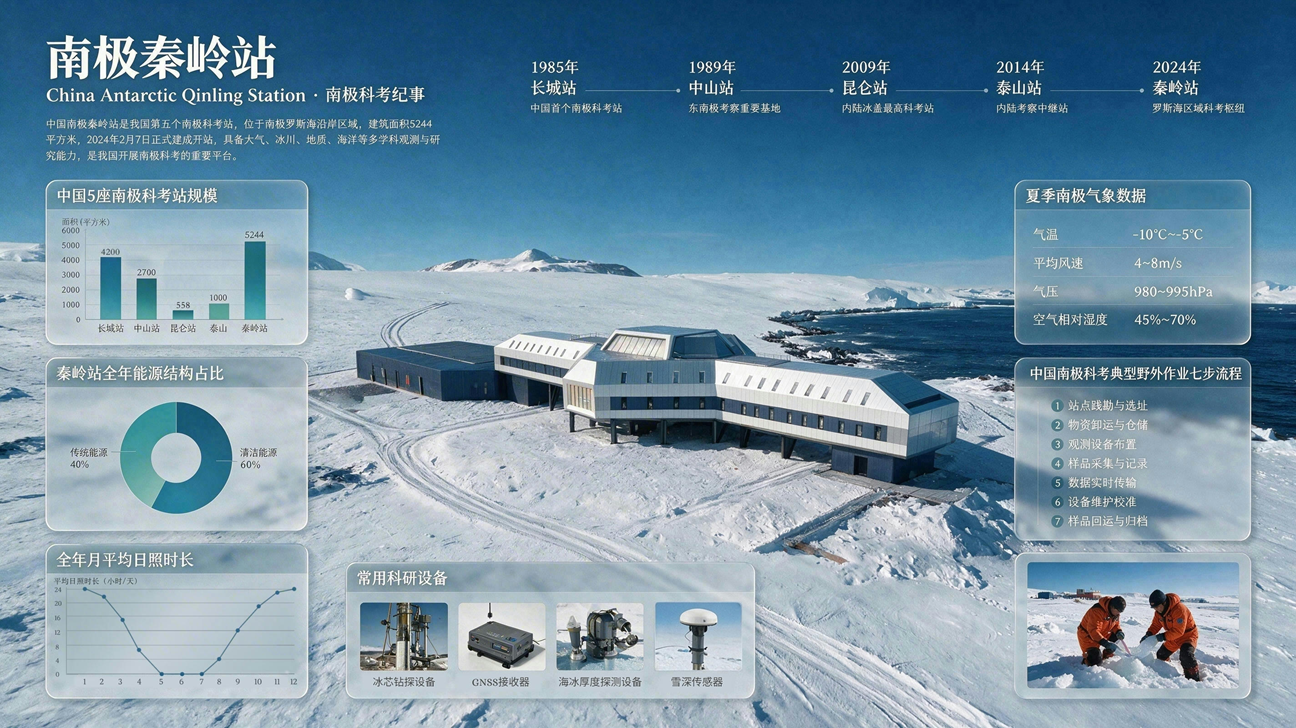
High-density information design is one of the clearest ways Seedream 5.0 Pro differs from a conventional text-to-image model. ByteDance says the model has been specifically optimized to reason about information, plan layouts, and produce dense infographic-style outputs. The challenge is not only to draw attractive objects; it must coordinate data, text, visual hierarchy, charts, labels, and realistic imagery inside one coherent canvas.
The official Antarctic Qinling Station example is designed to stress exactly that combination. It places a research station at the center while organizing a historical timeline, station-size comparison, energy mix, monthly sunshine trend, weather panel, fieldwork flow, scientific equipment, and field photography around it. That is a materially different task from generating a poster with a short slogan: the image has to function as an information interface.
Source: ByteDance Seed official launch article
For practical users, this makes the model especially interesting for education graphics, presentation visuals, research explainers, product comparisons, editorial diagrams, and marketing pages where text and visual structure matter as much as style. The important advantage is not simply that the model can render more words. It is that it attempts to organize those words and graphics into a useful hierarchy.
Interactive Precision Editing
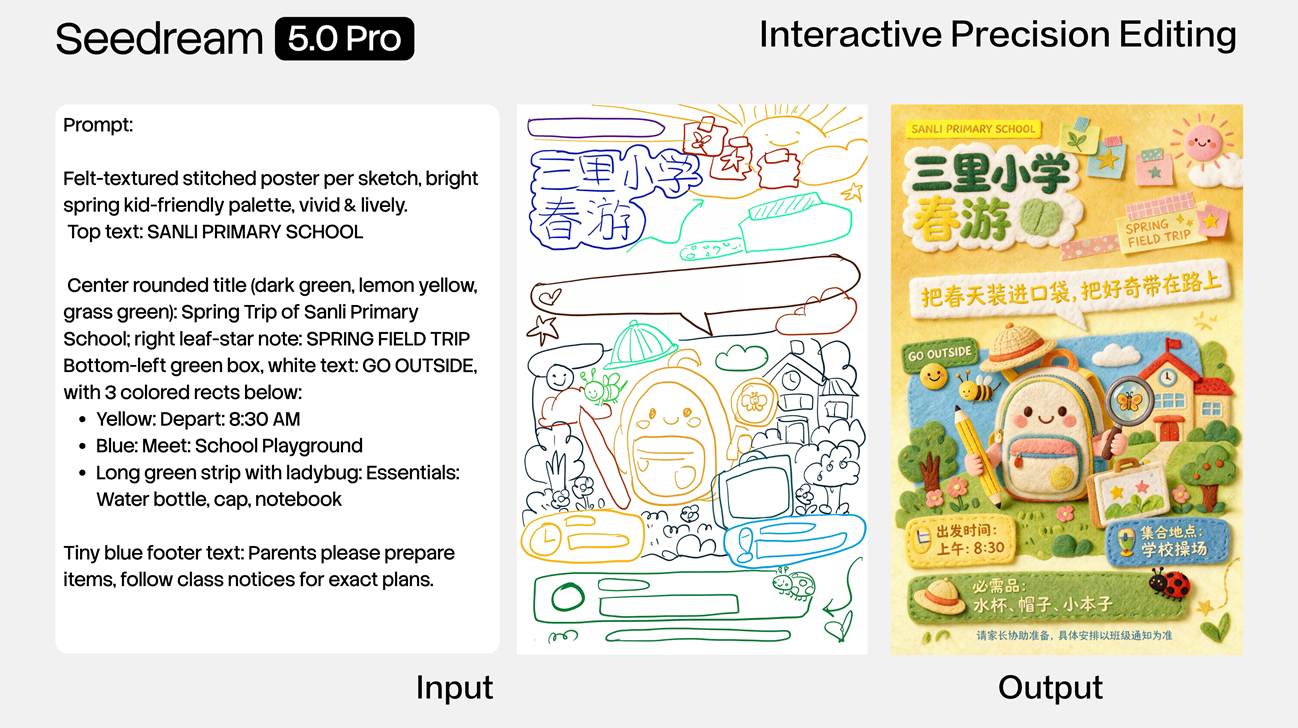
Text-only editing has an obvious weakness: a prompt can describe what should change, but it is often ambiguous about where that change should happen. Seedream 5.0 Pro addresses this by combining language with spatial control. ByteDance describes grounding and regional semantics as the basis for pixel-level interactive editing, allowing user-provided coordinates or marked regions to become deterministic editing instructions.
The control set includes point selection, lasso selection, box selection, doodling or sketch guidance, color editing, and material replacement. This changes the interaction from describe-and-regenerate to specify what, where, and how. In design iteration, that distinction is important: a creator can correct one product color, add an object in a selected region, replace a sofa material, or refine a poster section without asking the model to rebuild the entire scene.
Source: ByteDance Seed official launch article
The benefit is workflow stability. Repeated full-image regeneration can introduce unintended changes to faces, typography, lighting, or layout. Localized editing narrows the change surface. That does not eliminate drift, but it makes iterative design more controllable and gives Seedream 5.0 Pro a stronger production profile than models optimized mainly for single-pass generation.
Layer Separation
Layer separation is arguably the most design-software-like capability in the release. ByteDance says Seedream 5.0 Pro can separate a complete image into more than 10 independent layers, including text, the main subject, background, and decorative elements. Areas that were previously hidden by foreground objects can be inpainted so the resulting layers remain independently usable.
That matters because a flattened AI image is difficult to hand off into a normal design pipeline. If the model can reliably decompose an image into movable, scalable assets, the output becomes more reusable. A designer can rearrange elements, replace a subject, adjust a background, or create campaign variants without starting from zero. The model is therefore moving from final-image synthesis toward intermediate asset generation.
Multi-Image Fusion
Seedream 5.0 Pro can also combine multiple reference materials with a target scene. ByteDance describes multi-image fusion as a way to merge multi-source materials according to user instructions, which is useful for visual collages, product ideation, group compositions, character references, and campaign design.
The production value comes from maintaining relationships across references. A useful multi-reference model must decide which identity, object, style, texture, or composition rule should be preserved from each input. When this works, teams can treat existing brand assets, product photos, character sheets, or layout references as constraints rather than merely inspiration.
Photographic Visual Quality
The Pro release is not only about structure. ByteDance also emphasizes improved reconstruction of real-world lighting, object materials, reflections, refraction, light transmission, and skin textures. Official demonstrations include storefront glass, a coastal cliff glass villa, cinematic portraiture, AAA-style characters, water splashes, and panning photography.
These examples point to a useful distinction between photorealism and production realism. Photorealism asks whether an image looks like a photograph. Production realism asks whether different physical surfaces behave consistently inside the same image: glass should reflect and transmit light differently from wood, skin should not look like plastic, and motion blur should match the camera model. Seedream 5.0 Pro is clearly being pushed toward that second standard.
Native Multilingual Generation
ByteDance says Seedream 5.0 Pro supports direct input and high-quality generation in more than ten commonly used languages, including Chinese, English, French, German, Russian, Japanese, Korean, Spanish, and Arabic. The official material also emphasizes localized typography, including right-to-left Arabic text and Spanish accent marks.
This matters for commercial localization because a visual campaign is more than a translated sentence. The model has to preserve layout, text hierarchy, language-specific typography, and regional visual cues. For global marketing teams, one of the most valuable workflows may therefore be generating a base creative once and producing localized variants without rebuilding the full design manually for every market.
Benchmark Performance
ByteDance's launch material is rich in qualitative examples but does not publish a standardized numerical benchmark suite for Seedream 5.0 Pro. For a current quantitative signal, this article uses Artificial Analysis Image Arena data. The Arena uses blind pairwise user voting, so Elo should be read as a preference signal rather than a complete measure of factual accuracy, typography, editing reliability, or enterprise usability. The snapshot below is dated August 9, 2026 and will change as new votes arrive.
| Model | T2I Elo | T2I Rank | Editing Elo | Edit Rank | AA API Price / 1K |
|---|---|---|---|---|---|
| GPT Image 2 | 1,369 | #1 | 1,258 | #2 | $211 |
| Nano Banana Pro | 1,296 | #6 | 1,241 | #7 | $134 |
| Seedream 5.0 Pro | 1,275 | #8 | 1,246 | #6 | $90 |
| Seedream 5.0 Lite | 1,190 | #37 | 1,171 | #28 | $35 |
Snapshot: August 9, 2026. Source: Artificial Analysis Image Arena
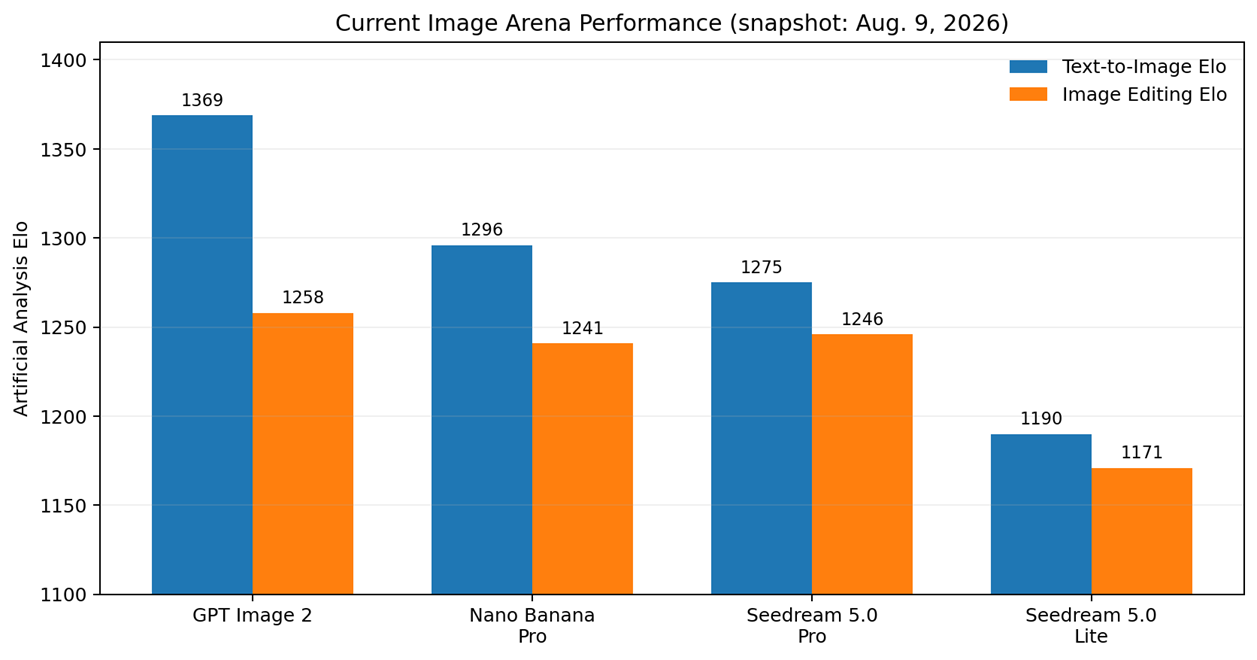
The headline result is that Seedream 5.0 Pro is more competitive in editing than its general text-to-image rank suggests. It trails Nano Banana Pro by 21 Elo in text-to-image preference, but leads it by 5 Elo in the image-editing arena. Against GPT Image 2, the gap is much larger in generation - 94 Elo - but narrows to only 12 Elo in editing.
That pattern aligns with ByteDance's product positioning. If the model were designed primarily to win single-shot aesthetic preference tests, a #8 text-to-image rank would look less impressive. But a professional editing model is judged by a different mix of attributes: local control, preservation of untouched regions, typography, structured layout, and the ability to iterate. The current editing result suggests the Pro release is already competitive in the area ByteDance emphasizes most heavily.
The family comparison is also revealing. Seedream 5.0 Pro is currently 70 Elo above Seedream 4.5 in text-to-image and 58 Elo above it in editing. It is 85 Elo above Seedream 5.0 Lite in text-to-image and 75 Elo ahead in editing. Those are not official ByteDance deltas; they are derived from the same Artificial Analysis text-to-image and editing snapshots, so they should be treated as current external signals rather than permanent model scores.
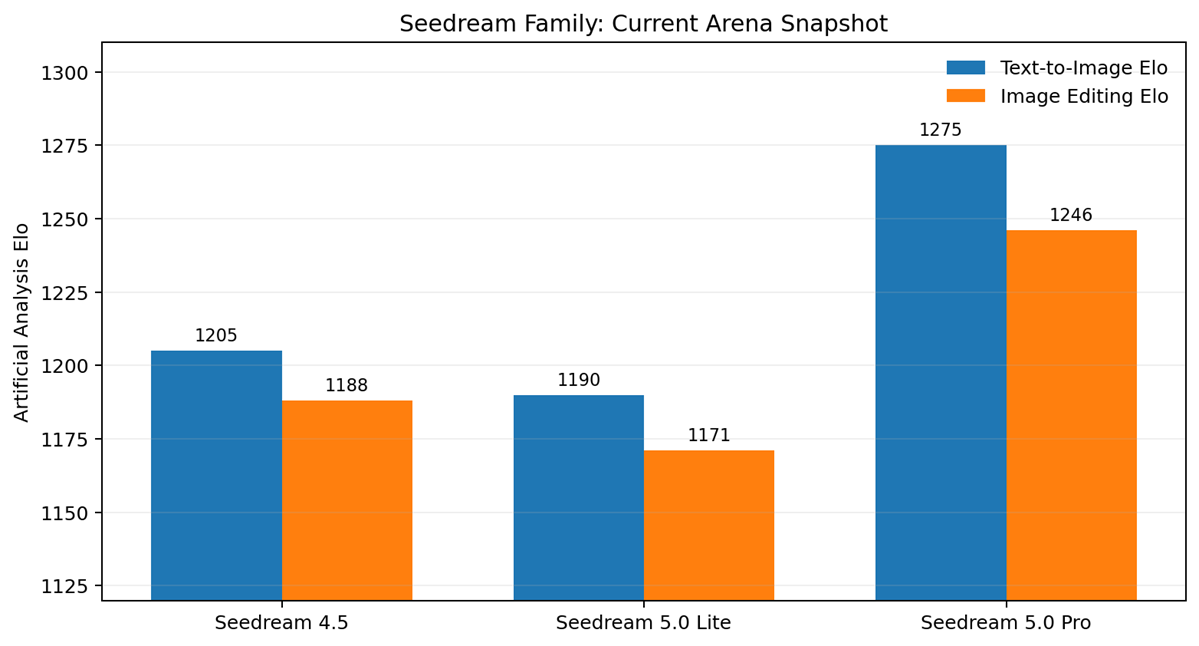
Figure 5. Current Seedream-family Arena scores show the Pro model separating from Seedream 4.5 and Seedream 5.0 Lite. Source: Artificial Analysis Image Arena
Seedream 5.0 Pro API Pricing
CometAPI currently lists Seedream 5.0 Pro at a starting price of $0.045 per request. That rate is simple to reason about at small and medium scale: 10 billed requests are $0.45, 100 are $4.50, and 1,000 are $45 before considering any workflow-specific differences in request structure or future pricing changes.
| Billed Requests | Cost at $0.045 / Request |
|---|---|
| 1 | $0.045 |
| 10 | $0.45 |
| 100 | $4.50 |
| 1,000 | $45.00 |
This should not be confused with Artificial Analysis's $90-per-1,000 figure. Artificial Analysis states that its API-pricing column reflects the cost of generating 1,000 images on the model creator's API at 1024x1024 with default settings. CometAPI's number is the platform's own current per-request listing. The two values answer different questions and should not be merged into a single universal cost claim.
For developers, the more useful pricing question is cost per accepted asset rather than cost per raw generation. A cheaper model that requires several full regenerations can become more expensive than a model that supports reliable local corrections. Seedream 5.0 Pro's strongest price-performance argument therefore depends on whether its precision editing actually reduces retries in the target workflow.
How Seedream 5.0 Pro Compares with GPT Image 2, Nano Banana Pro, and Seedream 5.0 Lite
There is no single best image model across every use case. The current market splits into several overlapping priorities: overall generation quality, editing fidelity, high-resolution output, typography, structured design, multi-reference workflows, speed, and cost. Seedream 5.0 Pro is most compelling when precision editing and production structure are weighted more heavily than leaderboard dominance alone.
| Dimension | Seedream 5.0 Pro | Nano Banana Pro | GPT Image 2 | Seedream 5.0 Lite |
|---|---|---|---|---|
| Primary positioning | Professional design + precise editing | Professional generation/editing with Gemini reasoning | High-end general image generation/editing | Lower-cost general Seedream generation |
| T2I Elo / rank | 1,275 / #8 | 1,296 / #6 | 1,369 / #1 | 1,190 / #37 |
| Editing Elo / rank | 1,246 / #6 | 1,241 / #7 | 1,258 / #2 | 1,171 / #28 |
| Structured infographics | Major official focus | Strong professional-design focus | Strong general image capability | General capability |
| Localized control | Point/lasso/box/sketch + region edits | Conversational/professional editing | Precise editing and instruction following | Less specialized than Pro |
| Layer separation | Officially highlighted | Not a defining feature in Google model card | Not a defining feature in launch page | Not a defining Pro-style capability |
| Current cited resolution | Up to ~2K on CometAPI endpoint | 1K/2K/4K in Gemini API | Provider/config dependent | Access-path dependent |
| AA price / 1K images | $90 | $134 | $211 | $35 |
| Best fit | Structured design, localized edits, reusable assets | 4K Gemini design workflows, grounding | Highest overall generation preference | Budget-sensitive general generation |
Seedream 5.0 Pro vs Nano Banana Pro
Nano Banana Pro is Google's professional Gemini 3 Pro Image model, described by Google as a reasoning-driven engine for professional-grade image generation and editing. Google's API documentation also supports 1K, 2K, and 4K output for Gemini 3 image models, which gives Nano Banana Pro an important high-resolution advantage over the current 2K ceiling listed on CometAPI's Seedream 5.0 Pro endpoint.
In the current Arena snapshot, Nano Banana Pro leads Seedream 5.0 Pro in text-to-image by 21 Elo, but Seedream leads Nano Banana Pro in editing by 5 Elo. The practical conclusion is not that one model is universally better. Nano Banana Pro is the stronger choice when Gemini integration, high-resolution output, and Google's grounding-oriented workflow matter most. Seedream 5.0 Pro is more distinctive when the task revolves around marked-region edits, sketch-driven layout, layer separation, dense infographics, and reusable production assets.
Seedream 5.0 Pro vs GPT Image 2
OpenAI's current image system is positioned around stronger text rendering, multilingual support, more precise editing, and professional image creation. In the Arena, GPT Image 2 is the clear leader in general text-to-image preference at 1,369 Elo, compared with 1,275 for Seedream 5.0 Pro. That is a meaningful gap and should not be minimized.
The editing comparison is much tighter: 1,258 Elo for GPT Image 2 versus 1,246 for Seedream 5.0 Pro. This suggests a useful division of labor. GPT Image 2 is currently the safer choice when the primary objective is maximum general generation quality. Seedream 5.0 Pro becomes more attractive when structured design controls are central to the workflow and when a lower access cost can offset some of the quality gap.
Seedream 5.0 Pro vs Seedream 5.0 Lite
The comparison inside ByteDance's own family is the easiest to interpret. Seedream 5.0 Lite is a broader, lower-cost model, while the Pro release concentrates on professional production, editing precision, and design structure. The current Arena data reinforces that distinction: Pro leads Lite by 85 Elo in text-to-image and 75 Elo in editing.
The choice therefore depends less on branding than on workflow. Use Lite when generation volume and cost dominate and the output can be accepted or regenerated as a whole. Use Pro when a design must survive multiple local revisions, preserve layout, incorporate references, handle dense text, or become a reusable asset rather than a single flattened image.
What Can Seedream 5.0 Pro Do?
Infographics and Educational Content
Seedream 5.0 Pro is unusually well suited to images that have to explain something. Examples include scientific infographics, educational posters, timelines, product-comparison graphics, process diagrams, presentation visuals, and editorial explainers. The model's advantage is the combination of text density, chart-like structure, and visual hierarchy inside a single generation.
Advertising and E-commerce
Commercial creatives often go through dozens of small changes: move a product, replace a background texture, alter a color, localize a headline, or generate a new campaign size. Precision editing and multi-reference fusion make those revisions more practical. Product photos, retail posters, social ads, e-commerce hero images, and campaign variants are therefore natural use cases.
UI/UX and Product Mockups
The official examples include interface-style layouts and demonstrate an ability to reason about spatial relationships across text, cards, images, and controls. That makes the model useful for concept-stage website heroes, app screens, product landing pages, pitch-deck visuals, and interface mockups. These outputs should still be treated as visual prototypes rather than production code, but they can compress the gap between an idea and a reviewable concept.
Image Retouching and Production Editing
Point, lasso, box, sketch, color, and material controls are especially valuable when an image is already close to correct. Rather than rerun the entire prompt, a creator can target one region. This is useful for retouching, object replacement, material exploration, prop changes, background repair, compositional cleanup, and iterative approval workflows.
Multilingual Localization
For global brands, one base creative can become a template for multiple regions. Seedream 5.0 Pro's multilingual text and localized visual handling make it suitable for adapting campaign graphics, posters, product pages, event materials, and educational content across languages. The model can accelerate the first draft of localization, while human review remains important for legal copy, brand terminology, and culturally sensitive material.
Reusable Creative Assets
Layer separation is the feature that most clearly moves the model beyond one-shot generation. If a poster can be decomposed into text, subject, background, and decoration layers, the result can continue through a conventional creative pipeline. That supports resizing, recomposition, subject swaps, seasonal variants, and asset reuse across channels.
Limitations of Seedream 5.0 Pro
Seedream 5.0 Pro is not a finished replacement for professional design software or human review. ByteDance explicitly says finer-grained text rendering and pixel-level editing consistency still have room to improve. That admission is important because the model's most ambitious capabilities - dense text and local editing - are also the areas where small errors can be expensive in a production setting.
- Fine typography still needs verification. Long copy, small labels, numbers, and multilingual text should be proofread before publication.
- Localized edits can still drift. Pixel-level consistency is an explicit area ByteDance says it wants to improve, so critical assets should be checked after every edit.
- The current CometAPI access path has practical limits: up to 10 references, roughly 2K maximum output, no streaming, and no batch generation on the listed endpoint. Other provider interfaces may differ.
- Arena scores are preference metrics, not a complete professional benchmark. They do not separately measure typography correctness, brand consistency, factual diagram accuracy, or edit preservation.
The safest production pattern is therefore generation plus review rather than generation plus automatic publication. Seedream 5.0 Pro reduces the amount of manual design work, but the higher the factual, legal, or brand risk of an asset, the more valuable a final human QA pass becomes.
How to Access Seedream 5.0 Pro Through CometAPI
Seedream 5.0 Pro is currently available on CometAPI under the model ID seedream-5-0-pro-260628. The platform lists the model as available through a production image-generation endpoint and supports text-to-image, image editing, and multi-reference workflows through the same model family.
A typical integration flow is straightforward: create a CometAPI key, call the image-generation endpoint, select seedream-5-0-pro-260628, provide the prompt and optional references, then specify output size and format. Teams should test representative tasks before production rollout, especially typography-heavy designs, localized edits, multi-reference compositions, and brand-critical assets.
curl https://api.cometapi.com/v1/images/generations
\ -H "Authorization: Bearer $COMETAPI_KEY"
\ -H "Content-Type: application/json"
\ -d '{ "model": "seedream-5-0-pro-260628", "prompt": "Create a clean product launch infographic with a clear visual hierarchy", "size": "2K", "output_format": "png" }'
The larger reason to use a unified API layer is comparative testing. Image models now have distinct strengths, and a production team may prefer Seedream 5.0 Pro for precision edits, GPT Image 2 for a difficult hero generation, and Nano Banana Pro for a 4K Gemini workflow. Keeping those models behind one integration layer makes it easier to route tasks by capability instead of forcing every image job through the same model.
Seedream 5.0 Pro is therefore best understood as a professional design-and-editing model rather than a simple upgrade in visual quality. Its current benchmark profile does not make it the universal leader in raw text-to-image preference, but its editing score, spatial controls, infographic focus, layer separation, multilingual design support, and competitive access price give it a clear place in production-oriented creative systems.