Choisissez votre plan
Blog Gemini 4 carbon
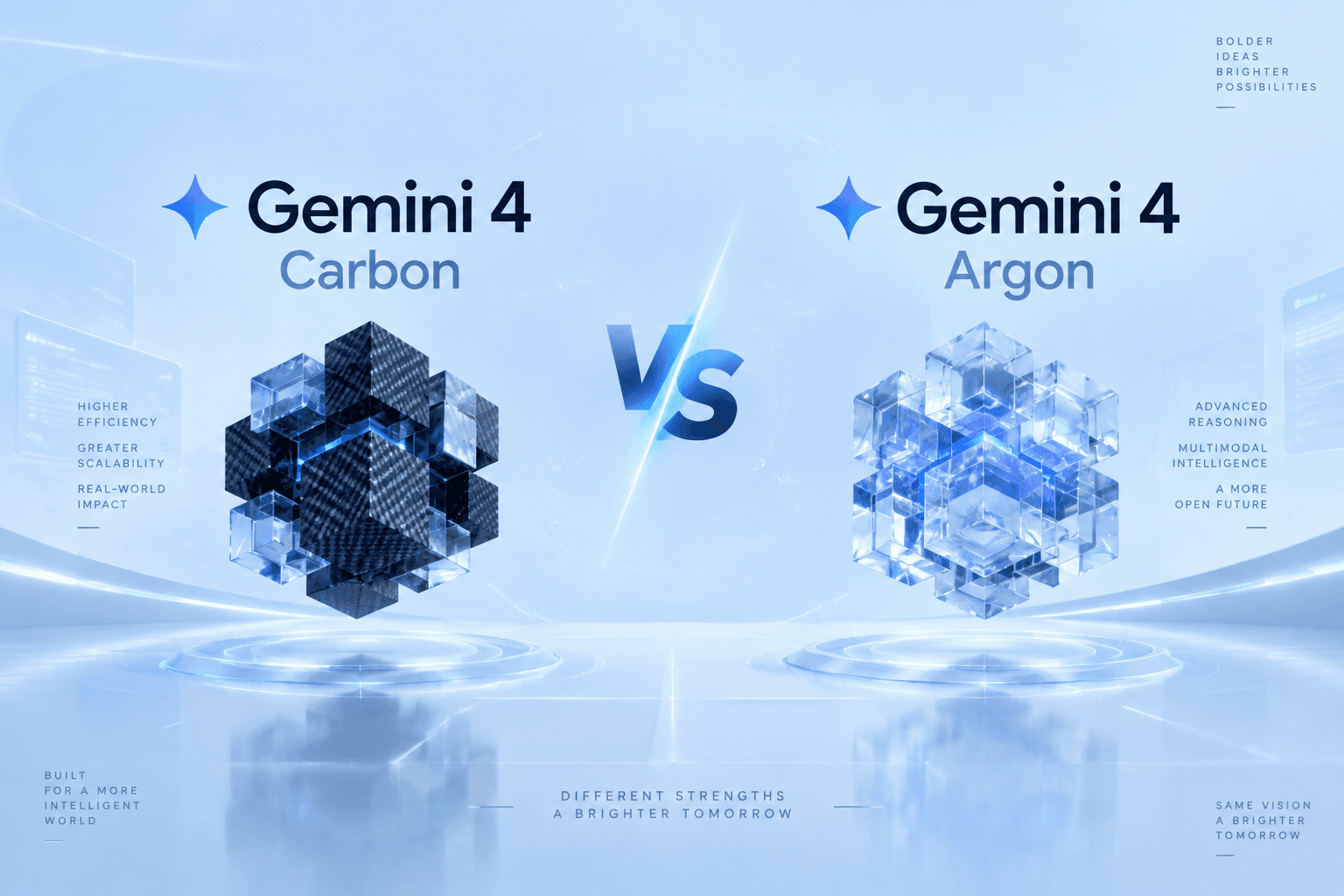
Gemini 4 Carbon contre Gemini 4 Argon : tests de performance, tarifs et lequel choisir
I don’t have verified public details on models named “Gemini 4 Carbon” and “Gemini 4 Argon.” They may be new or internal variants released after my knowledge cutoff. Without official specs, any direct comparison would be speculative. If you can share a link or spec sheet, I can produce a precise side-by-side. In the meantime, here’s a checklist to evaluate them across your requested dimensions: - Benchmarks: - General: MMLU, BIG-bench, GPQA, TruthfulQA, HellaSwag - Reasoning/Math: GSM8K, MATH, ARC-Challenge - Coding: HumanEval, MBPP, MultiPL-E, EvalPlus - Multimodal (if applicable): MathVista, ChartQA, DocVQA, MMMU - Long-context: Needle-in-a-Haystack, RULER-like tests - What to compare: overall scores, pass@1 vs pass@k, variance across domains, evaluation methodology transparency - Coding: - Supported languages and frameworks; pass@1 on HumanEval/MBPP; function calling and tool-use robustness - Repository-level code generation/refactoring; test generation; doc comprehension - Safety: secret leakage prevention, license-aware generation, hallucination rate, deterministic modes - Tooling: inline edits, diff mode, code execution/sandboxes, debugger integrations - Cybersecurity: - Alignment: jailbreak resistance, prompt injection resilience, content safeguards - Secure coding: vulnerability avoidance (OWASP Top 10/LLM Top 10), dependency hygiene - Model supply-chain: evals against red-teaming suites, reproducible inference, audit logs - Data handling: PII redaction, regional residency, enterprise compliance certifications - Context windows: - Max input tokens and output tokens; effective context retention curves (not just max limit) - Retrieval augmentation quality; memory/state features; tool-call chaining depth - Structured inputs (JSON mode), citations/attribution, long-document QA performance - API pricing: - Input/output price per million tokens; tiered discounts; burst vs sustained pricing - Batch/bulk inference rates; streaming vs non-streaming costs; caching credits - Tool/function-calling billing, image/audio modalities pricing, context caching charges - Speed: - Latency percentiles (P50/P90/P99) for short and long prompts; tokens/sec generation - Throughput under concurrency; cold start vs warm; streaming first-token latency - Regional performance differences; model sizes/modes (e.g., standard vs “flash”) - Availability: - Regions and endpoints (public API vs Vertex AI/AI Studio); on-prem or VPC options - Quotas and rate limits; SLA tiers; failover versions; versioning and deprecation timelines - Feature availability parity (function calling, batch, eval tools) across regions How to proceed: - Share the official spec or announcement for Carbon and Argon, and I’ll produce a concise, point-by-point comparison table across these metrics. - Alternatively, check the model catalog and pricing pages for their entries, then provide the listed specs (context size, pricing, latency, benchmark scores), and I’ll align them into a clear recommendation based on your priorities (quality vs cost vs speed).

Qu'est-ce que Gemini 4 Carbon ? Benchmarks, fonctionnalités & tarifs
Découvrez Gemini 4 Carbon, le nouveau modèle d’IA de pointe de Google. Explorez les benchmarks de cybersécurité, les fonctionnalités, les tarifs, les comparatifs et la disponibilité.