
TL;DR
GLM-5.5 is the expected next major model in Z.ai’s GLM family. Reuters has described GLM-5.5 as a later roadmap milestone, but the report did not provide a confirmed launch commitment, architecture, parameter count, context limit, benchmark table, price, or access plan.
Z.ai presents GLM-5.3 as its latest flagship model and the strongest factual baseline for estimating the next release. It uses the same base model as its predecessor, with gains driven by post-training, while supporting a 1M-token context / 128K output. Z.ai also reports a 50% coding-performance gain on its internal Code Bench.
The most credible expectation is not simply “a bigger model.” Z.ai has publicly said that future models will target long-horizon tasks and self-evolving autonomous agents. GLM-5.5 is therefore more likely to emphasize reliable task completion, self-correction, context management, tool use, and sustained engineering work than a single headline parameter increase.
Key Takeaways
- Reuters has identified GLM-5.5 as a later roadmap milestone, but Z.ai has not published an exact launch commitment.
- GLM-5.3 is Z.ai’s latest publicly documented flagship model.
- The current architecture baseline remains a roughly 744B-total / 40B-active sparse MoE class, because GLM-5.3 retains the same base model while improving post-training.
- GLM-5.3 already offers a 1M-token context window and a 128K maximum output, so GLM-5.5 may prioritize context quality and memory management rather than a larger advertised limit.
- Z.ai’s likely development direction is longer-running, more autonomous, self-correcting agents.
- A continued open-weight release is plausible because GLM-5.3 is positioned as an open-weight model, but the GLM-5.5 license remains unknown.
- No public evidence currently supports a specific trillion-parameter claim for GLM-5.5.
- CometAPI already provides a dedicated GLM-5.3 endpoint with a displayed 20% discount. If GLM-5.5 is officially released, CometAPI is expected to add it quickly at a discounted rate, while other flagship GLM models remain available through the same platform.
What Is GLM-5.5?
GLM-5.5 is the reported later milestone beyond GLM-5.3 in Z.ai’s frontier-model roadmap. The “5.5” name has appeared in Reuters reporting, but not yet in an official Z.ai model card, developer endpoint, release note, Hugging Face repository, or pricing table.
The model family has moved through a clear sequence. GLM-5 established the “Agentic Engineering” direction with a 744B-parameter sparse MoE. GLM-5.1 shifted attention toward sustained execution, and the next generation expanded usable context to 1M tokens. GLM-5.3 keeps the same base model but scales post-training much more aggressively, with stronger complex coding and long-horizon agent performance.
This progression suggests that GLM-5.5 will probably be evaluated by how long it can work reliably, how well it recovers from mistakes, and what it can actually deliver—not merely by how it performs on short single-turn tests.
What Is Likely to Be New in GLM-5.5?
A Shift Toward Self-Evolving Autonomous Agents
The clearest public signal comes from Z.ai’s CodeGeeX technical lead, who told Reuters that future models would target long-horizon tasks and self-evolving autonomous agents. That points toward agents that can run experiments, inspect results, revise strategies, and improve their own work within a bounded task environment.
For software engineering, this could mean a tighter loop of repository analysis, planning, implementation, testing, debugging, performance measurement, and verification. The model would be judged by the final state of the project rather than the apparent quality of any one answer.
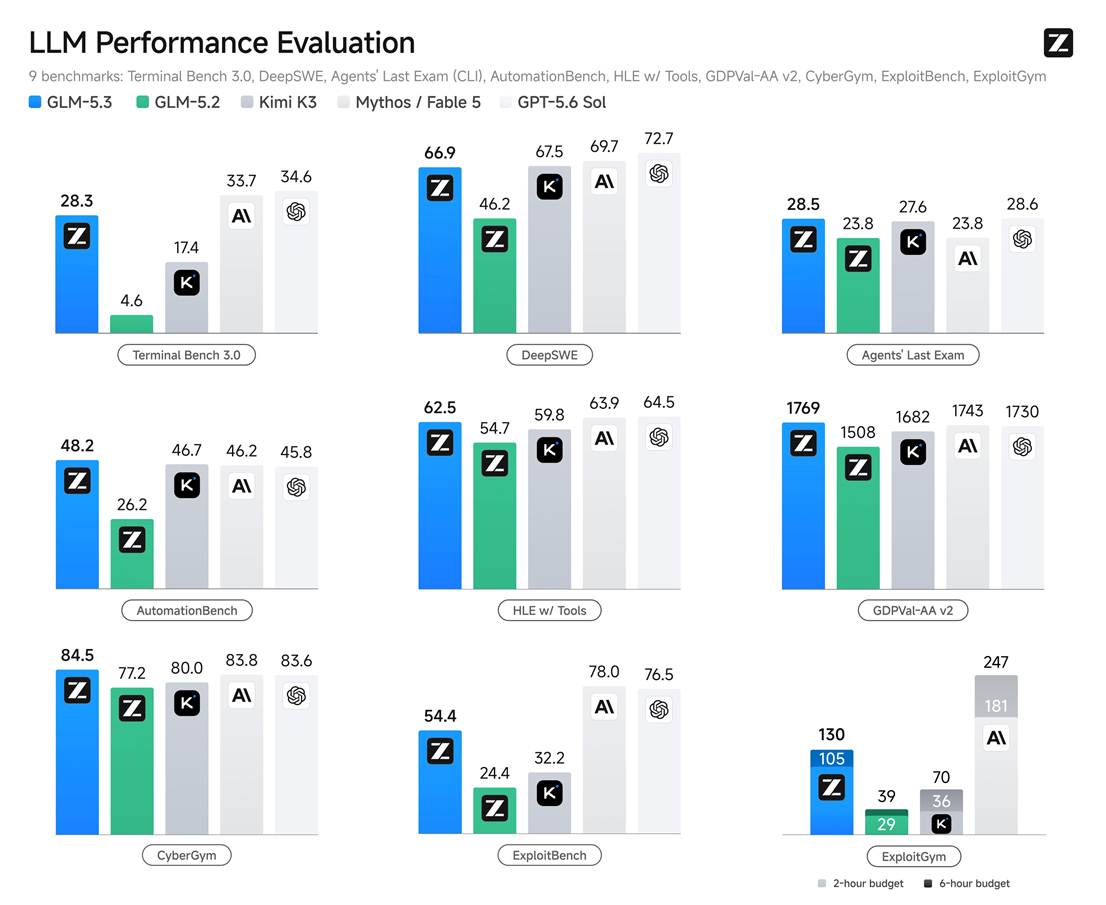
Visual baseline: the latest official benchmark figure in the Performance section documents GLM-5.3, not announced GLM-5.5 specifications.
A Continuation of Sparse MoE Scaling
A sparse mixture-of-experts architecture is the most defensible architectural expectation. The GLM-5 technical report describes 744B total / 40B active parameters, 256 experts, eight routed experts per token, and one shared expert. GLM-5.3 uses the same base model as its predecessor, so this sparse-MoE design remains the closest published architectural reference.
GLM-5.5 could increase model capacity, but there is no public evidence that it will cross one trillion parameters. Z.ai may obtain larger gains by improving training data, expert specialization, routing, reinforcement learning, speculative decoding, or inference efficiency while keeping the overall model in roughly the same scale class.
Better Use of Long Context
GLM-5.3 supports 1M input tokens and up to 128K output tokens. A larger headline context window is therefore not required for GLM-5.5 to be a meaningful upgrade. More valuable improvements would include better recall of early requirements, less goal drift, stronger retrieval across large codebases, more reliable context compaction, and lower serving costs.
Context compaction is especially important for agents whose tool logs and intermediate states can grow beyond the model window. GLM-5.3 carries forward SAO with compaction for long-horizon training, helping performance gains persist on extended tasks rather than only short ones. A later model could extend that approach.
More Efficient Sparse Attention and Decoding
Because GLM-5.3 retains the same base model, the current long-context stack continues to build on IndexShare, where groups of four sparse-attention layers reuse the same indexer. Z.ai reports that this design cuts indexer-related per-token computation by 2.9 times at a 1M-token context length, while multi-token prediction improves speculative decoding. GLM-5.3 then adds its gains primarily through scaled post-training.
GLM-5.5 could build on these techniques with more efficient token selection, KV-cache management, expert routing, or draft-model decoding. Such gains would directly affect latency and cost during long agent runs.
Stronger Reinforcement Learning and Verification
The GLM-5 technical report describes a sequential post-training pipeline covering reasoning RL, agentic RL, and general RL, supported by an asynchronous infrastructure that separates generation from training. This allows the system to explore more long trajectories and learn from planning, tool use, self-correction, and environmental feedback.
For GLM-5.5, the likely improvement is not simply more reasoning tokens. It is better outcome verification: knowing whether code compiled, tests passed, a performance target was reached, a tool call was authorized, or a requested deliverable actually satisfied the original constraints.
What We Don’t Know Yet
GLM-5.5 has a reported release window, but its final product specifications remain undisclosed. The projections below are deliberately conservative and should not be read as announced specifications.
| Area | What Is Public | Current Projection |
|---|---|---|
| Status | Reuters says the model is expected in August 2026. | An August announcement is plausible, but the timing could move. |
| Architecture | No GLM-5.5 architecture has been published. | A sparse MoE design derived from the GLM-5 family is the leading expectation. |
| Model scale | No parameter or active-parameter count is public. | A 750B-class model or a moderate scale increase is more defensible than a specific trillion-parameter claim. |
| Context window | No GLM-5.5 limit is public. | At least 1M tokens is plausible; better effective memory may matter more than a larger number. |
| Modalities | No GLM-5.5 input modalities are public. | Text-first coding and agents are the strongest baseline; native multimodality is uncertain. |
| Performance | No official GLM-5.5 benchmark scores exist. | The largest gains are likely in long-horizon coding, tool use, error recovery, and autonomous delivery. |
| API pricing | No rate card or model endpoint has been announced. | Pricing could remain near GLM-5.2 or carry a modest premium. |
| Open weights | No GLM-5.5 license has been announced. | An MIT-licensed release is plausible from precedent, but not guaranteed. |
| Access | No official preview, API, or weight-release sequence exists. | A staged rollout through Z.ai products, Coding Plan, API, and open weights is possible. |
Architecture and Active Parameters
The current architecture baseline is unusually well documented. GLM-5 uses 256 experts, eight routed experts plus one shared expert for each token. Its 744B total / 40B active design roughly doubled the total capacity of GLM-4.5 while increasing activated capacity more modestly from 32B to 40B.
Z.ai says GLM-5.3 uses the same base model as its predecessor, with all major gains coming from post-training. That makes the 744B-total / roughly 40B-active sparse-MoE design the nearest published architectural baseline, without implying that GLM-5.5 will retain the same layout.
The active-parameter count will matter more for practical serving than the headline total. It influences memory traffic, expert communication, latency, and the amount of hardware required per generated token. A model can become more capable without becoming proportionally more expensive if routing and attention improve.
Context Window and Memory
GLM-5.3 supports a 1M context window with a 128K maximum output. Z.ai positions this context capacity for complex software engineering and long-horizon Agent workflows rather than as a purely synthetic maximum.
For GLM-5.5, the important questions will be whether the model preserves early constraints, remembers completed work, retrieves the correct files, compresses old tool traces without losing critical state, and maintains consistent decisions across many hours. A nominal two-million-token window would be less useful than a reliable one-million-token workflow with lower latency and cost.
Performance
No GLM-5.5 benchmark results have been published. The current GLM-5.3 baseline includes 28.3 on Terminal-Bench 3.0, 66.9 on DeepSWE v1.1, and 28.5 on Agents’ Last Exam. Z.ai also reports a 50% improvement on its internal Code Bench, with the largest gains appearing in complex coding and long-horizon tasks.
Source: Z.ai official release &#xNAN;· View original image
Z.ai reports that GLM-5.3 leads its comparison on CyberGym, AutomationBench, and GDPval-AA v2, while GPT-5.6 Sol remains ahead on Terminal-Bench 3.0 and DeepSWE and Claude Fable 5 remains stronger on several exploit-development evaluations. These are vendor-reported results and should be interpreted with the evaluation setup in mind.
A meaningful GLM-5.5 improvement would be visible in repeated-run reliability and completion rates: fewer abandoned tasks, less strategy drift, more successful recovery after failed commands, better compliance with repository rules, and stronger final verification. Small gains on short reasoning tests would be less important than sustained execution on real projects.
API Pricing and CometAPI Availability
Z.ai has not published a general per-token API rate for GLM-5.3 on its standard pricing table. GLM-5.3 is available through the GLM Coding Plan, making subscription access a more relevant official reference until the standard API rate is fully published.
CometAPI lists GLM-5.3 at $1.12/M input and $3.528/M output, with a displayed 20% discount. It also provides dedicated access to GLM-5 and GLM-5-Turbo through the same API platform.
GLM-5.5 pricing has not been announced. A reasonable expectation is that Z.ai may keep it near the current flagship price class or apply a modest premium if inference cost rises. If GLM-5.5 is officially released, CometAPI is expected to add a dedicated endpoint quickly and continue its discount strategy, giving developers a lower-cost path alongside other flagship models.
Product Variants and Access Paths
The existing GLM ecosystem includes a flagship model, GLM-5-Turbo for faster agent workloads, a Coding Plan, hosted APIs, and open-weight checkpoints. GLM-5.3 supports three reasoning-effort levels, streaming, function calling, context caching, and structured output.
GLM-5.5 could appear first in Z.ai’s chat product or Coding Plan, followed by a standard API and downloadable weights. It could also launch with separate speed-optimized or vision-capable variants. None of those packaging choices has been announced.
Competitive Position and Likely Use Cases
GLM-5.5’s likely competitive position is an open or accessible coding-and-agent model with unusually long context and low serving cost. Its strongest use cases would include large-repository development, system refactoring, automated testing, performance optimization, research agents, document-heavy enterprise workflows, and private deployments that cannot rely entirely on closed external APIs.
The model will compete not only with closed frontier systems such as Claude Opus 5 and GPT-5.6, but also with other cost-efficient agent models. Z.ai’s advantage will depend on whether it can combine open deployment, strong coding, long context, and reliable autonomous execution without unacceptable latency or infrastructure requirements.
Open weights would be especially valuable for companies that need local security controls, domain adaptation, deployment on domestic accelerators, or direct control over the inference stack. However, a 750B-class MoE model remains expensive to self-host even when only a fraction of its parameters are active per token.
Exact Release Date and Access
Reuters has described GLM-5.5 as a future roadmap milestone. The wording reflects an expectation rather than an official launch commitment and does not identify a fixed rollout sequence.
Z.ai’s public documentation, pricing pages, and Coding Plan center on GLM-5.3. No official GLM-5.5 endpoint, model card, benchmark report, license, or detailed access plan has been published in the reviewed sources.
A future GLM-5.5 release remains plausible. “Release” could mean an announcement, a limited Coding Plan preview, a hosted chat rollout, an API endpoint, enterprise access, open weights, or all of these at different stages. Readers should distinguish among those milestones when the first official update appears.
Final Assessment
GLM-5.5 is best understood as an expected continuation of Z.ai’s shift from code generation to autonomous engineering. The public evidence supports a focus on longer-horizon tasks, self-evolving agents, sparse MoE efficiency, and practical task delivery. It does not support a final parameter count, benchmark score, context limit, price, license, or exact date.
The key question is not whether GLM-5.5 is larger than GLM-5.3. It is whether the model can remain aligned with a goal for longer, manage its memory more effectively, recover from failed actions, verify its work, and complete more real engineering tasks with less supervision.
Until Z.ai publishes a model card and access details, GLM-5.5 should be described as expected—but not yet announced. The August window is credible enough to monitor, while all detailed specifications should remain clearly labeled as projections.