
Summary
GPT-6 Astra posts exceptional headline scores, The largest gains appear when reasoning must be converted into action: terminal operation, software use, automation, long-context retrieval, scientific workflows, and cybersecurity. On already-saturated academic tests, the improvement over the previous OpenAI generation is often much smaller.
The model combines a 1,050,000-token context window with extensive tool support. OpenAI's published execution benchmarks suggest that the practical upgrade is strongest in long-horizon work, but harness design, reasoning effort, latency, and tool access materially affect the result.
Key Takeaways
- Astra's clearest gains are in agentic execution, not every form of question answering.
- Terminal-Bench, AutomationBench, computer-use, and database-migration results show substantially larger movement than GPQA or DeepSWE.
- The ARC-AGI-3 result demonstrates that model state, context management, and the evaluation harness can dominate the final score.
- A large context window matters only when information remains retrievable near the limit; MRCR is more informative than the advertised capacity alone.
- Higher token prices do not automatically mean higher task cost if the model needs fewer tokens, turns, retries, or human corrections.
- Production decisions should compare success rate, elapsed time, total cost, tool reliability, and correction burden together.
GPT-6 Astra at a Glance
OpenAI specifies up to 128,000 output tokens, text and image input, text output, and reasoning effort from low through max. These specifications make large, multistep workflows possible, but they do not prove that a model will retrieve the right evidence or complete a task reliably.
| Official specification | GPT-6 Astra in CometAPI | Practical Significance |
|---|---|---|
| Model ID | gpt-6-astra | Stable identifier for API routing |
| Context window | 1,050,000 tokens | Supports large repositories, archives, and agent histories |
| Maximum output | 128,000 tokens | Allows large reports, patches, and structured artifacts |
| Knowledge cutoff | April 30, 2026 | Later facts require tools or supplied sources |
| Input | Text and images | Supports documents, screenshots, diagrams, and mixed evidence |
| Output | Text | Produces prose, code, and structured text |
| Reasoning effort | low, medium, high, xhigh, max | Trades latency and cost for deeper search |
| Agent capabilities | Function calling, structured outputs, computer use, web/file search, hosted shell, Apply Patch, MCP | Enables end-to-end workflows rather than isolated answers |
| OpenAI Standard input | $10 per million tokens | Input size and cache reuse affect total cost |
| OpenAI cached input | $1 per million tokens | Applies when the prompt prefix is reused from cache |
| OpenAI cache writes | $12.50 per million tokens | Billed at 1.25× the uncached input rate |
| OpenAI Standard output | $50 per million tokens | Verbose outputs can dominate task cost |
| Requests above 272K input tokens | Input and cache rates ×2; output rate ×1.5 | The higher rates apply to the full request |
A context limit measures capacity, not usable recall. A tool list measures availability, not successful execution. Benchmarks are needed to test whether those specifications translate into completed work.
What Do GPT-6 Astra’s Benchmark Results Show?
The portfolio shows an uneven pattern. Astra barely moves beyond Sol on some academic and software-reasoning tests, yet produces double-digit gains on terminal work, automation, database migration, visual interaction, long-context retrieval, and advanced mathematics.
| Published benchmark | GPT-6 Astra | GPT-5.6 Sol | Claude Fable 5.1 | Astra vs. Sol |
|---|---|---|---|---|
| Terminal-Bench 4.0 | 57.9% | 37.3% | 55.8% | +20.6 pp |
| DeepSWE v1.1 | 74.1% | 72.7% | 67.4% | +1.4 pp |
| Database Migration Tasks | 63.9% | 42.7% | 57.8% | +21.2 pp |
| OSWorld 2.0 | 72.6% | 65.7% | — | +6.9 pp |
| ScreenSpot-Pro | 92.7% | 76.9% | — | +15.8 pp |
| AutomationBench | 41.4% | 18.1% | 31.4% | +23.3 pp |
| BenchCAD | 95.9% | 83.3% | 84.3% | +12.6 pp |
| FrontierMath Tier 4 v2 | 97.6% | 83.0% | 87.8% | +14.6 pp |
| GPQA Diamond | 96.0% | 94.6% | 93.7% | +1.4 pp |
| MRCR v2, 512K–1M | 96.3% | 73.8% | — | +22.5 pp |
| AA Intelligence Index v4.1.1 | 61.2 | 60.9 | 65.7 | +0.3 |
| ARC-AGI-3, Provider Adapter | 99.9% | 7.8% | — | +92.1 pp |
Three clusters emerge. First, the 1.4-point gaps on DeepSWE and GPQA indicate limited incremental movement on tasks where strong models already perform well. Second, gains above 20 points on Terminal-Bench, AutomationBench, database migration, and million-token retrieval show a much larger change in execution. Third, ARC-AGI-3 is an outlier whose interpretation depends on the harness.
Independent Testing result
Artificial Analysis reports Astra and Sol at roughly 61 on its Intelligence Index, while showing a much clearer gain on its Coding Agent Index. This independently reinforces the pattern in OpenAI's data: the largest improvement is concentrated in agentic execution.
At max effort in the Codex harness, Astra reportedly uses about one third as many tokens as Sol on the Coding Agent Index. Its Intelligence Index token use falls by only about 10%. Because Astra's per-token rate is higher, these two efficiency profiles create different economics.
| Independent evaluation | Observed Result | Production Interpretation |
|---|---|---|
| Intelligence Index | Little separation from Sol | Broad reasoning may not justify a large price premium |
| Coding Agent Index | Clear agentic improvement | Fewer tokens can offset a higher token rate |
| AA-Omniscience | Hallucination rate falls from 92% to 51% at max effort | Better abstention may matter for research and retrieval systems |
| Long-horizon knowledge work | Mixed progress across tasks | Local evaluation remains necessary |
No independent benchmark certifies production factuality or safety. Teams should separately score correct answers, justified uncertainty, unsupported claims, and failures to follow source constraints.
Why Is Astra Better Suited to Long-Horizon Agentic Work?
GPT-6 Astra adds three controls designed for work that changes while it is running. Long-running reliability also depends on the whole context system: the context window sets capacity; compaction controls how older material is condensed; persisted reasoning carries forward relevant model state; retrieval keeps earlier evidence searchable; and the application must preserve important tool outputs, test results, failed approaches, and user requirements. These mechanisms should be tested together with the agent harness.
- Async tool calling: Astra can continue independent reasoning or call other tools while an application executes a long-running tool.
- Mid-turn steering: an application can send a correction or new requirement over WebSocket without discarding completed work.
- Mid-conversation reasoning adjustment: a configuration update can raise or lower reasoning effort while preserving the cached prompt prefix.
Where GPT-6 Astra Actually Improves
Agentic Coding: Terminal Work Is the Larger Upgrade
Terminal-Bench 4.0 evaluates whether an agent can work through difficult terminal tasks rather than merely generate an isolated code answer. Astra reaches 57.9%, 20.6 percentage points above Sol and 2.1 points above Fable. That is a substantial generation-to-generation improvement for OpenAI, but a much narrower advantage over another frontier agentic system.
DeepSWE tells a different story: 74.1% for Astra and 72.7% for Sol. The 1.4-point gap cautions against generalizing from one coding benchmark. Astra appears to gain most when coding requires environment interaction, iteration, state preservation, and verification.
Database Migration Tasks reinforces that interpretation. The 63.9% result is 21.2 points above Sol and 6.1 points above Fable. Migration work combines code understanding, tool use, sequencing, and operational judgment—the kind of compound workflow where small reasoning improvements can accumulate into much larger completion gains.
For coding agents, evaluate the model and harness together. Repository instructions, terminal tools, retry behavior, context preservation, and test execution all contribute to the measured outcome.
Computer Use: Success Rate and Runtime Both Matter
On Agents’ Last Exam, GPT-6 Astra scores 59.3%, compared with 53.6% for GPT-5.6 Sol: a gain of 5.7 percentage points. This adds a broader agent-task result to the OSWorld 2.0 and ScreenSpot-Pro scores in the benchmark overview above.
Beyond accuracy, the OSWorld runtime comparison adds another practical dimension: OpenAI reports roughly 40 minutes per task for Astra versus about 75 minutes for Sol, or approximately 47% less elapsed time while also increasing task success.
An agent that succeeds slightly more often and finishes much faster can deliver a large throughput improvement. Procurement tests should therefore report success rate, elapsed time, tool calls, retries, and human interventions—not accuracy alone.
Automation and Professional Work
AutomationBench rises from 18.1% to 41.4%, a gain of 23.3 points. The absolute score is still far from perfect, but the change in failure profile is more meaningful than a one-point movement near saturation. On BenchCAD, Astra reaches 95.9%, leading Sol by 12.6 points and Fable by 11.6 points.
These results support a specific claim: Astra is better at converting instructions into sequences of validated actions. They do not prove equal gains for every business workflow. A production process may introduce authentication steps, proprietary interfaces, ambiguous policies, or data formats absent from the benchmark.
Science
Science is one of Astra's clearest capability gains. On FrontierMath Tier 4 v2, Astra reaches 97.6%, compared with 83.0% for Sol and 87.8% for Fable. The 14.6-point lead over Sol is substantial, although the benchmark covers a selected task distribution rather than the full scientific workflow.
Cybersecurity
Cybersecurity is a second major gain, with higher stakes than an ordinary leaderboard movement. On ExploitBench covering June through August 2026, Astra scores 39.0% versus Sol's 5.5%. OpenAI reports that this newer set targets vulnerabilities from the preceding three months to reduce historical exposure. In OpenAI's cybersecurity evaluation, Astra demonstrated the ability to discover and exploit two previously unknown zero-day vulnerabilities during controlled testing. This result is important because the evaluation was designed around recently disclosed vulnerabilities rather than long-known security issues, reducing the possibility that benchmark performance was simply caused by memorized examples. The result contributed to Astra reaching OpenAI's Critical cybersecurity capability threshold and therefore changes the safeguards required for deployment. The significance is not that Astra can autonomously conduct unrestricted cyber operations, but that its capability level changes the requirements for deployment safeguards. Systems with stronger vulnerability discovery and exploitation ability require stricter access controls, monitoring, sandboxing, and human review mechanisms.
Long-Running Tasks: Context Window Is Not the Whole Story
Astra's 1,050,000-token context window describes capacity, not continuity. Long-running performance also depends on compaction, persistent state, searchable earlier context, retained reasoning state, and preservation of tool outputs. In MRCR v2, Astra scores 100.0% at 256K–512K and 96.3% at 512K–1M, while Sol records 91.5% and 73.8%. The 22.5-point gap in the longest range shows that usable retrieval near the limit matters more than the advertised capacity alone.
MRCR remains a synthetic retrieval test, so production evaluation should preserve the evidence that summaries often lose: why an earlier fix failed, the behavior of a specific component, test results, historical requirements, and details buried in tool output. Repositories and research archives should also be tested with duplicate names, cross-references, stale policies, contradictory sources, and long distractor spans. This separates raw context capacity from the context-preservation and retrieval behavior that a long-horizon agent actually needs.
Context preservation: why Astra is different from traditional long-context systems
Traditional long-context workflows usually follow a pattern:
context → compaction → summary → continue
This approach reduces token usage, but it introduces a critical risk: important intermediate information may disappear during summarization.
The lost information is often not the final answer itself, but the operational details required for future decisions:
- why a previous fix failed;
- which component showed abnormal behavior;
- which test result changed the implementation direction;
- which user requirement was added later;
- which tool output contained important evidence.
GPT-6 Astra addresses this limitation by combining context preservation and retrieval mechanisms inside long-running agent workflows.
Instead of relying only on compressed summaries, the system can preserve important notes, retrieve earlier information when required, and maintain continuity between multiple tool interactions.
For coding agents such as Codex, this means a long debugging task can retain:
- previous failed experiments;
- repository changes;
- test outputs;
- architectural decisions;
- unresolved issues.
Therefore, the value of Astra's 1M-token context window is not only the amount of information it can receive, but whether the system can preserve and recover the right information after hours of interaction.
Reasoning and Interpretation
ARC-AGI-3: The Harness Is Part of the Result
ARC-AGI-3 provides the clearest demonstration that a frontier benchmark can measure a system rather than an isolated model. ARC Prize reports 62.7% with the Standard harness at max effort and 99.9% with Provider Adapter at high effort.
| ARC Prize evaluation | Standard Harness | Provider Adapter | Adapter Gain |
|---|---|---|---|
| max | 62.7% | 98.6% | +35.9 pp |
| xhigh | 59.3% | 98.4% | +39.1 pp |
| high | 54.8% | 99.9% | +45.1 pp |
| medium | 38.6% | 98.4% | +59.8 pp |
| low | 17.5% | 98.0% | +80.5 pp |
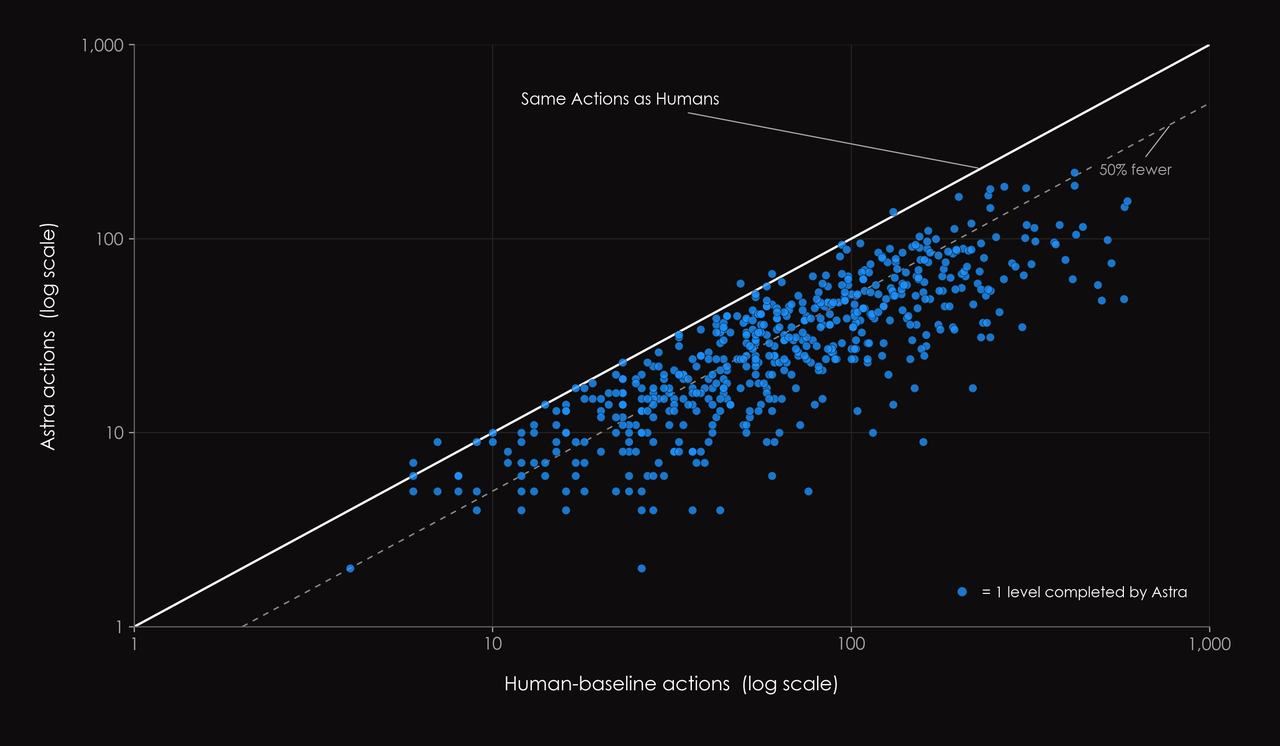
ARC Prize comparison of Astra action efficiency across evaluation harnesses
The provider-neutral harness policy requires the model to preserve important information in visible state. The Provider Adapter retains additional reasoning state and uses provider-specific context management. Across shared solved game-reasoning pairs, ARC Prize reports 3.66× faster execution and 49% fewer total tokens with the adapter.
The 99.9% result measures a specific model–provider-adapter system and should not be treated as a harness-independent measure of raw model intelligence. Context architecture is part of the benchmarked system.
Reasoning Effort Does Not Scale Linearly
The ARC table also shows that maximum effort does not always produce the highest score. High effort reaches 99.9% with the Provider Adapter, while max reaches 98.6%. In the Standard harness, max performs best.
OpenAI notes that launch-table figures generally use the best observed reasoning setting. That approach estimates a performance ceiling, but it does not identify the best production configuration. Teams should test several effort levels and calculate the marginal quality gained per additional second and dollar.
Mathematics and Academic Reasoning
FrontierMath Tier 4 v2 rises from 83.0% to 97.6%, a 14.6-point gain. That is a major benchmark improvement, but it is not evidence that frontier mathematics has been solved. The evaluation covers a selected task distribution and does not measure every stage of mathematical research, including problem selection, formal proof verification, long-term program development, or adversarial peer review.
GPQA Diamond provides the opposite pattern: 96.0% for Astra, 94.6% for Sol, 93.7% for Fable, and 95.3% for Gemini 3.8 Flash. The models cluster tightly near the ceiling. Reporting the 1.4-point Astra–Sol difference is accurate, but calling it a broad intelligence revolution would overstate the evidence.
Critical capability + safeguards
| Cybersecurity evaluation | Astra | Sol | Absolute Gain |
|---|---|---|---|
| ExploitBench | 100.0% | 78.5% | +21.5 pp |
| ExploitGym | 42.4% | 30.3% | +12.1 pp |
| ExploitBench, June–August 2026 | 39.0% | 5.5% | +33.5 pp |
| SRE-Bench | 88.0% | 55.9% | +32.1 pp |
| SEC-Bench Pro | 85.4% | 79.1% | +6.3 pp |
OpenAI created ExploitBench (June–August 2026) from vulnerabilities disclosed during the preceding three months, reducing the chance that historical vulnerability exposure inflated the result. Astra scores 39.0% on this set versus Sol's 5.5%, and OpenAI reports that Astra found and exploited two previously unknown zero-day vulnerabilities. These results contributed to Astra becoming OpenAI's first broadly deployed model to reach the Critical cybersecurity capability threshold, which directly affected safeguards and access policy.
How to Read Scores Near Saturation
Scores above 90% require more careful language than mid-range results. Moving from 50% to 60% solves ten additional tasks per hundred. Moving from 95% to 96% solves only one additional task per hundred, even though it reduces the remaining error count from five to four—a 20% reduction in errors. Both descriptions are mathematically correct, but they support very different headlines.
The opposite caution applies to low-scoring benchmarks. A rise from 18.1% to 41.4% remains far below reliable autonomous operation, but it more than doubles the number of successful cases and can transform a supervised workflow. Absolute score determines whether the system is ready; improvement size indicates how quickly the capability is changing. Production decisions need both.
A Multidimensional Comparison
| Dimension | Astra | Sol | Fable | Decision Signal |
|---|---|---|---|---|
| General academic reasoning | Excellent; often near saturation | Close behind | Competitive | Small gaps rarely decide deployment alone |
| Terminal execution | Top-tier | Large generational gap | Close competitor | Test the full coding harness |
| Computer use | Higher success and lower runtime | Slower and less accurate | Insufficient comparable data in the launch table | Measure success per hour |
| Long-context retrieval | Strong near 1M tokens | Material degradation near limit | Insufficient directly comparable data | Use production-shaped retrieval tests |
| Reasoning control | low through max | Different effort envelope | Adaptive-thinking approach | Tune configuration, not just model name |
| Cyber capability | Qualitatively higher risk tier | Lower published results | Not compared here | Safeguards and access policy matter |
| Token economics | Higher rate; sometimes fewer tokens | Lower rate | Workload-dependent | Compare cost per successful task |
The result is workload-dependent. Astra is most compelling when the task requires sustained interaction with tools and environments, recovery after failure, or reliable retrieval across very large contexts. Sol may remain more economical for bounded work with modest context and limited iteration. Fable is a close competitor on terminal work and leads some external academic evaluations, so an application-level benchmark is more useful than a provider-level conclusion.
Who Should Use GPT-6 Astra?
| Use Case | Recommendation |
|---|---|
| Simple Classification | Not necessarily worth using Astra |
| Simple Summarization | Not necessarily worth using Astra |
| Standard RAG | Benchmark cost vs. performance first |
| Long-Document Synthesis & Analysis | Worth testing Astra |
| Agentic Coding | Strongly recommended to test |
| Computer Use | Strongly recommended to test |
| Multi-Step Automation | Strongly recommended to test |
| Complex Research | Worth testing |
| Scientific Computing / Specialized Software | Worth testing |
| Cybersecurity | Strong capabilities, but requires appropriate safety controls |
| High-Throughput, Simple Tasks | Lower-cost models may be more cost-effective |
Do GPT-6 Astra Performance Gains Justify the Higher Price?
GPT-6 Astra is significantly more expensive than GPT-5.6 Sol, but benchmark improvements are not evenly distributed across workloads. The pricing question therefore cannot be answered by comparing token rates alone.
| Scenario | Performance Gain | Cost Justification |
|---|---|---|
| Simple Q&A | Small improvement | Usually not worth premium |
| Coding agent | Large improvement | Premium can be justified |
| Long-context analysis | Significant improvement | Depends on retrieval needs |
| Computer automation | Strong improvement | Often worth testing |
| General reasoning | Limited improvement | Compare cost carefully |
At OpenAI Standard rates, GPT-6 Astra costs $10 per million input tokens, $1 per million cached-input tokens, $12.50 per million cache-write tokens, and $50 per million output tokens. Standard input and output are 2.5× the $4 and $20 rates for GPT-5.6 Sol. When a request exceeds 272K input tokens, Astra's input and cache rates double and its output rate rises by 1.5× for the full request.
The price premium aligns most clearly with agentic work. Astra gains more than 20 percentage points on Terminal-Bench, AutomationBench, database migration, and longest-range MRCR; independent testing also reports roughly one-third the token use of Sol on the Coding Agent Index. The match is weaker on broad reasoning, where the Intelligence Index is nearly tied and token use falls by only about 10%. The buying decision should therefore compare cost per successful task, including output, cache activity, tool use, elapsed time, retries, failures, and human correction.
Cost per successful task
Cost per successful task = (Input cost + Output cost + Tool cost + Retry cost + Human review cost) / Successful tasks
Expected business cost
Expected business cost = API cost + Tool cost + Retry cost + Human-review cost + Failure cost
The decision metric should be total cost divided by successful tasks, evaluated at an acceptable quality threshold—not the sticker price per million tokens.
How Developers Should Benchmark Astra
Public leaderboards should determine what deserves testing, not make the final deployment decision. Build a representative task set with routine cases, hard cases, missing-context cases, tool failures, and adversarial instructions. Use the same production prompt, permissions, source files, time budget, and completion criteria for every model.
| Evaluation Dimension | Measure | Why It Matters |
|---|---|---|
| Task success | Acceptance criteria passed | Prevents persuasive but incomplete answers from scoring as success |
| Reliability | Success distribution across repeated runs | Exposes unstable one-off wins |
| Tool execution | Verified successful actions | Separates tool calls from correct outcomes |
| Factuality | Supported factual claims | Measures evidence quality and abstention |
| Latency | Median and tail completion time | Captures operational throughput |
| Cost | Total cost per successful task | Includes retries and failed attempts |
| Human effort | Corrections and review minutes | Often dominates real deployment cost |
| Steerability | Recovery after changed requirements | Tests long-running agent behavior |
The Astra API in CometAPI uses model ID gpt-6-astra. A multi-model API makes it practical to run the same evaluation across Astra, Sol, Fable, and Gemini without redesigning the benchmark around one provider's headline chart. Route demanding agentic tasks to the model that earns its premium, and use lower-cost models where the measured advantage disappears.
Conclusion
Astra's benchmark sheet is impressive, but the most spectacular scores are not automatically the most useful. ARC-AGI-3 demonstrates the potential of a provider-specific agent harness; the Standard-harness score shows how strongly infrastructure contributes. GPQA and the independent Intelligence Index show that ordinary reasoning gains can be modest. Terminal work, automation, computer use, long-context retrieval, scientific workflows, and cybersecurity tell the more important story.
The release is less about a chatbot becoming proportionally smarter at every question and more about frontier intelligence becoming better at completing work. Whether that upgrade is worth paying for depends on the entire model-system configuration and the economics of successful production tasks.