
TLDR: GPT-6 Sol is the rumored everyday-performance tier in OpenAI’s GPT-6 family, positioned below the flagship GPT-6 Astra (released September 3, 2026).
Community reports and alleged API sightings point to internal testing, significantly faster inference (claims of ~6× Astra on some tasks), and strong results on technical workloads such as long 3D/agentic tasks. No official announcement, pricing, or model card exists as of September 16, 2026. The most frequently cited windows are mid-to-late September 2026 (including a possible “ship week” around September 17) or OpenAI DevDay on September 29. Pricing is expected to sit meaningfully below Astra’s $10/$50 per million tokens and closer to (or under) the current promotional GPT-5.6 Sol rates. Developers can already access GPT-6 Astra and the full GPT-5.6 Sol/Terra/Luna lineup through platforms such as CometAPI at discounted rates while waiting for Sol.
Key Takeaways
- GPT-6 Sol remains unconfirmed by OpenAI; all details come from X/community leaks, alleged API listings, and internal-test anecdotes.
- GPT-6 Astra launched September 3, 2026 as the frontier flagship; Sol is widely expected to serve as the practical, higher-throughput companion.
- Rumored strengths include substantially faster generation, lower cost per task, and strong agentic/coding/3D performance.
- Release windows circulating: as early as September 17 or at DevDay (September 29, 2026).
- Expected pricing: materially cheaper than Astra ($10 input / $50 output); likely in the range of or below current GPT-5.6 Sol promotional pricing.
- CometAPI already provides discounted, OpenAI-compatible access to GPT-6 Astra and GPT-5.6 Sol/Terra/Luna, enabling immediate production use and easy migration once Sol appears.
What Is GPT-6 Sol?
GPT-6 Sol is the rumored next iteration of OpenAI’s Sol capability tier within the GPT-6 generation. In the GPT-5.6 family, Sol served as the flagship for complex reasoning, coding, cybersecurity, biology, and long-horizon agentic work, while Terra and Luna covered mid- and low-cost needs.
If the current reports prove accurate, GPT-6 Sol is intended as a more practical, higher-throughput member of the GPT-6 family—delivering strong capability at higher speed and potentially more attractive economics than the premium Astra model. Early descriptions frame it as an “everyday GPT-6” option rather than a pure capability ceiling model.
- GPT-6 Astra (released September 3, 2026) is the current frontier flagship: state-of-the-art computer use, coding, science, cybersecurity, and long-horizon agentic work. It features a 1,050,000-token context window, up to 128,000 output tokens, and reasoning effort levels up to “max.” Official API pricing is $10 per million input tokens and $50 per million output tokens (with higher rates for long-context requests).
- GPT-6 Sol (unreleased) is positioned as the practical daily driver—strong enough for most professional and agentic workloads but optimized for speed, cost, and throughput.
The Sol/Terra/Luna structure proved successful with GPT-5.6 (Sol as flagship, Terra as balanced everyday model, Luna as fast/affordable). Extending the same naming into GPT-6 would allow OpenAI to ship a high-capability everyday model without forcing every user onto the most expensive frontier tier.
When Is GPT-6 Sol Expected to Launch?
OpenAI has given no official date. Community and prediction-market signals cluster around two windows:
- Mid-to-late September 2026,specifically the week of September 15–19, with several accounts highlighting Thursday, September 17 after OpenAI staff comments about a “ship week” matching the scale of previous DevDay releases.
- OpenAI DevDay 2026 on September 29 in San Francisco (Fort Mason), a traditional venue for major model and platform announcements.
A high probability to a GPT-6 family release by the end of September. Astra’s unexpected early-September launch compressed the remaining timeline for companion models. Historically, OpenAI has followed flagship releases with lower-cost tiers relatively quickly (as seen with the GPT-5.6 family after its limited preview).
Until an official model page or API listing appears, any date remains speculative.
What Do We Know About GPT-6 Sol
OpenAI’s model naming shifted with the GPT-5.6 family in mid-2026: generation number plus durable capability tiers (Sol = flagship, Terra = balanced, Luna = fast/affordable). GPT-5.6 Sol launched publicly on July 9, 2026 after a short government-coordinated preview and became the high-capability everyday model, later receiving a promotional price cut.
On September 3, 2026, OpenAI released GPT-6 Astra as its new generation frontier model, positioned above the GPT-5.6 Sol tier for the hardest end-to-end agentic, computer-use, and professional workloads. Astra carries higher list pricing ($10/$50 per million tokens) and stronger reported results on several agentic and specialist benchmarks.
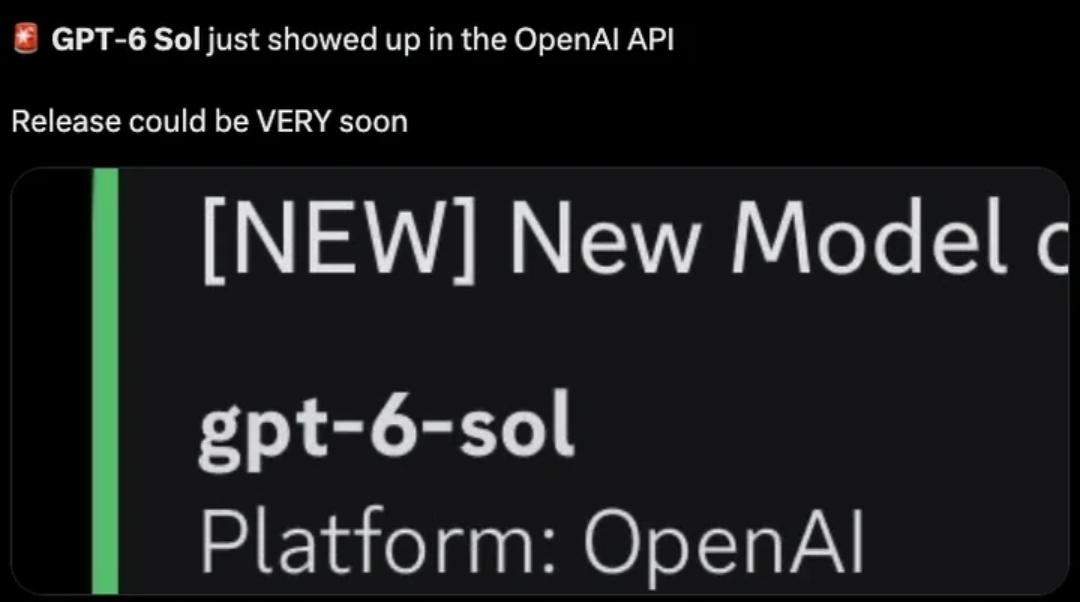
Shortly after Astra’s launch, reports of a GPT-6 Sol began circulating. On September 6, accounts noted internal testing and a possible DevDay (September 29) window. By September 10–13, additional posts claimed sightings in the OpenAI API and routing of existing GPT-5.6 Sol traffic to a GPT-6 Sol backend. Some observers reported that the new model answered questions beyond the GPT-5.6 knowledge cutoff without external tools. A third-party description of internal testing states that GPT-6 Sol Max was used for a zero-shot SVG task. A separate community screenshot shows a GPT-6 Sol label in an API-related interface.
By September 16, simultaneous gray-scale activity around GPT-6 Sol and Anthropic’s Opus 5.2. Early hands-on claims included dramatically higher speed (one widely shared figure was roughly 6× faster than Astra on a single test) and strong performance on coding, frontend generation, and technical tasks, with some testers stating quality matched or exceeded Astra while being more practical for frequent use.
Observed GPT-6 Sol Performance
The available third-party account reports roughly 28,000 visible output tokens in about three minutes for a zero-shot BMW M4 SVG task at max effort. The accompanying comparison reports about 25,000 tokens in 19 minutes for GPT-6 Astra Max. This produces an observed elapsed-time difference of approximately 6.3? and a derived visible-output rate of about 156 versus 22 tokens per second, but only for that single uncontrolled test.
Evidence-Supported GPT-6 Sol Features
The evidence supports only a narrow set of observations: the label gpt-6-sol appeared in a third-party interface image, one reported test used a ?Max? effort setting, and the model allegedly produced a large SVG output from a zero-shot prompt. Context length, maximum output, multimodal inputs, tools, structured outputs, streaming, snapshots, safety behavior, and API compatibility are not established.
Critically, as of the latest public checks (September 13–16), OpenAI’s official model list, pricing page, API changelog, and major aggregator catalogs contained no entry for gpt-6-sol.
| Evidence | Observed detail | What it can support | What it cannot support |
|---|---|---|---|
| Internal-test account | Sol Max used for a BMW M4 SVG task | The label may exist in a testing environment | Public API availability or final configuration |
| Task timing | About 3 minutes for Sol versus 19 minutes for Astra | A latency difference in that single run | Universal speed, quality, or cost advantage |
| API-interface capture | A GPT-6 Sol label appeared in a community image | Possible staging, routing, or allowlisted testing | A callable model for all developers |
| Official catalog check | GPT-6 Sol is absent | No documented general-availability model entry | Whether an internal model exists |
The evidence therefore supports “an unverified model label may be in testing.” It does not support “GPT-6 Sol is confirmed for imminent public availability.”
GPT-6 Sol Pricing (Rumors and Reasonable Predictions)
No official pricing has been released. Historical context provides the best guide:
- GPT-5.6 Sol launched at $5 input / $30 output per million tokens, later reduced to a promotional $4 / $20 (stated to run at least through November 21, 2026).
- GPT-6 Astra launched at $10 / $50.
Given OpenAI’s pattern of offering a high-capability but more economical Sol tier alongside a premium frontier model, the most plausible outcome is that GPT-6 Sol lands near or modestly above the current GPT-5.6 Sol promotional rates, remaining substantially cheaper than Astra on a per-token basis. Any significant price increase would reduce its appeal as an “everyday” GPT-6 option.
CometAPI often list new OpenAI models at 15–20% below official rates. Once GPT-6 Sol appears, aggregators are expected to follow quickly.
What Does the GPT-6 Sol Leak Actually Measure?
The cited test measures wall-clock time and approximate visible output for one zero-shot SVG generation task. It does not control server load, hardware, hidden reasoning tokens, sampling configuration, prompt routing, or output quality.
| Observed metric | GPT-6 Sol Max | GPT-6 Astra Max |
|---|---|---|
| Task | BMW M4 Competition SVG | BMW M4 Competition SVG |
| Prompting | Zero-shot | Zero-shot |
| Approximate visible output | 28,000 tokens | 25,000 tokens |
| Approximate elapsed time | 3 minutes | 19 minutes |
| Elapsed-time ratio | 1× | About 6.3× longer |
| Derived visible-output rate | About 156 tokens/second | About 22 tokens/second |
The output-rate row is a calculation from rounded third-party numbers, not a provider measurement. Because the runs may differ in hidden computation and serving conditions, it should not be used as a production throughput forecast.
The defensible result is limited: Sol showed lower elapsed latency in this one described run. The test does not determine whether Sol produced a better SVG, followed instructions more accurately, used less compute, or would remain faster under repeated workloads.
What Assistance Can CometAPI Provide?
While waiting for (or immediately after) GPT-6 Sol’s release, developers can already build production systems on the current frontier models through CometAPI. CometAPI offers OpenAI-compatible endpoints with permanent discounts (typically 20% below list rates on supported models), a single API key for 500+ models, and zero vendor lock-in.
- GPT-6 Astra is live on CometAPI at discounted short-context rates ($8 / $40 vs OpenAI’s $10 / $50). Full documentation and migration guides are available. How to Use GPT-6 Astra API and GPT-6 Astra Price details.
- GPT-5.6 Sol, Terra, and Luna remain excellent production choices and are also discounted on CometAPI. See the complete pricing and benchmark breakdown: GPT-5.6 API Pricing, Models & Benchmarks.
- Unified routing lets teams switch between Astra (maximum intelligence), current Sol (proven high capability), and future GPT-6 Sol with a single model-name change.
- Additional frontier and specialized models (image generation, other providers) are accessible under the same key, simplifying cost control and fallback strategies.
CometAPI’s OpenAI-compatible interface means existing SDKs require only a base URL and key change—ideal for rapid testing once gpt-6-sol appears in the official catalog.
What Is Officially Confirmed About GPT-6 Sol?
OpenAI’s public model catalog documents GPT-6 Astra and GPT-5.6 Sol. The same catalog does not provide a GPT-6 Sol model entry. This absence means that Sol-specific fields must remain unknown rather than be estimated from the names of other model tiers.
Which GPT-6 Sol Claims Remain Unsupported?
| Claim | Assessment | Reason |
|---|---|---|
| GPT-6 Sol is publicly available | Unsupported | No official catalog entry or general-availability documentation |
| GPT-6 Sol is universally 6× faster | Unsupported | The number comes from one uncontrolled task |
| GPT-6 Sol is cheaper than Astra | Plausible but unverified | No official Sol price |
| GPT-6 Sol has a 1.05M context window | Unsupported | The value is confirmed for Astra and GPT-5.6 Sol only |
| GPT-6 Sol targets everyday coding | Product inference | No official positioning statement |
| GPT-6 Sol will become available on a specific date | Unsupported | No official date |
This distinction prevents the article from turning a real leak into a fictional product specification. Unknown fields should stay unknown until the relevant artifact exists.
Conclusion
GPT-6 Sol, if the leaks prove accurate, would complete the practical side of the GPT-6 generation—pairing Astra’s frontier intelligence with a faster, more economical option for everyday high-value work. Until OpenAI confirms the details, the safest production path remains the models already live: GPT-6 Astra for maximum capability and GPT-5.6 Sol for proven performance and cost control. Both are accessible today through CometAPI, giving developers a seamless upgrade path the moment Sol arrives.